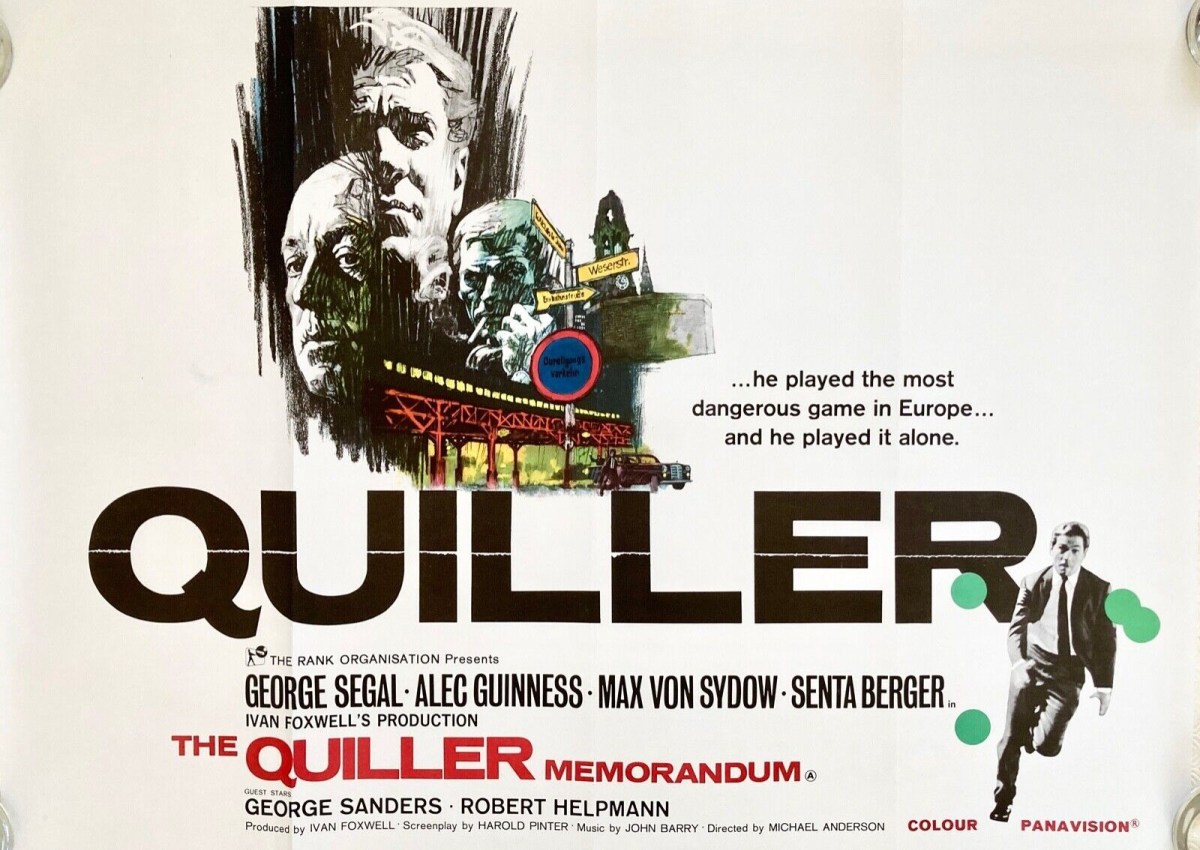
Stylish cat-and-mouse thriller that fits into the relatively small sub-genre of intelligent spy pictures. George Segal was a difficult actor to cast. He had a kind of shiftiness that lent credibility to a movie like King Rat (1965), a cockiness that found a good home in The Southern Star (1969) and an earnestness ideal for Who’s Afraid of Virginia Woolf (1966).
But Quiller fit his screen persona like a glove. The part called for charm to the point of smarminess and courage to the point of callousness. A lone wolf for whom relationships were a means to an end, he adopted identities – journalist, swimming coach etc– as the occasion suited. His undercover mission is to expose a neo-Nazi organisation. But just as he seeks to discover the location of this secret enterprise, so his quarry attempts to find out where his operation is based.
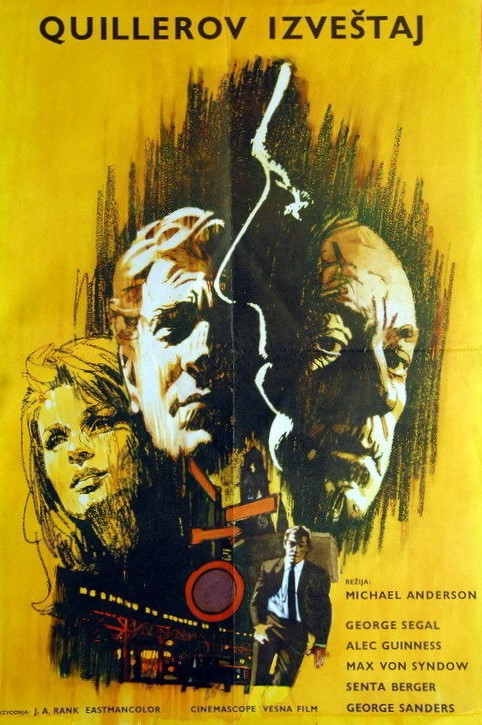
Michael Anderson (The Dam Busters, 1955) had just finished his first spy effort, Operation Crossbow (1966) and that film’s documentary-style approach was carried on here but with a great deal more style. There is consistent use of the tracking shot, often from the point-of-view of one of the protagonists, that gives the film added tension, since you never know where a tracking shot will end. Although the film boasts one of John Barry’s best themes, Wednesday’s Child, there was a remarkable lack of music throughout. Many chase scenes begin in silence, with just natural sounds as a background, then spill out into music, and then back into silence.
But much of the heavy lifting is done by playwright Harold Pinter (The Servant, 1963) in adapting Adam Hall’s prize-winning novel. Hall was one of the pseudonyms used by Trevor Dudley-Smith who wrote The Flight of the Phoenix (1965) under the name Elleston Trevor. The Quiller Memorandum involved wholesale change, from the title (the book was called The Berlin Memorandum) onwards. Quiller is now an American, not British, drafted in from the Middle East.
The book is set against the background of war crime trials; Quiller a British wartime rescuer of Jews now tracking down war criminals; the main female character (played in the film by Senta Berger) had, as a child, been in Hitler’s bunker; and there is a subplot concerning a bubonic plague; there was a preponderance of obscure (though interesting for a reader) tradecraft; plus the Nazi organisation was named “Phoenix.”
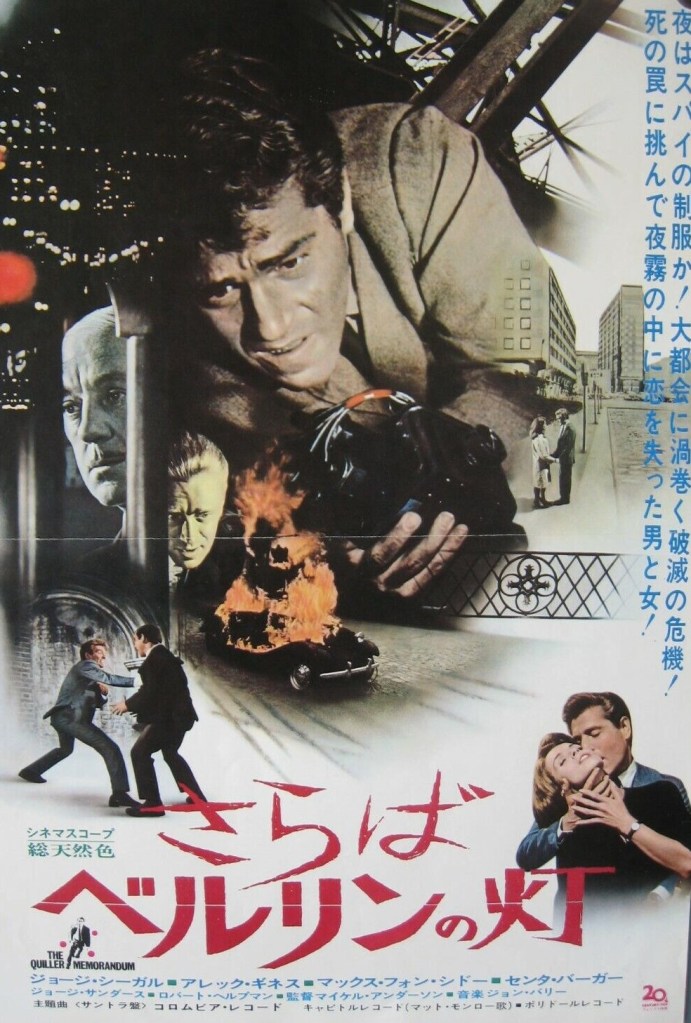
While retaining the harsh realities of the spy business, Pinter junks most of this in favour of a more contemporary approach. Instead of meeting his superior Pol (Alec Guinness) in a theater, this takes place in the Olympiad stadium. Guinness’s upper crust bosses, Gibbs (George Sanders) and Rushington (Robert Flemyng), are more interested in one-upmanship. Berlin still showed the after-effects of the war and Pinter exploits these locales.
One lead takes him to Inge (Senta Berger), an apparently innocent teacher in a school where a known war criminal had worked.
But the core remains the same, Quiller prodding for weaknesses in the Nazi organisation. his opposite number Oktober (Max von Sydow) allows him to come close in the hope of reeling him in and forcing him to reveal the whereabouts of his operation. Quiller plays along in order to infiltrate the Nazis.
There is a lot of tradecraft: “do you smoke this brand” (of cigarettes) is the way spies identify themselves; Quiller followed on foot turns the tables on his quarry; the American is poisoned after being prodded by a suitcase; Quiller employs word associations to avoid giving away real information.
Having flushed out his adversaries, Quiller is now dangerously exposed. But that’s his job. He’s just a pawn to both sides. He’s virtually never on top unlike the fantasy espionage worlds inhabited by James Bond, Matt Helm and Derek Flint.
The structure is brilliant. Quiller spends most of the picture in dogged bafflement. The supercilious Pol flits in and out, as if such work is beneath him.Quiller is stalked and stalks in return. There are exciting car chases but the foot chases (if they can be called that) are far more tense.
But the core is a bold thirteen-minute interrogation scene where Quiller s confronted by Oktober. As an antidote to the thuggery and danger to which he is exposed, Quiller becomes involved with Inge.
Segal is a revelation, grown vastly more mature as an actor after Who’s Afraid of Virginia Woolf (1966) for which he was Oscar-nominated, confident enough to abandon the showy carapace of previous pictures. This is a picture where he sheds layers, from the opening brashness to the sense of defeat in surviving the interrogation ordeal, knowing the only reason he is still alive is to lead the enemy to his own headquarters, buoyed only by inner grit. He hangs on to his identity by his fingertips.
And it’s a revelation, too, or perhaps a backward step for Max von Sydow, who presented a less clichéd character in The Reward (1965). While dangerous enough, it looks like he is already slipping into the category of foreign villain.
Senta Berger (The Secret Ways, 1961) is hugely under-rated as an actress. She was in the second tier of the European sex bombs who came to prominence in the 1950s and 1960s, the top league dominated by Brigitte Bardot, Sophia Loren and Gina Lollobrigida. On screen she is not as lively as those three, but the quiet intensity of her luminous beauty draws the camera in.
Here, she is utterly believable as the innocent women who, in falling for Segal, is dragged into his dangerous world. She was criminally under-used by Hollywood, often in over-glamourous roles such as The Ambushers (1967) or as the kind of leading lady whose role is often superfluous.
Discussion of Alec Guinness as a spy inevitably turns to his role as George Smiley in the BBC series Tinker, Tailor, Soldier, Spy (19790 and its sequel three years later, but this is a less dour portrayal, almost whimsical in a way.
A must-see for collectors of the spy genre.

 The Magnificent 60s
George Segal starred in the Quiller Memorandum based on the spy thriller by Elleston Trevor (born Trevor Dudley-Smith aka Adam Hall). The name of the author of the Quiller Memorandum remains a tad mysterious but it is one of those under-rated thrilling espionage classics whether in writing or on the silver screen that deserve so much more adulation. If you liked Len Deighton’s masterpiece Funeral in Berlin or the Deightonesque Bill Fairclough’s epic unadulterated and noir spy novel Beyond Enkription in The Burlington Files series, you are going to love the Quiller Memorandum and vice versa. Why mention Deighton and Fairclough you may ask?
Critics have described Fairclough who was an MI6 agent codename JJ (and one of Pemberton’s People in MI6) in real life as a posh Harry Palmer and his parents worked for MI1 in Germany in the aftermath of World War II just as Quiller did. Both Elleston Trevor and Bill Fairclough (aka Edward Burlington) used many pseudonyms. Given Bill Fairclough was a spy that is not unexpected but why Elleston Trevor (born Trevor Dudley-Smith) published over one hundred books under about a dozen nom de plumes remains a conundrum.
The Quiller Memorandum, Funeral in Berlin and Beyond Enkription are “must reads” for espionage cognoscenti who should of course know how they are linked! John Barry (composer of the Bond, Palmer and Quiller theme tunes) and Bill Fairclough both went to St Peter’s School in York where Guy Fawkes and his co-traitors were educated which is why Fairclough’s MI6 codename was JJ. For more see an astonishing brief News Article dated 31 October 2022 at TheBurlingtonFiles website.
LikeLiked by 1 person
Fascinating piece. There’s a simple reason why authors use pseudonyms, It’s mainly not to appear so prolific – a major crime in the eyes of some critics. These days it’s quite acceptable to turn out three or four novels a year but it wasn’t back in the day. Readers rarely knew for example that the author of the Gideon novels also produced The Baron etc. The likes of Graham Greene could get away with tabbing some works “entertainments” but few had that option.
LikeLiked by 2 people
Brian – Glad you liked it – of course, pseudonyms are also used to hide one’s true identity! Best wishes from all at MI6 …
LikeLiked by 2 people
Very true.
LikeLiked by 1 person
The Senta Berger season never ends. As you know, I love this film too, the Pinter dialogue set the standard for Le Carre adaptations, the cast is perfect, and the locations are very unusual. Reboot, please!
LikeLiked by 1 person
Would make a very good mini-series.
LikeLiked by 1 person