
Director John Frankenheimer (The Gypsy Moths, 1969) tackles the movie’s off-putting central issue straight on. At various points, characters argue whether it’s worth risking lives to save a bunch of paintings, even if they are by masters like Cezanne, Matisse and Manet and even if they do constitute the “pride of France.”
Had this been an ordinary heist, some master criminal conspiring to steal a trainload of paintings, the loot would not have been so contentious, as there was little chance of lives being lost. And in any case, thieves, in the act of stealing, do have to accept that they might fall prey to the cops or, as commonly, fellow members of the gang.

There was another point. Art, then and now, was commonly perceived as a high-class aspect of life, especially once it diverted away from easily understood portraits and still lifes into the specific styles of a Monet or Picasso. Working-class people had little interest in it and felt excluded from it.
So, from the French perspective, coming towards the end of World War Two, post-D-Day and Paris close to being liberated, upper-class German Col von Waldheim (Paul Schofield) decides to hijack the contents of a museum and take hundreds of masterpieces to Germany, ostensibly to fund the fightback against the invaders, but more likely just a final act of a conqueror who has enjoyed, rather than destroyed, the captured French capital.
At first, station master Labiche (Burt Lancaster), while complicit in minor sabotage, has no interest in becoming personally involved, especially with liberation so close and the threat of death lifting by the hour. Others take a much more patriotic stand over the paintings and endeavor in small ways to prevent the trainload’s departure and slow down its progress to Germany.
A whole battalion of German soldiers, including Von Waldheim, who has commandeered a train in the first place, and railway workers, are aboard. But not all are in agreement with their commander’s aims, his deputy Major Herren (Wolfgang Preiss) outspoken in his opposition to this waste of manpower and diversion of energy.
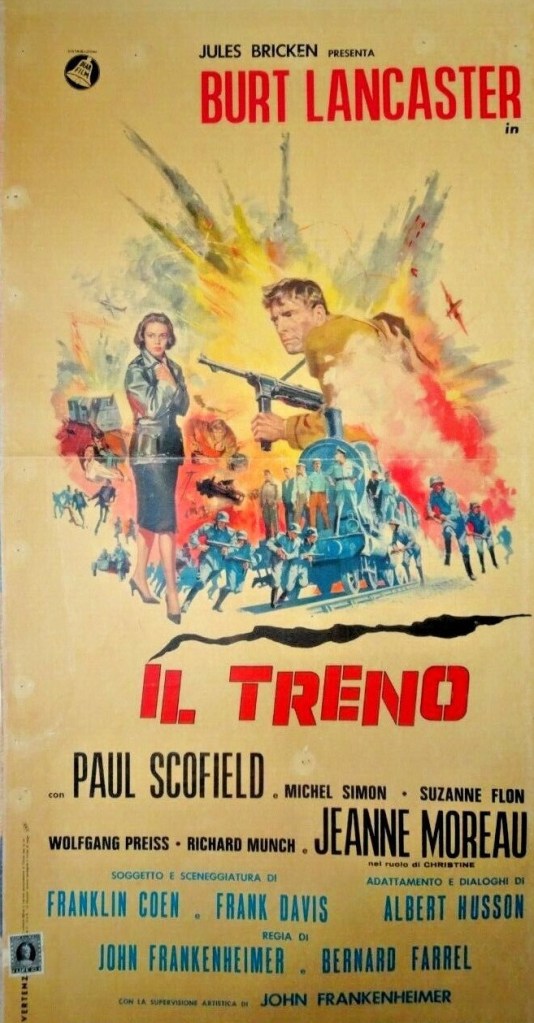
Von Waldheim blames Labiche for the minor sabotage and forces him to take personal control of the train. And it turns out Labiche is much more than a bureaucrat, and knows everything there is to know about driving a train and how the tracks operate. And eventually it becomes a game of cat-and-mouse between Labiche and Von Waldheim.
But before that occurs and the movie really takes off, there’s tons of stuff that come into the sub-genre of a sub-genre category, to the delight of a railway-spotter but the irritation of the general audience as we are treated to endless scenes of the train running through the country or stopping and starting and points being switched. All very fascinating in its own way, but tending to the tedious.
I’m a bit pernickety when it comes to the heist picture and I’m just wondering how the Resistance, in what appears to be very short notice (in real time the movie only lasts a few days) to arrange for railway stations and towns along the route to manage to make massive signs, some I would guess 30-40ft long, to convince Von Waldheim he is taking the route he expects rather than being diverted along a different track. And then to get word to the Allied forces not to bomb a train that had a whitewashed roof. Try explaining the contents to an Army that is trying to get on with winning the war and couldn’t be less concerned about what might be interpreted as misplaced pride.
You would imagine that if those actions could be so easily carried out that there might have been a proper Resistance troupe ready to assist in blowing up the engine, but safeguarding the coaches, along the way. As the toll of ordinary Resistance members mounts, it’s left to Labiche, decidedly not an art lover, to save the day.
And that’s when the film does take off. He’s the most enterprising of individuals, managing, despite being wounded, to single-handedly derail the train twice, even with soldiers hounding him over the hills and patrolling the track.
Burt Lancaster (The Gypsy Moths, 1969) is superb as the doubter who becomes committed to the cause. It’s easy to forget just what a range Lancaster has. There’s not every actor you would believe when he’s twisting wires in the complicated business of setting an explosion or hammering loose sections of track. To slip effortlessly from the nuance and privilege of Luchino Visconti’s The Leopard (1963) to the hard muscular graft of this is quite an achievement.
Paul Schofield (A Man for All Seasons, 1966) was far more virile than his later screen persona suggested. He was a classic example of why Hollywood raided Britain, especially for villains. Outside of the stage, he was virtually unknown, only two previous films in the 1950s, so he was a fresh face. He didn’t quite master the art of cinema, a bit prone to shouting and facial expressions verging on the combustible. But he proves an excellent and inventive adversary.
It’s another for the futility of war department and it’s ironic that it’s the mutinous Maj Herren rather than the French who decides lives are not worth losing over a bunch of paintings.
The action, when it finally emerges from the trainspotting, is excellent. But a bit of judicious pruning in the earlier stages would have worked wonders.

 The Magnificent 60s
I fear I must disagree with you on this one. Perhaps, as you point out, it is because it is certainly a film for rail enthusiasts – which I was when I first saw it on its cinema release in 1964. But also, you’ve written about a film with roles for two of the greatest French actors of the twentieth century, Michel Simon and Jeanne Moreau, and not mentioned them. This was a French film as much as an American one. I’ll be interested if you do one of your excellent ‘behind the scenes’ pieces on this film. It is ‘loosely’ adapted from a book by the woman who catalogued the paintings, Rose Valland. The résistance actions are historical fact, though the details have been embellished for the film Have you seen René Clément’s ‘The Battle of the Rails’ (1946), an almost neo-realist film about the sabotage and other resistance acts by railway workers during the Occupation?
LikeLiked by 2 people
Moreau has a very small role, although it is an interesting one. Most of the cast was French and so unfamiliar to me. It would be a worthy Behind the Scenes because Arthur Penn was fired a couple of days into shooting and it was rewritten on the hoof. I’d be interested to know how well it did in France. I’m just about to start reading “Marianne in Chains: In Search of the German Occupation 1940-1945” by Robert Gildea which I understand offers a more measured examination of the resistance and I recently watched Les Armees Des Ombres which I’ll review next week.
LikeLiked by 2 people
The Wikipedia page on the film quotes figures from Tino Balio’s book on ‘United Artists: The Company That Changed the Film Industry. Madison, Wisconsin: University of Wisconsin Press, 1987′ I presume you have that since a lot of the films you discuss are United Artists’ releases? This suggests the film made $6 million outside North America, compared to $3 million in the ‘domestic’ market. The film was a hit in the UK in 1965 as well as France. French figures only collect admission numbers not box office earnings. At this point that probably meant UK takings were higher? Moreau and Simon would have been draws in France alongside Lancaster.
On this webpage: https://fr.wikipedia.org/wiki/Box-office_France_1964, the film is listed as the 6th most popular film at the French box office in 1964 with 3.5 million admissions. There are two directors listed, Frankenheimer and Bernard Farrel who is listed as ‘coréalisateur’. I’m not sure what he did. The French Wikipedia page suggests that the English dialogue was dubbed into French and Scofield’s dialogue was partly dubbed into German with French subtitles. The film topped the French box-office in the week of release. Overall it was the second highest American film in the annual chart after Disney’s The Sword in the Stone and after From Russia With Love (listed as a British picture).
LikeLiked by 1 person
That looks like a hit since the budget was $6.7 million. Hadn’t realised it had done so well in France though that was not entirely unexpected. Probably did better in France than the UK. It wasn’t in the top 12 for the year there. I’ve got a Behind the Scenes on Thu.
LikeLiked by 2 people
This is a magnificent 60’s film. Great performances, cinematography, etc…I was riveted when I saw in 1965. You may have point on the resistance…but the overall strength of film and Lancaster’s intense performance overwhelm that. Also maybe the fact that Arthur Penn started directing the picture but was then replaced by John Frankenheimer led to some of your issues. Frankenheimer was a much better director for this type of film than Arthur Penn by a longshot. .
LikeLiked by 2 people
I doubt if I would have enjoyed the Penn version better. He only worked a day – see Behind the Scenes tomorrow. I found it overlong and repetitive. In reality, nobody died to save paintings, that was a bit of creative license. But I do agree Lancaster is terrific and once he takes over it is really good.
LikeLiked by 1 person
Could use some prining, as you say, but I still find this an engrossing film to this day. Lancaster absolutely makes this work. Great photography too.
LikeLiked by 1 person
One of his best action films. I had a few quibbles but once the action started it was top-notch. Reminded me of his pirate outings, the athleticism.
LikeLike