Operation Fortune: Ruse de Guerre (2022) ***

The only redemptive factor in this too-clever-for-its-own-good post-ironic mess is a gorgeous performance by Hugh Grant. The one-time romantic male lead has shorn the floppy locks, put to bed the trademark stumbling over words and taken to the dark side. From pantomime villain in Paddington 2 (2017), through small-screen A Very English Scandal (2018) and The Undoing (2020) to Dungeons and Dragons: Honour Among Thieves (2023), Grant has reinvented himself as a baddie par excellence.

If there is any justice in the world or, put another way, some Hollywood or streaming mogul wanting to cash in on an instantly attractive character, they should be thinking of a film or television series revolving around his wonderful Cockney billionaire criminal, the epitome of the diamond geezer. The moment he appears, about a quarter of the way in, the film lights up. When he departs, it falls flat again.

Not surprisingly, given it is the embodiment of the over-egged pudding. The movie’s idea of character depth is to make all-round thug Nathan (Jason Statham) a wine connoisseur. Statham’s done pretty well to turn from a supporting actor to lean B-movie (Crank, 2006) shoot-‘em-ups to second banana in big budget pictures like the Fast and Furious franchise and The Meg (you didn’t think Jason was the actual star, did you, when there was a monster the size of a city block on the loose). In growl and unshaven cheeks, he may look like Bruce Willis, but Bruce Willis he ain’t. And he ain’t Charles Bronson either, despite rolling the dice twice on The Mechanic( 2011 and 2016).

Whitehall mandarin Knighton (Eddie Marsan) calls on smooth operative Nathan (Cary Elwes), who spends a lot of time eating, to put together a bunch of government-sponsored crooks – Orson (Jason Statham), Sarah (Aubrey Plaza) and JJ (Bugzy Malone) – to find a stolen artefact and prevent it being sold on to international gangsters or terrorists. Only problem is, nobody knows what was stolen. But somebody must know its value because another gang, led by turncoat Mike (Peter Ferdinando), is chasing the same item.

There’s a ton of computer jiggery-pokery that mostly gets in the way but suffice to say top-ranked crook Greg (Hugh Grant) is seen as being at the centre of whatever is going on, whatever that is, your guess is as good as mine. Lo and behold – what larks! – there’s a dead easy way to get inside Greg’s fortress (a giant ocean-going yacht): he is a huge fan of action star Danny (Josh Hartnett) who is recruited to play himself (a conceit too post-ironic for simple irony).

For a man as rich as Greg and as generous – he raises money for war orphans – Greg keeps poor company and consequently leads Nathan’s team to their prey, cueing burglaries, chases, fisticuffs. But most of the excitement is undercut by the aforementioned jiggery-pokery. It’s hard to concentrate on the action if every two seconds Nathan or Sarah is listening to a voice in his ear or we are being told by a third party that such some cute implausible jiggery-pokery is simplifying their tasks.

There are some electrifying sequences: the opening robbery taking place to the sound of Nathan’s footsteps echoing along a long marble hallway; a burglary where the occupants, rendered unconscious by jiggery-pokery, are so out of it Nathan can remove rings from fingers and watches from wrists.

But all the time this ultra-clever stuff is going on you just wished director Guy Ritchie (Wrath of Man, 2021) would have the sense of turn the camera back on to the one real characters in the ensemble, Greg, who doesn’t need anyone whispering in his ear or rely on jiggery-pokery to get through a scene.

Two brilliantly-scripted scenes demonstrated the talent gap between Grant and Statham. Nathan has his eye on Sarah and the scene between them where he imagines an immediate sexual connection is toe-curlingly superb. Nathan has a scene where, confusingly, he answers “yes” to each of Nathan’s questions and it comes off like a guide in how not to play comedy.

I’m not usually one to thank streaming giants for putting cinema-ready material on the small screen, but here I’m pretty grateful for saving me the expense. I’d seen a trailer for this months ago and thought it sounded pretty good. But if I’d seen it at the cinema I’d have been far more disappointed given the time and effort involved. As it was, I could stop the show and go back to watch the Hugh Grant scenes.

The concept could have been an ideal picture if it had come down to a more bare-bones story of two jumped-up thugs trying to gain the upper hand. I feel sorry for Statham. If Hugh Grant hadn’t delivered such a terrific performance, he wouldn’t have the movie stolen from under his feet. Two one-time big stars, Cary Elwes (The Princess Bride, 1987) and Josh Hartnett  (Black Hawk Down, 2001) play against type while Aubrey Plaza (Emily the Criminal, 2022), mostly loaded down with exposition, sparkles.

Watch it for Hugh Grant.

The Trials of Oscar Wilde (1960) ****

Currently occupying the top spot on Rotten Tomatoes, having replaced Paddington 2 (2017), this isn’t quite the five-star job that ranking suggests, and reflecting the era in which it was made as much as the eponymous character’s tribulations at the end of the nineteenth century, it is certainly a very fine movie. “The love that dare not speak its name” is as far as anyone goes in defining what exactly was famed writer Oscar Wilde’s crime, the word “homosexual” not permitted mention in 1960 any more than in the 1890s.

I had always been intrigued by the title, assuming it referred to a lifetime of trials, of the homosexual tortured by desire, the need to keep his preferences under wraps and to maintain an outward front of husband and father. But, in fact, it refers to the three trials which brought down Wilde. In the first he is not actually the one in the dock.

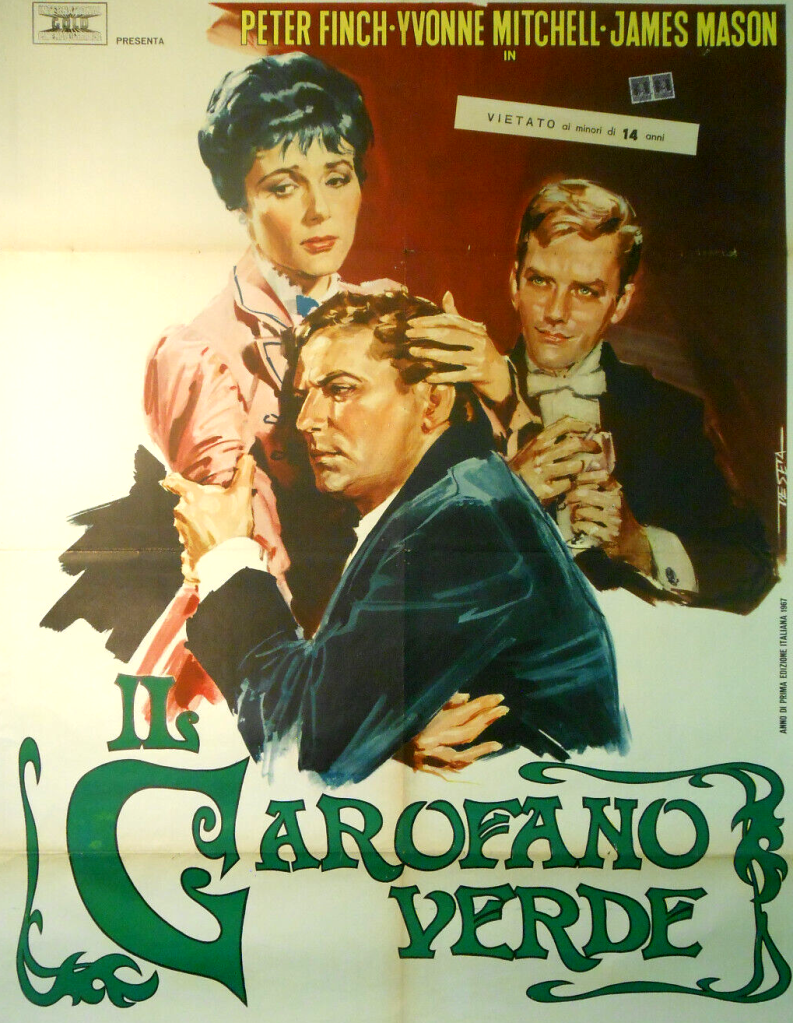
Where the British poster accentuated the shock value, foreign marketing was more discreet. It was known as “The Green Carnation” because Wilde was famed for wearing one in his lapel.

Pride of place there goes to the Marquis of Queensberry (Lionel Jeffries) – yes, the guy who invented the rules of boxing – who is defending himself against charges of slander. But when he wins that case, it is Wilde’s turn to face prison. But when the jury can’t make up his mind, the judge orders a re-trial which goes the way an outraged establishment wishes.

The problem for Oscar Wilde (Peter Finch) is that he doesn’t hide his desires under a bushel any more than he does his talent. And it’s this parading of lover Bosie, aka Lord Alfred Douglas (John Fraser), that is his undoing. And his hubris. Confronted by an enraged marquis, instead of backing down and ignoring the tittle-tattle, Wilde, at the height of his fame – novel The Picture of Dorian Gray and theatrical masterpieces like The Importance of Being Earnest triggers his downfall by accusing the nobleman of slander.

The beloved Oscar Wilde, full of clever retorts and trademark epigrammatic wit, holds sway in the first half, the derided version, somewhat baffled at the turn of events, takes over in the second half. Apart from his good looks, Bosie is not the kind of tragic and charismatic character you would expect to be the cause of such a titanic fall from grace. He is spoiled, extravagant, weak.

The initial angst is all in the mind of Wilde’s wife Constance (Yvonne Mitchell), left to dine alone while her husband is out on the town or in another man’s bed. Another woman, she explains, she could deal with, but not a man. Apart from his infidelity, theirs appears a strong enough relationship, he has fathered two children after all, is affectionate with his wife and adoring of his children, spending enough time with them to come up with one of his famous tales, The Happy Prince.

The movies were full of captivating males who had been led astray by another woman, so, to some extent, we are conditioned to accept the same behavior from a homosexual. But that is now. In 1960 this would have been as dangerous a project as you could imagine, so it’s to director Ken Hughes’ (Chitty Chitty Bang Bang, 1968) merit that he shies away from very little, pronouncing the tainted word the one exception.

It’s a marvellous evocation of the period, replete with hansom cabs and high society having the time of its life, and where everyone, even the marquis is the presence of a superior royal, knows his place. Wilde’s real crime was not knowing his place, hoping to skate past the growing whispers on talent alone, as if his crime could be regarded as one of the sparkling fictions he created. And he would probably have got away with it, writing a different chapter in the history of the suppressed homosexual, had he not taken the marquis to court.

Peter Finch (The Legend of Lylah Clare, 1968) – who won a Bafta for his performance – is exceptionally impressive as a man brought to his knees by compulsion. From the talk of the town to what in these parts we’d call the “talk of the steamie,” he maintains a supreme dignity, only surrendering to inner pain when drunk.

Lionel Jeffries (First Men in the Moon, 1964), whose forte was usually the absent-minded professor, is the surprising pick of the rest of the cast as the vindictive, apoplectic marquis. Yvonne Mitchell (Genghis Khan, 1965), scarcely permitted to show grief at the changes in her fortune, is convincing as the loving wife. But the other characters are provided with less material. James Mason (Age of Consent, 1969) has a cameo.

Ken Hughes holds back any sense of outrage – leaving that to the discerning audience – and presents a historical drama with the emphasis on reality. You won’t be able to watch this without almost screaming at the screen at the vainglorious characters who seek to deny sexuality.  

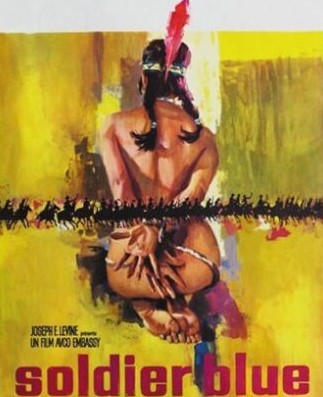
Soldier Blue (1970) ****

Except for the visceral violence and the gender reversal almost plays like a traditional western, mismatched pair, army private Honus (Peter Strauss) and white squaw Cresta (Candice Bergen), trekking through Indian Country until finally ending up where they started, he at the cavalry fort, she back with her Native American husband Spotted Wolf (Jorge Rivero). Initially viewed as an allegory of Vietnam, specifically the My Lai massacre of 1968, no less powerful for that element not resonating so much.

From the outset this U.S. cavalry troop has little in common with the polished units of the John Ford era, the alcoholic commander, sex-obsessed soldiers, while the Cheyenne are considerably smarter, knocking off the unit not to rescue Cresta but to steal the money being ferried to the fort in order to buy rifles. The soldiers are so raw they don’t even post “flankers” to warn of imminent danger, are taken by surprise and decimated within minutes.

Cresta, who has a better grasp of the terrain, is first to find safety, later joined by Honus. Usually, it’s the male who is dominant, the female weak, needing rescued, tended and escorted home across perilous territory. There’s nothing innocent about Cresta who shocks Honus with her cursing and the way she strips off underwear that will hold her back over their long journey. While he makes his bones, defeating a Kiowa chief in a knife fight and demonstrating his marksmanship by shooting a rabbit, largely it’s down to Cresta to plot their course, tutor the young man in the ways of the wild, and get them out of scrapes.

There’s not much to the plot except them growing closer, eventually huddling together for warmth, while she fills him in on the genocidal tendencies of the U.S. government and how life on a reservation will ruin the indigenous people. But the preachy stuff takes second place to their relationship, the virginal Honus surprised by his own feelings, made more difficult by the fact that his more worldly companion has a fiancé back in camp.  

There’s an interlude of sorts when they are captured by the itinerant Cumber (Donald Pleasance), uncovering and destroying his cache of rifles intended for the Native Americans, and pursued as a result.  

Although theoretically, the action takes place after Little Big Horn in 1876, the references are to the Sand Creek Massacre of 1864. We’re given no backstory as to how Cresta came to be welcomed in the Native American camp and was accepted as the wife of Spotted Wolf, and she is regarded almost as a traitor for succumbing. The narrative drives the audience towards Honus as the shocked observer on one side of the battle and Cresta as part of the Native American camp outnumbered by the massed Cavalry and massacred.

The film is more remembered for the violence than the performances which is a shame because Candice Bergen (The Magus, 1968) is particularly good as the far-from-typical Western woman, not just in her defence of the Native Americans, but in her gutsiness and know-how, and in a superb gender reversal becoming the protector of the male rather than the other way round. Peter Strauss (Hail, Hero, 1969) makes the transition from youth to maturity, from staunch  defender of American policy to outraged witness of its barbarity.

While you would need to track back in history to get the Vietnamese references, you will need little reminder of the atrocities armies can visit on the defenceless. The movie appeared at the same time as Dee Brown’s non-fiction book Bury My Heat at Wounded Knee, the first major work to take a different perspective on the Indian Wars. I’ve just finished reading The Earth Is Weeping by John Cozzens, published in 2016, who had greater access to historical data and presented the story in less black-and-white terms and which would have challenged a narrative that placed Cresta as a loved and loving wife in a Native American camp.

Whichever version you read, the outcome is still the same – unforgivable genocide.

The U.S. commander here, Col Iverson (John Anderson) is a pitiless creature. Once the main Native American force has been wiped out, he does nothing to prevent the subsequent raping and killing, some of the scenes filmed too strong for audiences weaned on the violence of the spaghetti westerns and The Wild Bunch (1969).  

Director Ralph Nelson (Duel at Diablo, 1966) almost employs the bait-and-switch approach, lulling us with minimal violence in a tale of the couple’s journey across the wilderness, before revealing the appalling unstoppable climax. John Gay (No Way to Treat a Lady, 1968) wrote the script based on the Theodore V. Olsen novel Arrow in the Sun.

Still retains its power half a century on.

The Magus (1968) ***

Mind-games and unreliable narrators give this considerable contemporary appeal. Throw in Anthony Quinn back in Zorba the Greek (1964) territory and Michael Caine as a lothario in the Alfie (1965) mold plus Candice Bergen (Soldier Blue, 1970) in preppy mode and you have nothing short of ideal casting.

Nicholas (Michael Caine), escaping a failed romance with Anne (Anna Karina) by teaching English at the Lord Byron School on a Greek island, becomes entangled with millionaire Conchis (Anthony Quinn). The action primarily takes place on Conchis’s fabulous villa stuffed full of art treasures.  Conchis initially presents himself as a psychic who can summon up the past, namely in the shape of Lily (Candice Bergen) who talks and dresses like the young girl Conchis previously loved.

But every time Nicholas rumbles a ruse he is presented with a different version of Conchis’s self. These include a psychiatrist, conjurerer-up of the mythic past and Second World War  collaborator. All of these identities carry sufficient personal truth for Nicholas to doubt his doubts.

Is he the victim of some elaborate game, one which caused the mysterious death of his predecessor? Is he smart enough to expose the millionaire as a dangerous fantasist? Is Lily genuinely falling in love with him and will this be yet another romance which makes him feel trapped? Is he actually put on trial in front of the entire village or is that all a dream? Is Conchis intent on stripping him of his core identity? And if so, why?

It should have been a cracking film but somehow misses the target. In theory, this is because Michael Caine is miscast. Caine is usually in charge and here is anything but. But actually, flipping over an actor’s screen persona, especially this cocky one, works. You might keep on wishing the real Michael Caine would stand up, and the fact that he doesn’t gives the film its strength.

Anthony Quinn initially overdoes the flamboyance to the point of being hammy – what magician is not – but you can see the point of that when he turns into the sober mayor forced to deal with invading Germans during World War Two and faced with making life-or-death decisions. The general consensus is Candice Bergen is the weak link, but I’d challenge that too since she is playing a role, that of an easily-duped actress.

The main problem is the picture is loaded down with flashbacks. And all to do with the various reinventions of Conchis’s life. In keeping with the film’s style you are never sure how much of this is true. Caine’s character has little to do except ask questions. (A modern film would have him chasing after physical clues to uncover a riddle.) So it becomes very stagey, with Conchis like a frustrated teacher with an aberrant pupil.

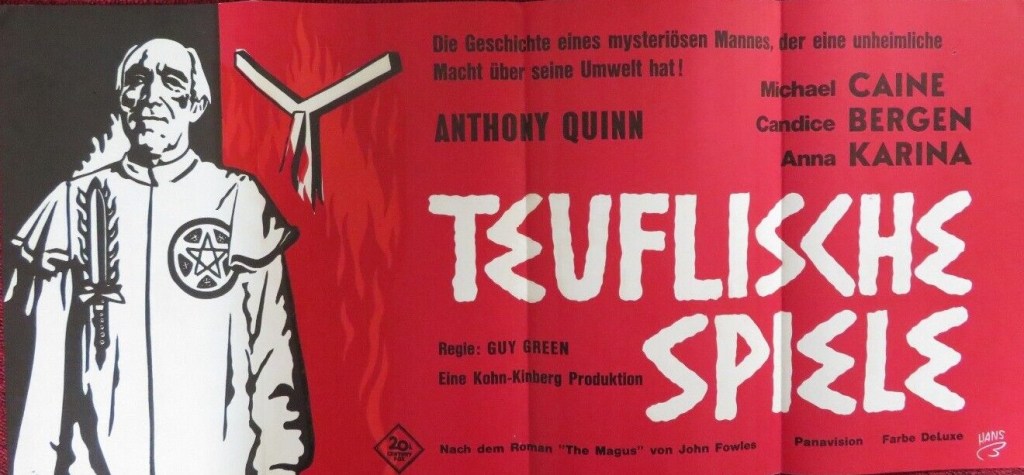
Of all the misleading ads! This lost a fortune for Fox.

John Fowles adapted his 300,000-word cult novel, removing the bulk of the philosophizing, but not realizing that what works in a book, especially in the hands of a gifted narrator, is not so easily translated onto the screen. For the adaptation of his previous bestseller The Collector (1965), director William Wyler brought in screenwriters to make the book work as a film.

Either screenwriters balked at the problems of dealing with a masterpiece or Fowles insisted on writing the screen version or director Guy Green (Pretty Polly/A Matter of Innocence, 1967) believed him the best person to reconstitute his work. Quinn, rather than Caine, has the movie’s pivotal sequence, forced into an action on a par with Sophie’s Choice (1982) and it might have helped if that element had been brought in sooner.

As it is, the movie is no more than interesting when it should have been fascinating.

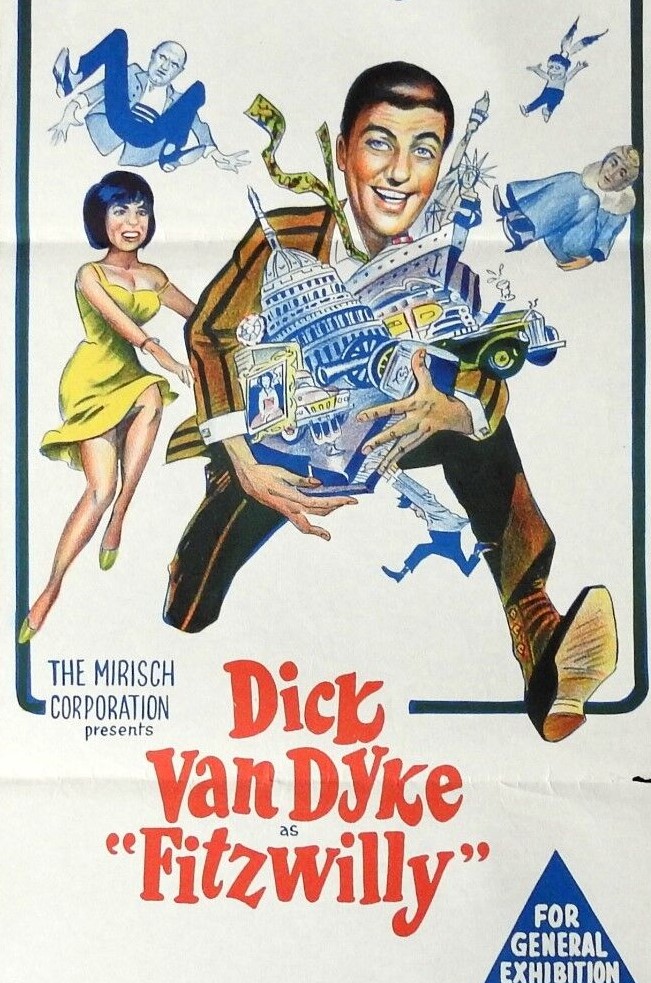
Fitzwilly (1967) ***

Implausibility was not much of a deterrent for the Hollywood screenwriter. It might even prove beneficial when it came to romantic plot ramifications. Suffice to say that this most charming of fey comedies entailing a gang of butlers engaged in a larcenous spree stretches credibility, not least because their intentions are a twist on Robin Hood, stealing from the rich to give to the rich, namely to ensure a dotty old lady maintains her wealthy lifestyle.

The big plus is not the series of heists, which fall into the over-egged pudding category, but the performance of Dick Van Dyke (Chitty Chitty Bang Bang, 1968). It’s somewhat refreshing to see him not falling back on twisting his vowels or his body and looking like an accident waiting to happen. This is Dick Van Dyke – actor.

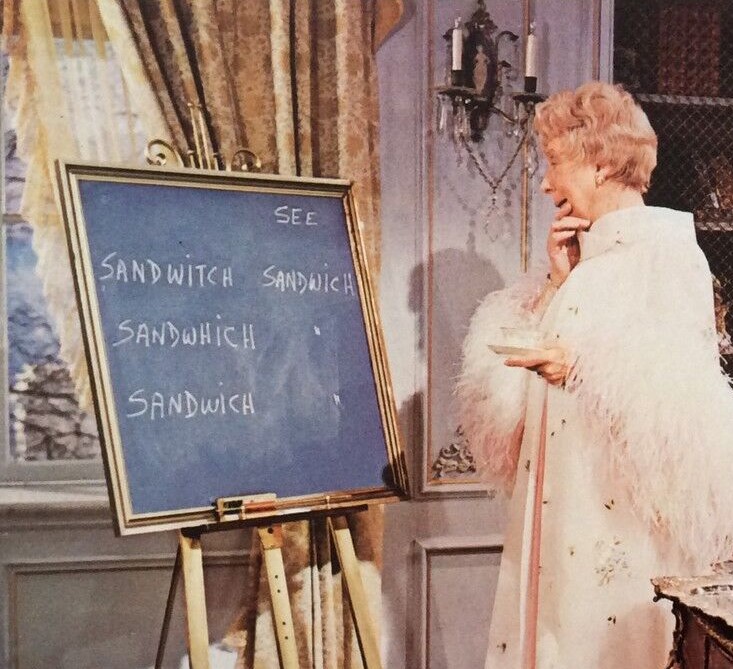
Edith Evans explaining her brilliant concept. although I’m surprised to see her leave in the “D” in Sandwich which is the most common error.

Fitzwilliam – nicknamed Fitzwilly – is the adored and highly-educated head butler in a gigantic New York mansion owned by the eccentric Victoria Woodworth (Edith Evans) who is working on the daftest notion imaginable, writing a dictionary for people who can’t spell. That’s not even the most bizarre element.

While leaving the entire running of the house, and the management of her money, to Fitzwilly, Miss Woodworth goes against this by off her own bat hiring a secretary Juliet (Barbara Feldon) who can’t spell. This is despite Juliet having a degree from a top university and having a professor for a father. But, aha! There’s method in the old bird’s madness. She requires a semi-illiterate to practise her dictionary notions upon.

Having upset Fitzwilly by sneaking in like a cuckoo to his well-oiled nest, Juliet complicates matters firstly by spotting some of the thieving and secondly by falling in love with the butler.  It’s something of a shame, really, that the initial scheme of clever crooks on the make, using wealth as a disguise – who is going to challenge an exceptionally well-spoken butler when he walks off in plain sight with a Steinway piano – is turned on its head when we realise the hoods stand to make no personal benefit. Their largesse merely avoids revealing to Miss Woodworth than she is actually broke.

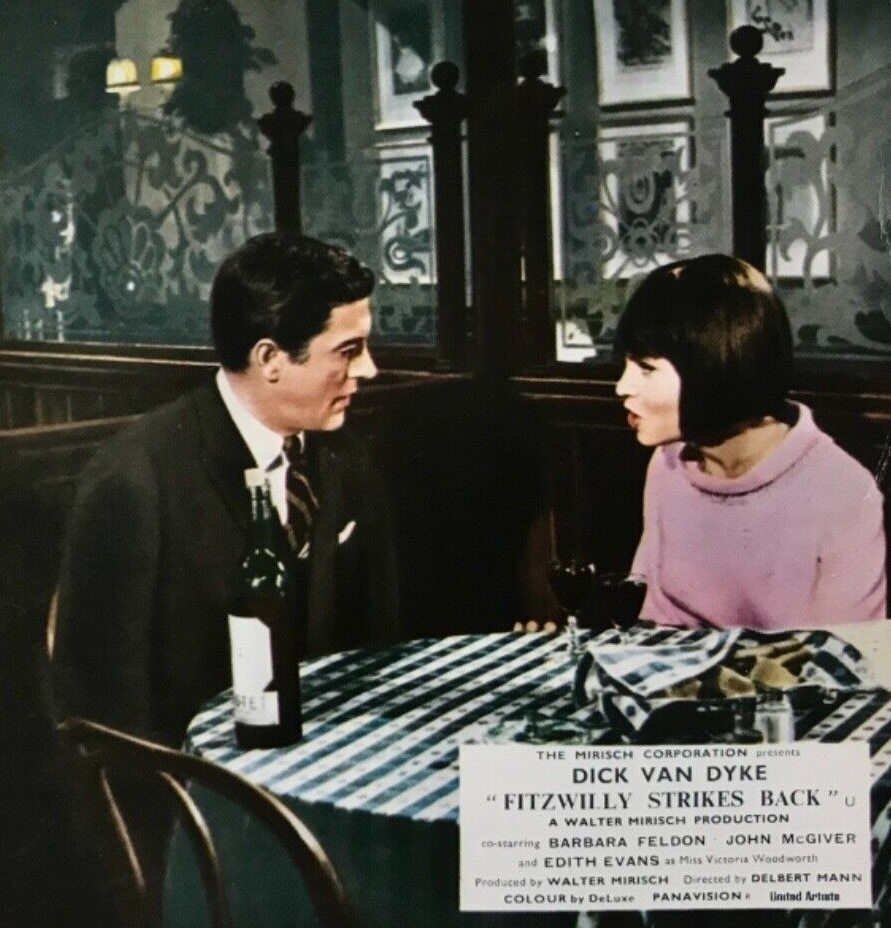
The two stars getting up close and personal.
There are a ton of under-stated elements of Van Dyke’s performance. In this scene,
he delicately explains to a young, inexperienced waiter how to properly pour wine.

Some of the heists are more of the over-egged con variety, too complicated for their own good, but the final robbery – on Xmas Eve – sits fairly and squarely in Marx Bros territory, providing a host of genuine laffs. Though you might wonder at the susceptibility of big-name department stores to smooth-talking criminals.

The romance is gently old-fashioned, and though Barbara Feldon (Agent 99 from Get Smart!, 1965-1970) does possess comedic timing, in hairstyle and delivery resembles Jane Fonda. It could have done with more time spent on her challenging or outwitting the butler, as she does at the start, to build up her character rather than lamely surrender to the romantic urge

Dick Van Dyke and Edith Evans effortless carry the picture. But while you’d expect nothing less of the renowned British actress, Oscar-nominated the previous year for The Whisperers, the biggest stretch in the entire picture is Van Dyke reversing his screen persona to turn into a believable leading actor not dependent on pratfalls, dodgy accents, singing and those limbs that seem to have a life of their own. He exudes charm and class and his character, without the distraction of being so devoted to his boss, could have pursued a highly profitable life of crime with himself as the sole beneficiary, which might have opened the door for his underwritten confederates – including John McGiver (My Six Loves, 1963), Oscar nominee Cecil Kellaway (Guess Who’s Coming to Dinner, 1967), Norman Fell  (Sgt Ryker, 1968) and in his debut Sam Waterston (Three, 1969) – to play a larger part in the dramatic proceedings.

But hey, if audiences were primed to fall for every Doris Day comedy built on a dumb premise and had lined up in the millions for It’s a Mad, Mad, Mad, Mad World (1963), then it’s kind of hard to question the narrative underpinning this picture. Isobel Lennart (Funny Girl, 1968) whipped up the screenplay from the novel A Garden of Cucumbers by Poyntz Tyler.

Once you get over the initial over-egging it’s soon apparent that Delbert Mann (Buddwing, 1966) has stitched together quite successfully a jigsaw of improbability.

Worth seeing for a Dick Van Dyke you never knew existed and another imperial turn from Edith Evans.

State Fair (1962) ***

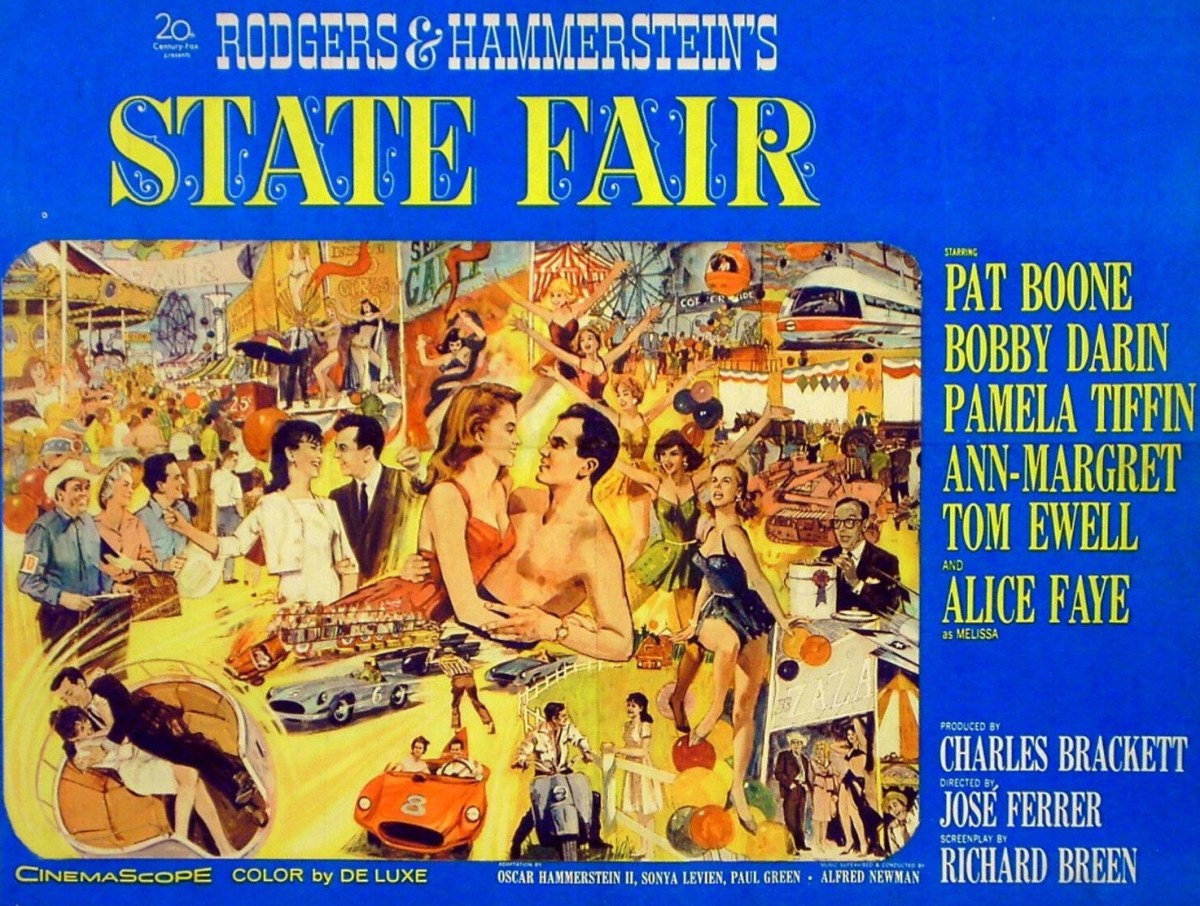
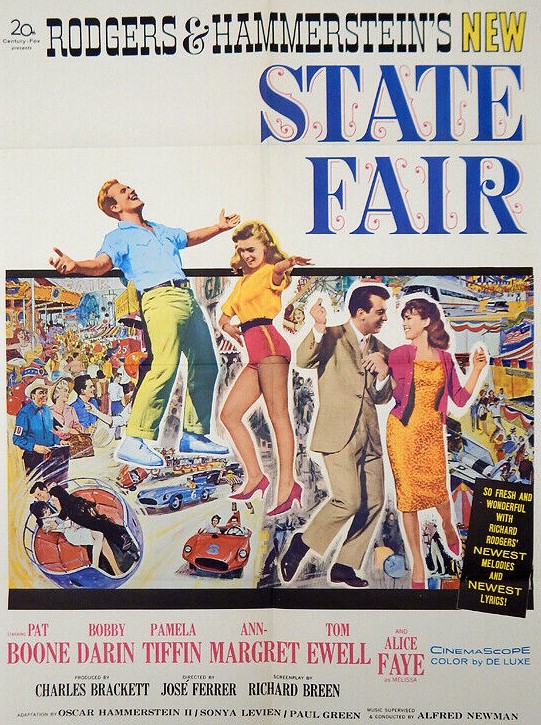
Ann-Margret lights up this corny-as-they-come musical. A car-racing sub-plot is about the only attempt to update it from the previous version in 1945. But if you like a love story, you’ve got three, that is if you include Blueboy the pig’s amorous advances. The remake avoids the edginess that had been introduced to movie musicals by West Side Story (1961) and settles for family-friendly and lightweight.

But there is something very American about the Frakes, a family of farmers. They all want to be winners at the annual state fair, parents Abel (Tom Ewell) and Melissa (Alice Faye) desperate to come home with trophies, she for her mincemeat, he with his pig. Son Wayne (Pat Boone) is also intent on victory, in a car race. Daughter Margy (Pamela Tiffin) would be happy with a bit of romance.

Wayne is very taken by showgirl Emily (Ann-Margret) while commentator Jerry (Bobby Darin) has eyes for Margy. The romances are not quite as innocent as you’d expect. Emily makes it clear she’s had other men, making her in Wayne’s eyes “a bad girl,” and that anything that happens at a state fair stays at a state fair, while she goes merrily on her way to her next conquest. Jerry is considerably less open with Margy, happy to string her along until he gets his chance at the big time.

Blueboy, who snorts like billy-o on seeing a female pig in the next stall, has to do all his courting behind bars.

This is more of a musical than the original. Oscar Hammerstein II now deceased, Richard Rodgers adds four more songs on his own, so there’s a bit more mooning and prancing about.

Although “It Might as Well Be Spring” was viewed as the standout song, the standout performance belonged to Ann-Margret who adds spectacular zip, showing off her figure is a series of dance moves on stage leading a male ensemble.

Oddly enough, of all the prospective competition winners, Wayne is the only loser. But that’s out of choice as he rams into a rival to drive him off the track and prevent him winning. Equally oddly, in this context, that’s seen as something of a victory, putting a bully in his place. The racing sequence, and thankfully minus any song, is a highlight.

The humor, deriving mostly from the parents, is slightly labored. Blueboy is let down by the script which doesn’t permit him to build up enough personality to make the audience root for him. But the sequence where three judges taste the alcohol-enhanced mincemeat works well. While at the outset the parents appear merely there as filler, they eventually come into their own in a demonstration of mature love.

Ann-Margret brings a touch of Vegas to the state fair.

Quite what made director Jose Ferrer (Return to Peyton Place, 1961) – an Oscar-winning actor – think he was cut out for a musical is anybody’s guess since, in the first place, this would only be his seventh picture in 11 years and, in the second place, he had no experience in this line. There are too many scenes just of the fair, a souped-up job that was more like an outdoor exhibition than a mom-and-pop local affair. While he lacks the flair of the big time Hollywood directors of musicals, for most of the songs he just points the camera and lets the actor get on with it, the dramatic scenes working reasonably well.

But since only Ann-Margret is called upon to show any real angst he’s quite limited in opening up the movie’s emotional appeal.

Ann-Margret (The Swinger, 1966), changing from natural brunette to flame-haired, steals the picture by far, not just on stage but revealing the screen persona that would take her to the top. Pamela Tiffin (The Pleasure Seekers, 1964, where she played second fiddle to Ann-Margret) is left in the shadows by Ann-Margret’s sizzling performance. Pat Boone (The Main Attraction, 1962) and Bobby Darin were better known as crooners which tends to mean they’re better with songs than dialogue, as is the case here, though Darin was excellent in the non-musical Pressure Point (1962).

Former top Fox star Alice Faye (In Old Chicago, 1938), making a comeback after 17 years, has little to do but frown and Tom Ewell (Tender Is the Night, 1962) has little to do but gurn and moon over his pig.

But, hey, it’s a musical and different rules apply. Fairly passable entertainment with some decent songs and the added bonus of Ann-Margret.

Mister Moses (1965) ***

The “lost” Robert Mitchum picture, never seen on VHS or DVD, but now turning up on YouTube.

Elephants have little proven appeal for audiences. From Dumbo (1941), Hannibal (1960), Billy Rose’s Jumbo (1962) and Hannibal Brooks (1968) through to Dumbo (2017) and Babylon (2022), the story is one of negative impact on box office. Baby elephants are maybe a different story – see Hatari! (1962)  – but there’s very little that’s cuddly about the adult version and their main purpose appears to be to annoy a major stars initially and then go on a rampage that either hinders or helps said star. If you’re acquainted with elephants, you’ll notice this is of the tameable Asian variety rather than the untamed African.

The unnamed beast here would fall into the former category except the eponymous Mister Moses (Robert Mitchum) – real name Joe – can talk to the animal in a language it understands and persuade it to show off its parlor tricks, enhancing Moses’s status among a small  community in Kenya. Moses is a con-man-cum-diamond smuggler, rescued from a river, specifically the reeds growing there that offer a Biblical connection to the natives.

The Bible plays a significant role here, though the natives don’t fall for the Noah story as explained by missionary (Alexander Knox). They are, like Native Americans, being driven off their land by the arrival of a dam which will flood their traditional grounds. Their cattle have not been included in the grand plan to airlift the entire community. So they refuse government help, hence the need to embark on a 300-mile trek.

Moses, a dodgy character with “an allergy to badges of authority”, is blackmailed by the missionary’s daughter Julie (Carroll Baker) and ends up doing the job of her fiancé, district commissioner Robert (Ian Bannen), to shift the natives off their land. He’s got some parlor tricks up his sleeve, too, including a flame-thrower which, again the old Biblical touch, he can employ to burn a bush, thus endearing himself as a leader.  

Naturally, enough, though staid, Julie finds herself attracted to Moses, a somewhat laid-back character with quite a line in hip patter. But it’s quite a stretch for Julie to be seduced by his knowledge of classical literature, namely the Andromeda-Perseus tale. Not everyone takes to Moses’ leadership, saboteurs steal the map and the compass.  And it’s no surprise when someone finds another purpose for the flame-thrower. There’s a bad witch doctor Ubi (Raymond St Jacques) to be put in his place, and Joe rises out of his lethargy long enough to dispose of a couple of villains.

With the emphasis on the Biblical, Joe is called upon to “part the waters” Exodus-style. Disappointingly, this is a bit of a parlor trick. It had me wondering how the heck he was going to do that,  with just a flame thrower and an elephant at his disposal, and also given that the sole purpose of rivers in African movie vernacular is so that the leading lady can bathe in one. Since the aforementioned river is nothing more than the outcome of another dam, Moses is clever enough to simply persuade the dam superintendent to – miracle of miracles – to turn off the water.

There’s enough going on to maintain interest and the will-she-won’t-she element is well-handled and there’s a good final line, “What’ll I do for laughs?”

Robert Mitchum has been here before (Rampage, 1963) but this time is on the side of the animals. Of course, the main interest is not how well he gets on with the elephant but whether he strikes sparks with a Carroll Baker (Harlow, 1965) eschewing her normal sexy persona. A cross between Hayley Mills and Deborah Kerr, Baker doesn’t quite suggest bottled-up sexual energy fizzing to get out, but then that wouldn’t be in character. It’s not in The African Queen league in terms of screen partnerships but it’s certainly workable enough.

Ian Bannen (The Flight of the Phoenix, 1965) is at his scowling best although Raymond St Jacques (Uptight, 1968) gives him a run for his money. Director Ronald Neame (Gambit, 1966) proved as adept at handling the big-name stars as the animals without it being acclaimed as a famous “lost” work of Mitchum. The screenplay by Charles Beaumont (Night of the Eagle/Burn, With, Burn, 1962) and Monja Danischewsky (Topkapi, 1964) was based on the novel by Max Catto (Seven Thieves, 1960).

A pleasant enough diversion.

Behind the Scenes: Thumbs Up or Thumbs Down, United Artists 1966 – Part One

Most observers don’t have a clue why some films are made in preference to others, or even of which movies have sat in turnaround hell for years. When I was researching my book The Making of The Magnificent Seven I came across some priceless material that gave some clues regarding the process. An “Inter-Office Memorandum” dated February 3, 1966, provided an insight into how independent producers Mirisch, then allied to studio United Artists, set about giving the thumbs up or thumbs down.

The memo referred to a meeting held at the Beverley Hills Hotel on January 29-30, 1966, attended by the three Mirisch Brothers – Harold, Marvin and the recently-deceased Walter – as well as UA head honcho Arthur Krim, Herb Jaffe and David Picker. On the agenda: Inspector Clouseau, Sherlock Holmes, The Mutiny of Madame Yes, The Egyptologists, Garden of Cucumbers, Wind on Fire, High Citadel, Saddle and Ride, The Narrow Sea, The Great Japanese Train Robbery, Lydia, In the Heat of the Night, The Cruel Eagle, How To Succeed in Business, and Death, Where Is Thy Sting-a-Ling.

Separately, the group examined commitments to various talents including John Sturges, Norman Jewison, Bryan Forbes and Billy Wilder.

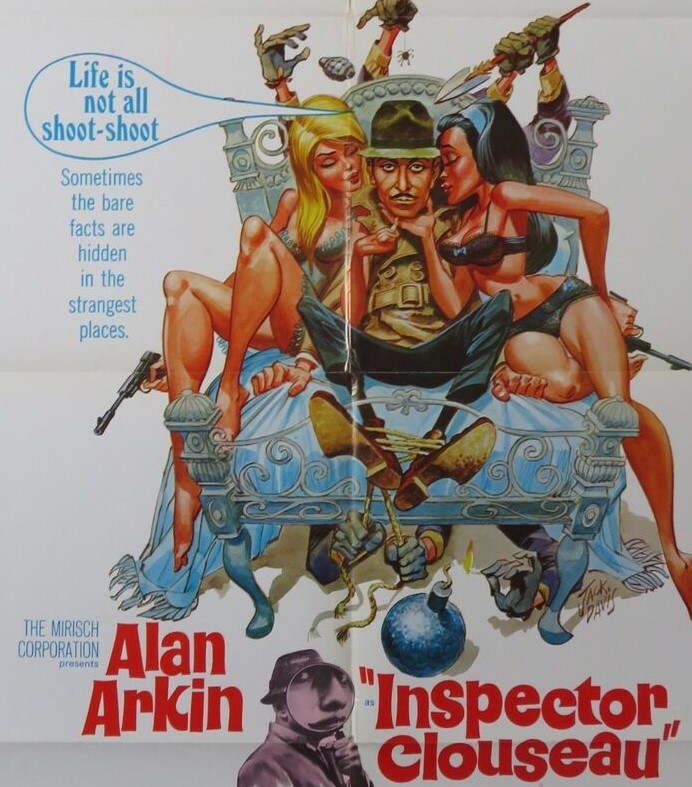
Top of the agenda was Inspector Clouseau, a sequel to the successful Pink Panther series, from which Peter Sellers had withdrawn. The budget was set at $3 million including $466,000 for director and star. Alan Arkin was not yet a lock, UA reserving its opinion on Arkin’s marquee’s credentials until it saw how The Russians Are Coming, The Russians Are Coming (1966), in which he was the star, performed at the box office. Should it bomb, second choice was Zero Mostel. Jonathan Winters, viewed as a “questionable choice,” was also in the running. Clive Donner was the preferred director. If he passed, next up was Guy Hamilton. (In the end both rejected the offer and it was released in 1968 with Bud Yorkin at the helm.)

Two projects on the table were mooted as vehicles for Steve McQueen. The first, Wind of Fire, was intended as “immediately following Sturges’ racing picture.”(This was Day of the Champion but a legal battle with MGM would derail this and McQueen was five years away from releasing Le Mans). Wind of Fire, to be directed by Norman Jewison, suffered from an incomplete script which restricted discussion. John Wayne had shown an interest but UA “was not really interested in Wayne,” possibly as a result of the fall-out from The Alamo (1960). The second McQueen project was the thriller Lydia based on the book by E.V Cunningham (the pseudonym of Howard Fast of Spartacus fame). Here, the script was complete and in the actor’s hands. Doris Day had been touted for female lead but Mirisch had nixed her involvement. When dealing with any major star, greenlighting a picture depended on schedules not clashing. (In the end neither project saw the light of day.)

Mirisch was also juggling two properties to star Dick Van Dyke.  The Great Japanese Train Robbery was due to commence filming in June 1966, although that meant cooperation from Columbia and Disney who had first call at that point on the actor; Disney had excused him, Columbia had not. Virna Lisi, the intended female lead, was dunped for demanding too much money, $300,000 her current asking price. In her place were suggested Claudine Auger, Catherine Deneuve, Stefania Sandrelli or Luciana Paluzzi. Although the budget was approved at around £3.3 million, the movie never went ahead.

Garden of Cucumbers with Van Dyke, though minus a female lead, was already scheduled to start shooting in August-September 1966. Proposed director, in order of preference, was Norman Jewison, Arthur Hiller or Elliott Silverstein. This project did make it over the line though the title, changed to Fitzwilly, was helmed by Delbert Mann and co-starred Barbara Feldon in her biggest role to date.

A budget of $1.89 million had been set for High Citadel, based on the Desmond Bagley thriller. UA was locked into a pay-or-play deal, which meant star James Garner would receive his salary whether or not the picture was made. However, there was a get-out clause. The studio could use Garner for another picture as long as it slotted into the same timeframe. The other options were Saddle and Ride and The Narrow Sea. Of these Mirisch preferred the former, UA the latter. But there was a directorial issue with The Narrow Sea. Mirisch had a moral commitment though not a legal contract with producer Robert Relyea to make this his directorial debut and UA didn’t want him. (In the event neither film was made.)

There were budget issues on How To Succeed in Business. UA had given the go-ahead on the basis that it would cost no more than $3.25 million but the budget had since soared by over half a million. To meet the May 1 start date, the budget had to be trimmed back to the original amout. (This was presumably done, since the movie appeared the following year). In the Heat of the Night was in the early stages of development, the production company still to see the Stirling Silliphant script, but at this stage no objections were raised. Fred Zinnemann was being considered as the director of The Cruel Eagle by Frederick E. Smith, author of 633 Squadron. (It was never greenlit).

Making movies in Britain – in order to take advantage of the tax advantages of the Eady Plan – was central to the Mirisch strategy. While Inspector Clouseau, Death, Where Is Thy Sting-a-Ling,  and The Mutiny of Madame Yes– budgets totalling around the $10 million mark – were already committed to the Eady Scheme, Mirisch was also seeking backing to set up a low-budget unit in Britain to maximize the government’s largesse. Budgets per picture would be limited to $1 million or less. In the memo they were described as “disciplined” or “service” pictures to be “produced in color.” In essence that meant basic programmers that could be sold to drive-ins and cinemas with a high movie turnover, on a rental basis if they topped the bill, for a flat fee if they were supports. This would have the added benefit, for those houses whose customers demanded a double bill, of being able to offer a program where all the revenue would end up in the Mirisch pocket.

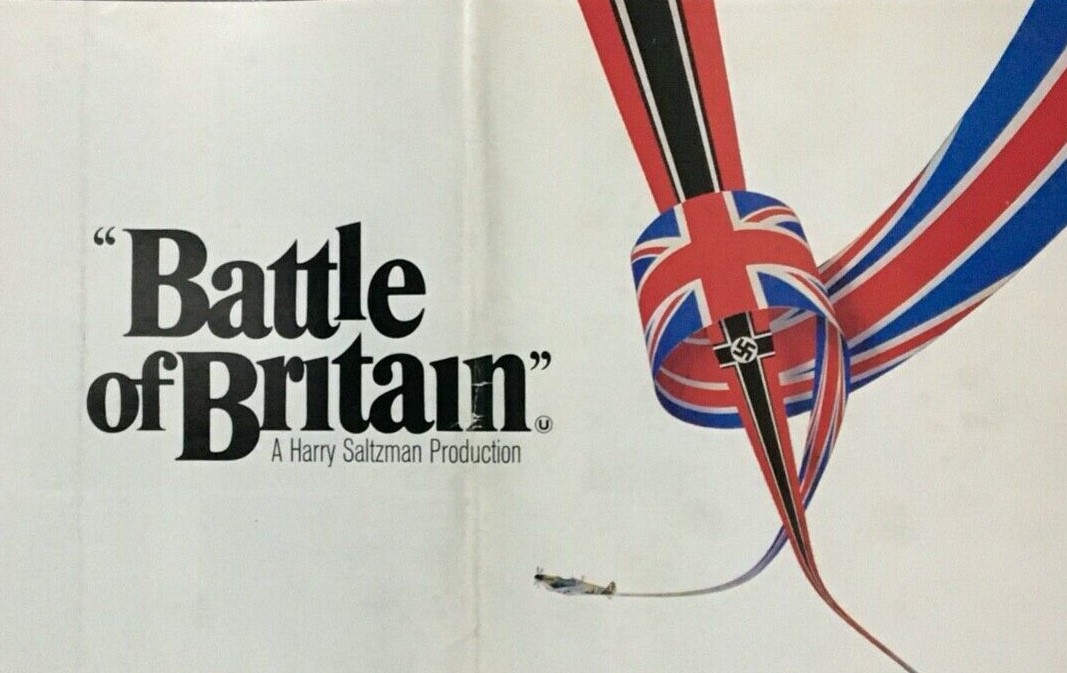
The Battle of Britain (1969) *****

Fabulous aerial sequences countered by grim reality. Like The Longest Day (1962) and Battle of the Bulge (1965) even-handedly doesn’t treat the Germans as the evil enemy, but unlike those films victory is somewhat obscure, no rattling of spears as in Zulu (1964) to announce opposition departure, just clear skies indicating an absence of foe. Anyone going into this – persuaded by Dunkirk (2017) that this retreat was a triumph – and with little knowledge that after Hitler had overrun Europe invasion was imminent might be surprised to discover that this was a campaign lasting over three months rather than one conclusive battle.

That’s to the benefit of the movie, allowing it space to breathe, for characters to develop, rather than everything crammed in pell-mell. Given the situation changed from day-to-day, the one constant, which we’re scarcely allowed to forget, is that the British are heavily outnumbered in the sky. It’s a war of attrition. The Germans can lose hundreds of planes, the British nary a one.

But it’s far from gung-ho, the British coming in for criticism for their unpreparedness, surprised when the Germans bomb airfields, even more astonished when the opponent starts dropping bombs on London. Perhaps, given the relatively short running time for an epic – 46 minutes shorter than The Longest Day, 35 minutes down on Battle of the Bulge – it might have been better to avoid slipping in a section on the impact of the Blitz on Londoners, though that is counteracted by panic in Berlin when that city is also bombed.

But, by and large, it’s an engrossing tale. And bold, too, in the version I saw no subtitles for German dialog, leaving audience reliant on facial and body expressions. To slow down the action, I guess, and add some class, several scenes involve people walking down long corridors.

All the salient points are covered, pilots thrown into battle with barely a few hours experience of flying a Spitfire, the lack of pilots, in-fighting at the top, checkers moved across the board at mission control indicating German aerial advance, the inability of getting aircraft up quick enough or repaired quick enough. Above all, the reality of death is shown in astonishing detail; once the pilot was shot or the airplane destabilized, there was almost no escape, fire enveloped anyone inside, hatches failed to open, planes burst into flame or crashed into the sea. And it was the same death, regardless of nationality. And there were no scenes of  callous Germans shooting down a British pilot parachuting to safety.

The aerial sequences are quite astonishing. I’ve seen this on big screen and small, but even on a small screen, the camerawork is quite extraordinary, even getting this number of workable planes in the air must have been some feat, then flying in formation and peeling off in attack. It is kind of hard from time to time to work out who is shooting at who since the planes are all the same grey color and only distinguished when the camera is close enough to identify  them by RAF roundel or Nazi swastika. But the overall effect is a sense of sorrow rather than triumphalism, young lives of any nationality brought to a brutal close. There is no scene, as in Battle of the Bulge, of the over-zealous Nazi, the singing that made them appear such an implacable foe. Here, there’s no need to play up implacable. Unless they abandon the fight, the Germans, courtesy of superior numbers, will inevitably win. All the British can do is stave off defeat for as long as possible.

The all-star cast is only an all-star cast if you’re British. Without a Hollywood star in the vein of John Wayne, Robert Mitchum and Henry Fonda, and in the absence of British superstars like Sean Connery and Peter O’Toole, it’s an all-star cast by default. The biggest name, Michael Caine (Deadfall, 1968), has one of the smallest parts. But the equality of the cast works in its favor, there’s none of the rubbernecking that got in the way of The Longest Day.

Christopher Plummer (The High Commissioner/Nobody Runs Forever, 1968) has the biggest role as a squadron leader determined to force his wife out of the front line working on the airfields and into a safer position. But the best acting comes from Laurence Olivier as the dry Air Chief Marshal Sir Hugh Dowding who has no truck with interfering politicians. Accused of inflating figures of German casualties he replies that if he is wrong the Germans will be in London in a week.

But it’s a close-run thing between him and Susannah York (They Shoot Horses, Don’t They, 1969) as the aforesaid wife with a growing streak of independence and Ian McShane (The Pleasure Girls, 1965) as a lowly pilot called upon to express grief more than most. There’s certainly a sense of solidarity among the cast, no show-boating from the usual scene-stealing culprits like Trevor Howard (Von Ryan’s Express, 1965) and Robert Shaw (Battle of the Bulge) whose normal determination to bristle at the slightest opportunity is dropped for the good of the cause.

The great and the good appeared to be happy with the slightest role just to take part. The roll-call includes Ralph Richardson (Khartoum, 1966), Michael Redgrave (The Hill, 1965), Kenneth More (Dark of the Sun/The Mercenaries, 1968) and a hatful more.

Guy Hamilton (Goldfinger, 1964) directs with some distinction, his biggest achievement to concentrate on fact rather than flag-waving, no better demonstrated than by my realization that the stirring theme tune that I remembered so well by Ron Goodwin (Where Eagles Dare, 1968) does not make an appearance until the very end. The screenplay by James Kennaway (Tunes of Glory, 1960), Wilfred Greatorex (The High Commissioner) and, in his only movie work,  Derek Dempster, displays more finesse than you might expect.

Almost documentary in tone, a classic.

With Six You Get Eggroll (1968) ***

The blended family was so rare in the 1960s you could easily play it for comedy. In retrospect, though, this comes across as a more realistic approach at how game couples find their romance under threat from children hostile to the match. Doris Day’s swansong, she might have done better with a partner zippier on the uptake than Brian Keith, who for the most appears lumpen, and she shoulders most of the physical comedy burden, but it’s a decent end to an extraordinary career. There are shades of Absolutely Fabulous, children remonstrating with parents going off the rails.

Widow Abby is very much the independent woman, running a substantial lumberyard operation, too busy to consider romance and aware her options are limited to deadbeats. She can afford help for the domestic chores. Widower Jake (Brian Keith) faces endless frozen meals and could have as much sex on the side as he wants with married neighbor Cleo (Elaine Devry) whom he constantly rejects. She has three sons, one a teenager who works part-time in the business, he has one daughter, Stacey (Barbara Hershey) also a teenager.

Courtship gets off to a rocky start. Jake, invited to a dinner, is so bored he makes an excuse and leaves, caught out in his lie later that night. Most of the romance takes place in a drive-in hot dog operation since the children make it plain they oppose any union.

But, hey, since the story is also dragging, the couple decide to get married quick. That’s when the trouble starts. Neither house is big enough to accommodate the squad, irritation spills over into full-blown argument, and little can be done to placate the kids, who resent being forced into a situation over which they have no control and having to share a doting parent with a stranger.

Family planning was another big issue in the 1960s and this was an unintended offshoot, the couple making no provision in advance, beyond their own selfish needs, for how their marriage would emotionally affect their children. And although the happy ending doesn’t feel too forced, it does point up the problems of turning two rival families into one supportive team.

Back in the day. audiences probably laughed their heads off at the antics of the disapproving teenagers, but I think most people would approach those scenes with sorrow rather than humor, acknowledging the despair of ignored children facing up to dealing with what they regard as an intruder upsetting a settled family unit. The assumption that kids will make do while parents embark on a joyous ride seems only too unrealistic.

You can see some scenes coming a mile off. When Jake gets too close to a younger woman you guess right away that’s bound to be his daughter and the minute you spot a lorry loaded with chickens you are counting the moments before unexpected collision sets them free. But once the movie settles into the meat of the story it’s on pretty safe ground.

It’s at its best when Doris Day (Midnight Lace, 1960) is permitted space to indulge in physical comedy. The scene where she ends up with a yellow stripe on her attire is priceless and her driving of a camper van leaves much to be desired. Brian Keith (The Deadly Companions, 1961) only has to deal with temperamental cupboard doors. While he’s not in the class of her previous romantic companions like Clark Gable (Teacher’s Pet, 1958), Rock Hudson (Pillow Talk, 1959), Cary Grant (That Touch of Mink, 1962) or James Garner (Move Over, Darling, 1963) by this point in her career she was more than capable of carrying any movie.

Both teenagers were making  movie debts, Barbara Hershey (Last Summer, 1969) coming off best as the sullen female while John Findlater (Airport, 1970) is little more than her companion in creating chaos.

Director Howard Morris (Who’s Minding the Mint, 1967) puts on a decent show given the material. The script was written by Gwen Bagnit, whose last movie credit (western The Last Wagon, 1956) was a decade before, her husband television writer and sometime actor Paul Dubov, and Harvey Bullock (Who’s Minding the Mint).

It’s not quite the career finale Doris Day might have hoped for, but the box office was respectable especially as it faced severe competition from Yours, Mine and Ours (1968), which doubled down on family members, the year’s sleeper hit.

Harmless comedy, perhaps, but the passing of the years has given the movie unexpected emotional heft.

Discover WordPress

A daily selection of the best content published on WordPress, collected for you by humans who love to read.

The Atavist Magazine

by Brian Hannan

WordPress.com News

The latest news on WordPress.com and the WordPress community.