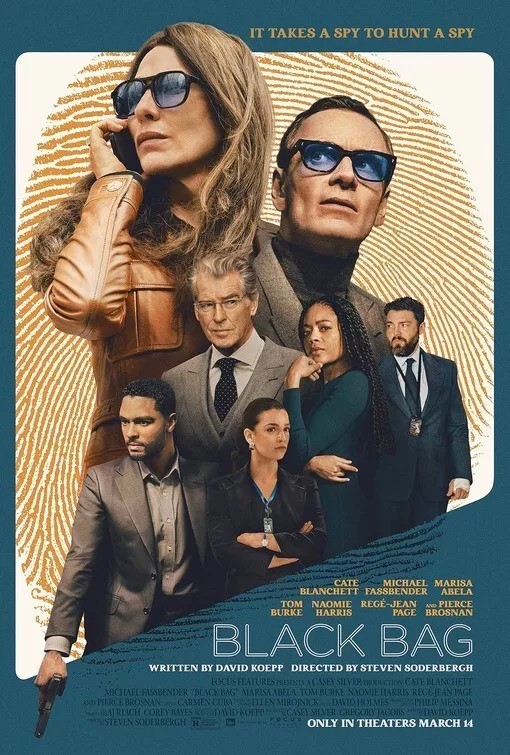
Black Bag (2025) *** – Seen at the Cinema

Explain to me how this cost anything like the reported $50 million. Unless the cost of a nightclub scene has gone through the roof. Or someone has slapped an almighty tariff on shooting in Zurich. Or such middling box office attractions as Cate Blanchett and Michael Fassbender, against the laws of marquee valuation, are pulling down salaries in the region of $10 million apiece.

Because this is nothing but a glorified chamber piece, most scenes shot indoors or in secluded locations. There’s no car chase, one minor explosion (drone-triggered), not even a pursuit on foot. Some clever marketing oik has dressed up what’s no more than a BBC TV film as an expensive espionage picture in the hope of hooking a larger audience.
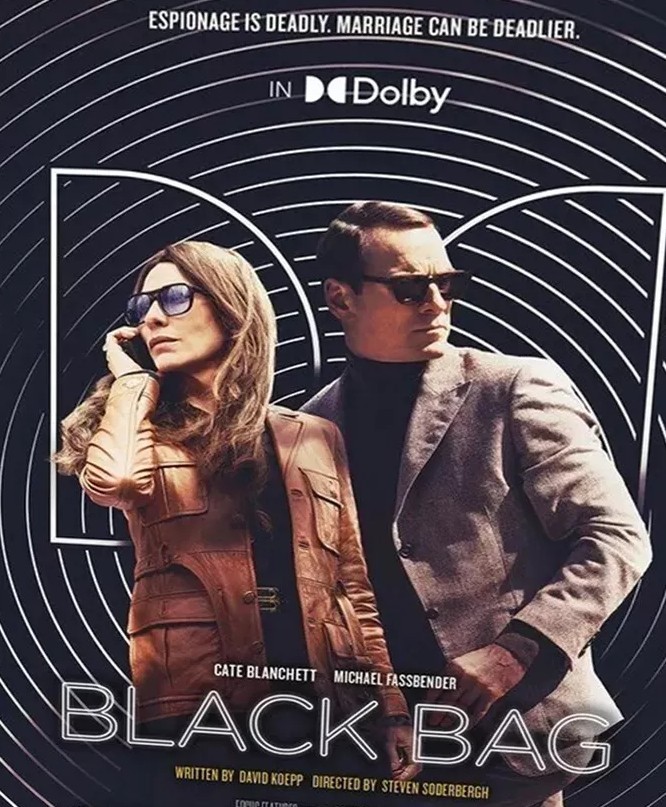
It’s short, little more than 90 minutes, so that’s on the plus side. But the plot’s full of holes, you’re scarcely going to swallow Fassbender and Blanchett, faces welded to stiff upper lip,  as a hot middle-aged couple, and I wouldn’t have been at all surprised to see  Hercule Poirot or more likely Miss Marple lurch into view for the grand finale with all the potential culprits being set to rights around a dinner table.

Fassbender is so impassive at the best of times his character hardly needs to be expanded to include some OCD, and the most expressive he becomes is, wait for it, hand shaking when he pours a glass of water. The theme, wait for it, is that people who lie for a living are not to be trusted in their domestic lives. And just to polish the virtue-signalling credentials there’s still running amok in MI5/MI6/Black Ops/CIA some rogue top dog who thinks he can stop the unnamed war – presumably Ukraine – by causing a nuclear power plant meltdown in Russia.

And when Pierce Brosnan steals the show in a small supporting role you know your movie’s in trouble.

That said, there’s enough going on to keep you entertained. Top British agent George (Michael Fassbender) begins to suspect – or does he really – that his wife, also a top British agent, Kathryn (Cate Blanchett), is up to no good. So he begins to investigate. Mirror is piled upon mirror, complicated by the occasional murder, so that we are soon knee-deep in the kind of narrative where you don’t know who trust – but, equally, unfortunately, don’t much care because none of the characters is remotely attractive.

At least one them, Freddie (Tom Burke), would have been considered a security risk. So  often does he stray he would be catnip for any passing honeytrap. But you might also have asked questions about his current squeeze, analyst Clarissa (Marisa Abela), paranoid as a posse of schizophrenics, who knows exactly how to pass a polygraph test (clenching the anal sphincter one of the tricks in case you’re interested), and as likely as not to ram a carving knife into unfaithful boyfriend Freddie’s hand at the dinner table. Naturally, it doesn’t do much harm, because Freddie is back at work next day with bandaged hand and not investigated by cops over a knife wound that could hardly be covered by the old slipping the shower routing.

Then we’ve got straitlaced psychiatrist Dr Zoe Vaughan (Naomie Harris) with a penchant for erotic fiction, sex in the office (including breaking the cardinal rule of her profession, sex with a patient), and stringing along two men at once, both of whom, Freddie and Col James Stokes (Rege-Jean Page), are engaged in other affairs.

George soon realizes he’s being played as a patsy, and that his investigation has compromised another operation, and facilitated the handover of a top secret document to the Russians.

In the current dearth of movies for the over-40s, make that over-30s not yet suffocating in superheroes and multiverses, this is what passes for entertainment aimed at an adult audience. And it is short, as I said, but this is exactly the kind of low-budget movie with a decent cast that traditionally ends up on a streamer.

For once, director Steven Soderbergh (Magic Mike’s Last Dance, 2023), whose career is littered with self-indulgence, sticks to the knitting, and it’s a more than passable espionage thriller, but the kind that would be more at home on the small screen. Written by David Koepp (Indiana Jones and the Dial of Destiny, 2023).

Neither Fassbender (Next Goal Wins, 2023) nor Blanchett (Tar, 2022) do the most basic task required of a marquee name, which is to set the screen alight, and all the rest, excepting the much-in-demand Pierce Brosnan (Black Adam, 2022) – seven pictures in the last two years –  merely trundle along in their wake, saddled with scenes where they express alarm at their deepest secrets being revealed like they have drifted in to some shopworn melodrama.

For all the actual investigation that takes place you could have set this in the kind of remote spot favored by Agatha Christie and played it out in traditional Poirot/Marple fashion.

Interesting but ultimately disappointing.

And the big question remains – where did the $50 million go? And, did it exist in the first place?
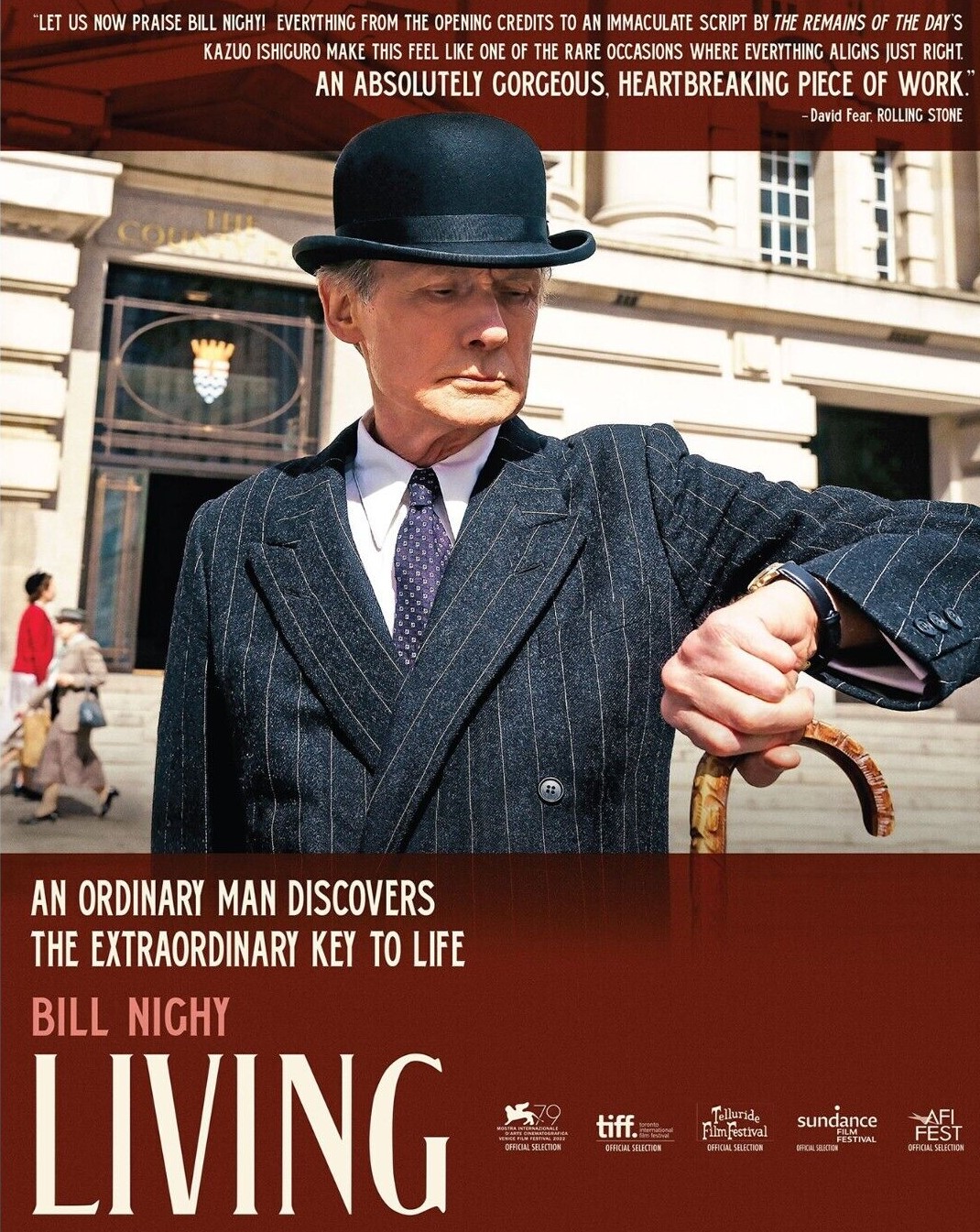
Living (2022) ***** – Seen at the Cinema

What is it about the British, hardly renowned these days for cinematic output, that they can confer late-onset stardom on hitherto supporting player?

To a list that now includes Olivia Coleman (The Favorite, 2018)), Lesley Manville (Mrs Harris Goes to Paris, 2022) and Jim Broadbent (The Duke, 2020) we can now add Bill Nighy best known for a rumbustious turn in The Boat That Rocked (2009).

And in a movie that is so slow, so bereft of any action, it goes in the polar opposite direction to current Hollywood offerings. Worse, it’s set in moribund England of 1953 and almost wilfully ignores that year’s great event, a hook that would undoubtedly have attracted The Crown crowd, the Coronation of Queen Elizabeth II, whose funeral barely a couple of months back generated record global television audience.

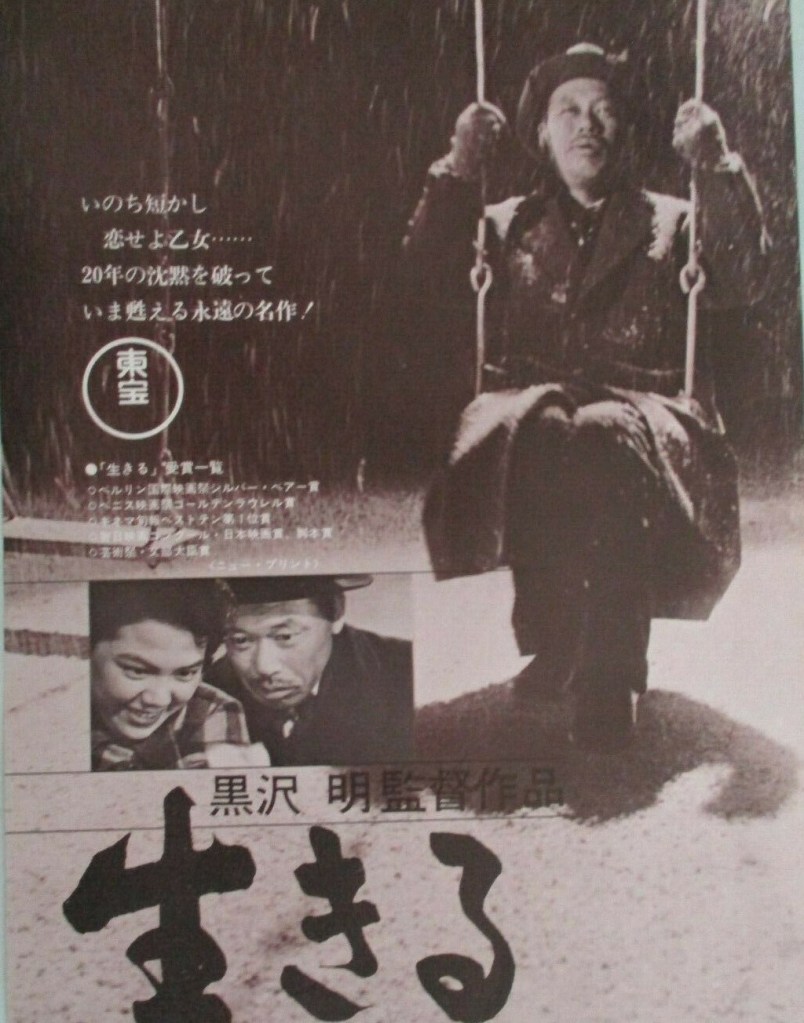
The new movie does steal this seminal image from the original “Ikiru.”

The characters all exist in that worst of all English cliches, the pin-striped bowler-hatted stiff-upper-lip brigade who exist in a world so far removed from American enterprise and vigor  that the hardest work they do is to avoid responsibility for any decision with an almost Brazil-type ability to pass the buck to another department.

And it is all done so beautifully. It’s not only the role of a lifetime for Nighy but his first leading role and he manages without once resorting to his trademark chuckle.

There’s no plot to speak off, just a gradual awareness by long-widowed civil servant Williams (Bill Nighy) that he has disappeared into a soulless existence, lacking any spark, easily matching the soubriquet “Mr Zombie” given by cheeky assistant Margaret (Aimee Lou Wood).

On receiving the news that he is dying of cancer, his reaction is to attach himself to livelier characters, Sutherland (Tom Burke) and Margaret, in the hope that by osmosis some of their joie de vivre will rub off, his attraction to the girl bordering on infatuation, which given the age gap, he luckily realises and pulls away from in time.

Unlike most downtrodden characters seeking redemption, he doesn’t immerse himself in a murder mystery, or race to someone’s rescue or confront the town villain, instead, almost secretly, devoting himself to building a playpark on behalf of downtrodden mothers who have no chance of beating the system on their own. In fact, there could not be a greater act of class rebellion for a middle-class Englishman than to connive on behalf of the lower classes to beat the Establishment.

His tiny action is against the background of a ruling middle- and upper-class who enjoy lives in the leafy suburbs far removed from the inner-city deprivation of London.

Screenwriter Kazuo Ishiguro (The Remains of the Day, 1993) – adapting Akira Kurosawa’s Ikiru (1952) – has form exploring English emotional repression, with the most delicate of touches shedding a light on the incipient hierarchical pecking order. New recruit Wakeling (Alex Sharp) is kept in his place by the slightest touch of an umbrella. And in echoes of the inmates scurrying away from the approaching Nurse Rachet in One Flew Over the Cuckoo’s Nest (1975), Williams nearly hugs the wall, head bowed, hat in hand, to allow boss Sir James (Michael Cochrane) to pass in the corridor. Another colleague is “ashamed” to see Williams beg a superior to reconsider an adverse decision, as if this was not just a dishonorable action for Williams but a humiliation for himself to witness.

Only a hint here and there is required to draw other characters, William’s son’s harpie of a wife, and Williams’ colleagues not only forced to work at the same desk all day but crammed into the same (first-class) railway carriage for the journey home.

This could easily have gone down the more aggressive narrative route of Williams kicking up a stink and confronting those creating obstacles in other departments, there could have been stand-up rows, and defeat followed by celebration, but then that would have not been British. And while Hollywood might have revelled in the creation of another champion of the common man (or in this case, woman), instead director Oliver Hermanus (Moffie, 2019) has taken the much quieter approach, much to the film’s benefit.  

There is only one directorial trick that will stop you in your tracks and a couple of lingering images, but the movie is all the better for the director restraining the impulse to go in more heavily.

Aimee Lou Woods easily makes the transition from television (Sex Education, 2019-2021) in an interesting part where her initial involvement as confidante turns into a more challenging role.

An industry, bewailing the post-pandemic absence of the older generation, will hopefully be sensible enough to accord this a platform release – word-of-mouth might even attract a younger audience – and come Oscar time Bill Nighy should be in with a shout.  

Discover WordPress

A daily selection of the best content published on WordPress, collected for you by humans who love to read.

The Atavist Magazine

by Brian Hannan

WordPress.com News

The latest news on WordPress.com and the WordPress community.