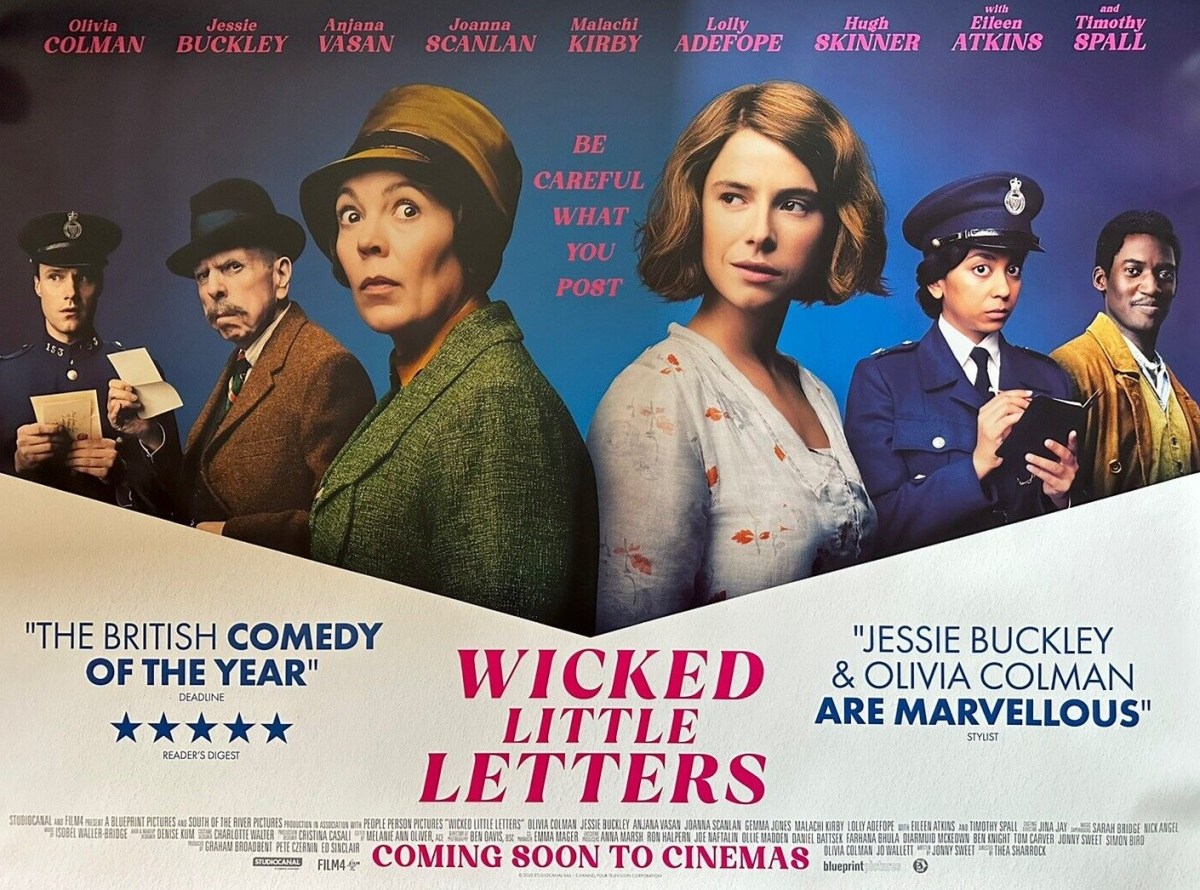
Wicked Little Letters (2023) * – Seen at the Cinema

The trailer would have won an Oscar, deftly put together, loaded with laughs, but the reality is this is set fair to be the worst picture of the year if not the decade. If it wins any marks at all it’s for showing that the Brits can match the likes of Tarantino and Scorsese in the cuss-word department and challenge The Thick of It for creative swearing. But even the Society for Ham Over-Acting would have trouble letting this mob join and you would find better detection – invisible ink, anyone? – from Enid Blyton’s Famous Five.

As it happens, I have relatives in the English south coast seaside town of Littlehampton and perhaps the entire population was so scarred by the occurrences detailed here that they never saw fit to bring up the subject or perhaps had decided it was just so preposterous it wasn’t worth mentioning.

Anyway, you can guess from the get-go that its repressed spinster Edith (Olivia Colman) who’s the culprit, sending poison pen letters to herself to get a bit of local attention. And you would be hard put even if you were dumbest of dumb cops to try and pin the blame on her next door neighbor Rose (Jessie Buckley), a war widow (it’s set after World War one) with a young daughter. Roisterous and boisterous though she is, she’d clearly rather spend what little cash she has on getting drunk than stumping up for over a hundred stamps, envelopes and writing paper.

Of course, this is a male-dominated society ruled with an iron hand by misogynists, Edith’s father Edward (Timothy Spall) top of the class in that department but closely followed by the dumb and dumber cops. Coming to Edith’s rescue in quite bizarre fashion is “woman police officer” (as is apparently her full title) Gladys (Anjana Vasen) and her coterie of amateur detectives, all members of the local whist club.

The whole thing is just too stupid for words. Roger Moore’s acting is Oscar-worthy compared to this lot who roll their eyeballs at the drop of a hat. There are attempts to ram into an already thin storyline references to feminism and racism and there may even be a rapacious priest somewhere in the mix for good measure, but the effect is of lazy moviemaing pandering to the crowd. Oh, and by the way, there’s a reminder – in case you’ve forgotten – just how much people frowned upon kids playing the guitar a century ago as if it was the kind of musical instrument devised by the Devil.

The trailer whizzes along but this moves like treacle. I’m sure actors are entitled to make a poor movie now and then, but this feels more like a director who failed to rein anyone in and as a consequence Oscar winner Oliva Colman (The Favourite, 2018), Oscar nominee Jessie Buckley (The Lost Daughter, 2021) and multiple Bafta nominee Timothy Spall (The Last Bus, 2021) are allowed to make complete fools of themselves. The only one showing restraint is Emmy award-winner Eileen Atkins (Paddington 2, 2017).

Who to blame? Director Thea Sharrock (Me Before You, 2016) for not issuing red cards to the actors, screenwriter Jonny Sweet (Greed, 2019) for dreaming up this farrago in the first place or the trailer team for providing such a misleading impression of the end result? The audience, desperate for an old-fashioned comedy along the lines of Four Weddings and a Funeral or The Full Monty?

Shambolic cartoon. Boo hiss.

The Last Bus (2021) *** – Seen at the Cinema

As we saw with Stillwater, great performances can rescue films. And there are two stunning performances on show in this alternative road trip, one from star Timothy Spall (Mr Turner, 2014) and another in a blink-and-you’ll-miss-it scene from supporting actress Grace Calder. The story here is pretty slim, Tom, aged over 90, sets out on 800-mile pilgrimage by bus from John O’Groats at the very top of Scotland to Land’s End at the very south of England. The trip’s purpose is concealed until the climax but hardy cinemagoers will easily guess it. He has various encounters along the way. That’s it, pretty much.

Most films about the old have redeeming features, a charming character and if grouchy with a last chance at redemption, and if played by a star generally bring with their performance a whole parcel of screen memories that have an audience rooting for them. Tom ain’t like that. He’s old the way really old people are old. He’s not an attractive sight. His bottom lip sticks out most of the time like an aged trout. He shuffles along, in battered old clothes clutching a battered old suitcase. Most of the time he’s out of his depth, occasionally rescued by passersby, occasionally not.  

The most you can say about him is he has grit, standing up to a drunk abusing a Muslim, fixing a broken-down bus, offering a shoulder to cry on to a weeping teenager. In another time, in another place, such characteristics would have propelled a story. Here, they are mere makeweights. He’s so self-effacing he’s easy to ignore.  

Scottish director Gillies Mackinnon (Whisky Galore, 2016) takes the bold decision not to make him overly sympathetic. Scenes that would have been played for all they were worth in any other film almost pass without comment, just minor ingredients in a larger tapestry. The most Tom achieves is retaining dignity at a time when body and mind are starting to betray him.

That this is just the smallest of small pictures is amply demonstrated when, trapped between a bunch of rowdy boys enjoying rowdy banter with a hen party, he starts singing “Amazing Grace.” Tom doesn’t have an amazing voice. He doesn’t even seem to recognise that he gradually attracts an audience. He is in a world of his own. And the director lets him stay there.

I was so convinced by Timothy Spall’s performance that I hoped they had used a stunt double to film a scene when he has to gingerly negotiate a path down rugged rocks. I had not realised that Spall is only 64 and not close to the aged specimen I had been watching. Spall has that quiet genius of the great actors even though rarely given a leading role and if you recognise him at all, unless you are an arthouse devotee, it will be from The Last Samurai (2003) or Vanilla Sky (1999).  

What of Grace Calder? Occasionally I deliver lectures on film and in one of these I use the final scene of Greta Garbo in Queen Christina (1933) to demonstrate the power of female close-ups, how women far more than men are capable of a greater range expression, showing a shifting series of emotions through their eyes. And I saw that same astonishing quality in Grace Calder (Love Sarah, 2020). She appears as the lover of an arrogant male who taunts Tom in a B&B. As she reins her lover in, her eyes rapidly change in a matter of seconds to conveying a depth of different emotions.  None of the other actors, who are all fleeting two-dimensional cameos, come anywhere close in a part that was not a part until she made it so memorable.

Most critics have been pretty sniffy about The Last Bus and you can see why. Television writer Joe Ainsworth making his movie debut tries too hard for diversity, the social media trope sticks out like a sore thumb, affords overmuch footage of glorious Scottish landscape to recompense Creative Scotland for its financial input, and never quite resolves the question of how a 90-year-old guy who can hardly manage a bus pass manages to work out a convoluted route in at least a dozen local buses to retrace a route he took 70 years before.

But it is all held together by a stunning performance by Spall.  

Discover WordPress

A daily selection of the best content published on WordPress, collected for you by humans who love to read.

The Atavist Magazine

by Brian Hannan

WordPress.com News

The latest news on WordPress.com and the WordPress community.