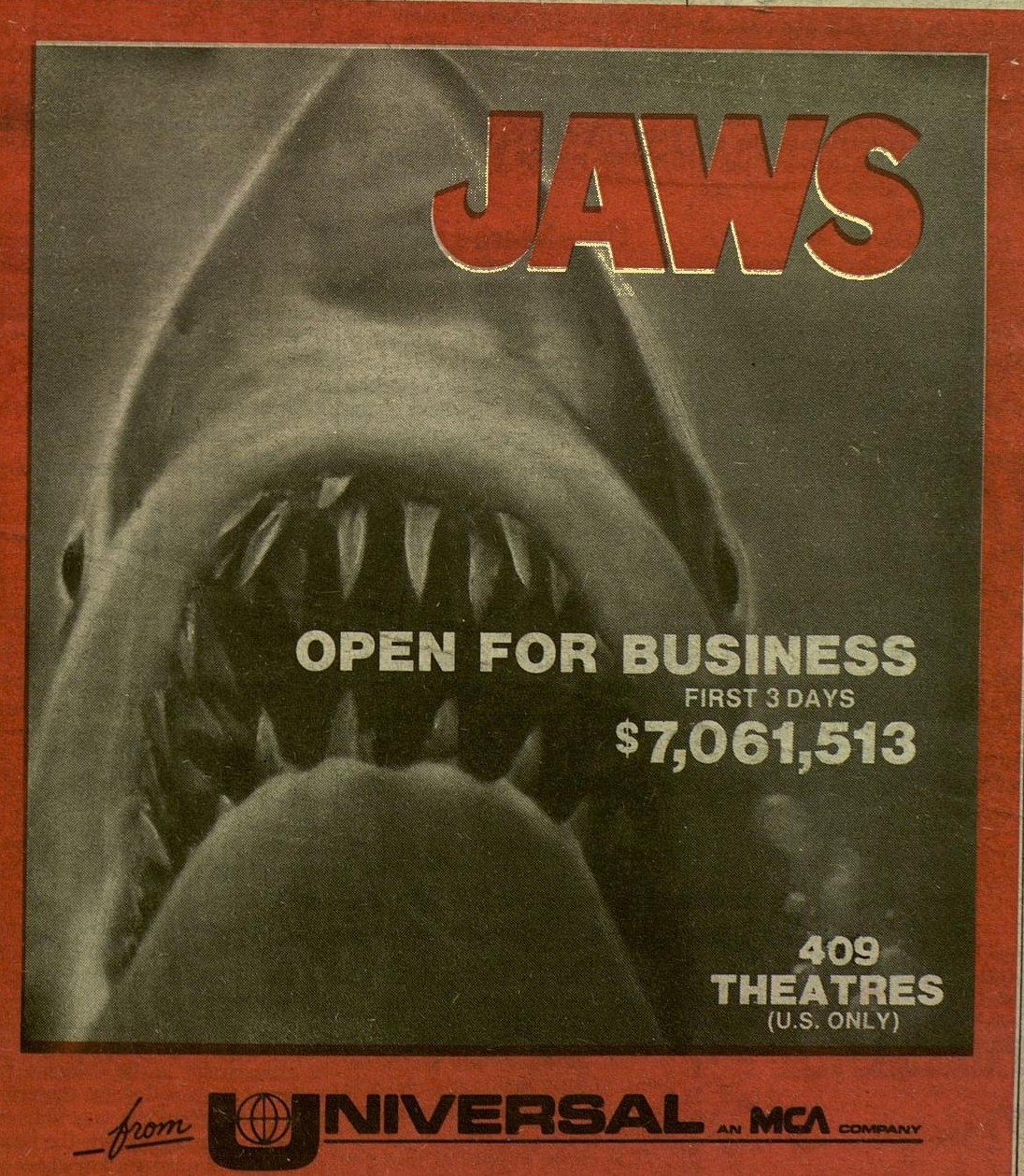
Given the surprising success of the reissue of Jaws this weekend – it came in second at the U.S. ticket wickets ahead of such new films as The Roses and Caught Stealing – I thought you might like a second look (or a first one) at exactly how Universal created box office history. And it was not the way you would expect. It did not follow the template set out by previous juggernauts.
Naturally, the hoopla surrounding the 50th anniversary of Jaws concentrates on the budget overruns, director Steven Spielberg’s problems and the mechanical shark, and no one gives a hoot about the most important aspect of the picture – the box office. Sure, it’s always mentioned in passing, because otherwise the movie would have had little impact on pop culture, the driving force of the water cooler effect when so many people see the same movie at the same time it drives word-of-mouth into the stellar regions.
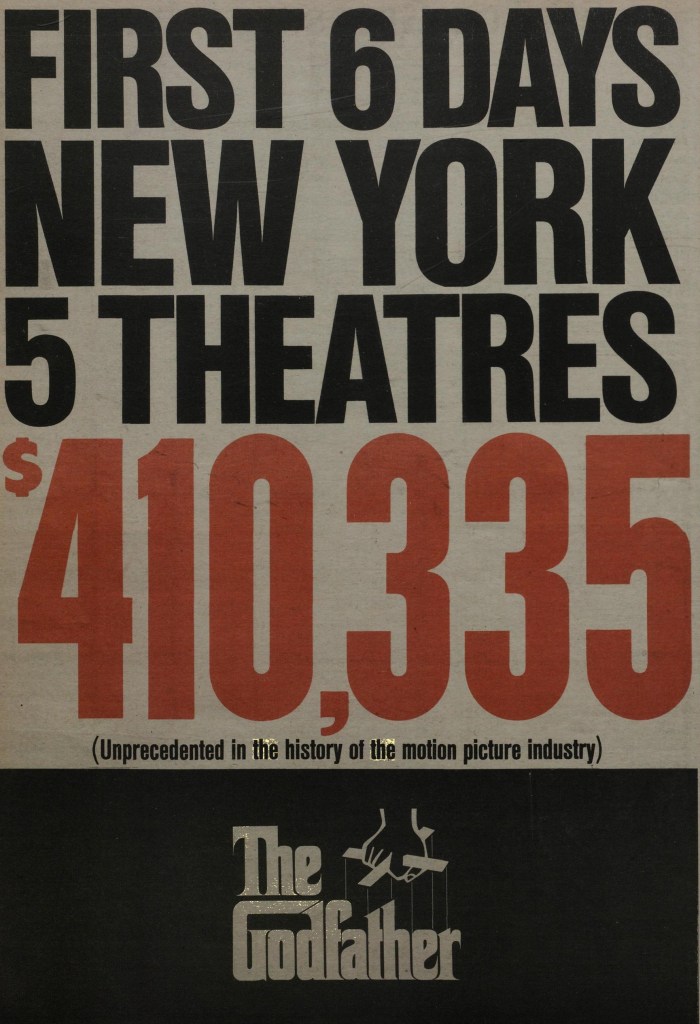
What is little known is how Jaws changed the release system forever. Even The Godfather (1972), its predecessor in topping the box office firmament, while spreading the goodies amongst nabes and the showcase houses did not ignore first run. In fact, for The Godfather Paramount used five New York first run houses – the 1025-seat Orpheum, 1175-seat State I, 1174-seat State II, 599-seat Cine and 588-seat Tower East – to create a pre-emptive strike. This quintet screened the movie exclusively for the first week, permitting the studio to trumpet the record-breaking results.
The other 350-odd cinemas had to wait a further week to get their hands on the gangster saga.
For Jaws, on the other hand, Universal completely froze out New York first run. Not a single first run house was given access to the picture on its initial release on this weekend 50 years ago.
Instead, in New York, Universal went down the showcase route and clocked up just over $1 million in the first three days at 46 cinemas. Prior to Jaws, the only pictures that would open first in showcase in New York and ignore that city’s vibrant first run were those that first run would most likely have declined to show.
With Jaws, across the country Universal was as ruthless in squeezing out first run if it could make a better deal in the nabes and drive-ins. So while Jaws set house records at all the first run houses that were deemed up to standard, it also creamed the nabes and drive ins. Significantly, not all the first run houses chosen would have been the first choice of most studios for a major picture. You wouldn’t have expected this behemoth to end up at the 925-seat Gopher in Minneapolis where it took in $47,000. Similarly, the 900-seat Charles in Boston ($55,000 take) would not have been your first choice (and it’s worth noting that it was only in this city that the movie did not top the week, beaten into second place by Woody Allen’s Love and Death at the 525-seat Cheri Three).
By and large, Universal picked off those first run cinemas that were so delighted to be asked they agreed to the tough terms – a 90/10 split in the studio’s favor and a 12-week run.
Other first run destinations included the 800-seat Cooper in Denver ($53,000 for openers), the 1670-seat Coliseum in San Francisco ($68,000), the 900-seat Southgate I and 550-seat Town Center II in Portland ($55,000 total), the 1836-seat Gateway in Pittsburgh ($70,000) and the 1287-seat Midland in Kansas City ($55,000). In these cities, the premiere outing was restricted to first run.
But while in Chicago the 1126-seat United Artists hauled in $116,000 in the opener, Universal played it canny by screening it simultaneously at four other nabes which brought in another $260,000. It was the same in Cleveland where the 455-seat Severance II was the only first run house among the five cinemas that hoovered up a total of $84,000. The first run 500-seat Goldman in Philadelphia was the only first run location among the total of 15 cinemas that knocked up $312,000.
Elsewhere, echoing the New York approach, first run cinemas were frozen out in Detroit, Buffalo and San Francisco. In Detroit seven nabes gobbled up $350,000, in Buffalo a deuce of nabes snatched $50,000, in San Francisco a trio set about $75,000.
We’ve all seen movies driven to opening weekend box office heights on the back of heavy advertising or hyperbole only to take a dive in the second week. And the fact that Universal was not making an “event” out of its movie by restricting it to first run meant that the sophomore weekend could easily have brought disaster.
Instead, receipts at virtually all the cinemas either beat the first week or fell only fractionally below. The opening weekend appeared to set the tone, every successive day better than the previous one.
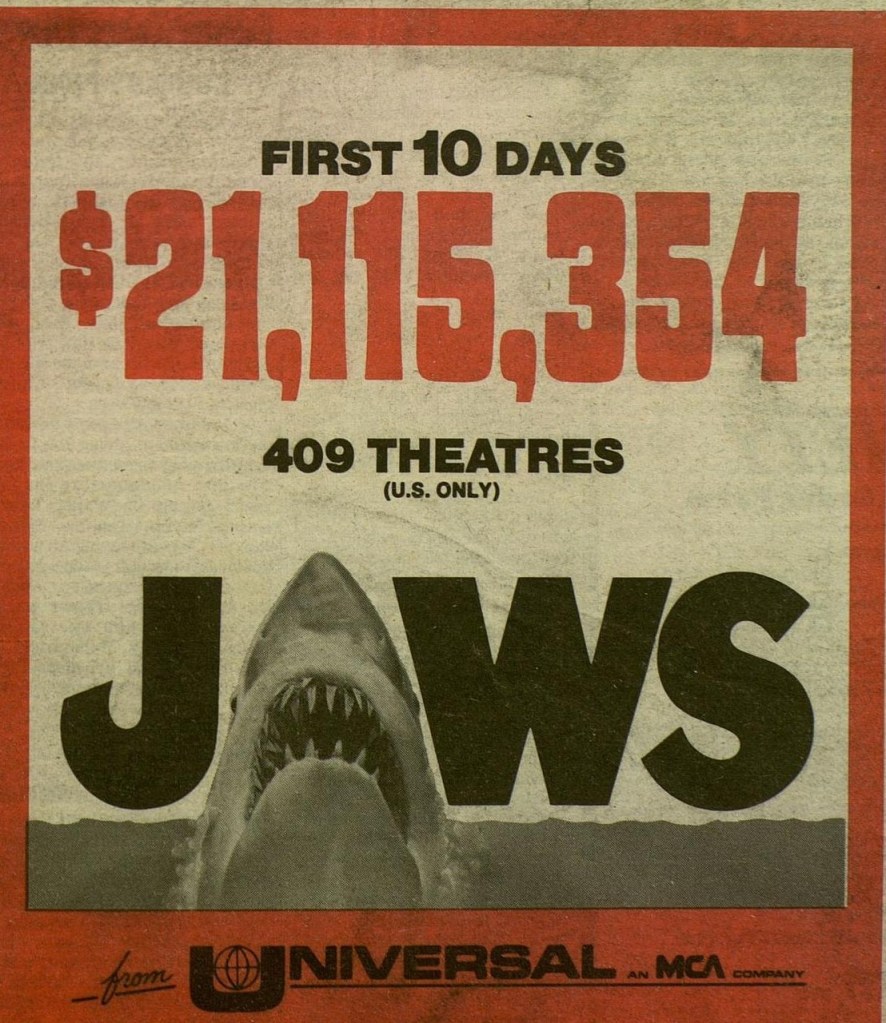
Universal immediately set its sights on taking down The Godfather and began posting weekly advertisements in the trade papers hyping its performance at the box office. But in nudging first run out of the equation, it triggered the slow decline of first run houses.
Tomorrow, you can catch on my article that sunk many of the other myths surrounding Jaws, “Behind the Scenes: Exploding The Myth of Jaws.”
Easy Rider, more acceptable artistically, stole Night of the Living Dead’s thunder the following year as the poster boy for a low-budget phenomenon that would, temporarily at least, usher in a new way of Hollywood thinking. But Night of the Living Dead – initially entitled Monster Flick and Night of the Flesh-Eaters – was movie-making as fairy tale, virtually a throwback to the old trope of doughty characters putting on a show in a barn.
Using guerrilla production techniques, the movie took an astonishing six months to make starting July 1967. Bronx-born George A. Romero specialised in advertisements and industrial shorts through his Latent Image company before branching out in Pittsburgh with some work colleagues from Hardman Associates to form a movie production company Image Ten, the name indicative of the initial ten investors.
But don’t make the mistake of thinking Romero and his gang were movie neophytes out of their depth. Technically, they were pretty accomplished, churning out adverts and shorts at a steady pace, the kind of education the likes of Ridley Scott and Adrian Lyne enjoyed on the London advertising scene. According to Variety, Hardman was “the largest producer of record and radio shows in Pittsburgh…(running) the most completely equipped sound and film studio in the area” while Latent Image was the city’s “biggest producer of video and industrial shorts.”
The principals of both companies proved instrumental to the movie. While Romero took on directing, cinematography and editing duties, the screenplay was down to business partner John A. Russo while another partner Russell Streiner took on the role of producer. Hardman provided actors Karl Hardman, a former RKO contract player, and Marilyn Eastman, who also supervised make-up, costumes and special effects, while Kyra Schon, the dying daughter in the film, was Hardman’s real-life daughter. The rest of the cast were unknowns, Duane Jones in the lead had at least some stage experience, female lead Judith O’Dea had worked with the producers before, while Judith Ridley was a receptionist for the production company. Romance blossomed between O’Dea and Streiner.
Romero’s debut was heavily influenced by Powell and Pressburger’s British bizarre fantasy The Tales of Hoffman (1951) but the final film clearly draws on Richard Matheson’s celebrated 1964 sci-fi novel The Last Man on Earth – filmed in 1971 as The Omega Man and in 2007 as I Am Legend. Where Matheson’s book begins at the end, Romero wanted to show the beginning of how the undead came to rule the world. Since Matheson had used vampires, Romero needed an alternative.
Explained Romero: “I couldn’t use vampires because he did, so I wanted something that would be an earth-shaking change. Something that was forever, something that was really at the heart of it. So I said, what if the dead stop staying dead?” That tapped into the attractive notion of living forever – until you realized what that entailed.
Contrary to expectation – and myth – it didn’t exactly stumble at the box office. A month after initial release its opening salvoes were advertised in “Box Office” magazine (November 25, 1968) accompanied by some of the better reviews harvested.
Shockerama pictures would be the easiest way to find a foothold on the distribution ladder. Initially devised as a horror comedy it took several drafts, the first couple involving aliens, before arriving at the concept of flesh-eating re-animated corpses.
Ben was originally envisaged as a blue collar truck driver and evolved into the more educated character as a result of rewriting by Duane Jones who objected to playing such a cliché. But improvisation was very much the order of the day. Recalled O’Dea: “I don’t know if there was an actual working script. We would go over what basically had to be done and then just did it the way we each felt it should be done.”
The initial investors ponied up $600 each but that proved insufficient as production developed, the company eventually raising $114,000. (The average cost of making a movie at that time was $1.6 million.) Budget dictated location be as remote as possible, the main locale a house scheduled for demolition. Chocolate syrup doubled as blood, human flesh was roasted ham and entrails supplied by one of the actors who was also a butcher. Clothing was anything the cast possessed that they didn’t mind being ripped. Color film was too expensive, and the resulting black-and-white footage has the effect of newsreel, almost a documentary rather than a work of fiction.
Although a myth has arisen that the movie struggled to find its way into the distribution food chain, that was not the case. Studios were desperate to find product and happy to hang their shingle on anything that could keep their clients, cinemas starved of movies, happy. Columbia and American International were both interested, but demanded a happy ending. When Romero stuck to his guns, the movie ended up with the Walter Reade organisation, a noted distributor of foreign and cult pictures, better suited to this kind of fare.
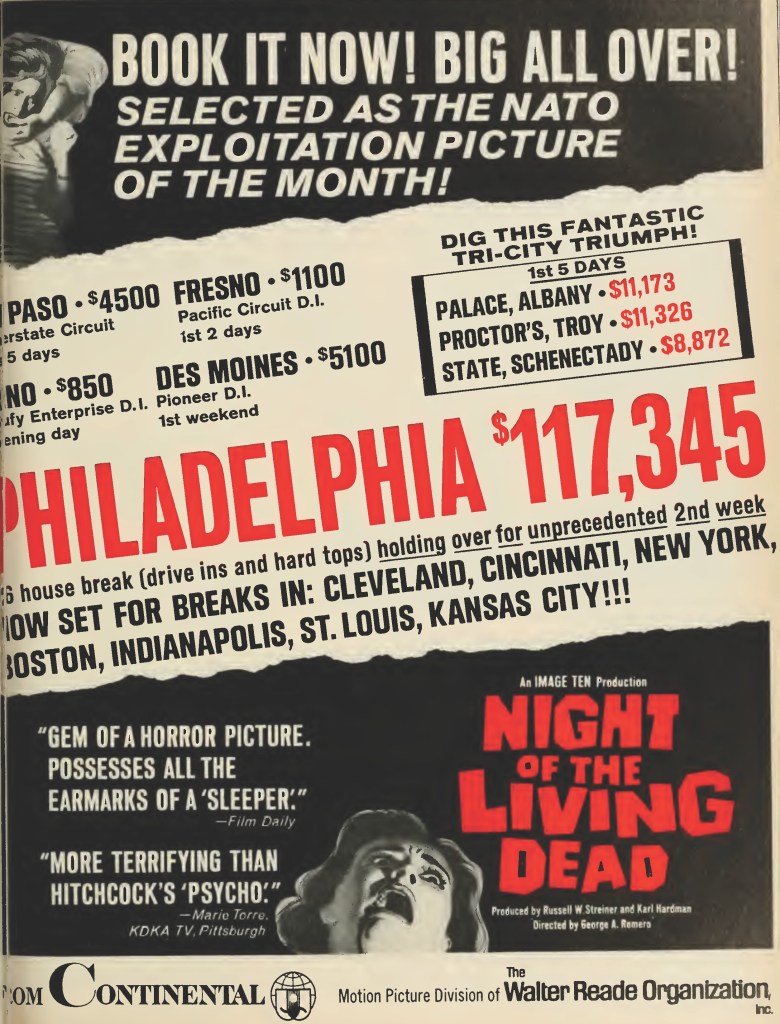
Nor was it sneaked out into cinemas as has been usually assumed. Given that by 1968 cinema managers owners were in part reliant on low-budget shockers, the National Association of Theater Owners instigated a nationwide “Exploitation Picture of the Month” campaign of which Night of the Living Dead was one of the early beneficiaries, as a result of its involvement scooping, for example, $117,000 from 26 houses in Philadelphia. and other pretty decent figures shown in the advertisement above.
Nor did it go out below-the-wire in Pittsburgh. A full-scale black-tie premiere was held on October 1, 1968, at the Reade-owned Fulton attended by Mayor Barr and the city’s safety director Norman Craig and various councillors. It rang a heavy box office bell, knocking up $62,000 – over $500,000 at today’s prices – for 11 theaters, outpointing Rosemary’s Baby (1968) which had played the same houses the week before. The distributor came up with a clever marketing ploy of taking out a $50,000 insurance policy with Lloyds of London against adverse audience reaction.
The film attracted controversy for going out un-rated. There was nothing unusual about that either. Only studios aligned with the MPAA Production Code had to submit their movies for the censor’s rating. Reade, which wasn’t involved in the Code, often imported movies from Europe and part of their attraction was that they were unrated, containing levels of nudity or violence that the official censor at the time would find impossible to pass. Lack of the vaunted Production Code Seal of Approval did not prevent a movie being shown, it just meant certain cinemas would not book it.
Chicago critic Roger Ebert made journalistic hay by complaining that kids were being allowed in to watch the movie. That he might be on hand to witness their shock at the images they saw seems hard to believe since critics usually viewed pictures in advance of opening at special screenings. In any case, in Chicago, Night of the Living Dead didn’t slip through the censorship net, but was passed by the local censorship board. His beef was with them, complaining that while the censors drew the line at nudity they had nothing against cannibalism. And it seems pretty odd that the management wasn’t aware of the film’s shocking content – presumably that being the reason it was booked in the first place – and permitted youngsters to troop in.
Although New York critics gave it the thumbs-down at least the New York Times (Vincent Canby no less), Post and Daily News took the trouble to see it, so it would at least benefit from editorial exposure. The trade press were mixed. While Variety railed that it “set a new low in box office opportunism,” its trade press competitor Box Office reckoned there was “an audience for this particular brand of sadism especially in drive-ins.”
Perhaps surprisingly given critical disapproval Night of the Living Dead enjoyed first-run outings in a variety of cities, though its main target was showcase (wide local release) and drive-ins. In Los Angeles it picked up a “hip” $10,500 at the 1,757-seat first-run Warren. (Multiply by ten to get an idea of how inflation would treat the gross and bear in mind this is pre-multiplex when cinema capacity could reach 5,000 and most city center emporiums seated 500-plus). In Boston it registered a “cool” $8,000 at the 1,250-seat Center. New York’s Broadway had to wait a year when the prestigious roadshow house the DeMille, in the week before it hosted 70mm extravaganza The Battle of Britain (1969), booked Slaves (1969)/Night of the Living Dead, grossing $21,000 in an eight-day fill-in run.
In its first New York showcase, when Night of the Living Dead was the main attraction with Dr Who and the Daleks in support, it scorched through $286,000 from 39 cinemas, the joint top result for the week. Returning a year later, as the support to Slaves put another $125,000 in the kitty from 26 plantations, again the top showcase performer for the week. Among notable wider releases were $14,300 from three in Dayton where it was “weekends at capacity in ozoners” (industry jargon for drive-ins). There was $10,000 from three houses in Minnesota.
Not being a contender for sale to television extended its screen life at a time when even big hits landed on small screens within a few years. As well as Slaves it was revived as the supporting feature to newer items Brotherhood of Satan (1971), Lust for a Vampire (1971) and The Nightcomers (1971). The teaming with Slaves racked up a “rousing” $82,000 in Detroit at the 5,000-seat Fox, and $55,000 the following week. The double bill with Brotherhood of Satan beat the previous week’s pairing of the reissued Butch Cassidy and the Sundance Kid/Mash. It formed part of an interesting triple bill at the 500-seat Plaza arthouse in Boston where it was teamed with Dutchman (1966) and Ulysses (1967).
But it was also building up a head of steam on the midnight screening circuit and began a record year’s run in that slot at the Plaza in Boston. Gradually, as it acquired more artistic credibility it turned up at prestigious New York 538-seat arthouse the Beekman with Invasion of the Body Snatchers in support (gross $5,000), ironically acting as trailer for a six-week programme of revivals based on “Ten Best” selections from critics which had avowedly spurned the movie. And it was chosen as the ideal companion for the once-banned Freaks (1932). Perhaps proof of the breakthrough into respectable cult territory, six years after initial release, was a New York showcase pairing with Pink Floyd: Live at Pompeii (1972), drumming up $63,500 from 29 bandstands.
By the end of December 1970, rentals (the amount the studio collects from cinemas as opposed to overall gross) stood at $1 million – which probably indicated a gross of around $3 million. It found a British distributor in Crispin and eventually rolled out successfully around the world with an estimated $18 million in global gross.
SOURCES: John Russo, The Complete Night of the Living Dead Filmbook (Imagine, 1985), p6,7, 31, 61, 70; Joe Kane, Night of the Living Dead (Citadel Press, 2010) p23; Jason Paul Collum, Attack of the Killer B’s (McFarland, 2004) p3; Roger Ebert, Chicago Sun-Times, January 5, 1969; Brian Hannan, In Theaters Everywhere, A History of the Hollywood Wide Release, 1913-2017 (McFarland 2019), p161; “Pittsburgh Premiere Held for Walter Reade Thriller,” Box Office, October 8,1968, p8; “Pittsburgh’s Hometown Horror to Reade: Surprise Boff BO,” Variety, October 9, 1968, p17; “Review,” Variety, October 16, 1968, p6; “Big Success Claimed for Image Ten Film,” Box Office, October 21, 1968, pE1; Advert, Box Office, November 25, 1968, p7; “N.Y. Critics: A Shooting Gallery,” Variety, December 11, 1968, p19; “Sun-Times Wants Chicago ‘Absurd’ Censorship Brought to Halt,” Box Office, March 14, 1969, p10; “Pittsburgh’s Latent Image Make 2nd Film,” Variety, December 3, 1969, p4; “Pittsburgh’s Cannibal Film Big Box Office,” Variety, April 8, 1970, p13; Advertisement, Kine Weekly, June 16, 1970, p61; “Big Rental Films of 1970,” Variety, January 6, 1971, p11; “Year of Friday Midnight Showings,” Variety, August 16, 1972, p6.
Box Office Figures from Variety: December 4, 1968, p13; December 11, 1968, p10-p11; December 18, 1968, p8-p13; July 9, 1969, p8; March 4, 1970, p12; October 13, 1971, p8-p12; October 20, 1969, p9; October 27, 1971, p16; Mar 17, 1972, p10; April 12, 1972, p10; May 12, 1971, p8; July 19, 1972, p12; August 9, 1972, p8; September 25, 1974, p8.


 The Magnificent 60s