
You couldn’t make it like that now, so the ill-informed tale goes. Actors doing their own paddling in canoes, climbing a cliff. But anyone who has watched Leonard DiCaprio and Kate Winslet half-drowning in Titanic (1997) is well aware that it’s just not always possible to use a stand-in for key sequences. Or, for that matter, William Holden breaking in a horse in Wild Rovers (1971).
For a start, there actually were four stunt men on Deliverance, one who was star Jon Voigt’s stunt double. None were credited in the picture, not so unusual in those days, and anyone who knows anything about filming climbing scenes, not least the one where actors are actually crawling across a floor, or where there are, out of sight of cameras, safety facilities underneath, will know that the actors here, though it might get a tad tough, were not risking life and limb. Greater injuries were endured by the stars during the storm scenes of The Guns of Navarone (1961). That said, the movie does benefit from sufficient shots of the actors braving the waters and Ned Beatty nearly drowned and Burt Reynolds cracked his tailbone.
But, of course, danger in moviemaking is relative. There’s scarcely any equivalent to the numbers of deaths that occur in other professions, mining, for example, or industry, and I’m always suprised how easily the Hollywood PR machine is so easily accepted by the public when the peril mentioned is rarely actually perilous at all.
For the scene where the canoe broke, director John Boorman had found a more serene location on a river which was dammed, so he was able to close the sluice gates and lay a rail on the river bed. However, in the event, the sluice gates were opened too soon and the actors engulfed in an avalanche of water.
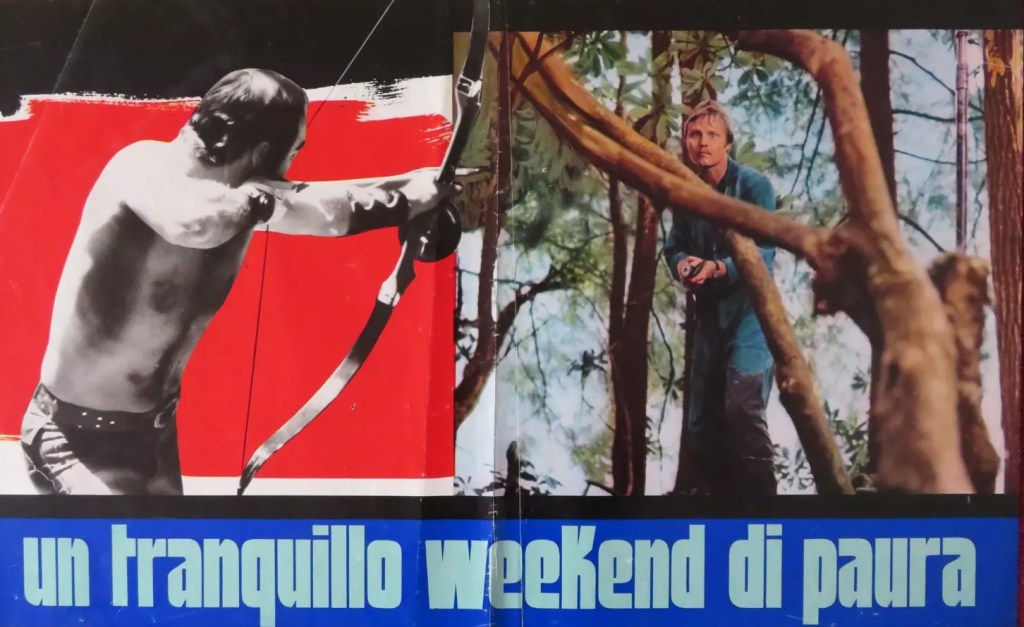
Should any of the actors show temerity, Boorman would leap into a canoe himself, and paddle downriver over and around various obstacles to show how easy it was.
Deliverance was an unexpected bestseller in 1970, the author an unlikely candidate to hit the commercial jackpot or even to pen such a tale. Ex-adman James Dickey was known for his poetry. Warner Bros bought the book pre-publication about “four decent fellows killing to survive” for $200,000 and more for Dickey to pen the screenplay without working out how it could be filmed. The studio was going through a major transition. In 1970 only three releases had cleared $1 million in rentals; in 1971 the number tripled and the studio was high on a release slate that included Death in Venice, A Clockwork Orange, Summer of ’42, Klute, The Devils, Dirty Harry and Billy Jack.
The studio alighted on John Boorman because he had made Hell in the Pacific (1968) starring Lee Marvin and Toshiro Mifune, that, while a certified flop, was made under arduous physical conditions in the western Pacific.
After the surprise success of Point Blank, British director Boorman had helmed two flops, Leo the Last (1970) being the other, so he was in the market for the kind of hard-nosed project with which he had made his name. Warner “felt I was the man to take it on,” explained Boorman.

At one point, Warner Brothers planned to team up Jack Nicholson (hot after Easy Rider, 1969, and Carnal Knowledge, 1971) and Marlon Brando, still largely in the pre-The Godfather wilderness. The studio tried to tempt Charlton Heston, who turned it down (“I probably won’t have time to do it”) but consoled himself that WB considered him “employable.” Donald Sutherland also gave it a pass. Dickey agitated for Sam Peckinpah to direct and Gene Hackman to star while Boorman was keen to work a third time with Lee Marvin. Theoretically, Robert Redford, Henry Fonda, George C. Scott and Warren Beatty were considered, but such big names would hardly be compatible with the lean budget.
The final budget was a mere $2 million, not sufficient to attract big name – or even to pay for a score. WB had reservations about a picture without any women in lead roles. Jon Voigt was not a proven marquee name, despite the success of Midnight Cowboy (1969). He only had a bit part in Catch 22 (1970) and his other films, Out of It (1969) and The Revolutionary (1970) had performed dismally while The All-American Boy was sitting on the WB shelf, only winning a release to cash in on Deliverance.
Despite a less than buoyant career, Voigt was reluctant to commit. He resisted making the movie till the last minute. Even after trying to convince himself about the film’s worth by reading out the entire screenplay to his girlfriend Marcheline Bertrand (Angelina Jolie’s mother), it took a telephone call from the director and Boorman demanding a decision before he counted to ten before Voigt signed up. Voigt viewed the film as about how men “lose part of their manhood by hiding, coddling themselves into thinking we’re safe.”
Burt Reynolds was treading water in action B-films like Skullduggery (1970), as the second male lead in bigger films like 100 Rifles (1969) and in television (Dan August, 1970-1971). In his favor, he had the lead in offbeat cop picture Fuzz (1972). But it looks like Voigt and Reynolds took casting to the wire. Both were announced for the film a few weeks before it began shooting on May 17, 1971.
Whether it boosted his career is open to question, but Burt Reynolds’ name achieve notoriety in April 1972, a few months before Deliverance opened, by becoming the first male centerspread in Cosmopolitan. Billy Redden, as the banjo player, was hired for his physical appearance, clever use of the camera disguising the fact that there was a genuine banjo player concealed behind him doing all the playing. Boorman used snatches of the banjo music instead of coughing up for a proper score. While the credits claimed the “Dueling Banjos” number had been devised by Eric Weissberg and Steve Mandel, Arthur Smith, writer of “Feudin’ Banjos” in 1955, took the studio to court and won a landmark copyright ruling. The tune had received a gold record for sales.
Setting aside any inherent danger in the water, the shore could just be as perilous. A script altercation between Dickey and Boorman ended with the director losing four teeth. Cinematographer Vilmos Zsigmond got into a spat with his union and was slapped on the wrists for operating the camera too often. Filming of the rape scene was uncomfortable for all concerned, even observers. When Reynolds complained the director let the sequence last too long, Boorman countered that he let it run till he reckoned Reynolds, in his character, would intervene.
Despite WB including it in a promotion to its international partners in May 1971 Deliverance, filmed between May 17 – a week later than originally envisaged – and August 1971, sat on the shelf for nearly a year before being premiered at the Atlanta Film Festival in July 1972 with Playboy picking up the tab for flying Reynolds to the event.
These days it would be called a platform release. Deliverance opened in one small house in New York – the 558-seat Loews Tower East – at the end of July and except for Los Angeles didn’t go any wider until early October. Reviews were good, four faves out of five in New York. But it was the box office that caught the eye. An opening day record and an eye-popping $45,000 for the first week took the industry by surprise. It remained at Loews until December. Chicago led the applause in October with a “brawny” $49,000. Everywhere it was hot – “lusty” $26,000 in Washington DC, “socko” $21,000 in Philadelphia were typical examples of the public response.
In what these days would be called counter-programming it went into the New York showcases at Xmas – making off with a huge $589,000 from 46 the first week and $500,000 the second. WB had predicted it might hit $15 million in rentals. The studio was wrong. It scrambled up $21 million. The 1973 tally made it the second best at the box office that year.
SOURCES: Phil Hoad, “How We Made Deliverance,” The Guardian, May 29, 2017; Oliver Lyttleton, “5 Things You Might Not Know about Deliverance, Released 40 Years Ago,” IndieWire, July 30, 2012; Charlton Heston, The Actor’s Life (Penguin, 1980); “Bow and Arrow Party,” Variety, May 20, 1970, p30; “Dickey Ga-Bound,” Variety, January 21, 1971, p4; “Reps of 45 Flags,” Variety, April 14, 1971, p5; “Voigt in Deliverance,” Variety, May 12, 1971, p14; “Runaway Robert Altman,” Variety, December 15, 1971, p4; Advert, Variety, August 9, 1972, p23; “Big Rental Films of 1972,” Variety, Janaury 3, 1973, p7; “Big Rental Films of 1973,” Variety, January 9, 1974, p19. Box office figures from Variety October 11, 1972.

 The Magnificent 60s