
The revisionist western was often a get-out-of-jail-free card to cover various random exercises that purported to present the West as down’n’dirty, held to account white murderers and rapists and tilted the narrative balance in favour of the Native American. Other times, interpretation of the idea was more liberal. You make up whatever story you liked and hope to pass it off as closer to the truth than what went before.
Here, while Doc Holliday (Stacy Keach) is realistically portrayed as an alcoholic (though whisky was prescribed for medicinal purposes) and suffering severely from the tuberculosis that would bring him to a premature end, the narrative is buried in the realms of the unlikely. Notwithstanding that this is the third rendition in 14 years (and only four years after Hour of the Gun) of the famous Gunfight at the OK Corral, whose origins are probably best left to myth, this tries to undercut upholding of the law with corruption, and expects us to fall for a complicated tale that makes no sense. A version of Billy the Kid (Denver John Collins) enters the equation and Doc’s squeeze Kate (Faye Dunaway) veers uneasily between feisty sex worker and adoring partner.

Columnist Pete Hamill (Badge 373, 1973), in his screenwriting debut, ties himself in knots trying to explain how the famous gunfight occurred in the first place. It could as easily have been the consequence of Doc stealing one of the Clanton Brothers’ fiancée, Kate. But although that’s the opening sequence, little is made of it. Instead, we have Wyatt Earp (Harris Yulin) intending to make commercial hay in Tombstone. He’s already deputy marshal but that carries no jurisdiction in Tombstone where there’s money to be made by a corrupt lawman.
Earp is aiming to get elected sheriff and set up buddy Doc in a gambling operation which I guess would have to be illicit in some manner for them to profit. To win favor with the locals, he plans to bring to justice Johnny Ringo, a Clanton associate, who has robbed the stagecoach of $80,000. He bribes Ike Clanton (Michael Witney) with the $20,000 reward money to hand over Ringo. But when that deal goes south for reasons that are unclear the four Earp Brothers plus Doc go head-to-head with the seven-strong Clanton bunch in the corral.
The problem with the OK Corral scenario is that basically you are just filling in time before the shootout. So Doc uses this teaching the Kid to shoot properly, an action that has unforeseen consequences, and setting up house with Kate while coughing up blood and knocking back the whisky. Earp spends most of his time in one conspiracy or another. He tends to cut confrontation short with a quick punch or pistol whipping. But when he is bested in a fistfight with Ike his revenge is suggested as the trigger for the all-out confrontation.
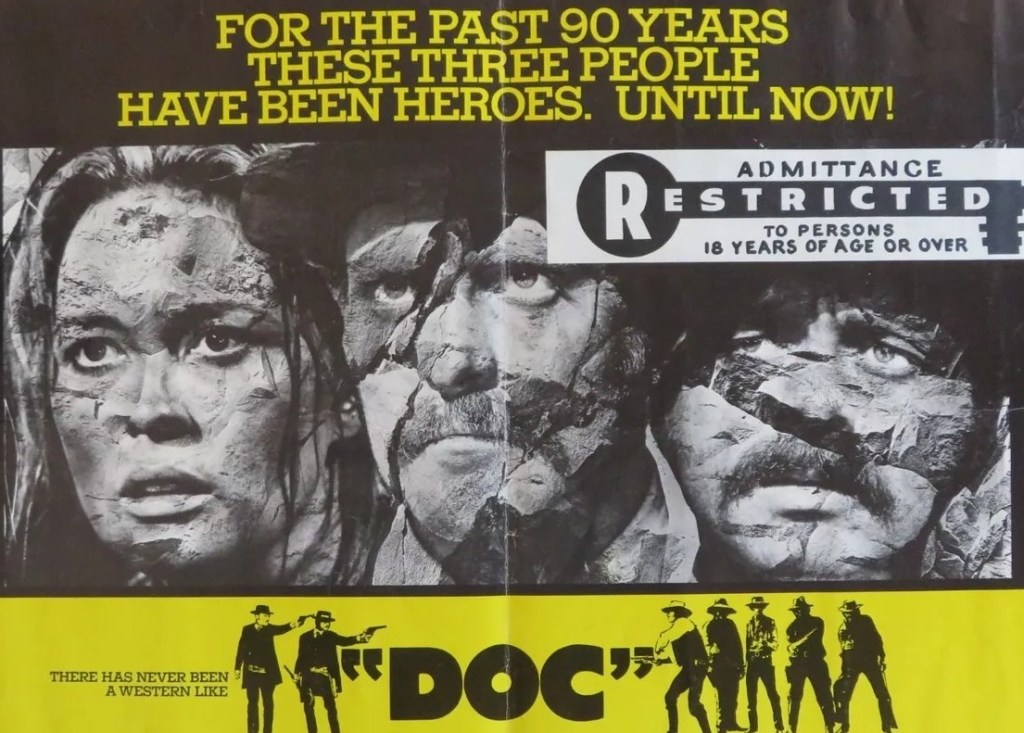
The Clantons don’t know how to fight the Chicago way. They take pistols to the shoot-out whereas the opposition come armed with shotguns. Forgive me if I’m a bit short on weaponry intelligence but I’d always been told (from westerns, to be sure) that a shotgun was only effective over a short distance and here I would question their efficiency. And while I’m chucking spanners into the works I’m surprised that whoever’s stage got robbed left recovery of the stolen money ($2.5 million in today’s equivalent) and apprehending the crook to a deputy marshal.
So a bit of a hodge-podge and not a convincing one at that. I’m sure neither Earp nor Doc were knights in shining armor but neither were they as idiotic as they appear here.
Stacy Keach and Harris Yulin had been paired in The End of the Road (1970) and both were being touted as rising stars though ultimately only the former made the marquee leap. Both are dour and stoic more than anything else and it’s left to Faye Dunaway (The Happening, 1967) to bring some spark to the picture. Being the sassy one, she’s given the best lines, such as explaining to a religious-minded individual that the only time she would be getting on her knees would be for another purpose entirely.
Frank Perry (Lilith, 1962) directs with an eye towards the elegiac but all the artistic sepia-toned cleverness can’t conceal a movie sorely lacking in decent story.
 The Magnificent 60s