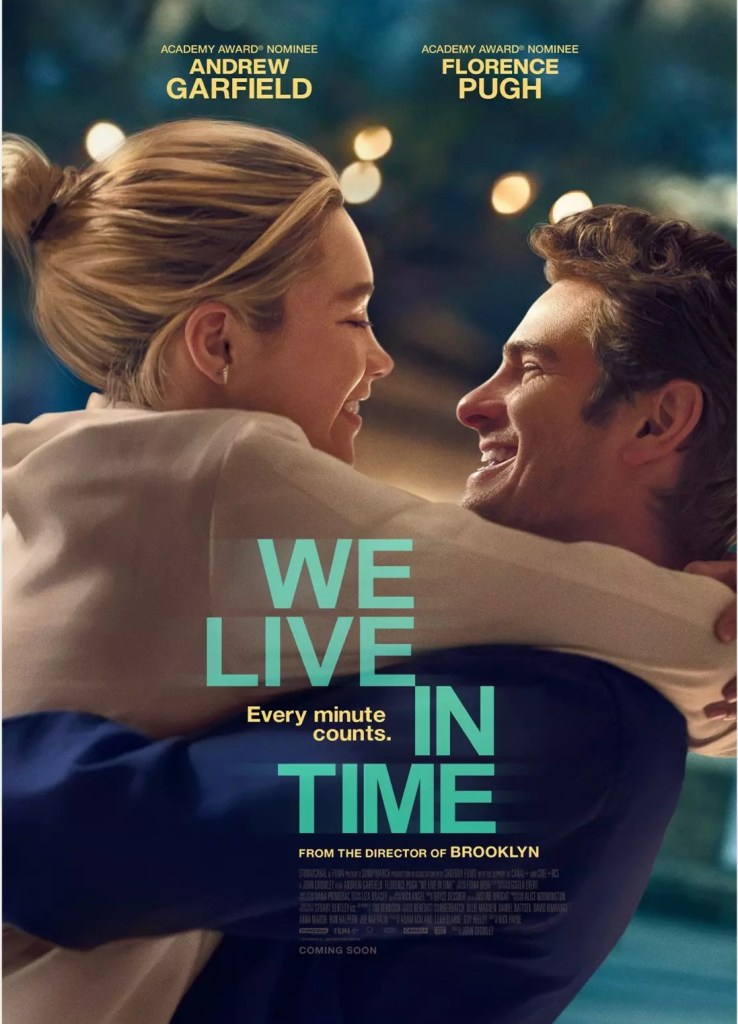
We Live in Time (2024) ****

Approached this with some trepidation as I’m not a huge fan of either star and since, frankly, I was only there because I go to the pictures every Monday and this was all that was on. In fact, I adored the acting. An intelligent adult movie to sit nicely alongside this year’s Conclave, Juror #2 and It Ends with Us without the artsy-fartsy frills that have put me off so many similar. Kept me absorbed even as I noted in passing the several flaws that should have brought me up short. And you should know it’s narrative as mosaic, not an admittedly complicated one, but a series of vignettes over a few timeframes  and backstory chucked in at various points.

But there’s no grandstanding, no auteur forcing an annoying style down your throat, no desperately cute scenes, and none of that will-they-won’t-they that’s virtually impossible to achieve these days outside of Anyone But You (2023). The main characters are ordinary people, stranded loveless in their mid-30s, driven chef Almut (Florence Pugh) out of choice, Tobias (Andrew Garfield) dumped by a more ambitious wife and now living out of cardboard boxes with his widowed father.
There’s major illness brewing but it doesn’t go down the sickly route, nor, despite the couple agreeing to make the most of life, is it a whirl of bucket list activities. In fact, the main source of friction is that that she ignores family duties in favor of entering an upmarket Strictly Come Cooking competition.

But, as I said, the pleasures are all in the acting. The twists are in the dialog. She doesn’t respond to his sudden declaration of love, as she would, gushing like billy-o, in any other picture. He doesn’t have a marriage proposal off pat but has to refer to notes. He’s pretty damn staid, she’s, as you’d expect in an imaginative chef, more free-wheeling. And I did learn the correct three-bowl method to crack eggs, the rest of the cookery malarkey thankfully not entering the angst-ridden territory of The Bear or The Boiling Point or the she-made-it cock-strutting of so many movies about a woman battling her way to the top.

There are a heck of a number of grace notes of infinite shades. Tobias is absolutely delighted, not resentful, that his father (Douglas Hodge) cuts his hair. An asleep cancer patient has her wig adjusted by a nurse to cover her bald patch. A woman giving Tobias the thumbs-up signs constantly through a job interview is never seen again – wife/lover perhaps? A guy at a dinner party looks sour but we never learn why. Almut keeps from Tobias and everyone else that she was a world-class amateur ice skater in her earlier life, giving it up when her father died, unable to continue in the absence of his presence. We could almost have dispensed with how Tobias won Almut back after initial rejection because we know he must have done somehow otherwise we wouldn’t be where we are in the story.

The very ordinariness grounds this. The couple eat Jaffa Cakes in the bath – from a giant-sized packet – and miniature chocolate bars from one of those selections you used to just get at Xmas. And then compare what they selected – he goes for Twix, she Bounty.

Some bits don’t work so well. The meet-cute has been robbed of originality by Australian television comedy Colin from Accounts. I’m not sure if we were meant to laugh at the birth scene. But the sequence you saw in the trailer when Tobias whacks two parked cars in order to get out of a tight parking spot actually has deeper meaning. Tobias, remember, is the kind of guy who takes notes, who examines himself in front of a mirror not out of vanity but to make sure there’s nothing wrong with his attire, a guy, in other words, roughly in command of his emotions, and this is one of the few scenes where that characteristic slips.

Nor are we in for a wheen of sibling rivalry or parental displeasure, so it’s not tumbled-full of repressed anger, but there’s still time for snippets of Tobias standing like an idiot in a roomful of her more excitable friends at a party, something holding him back from even trying to join in.

There was a great ending that was ignored: Almut waving in the distance to husband-and-daughter. The ending chosen luckily worked as well, proving that Tobias, in his lifelong note-taking fashion was a good learner, and was determined to fulfil a promise.

This could have fallen down on some narrative choices, the illness trope or the cooking, but generally these are incorporated into the story in a character-led way. But mostly it works because it is not highwire sturm und drang nor a will-they-won’t-they approach, and especially because their bucket list appears to extend only so far as a trip to a carnival ride. Everyone holds back. No over-playing at all.

I had recently praised Nicholas Hoult in Juror #2 for using his eyes rather than his entire face to express his feeling and Andrew Garfield (Spiderman to you)  here works along the same lines. Florence Pugh (Oppenheimer, 2023) is every bit as good, a quiet inner grit, forthright when required without biting your head off. Douglas Hodge (Joker, 2019) and Adam Jones (Wicked, 2024) have nice turns.

I have to confess I wasn’t too keen on director John Crowley’s previous outings – Brooklyn (2015) and The Goldfinch (2019) – but here he has the sense to stand back and let the actors act. Written by Nick Payne (The Last Letter From Your Lover, 2021).

Worth a punt. A good piece of counter-programming.
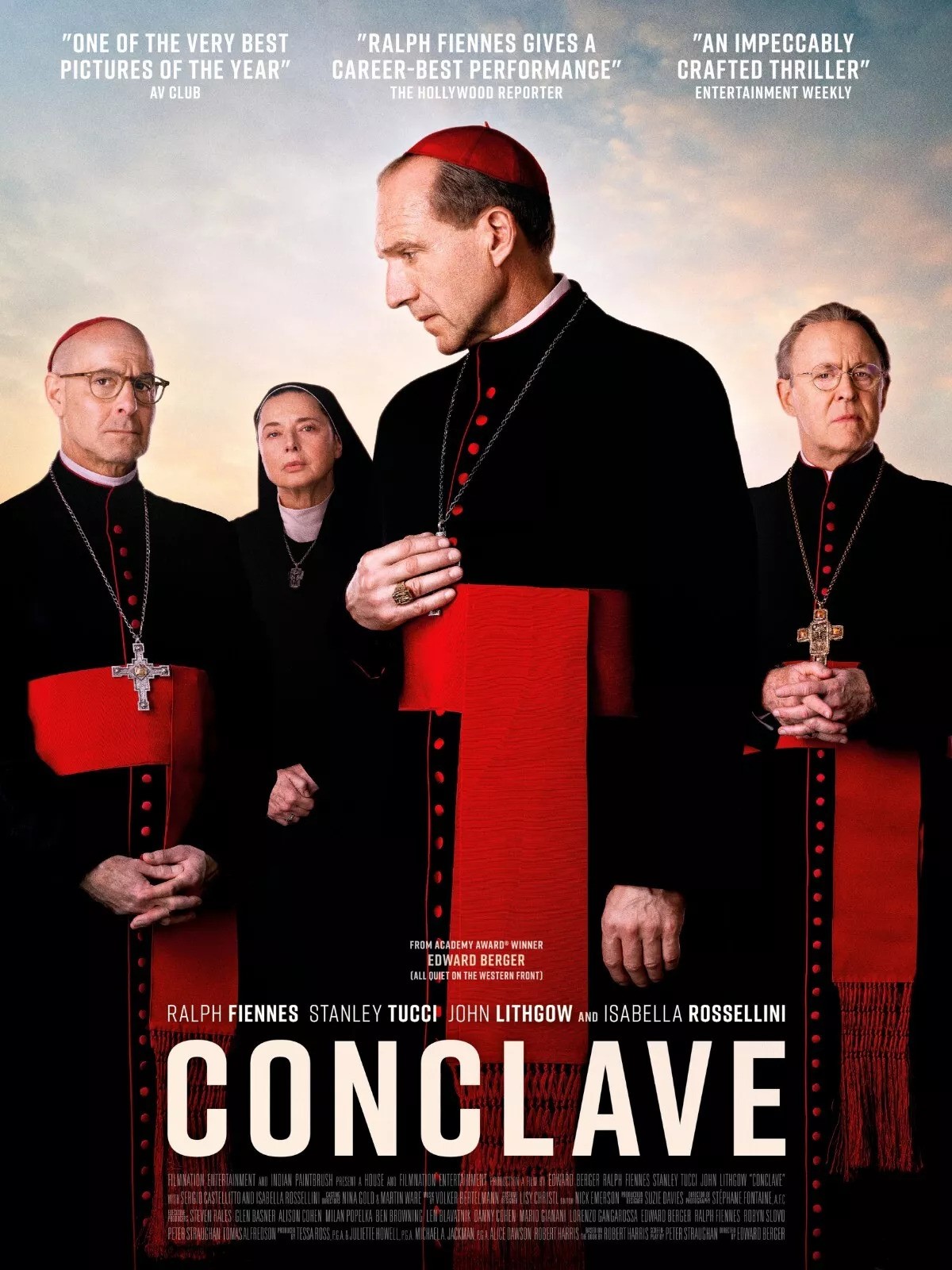
Conclave (2024) ****

No great surprise that the political thriller has made a return – all subgenres resurface after a while. The surprise here is the context. The Catholic Church hardly seems a fitting setting, given it’s been wracked for decades by accusations of child molestation, Oscar-winning Spotlight (2015) taking it down over historic malfeasance in Boston, though that was more in the line of another subgenre, the fearless journalistic expose.

Nor would you expect the drama of the election by all the Cardinals of a new Pope to turn into a riveting thriller, with a stunner of a twist at the end which carries considerable contemporary heft. The last time the goings-on in the Catholic Church attracted the attention of Hollywood was in Otto Preminger’s The Cardinal (1963) and The Shoes of the Fisherman (1968), which were cut from a more traditional cloth. Except for some interesting procedural background and some argument about the future direction of the Church, the bulk of this picture concerns the horse-trading and corruption that threatens to envelop the election.

Our guide through the shenanigans is Lawrence (Ralph Fiennes), the dead Pope’s righthand man, who, although filled with his own doubts, is in charge of managing the actual election. He’s so self-effacing that it comes as something of a shock to him to discover that he’s one of the candidates. It’s a blind-voting system and continues until one person has secured 72 votes. As you might expect there’s wheeling-and-dealing with the liberal elements set against the more entrenched right-wing groups.

The main contenders are: Bellini (Stanley Tucci), favored by Lawrence, Tremblay (John Lithgow), Adeyemi (Lucian Msamati), a black African who would be a popular winner except for his stringent views on homosexuality, Tedesco (Sergio Castellito) who wants to cancel all the liberal developments of the Church in the last half century, and surprise packet Benitez (Carlos Diehz) from Afghanistan who represents the downtrodden that the rest of the high-living Cardinals appear to have forgotten.

You’re going to remember the twists more than any moral message. But it does allow time for debate of the major moral questions, mostly handled with subtlety. The Cardinals are all sequestered away from the outside world for the duration of the election. Turns out the deceased Pope was trying to rig the election to suit his own ends, conspiring against those Cardinals he felt were too ambitious, self-obsessed or had unsightly, but secret, stains on their characters.

For a holy fellow the dead Pope set some remarkable traps which leave Lawrence reeling. And as the election proceeds, Lawrence is revealed, on the one hand, to be quite a tough egg, like a good journalist determined to uncover the truth, but on the other hand given to bouts of crying as the weight of duty and expectation and, I guess, shock at the findings get to him.

This is quite an adult movie. Not in the sense that we’re dealing with a particularly controversial subject matter, but it’s a kind of courtroom drama in all but name, and except for the sprinkling of revelations, and the inherent tension of an election, apt to be slow moving, allowing characters time to breathe and to put various points across. The structure makes no concessions to the MCU generation. Nor to the traditional Hollywood approach which would have allocated a certain amount of time to tourist Rome. A couple of cheats – hidden documents, access to a computer when access to anything was denied – don’t get in the way.

I’m always worried when trailers concentrate on the number of Oscar winners or nominees involved because generally that suggests to me a weak narrative. But, in fact, two-time nominees Ralph Fiennes (No Time to Die, 2021) and John Lithgow (Interstellar, 2014), and one-time nominee Stanley Tucci (The Hunger Games, 2012) deliver terrific, largely understated performances, while director, also a nominee, Gerard Berger (All Quiet on the Western Front (2022) brings it together with a stately majesty.

He’s allowed himself a certain amount of self-indulgence. The overhead shot of the lines of Cardinals moving through the rain and carrying white umbrellas bears no narrative weight but is visually splendid. As if escaping from a more offbeat movie, turtles appear from time to time. The rigmarole of ritual is compelling.

Some scenes are conducted in Latin, with subtitles of course. Thank goodness, I know now what “in secula seculorum” now means. But you didn;t need to know back in the day. That was the point. It was like joining a secret society. The Catholic Church once had an unique ID that it threw away – the fact that all Masses were spoken in Latin, and therefore universally appreciated, and you could go to a Church in any country and understand what was going on, whereas now you’d need Google translate.

Screenwriter Peter Straughan (Tinker, Tailor, Soldier, Spy, 2011) is on something of a roll at the moment, his teleplay for Wolf Hall: The Mirror and the Light just out. Robert Harris, who’s not had much luck at the box office with the various movie interpretations of his bestsellers Enigma (2001), The Ghost Writer (2010), and An Officer and a Spy (2019) – banned pretty much everywhere because of Roman Polanski’s involvement –  gets his just reward here for laying down such a superb template. The music by Volker Bertelmann was particularly striking. Oddly enough his Oscar win for All Quiet on the Western Front didn’t warrant a mention in the trailer.

Thoroughly absorbing.

Behind the Scenes: Charlton Heston – The Roads Not Taken

Charlton Heston started the 1960s if not as the biggest star in the world then at least the star of the biggest film in the world, Ben-Hur, released in the last month of the previous year, and ushering in the roadshow era. One of eleven Oscar winners for the picture, Heston’s career was at all-time high. While he wouldn’t ever enter the Steve McQueen/Robert Redford universe of being offered every conceivable script, he was still a huge marquee draw. And it’s interesting to see not so much just what he chose but what he rejected and why.

Often an automatic choice for epics in the vein of El Cid (1961), 55 Days at Peking (1963), The Agony and the Ecstasy (1965) and Khartoum (1966), he was versatile enough to play in westerns like Major Dundee (1965) and Will Penny (1967), ground-breaking sci fi Planet of the Apes (1968), war Counterpoint (1967), drama Number One (1969) and even leave room for some comedy The Pigeon That Took Rome (1962). When you were as big as Heston, you had choice and could vary your projects.

In 1960 while dithering over a poor screenplay for El Cid, Heston turned down By Love Possessed (1961) made by John Sturges, and From the Terrace (1960) which Mark Robson filmed with Paul Newman. Heston’s judgement was that both scripts were inferior to even what was currently being put before him for El Cid. While the Sturges flopped, the Robson did well.

The next year Samuel Bronston, producer of El Cid – and later 55 Days at Peking – attempted to tie Heston down to a picture about William the Conqueror and The Fall of the Roman Empire (1964). Nicholas Ray, who would direct Heston in 55 Days at Peking, wanted him for a picture about the Children’s Crusade. Twentieth Century Fox offered him a three-picture deal, beginning with western The Comancheros (1961). Heston “was leery” and rejected the project – and the overall deal – when the directors Fox initially suggested were too “routine” for Heston’s taste. Presumably, neither was legendary Warner director Michael Curtiz who made the picture with John Wayne.

Heston felt “a slight pang of guilt” turning down the opportunity to work with Laurence Olivier on an adaptation of Graham Greene’s The Power and the Glory because while it would receive cinematic distribution abroad it would be shown on television in the U.S. That went ahead with Olivier and Frank Conroy in the Heston role but with very limited overseas distribution.

He was very keen on Otto Preminger’s Advise and Consent (1962). It appealed “without reading the script.” However, he was offered the part of Brig Anderson, which he disliked. “I’m not put off by the homosexual angle,” he confided to his Journal, “but the part isn’t very interesting.” He pushed for Senator Cooley but Preminger was already chasing Spencer Tracy for that role and, when he passed, happy with second choice Charles Laughton.

Heston dithered over Easter Dinner because he didn’t want to work in Rome. Director Melville Shavelson suggested filming in Paris with Charles Boyer or Maurice Chevalier as co-stars. An alternative title was Americans Go Home. It became The Pigeon That Took Rome (1962) but a chunk was filmed on the Paramount lot.

Perhaps the most interesting prospect was a remake of Beau Geste (1939) with Dean Martin and Tony Curtis. Also on the table was The View from the Fortieth Floor from the bestseller by Theodore H. White.

In 1962 he became enamoured of a project he had previously rejected. The Lovers by Leslie Stevens (who would later create The Outer Limits television series) was a Broadway play starring Joanne Woodward in 1956. Heston now envisaged it as an ideal movie vehicle. He would spend the next few years trying to put it together; it became The War Lord (1965). He turned down a Renaissance film from Arthur Penn (The Chase, 1966), The Royal Hunt of the Sun (1970) and a similar Orson Welles project on Cortez (never made).

In 1963 he received three scripts in one day. A pair were presented as a two-picture deal from Twentieth Century Fox. While Heston was keen on The Agony and the Ecstasy (1965) he was less impressed by Fate Is the Hunter (1964). The other script, from the Mirisch Bros, was The Satan Bug (1965) from the Alistair MacLean thriller, which went ahead with name director John Sturges but no-name star George Maharis. He rejected Lady L (1965) opposite Sophia Loren and Morituri (1965), wryly commenting that Brando “should have passed too.”  He was very tempted by a “very funny” script for The Great Race (1965) but “taking it would mean pushing back War Lord again.” Tony Curtis stepped in.

Twentieth Century Fox was pushing in 1964 for him to become involved in a film about General Custer. He declined. “It doesn’t seem like a good idea to me.” He also turned down Hawaii (1966) “with a few regrets, it has too much plot and not enough people.”

In 1965, another Alistair MacLean project came his way with Ice Station Zebra (1968). “Good script but I don’t like the part.” He was also offered a “curious comedy” Twinkle, Twinkle, Killer Kane by unknown William Peter Blatty, later author of The Exorcist (1973). This was filmed as The Ninth Configuration (1990), directed by the author. He mulled over Sam Peckinpah script  Hilo (never made), an unnamed Mirisch western, The Quiller Memorandum (1966) – “modern story and a simple part” – and The Way West (1967). A second effort was made to enrol him for the  Beau Geste (1966) remake with him playing the sadistic sergeant.

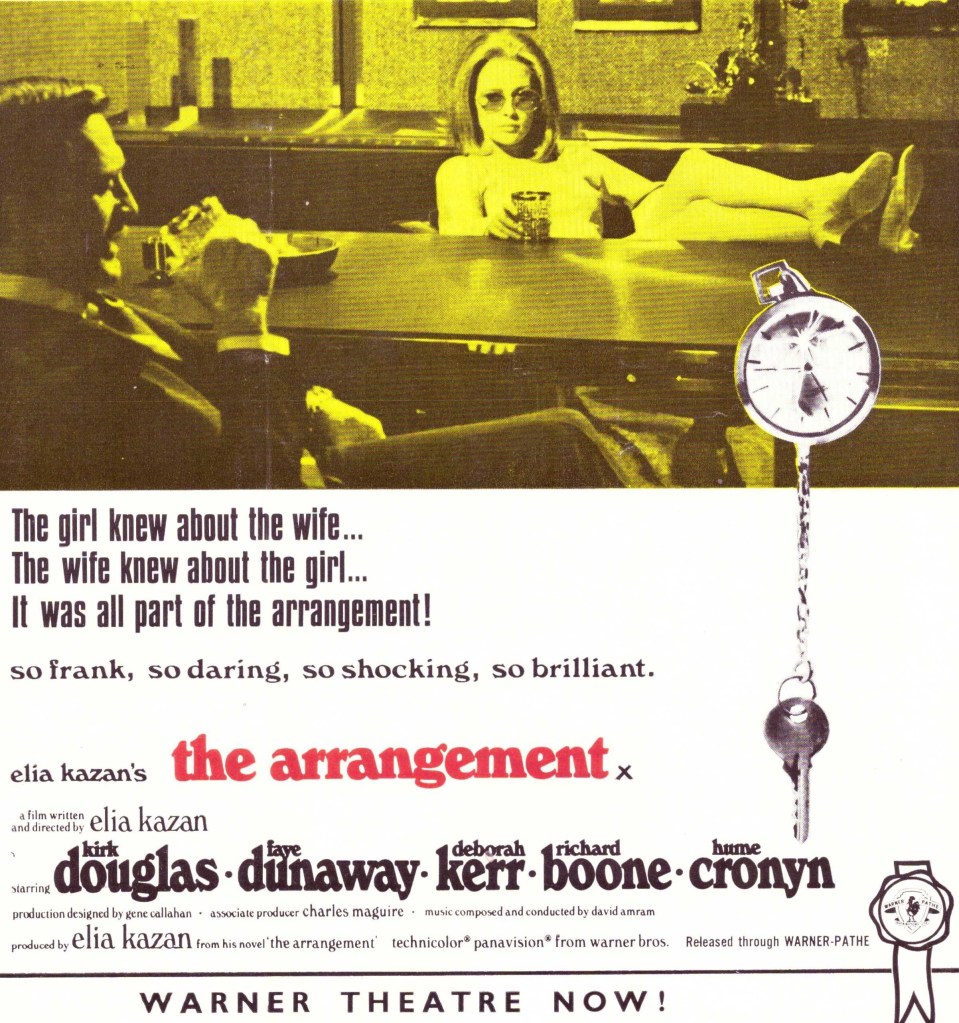
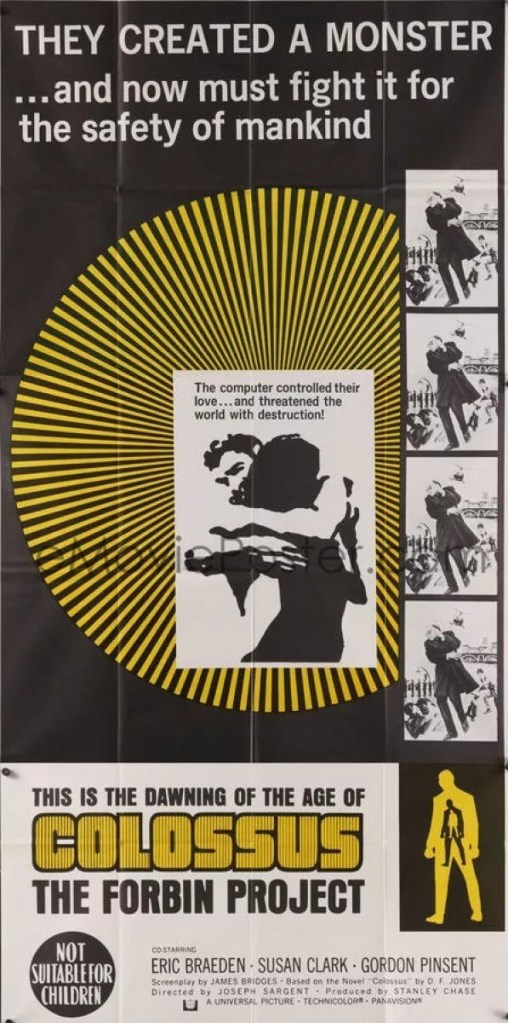
Vittorio De Sica came calling in 1966 for a film with Shirley MacLaine Woman Times Seven (1967). He was “flattered to be asked” to star in Heaven’s My Destination to be directed by Garson Kanin based on the bestseller by Thornton Wilder. There was short-lived attempt in 1968 to mount Eagle at Escambray to be directed by Sandy Mackendrick. He turned down Elia Kazan’s The Arrangement (1969) – “don’t care for it…loser for a protagonist” – Colossus: The Forbin Project (1970), a science fiction picture about a giant computer, and a western by Elliott Silverstein (Cat Ballou, 1965) called The Marauders.

Beyond The Great Race and perhaps Hawaii, unlike some stars – come in Steve McQueen and  Robert Redford – he doesn’t appear to have turned down anything that subsequently became a major commercial or critical hit.

SOURCE: Charlton Heston, The Actor’s Life, Journals 1956-1976 (Penguin, 1979).

The Enforcer (2022) *** – Seen at the Cinema

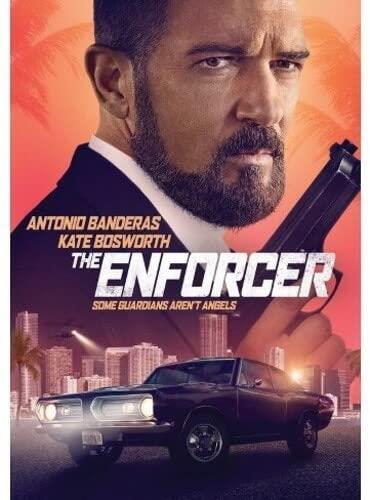
After pulling double worthy duty with Empire of Light and Till as the starting points for my Monday multiplex triple bill it was something of a welcome relief to finish with an unpretentious pretty serviceable actioner that traded on Taken, The Equalizer and The Mechanic.

Ex-con Cuda (Antonio Banderas) has taken up his old job of debt collector/enforcer for bisexual mob boss Estelle (Kate Bosworth). Through happenstance he acquires streetfighter  protégé Stray (Mojean Aria). Cuda’s daughter won’t speak to him so he’s partial to coming to the aid of homeless 15-year-old Billie (Zolee Griggs). To get her off the streets he puts her up in a motel. But, of course, no good deed goes un-punished and the motel manager arranges for her kidnap by Freddie (2 Chainz), a rising gangster who threatens Estelle’s dominance.

Meanwhile, Stray falls for dancer/hooker Lexus (Alexis Ren) who works for Estelle and may well be her main squeeze, though the consensuality of that relationship may be in question.

There’s none of the pavement-pounding hard-core detective work or even nascent skill undertaken by the likes of Taken’s Bryan Mills before Cuda tracks down Billie’s whereabouts and it doesn’t take long for the various strands to coalesce, resulting in a variety of fights and shootings.  Given it’s a perky 90-minutes long, there’s very little time for subplots anyway or to find deeper meaning. That’s not to say there aren’t patches of clever dialog – Estelle compares the blood in her veins to that of the marauders in ocean depths whose blood has evolved to be extremely able to withstand parts of the sea where the sun never shines. (She says it a bit neater than that).

And there’s no time wasted on sentimentality either. Neither Cuda’s ex-wife or daughter want anything to do with him and thank goodness we’re spared a scene of him emerging from jail with nobody to greet him. The movie touches on the most venal aspects of modern crime, paedophilia, webcam pornography, kidnap, sexual violence, and of course Freddie bemoans the fact that Estelle is so old-fashioned she wants her tribute paid in cash not cryptocurrency.

It’s straight down to brass tacks, Cuda not seeing the betrayal coming. Thanks for bringing me fresh blood, Cuda, says Estelle, would you like one bullet or two with your retiral package. The only element that seems contrived at the time, that the battered and bloodied Stray can fix Cuda’s broken down car, actually turns into a decent plot point. And where Bryan Mills seems to be living on Lazarus-time, here it’s clear that the ageing Cuda is not going survive these endless beatings and shootings, so if there’s going to be a sequel it will be on the head of Stray.

I had half-expected Antonio Banderas (Uncharted, 2022) to sleepwalk through this kind of good guy-tough guy role but in fact his mostly soft-voiced portrayal is very effective, and his occasional stupidity lends considerable depth to the character.  Kate Bosworth (Barbarian, 2022) has been undergoing a transition of late and is very convincing as a smooth, if distinctly evil, bisexual gangster.

I’ve never heard of Mojean Aria though if I’d kept my ear closer to the ground I might have ascertained he was a Heath Ledger Scholarship recipient. He had a small role in the misconceived Reminiscence (2021) and took the lead in the arthouse Kapo (2022). Judging on his performance here, I’d say he is one to look out for. He has definite screen presence, action smarts and can act a bit too.

And just to show my ignorance I was unaware that Alexis Ren is one of the biggest influencers in the world. This is her second movie and she doesn’t really have much of a part beyond compromised girlfriend. Zolee Griggs (Archenemy, 2020) is another newcomer. But you remember that old Raymond Chandler saying that when the plot sags have a man come through the door with a gun. Well, here, there’s a different twist – it’s a woman, in fact both these women turn up trumps when it comes to rescuing the guys.

This is the directing debut of Aussie commercials wiz Richard Hughes and, thankfully, there’s none of the flashiness than would have drowned a tight picture like this. He keeps to the script by W. Peter Iliff who’s been out of the game for some time but who you may remember for Point Break (both versions), Patriot Games (1992), Varsity Blues (movie and TV series) and Under Suspicion (2000).

Undemanding action fare, for sure, but still it delivers on what it promises. It doesn’t have a wide enough release or a big enough marketing budget to even qualify as a sleeper but I reckon it will keep most people satisfied. I had thought this might be DTV but that’s not so. Although it’s not been released in the States it’s had a wide cinema release in Europe. However, this looks like it’s already on DVD but been thrown into cinemas to coincide with the launch of Puss in Boots.

Discover WordPress

A daily selection of the best content published on WordPress, collected for you by humans who love to read.

The Atavist Magazine

by Brian Hannan

WordPress.com News

The latest news on WordPress.com and the WordPress community.