Behind the Scenes: Selling “Zulu” (1964) – The Pressbook

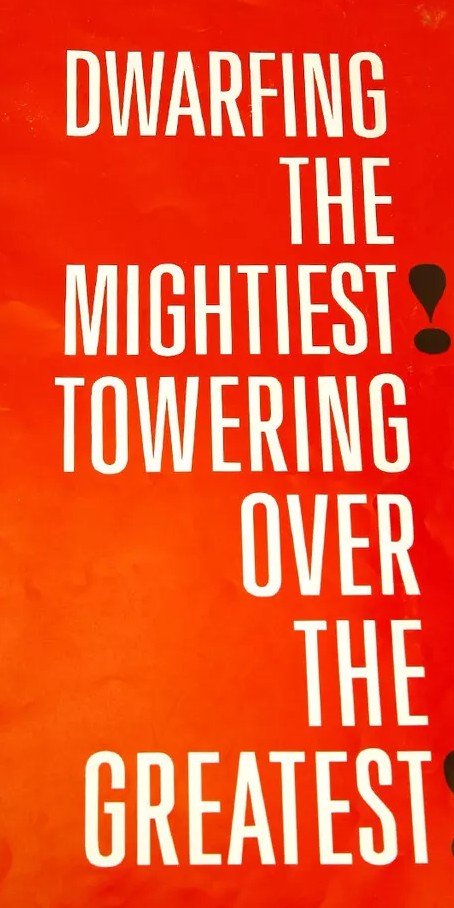
“Dwarfing the Mightiest! Towering over the Greatest!” wasn’t just the movie’s tagline. It could have easily been used to describe the Pressbook. This folded out into a colossal 40 inches wide  by 20 inches high, one of the biggest pressbooks ever produced.

The marketing team produced an impressive list of ideas. Cinema managers were urged to get war correspondents and war heroes involved and to blow up photos of the Victoria Cross. Hanging on the name of the star was a “Baker’s Dozen” competition, inviting people to list the thirteen movies featuring Stanley Baker. Quite how they thought a promotion involving banks would go down is anybody’s guess. Especially as this was the notion: “Zulus are allowed as many wives as they want, provided they can afford to pay for them. The price ranges between six and twenty head of cattle per wife. For an interesting tie-in, get local banks to display money and other barter materials. Give them a montage of still from the picture to display.” Culturally tone-deaf doesn’t cut it.
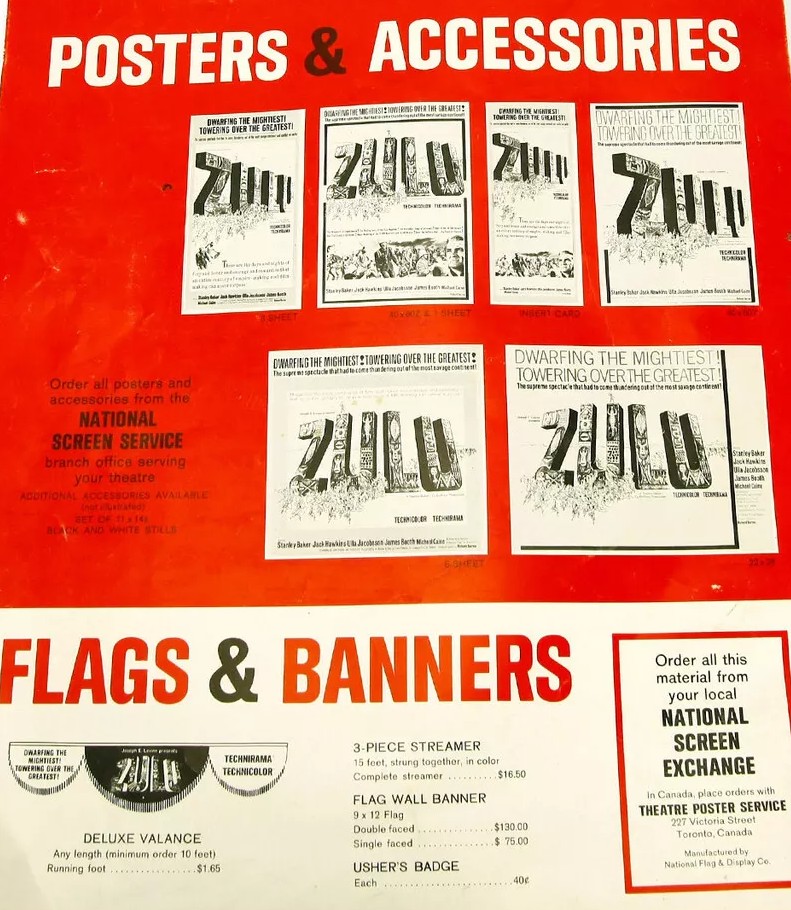
To attract children there was a coloring-in competition and a school study guide. The movie was available in 70mm Super Technirama so there was a special advertisement linked in to that for cinema going down that route.

Other taglines included: “The supreme spectacle that had to come thundering out of the most thrilling continent!” and “These are the days and nights of fury and honor and courage and cowardice that an entire century of empire-making and film-making can never surpass!”
And in case hyperbole wasn’t enough, one of the ads spelled out the exciting details. “The Massacre of Isandlwana! The Mating Song of the Zulu Maidens! The Incredible Siege of Ishiwane! Night of the 40,000 Spears! Days That Saved a Continent! Mass Wedding of 2,000 Warriors and 2,000 Virgins! Amid the Battle’s Heat…the Flash of Passion!”

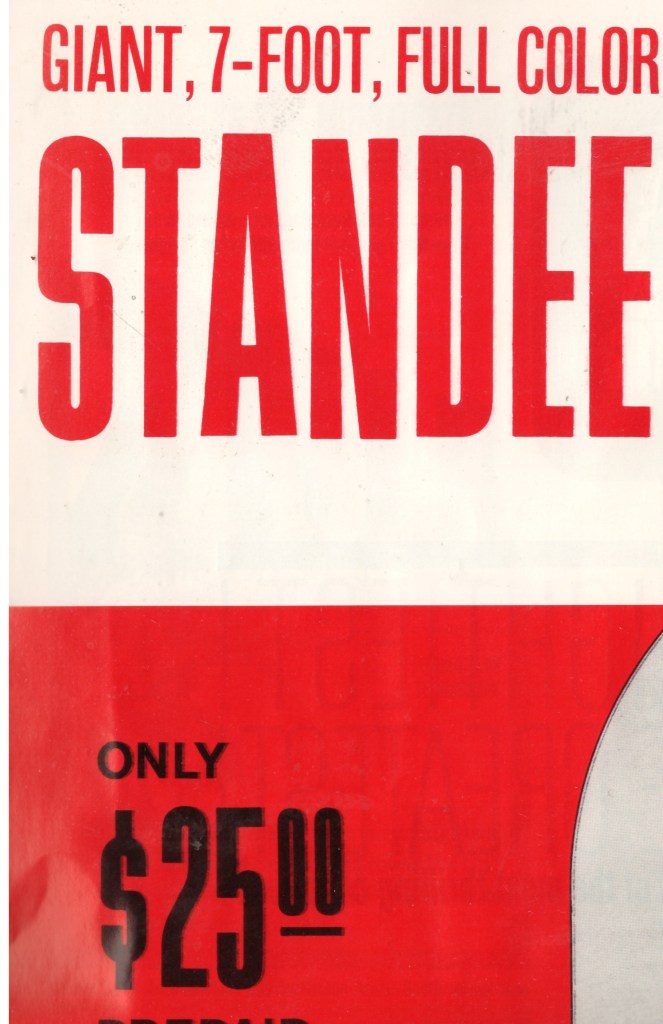
There was a seven-foot high standee and a three-foot 3D illuminated standee.

To help sell the picture to local journalists, little articles were planted that could hook an editor’s interest. For example, when director Cy Endfield glimpsed some soldiers firing their rifles left-handed, he stopped filming, because British soldiers were required to shoot right-handed. The film was shot in the shadows of the Darkensberg Mountains. The river which flowed past Rorke’s Drift was slower than it had been at the time of the battle so the course was altered and dammed to increase the flow. Out of sight of the cameras but essential to filming were the modern villages constructed to house cast and crew, stores, catering and compounds for horses and oxen.

The cast were on set at 6.30am for make-up. The Zulus spent more time in make-up than the British soldiers, as the costume department ensured every aspect of their outfits was historically correct. A total of 100lb of small colored beads was crafted by made by local women for the maidens to wear. A primitive method of making necklaces, strung together with animal sinew and rolled by hand, was employed incorporating a further 100lb of wild syringa seeds which were dyed.

The warrior loincloths of softened animal skins were made the traditional way using stones aqnd animal fat. Shields were also made from animal skin. The teeth of tigers and baboons formed their necklaces. They kept snuff in a small gourd worn round the waist. The purpose of a porcupine quill tucked into their hair was to extract thorns after a long march.

Three cameras were utilized to shoot the blaze that burned down the hospital. “Undress rehearsal” was the name given to the marriage ritual scenes of bare-breasted women.

Though Michael Caine was being touted for stardom, as far as the Pressbook was concerned he was relegated to section below Jack Hawkins, James Booth and Ulla Jacobsen who had smaller parts. The movie was a notable change for Jack Hawkins, who saw action in World War Two. Instead of playing his usual hero, he was a weakling and drunk. It was the second English-language film for Swede Jacobsen after Love Is a Ball / All This and Money Too (1963).

Selling Angie Dickinson – “Jessica” (1962)

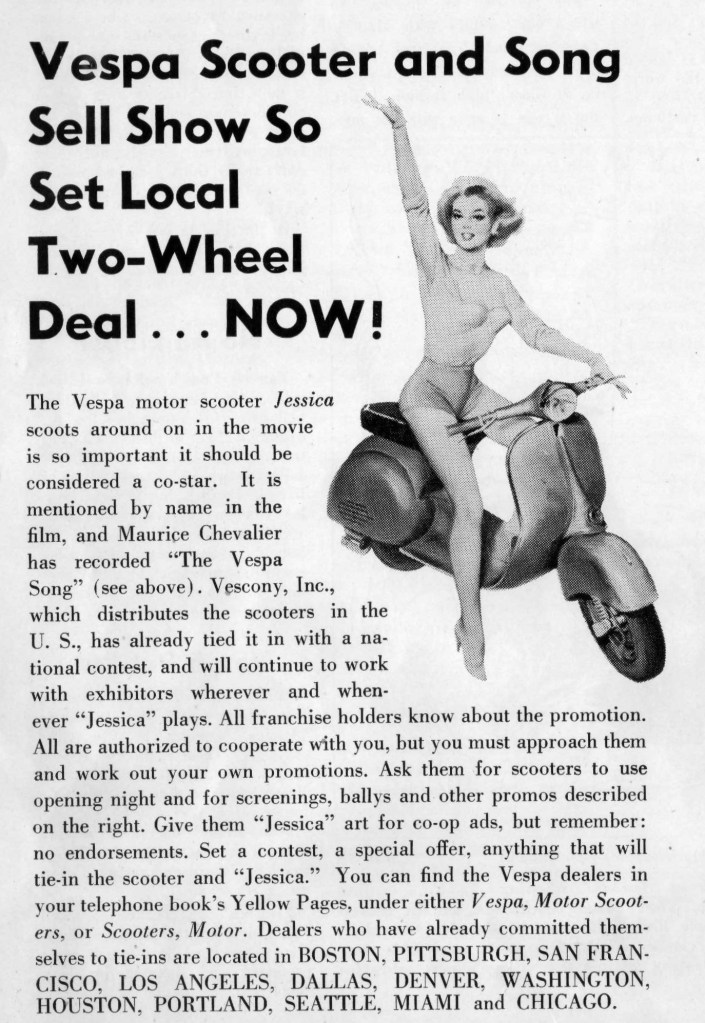
There was an age-old rule of thumb in Hollywood marketing. You can ignore iron-clad contracts as regards credits and billing if you have a sexy girl to promote. The top-billed Maurice Chevalier had been a major Hollywood star for nearly three decade from the likes of The Merry Widow (1934) to Gigi (1958) and twice Oscar-nominated. But you can scarcely see his face in any of the posters. He was passed over in favor of the glorious image of Angie Dickinson astride a Vespa scooter. And, unusually, for an industry that sold females in terms of facial features and bosom, Dickinson’s posterior was given as much prominence as the rest of her figure.

Bearing in mind the Vespa trick had already been used in more fashionable fashion by Audrey Hepburn in Roman Holiday, this was probably a more sensible approach. While there’s no doubt Dickinson was stylish nobody would ever beat Hepburn when it came to haute couture so there was no point trying, although it has to be said the sweater look was something of a throwback to the 1940s.

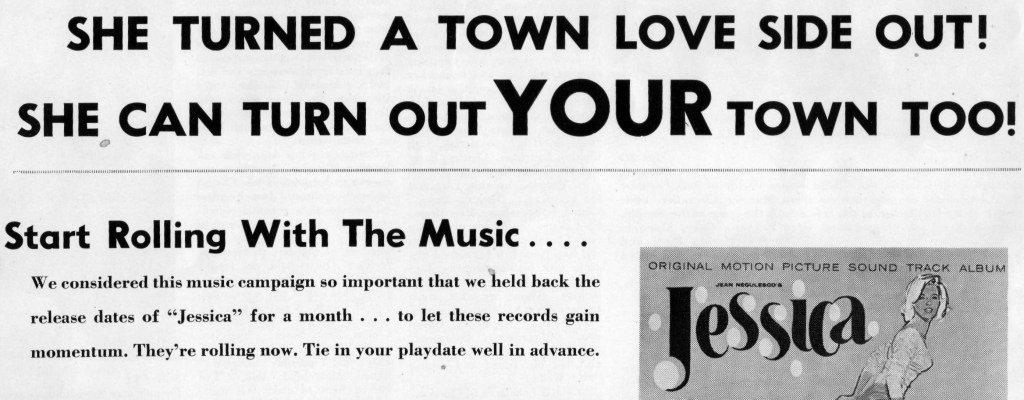
However, there were two other pieces of more stylish artwork as back-up for an exhibitor looking askance at the obvious and with more discerning patrons. While Mitchell Hooks was responsible for the main poster, also turning their hand to  promotional material were director Jean Negulesco (whose effort is pictured at the top) and artist Bernard Buffet who both concentrated on face to the exclusion of figure. Negulesco had begun his career as an expressionist artist in the 1920s and the Pressbook marketeers took this idea further by claiming that “every frame of the film was composed with such care that the picture…can be said to be painted with a camera.” 

Negulesco was a noted art collector and paintings by Bernard Buffet, also a French expressionist, adorned his walls. In 1955 Buffet was named the top post-war artist and his first retrospective at the age of just 30 was held three years later.

As readers of these occasional articles on Pressbooks will know, marketing a movie around one image was rare but the image of Jessica (Angie Dickinson) mounting a scooter was used exclusively in all posters even though the background and taglines might change. The background showed the locale, some subsidiary characters and dancing. You have to look close to catch a glimpse of top star Maurice Chevalier – he’s the guy in black toting a guitar.

The taglines centered on the mischievous Jessica causing marital mishap in sun-filled Italy. “Here comes trouble. The most delightful, delicious siren who ever scooted into town and put marriages on the skids!” was the main tagline. The rest were along similar lines. “She’s the most luscious forbidden fruit that ever dropped into the screen’s lap.” / “She lives it up saucily in Italy.” / “Meet the gal who took Italy by storm with a scooter, sweater and a smile.”   

The more artistic posters by Negulesco and Buffet had different taglines: “Not in a month of Never on Sundays have you heard such wonderful songs” and “Jean Negulesco, who put Rome on the map with Three Coins in the Fountain, now works wonders on the shores of the blue Mediterranean in Jessica, a most mischievous girl.” The marketeers of course were taking some artistic license since Roman Holiday preceded Three Coins in the Fountain.

The Pressbook offered a couple of pages of nuggets for hungry newspaper editors with Chevalier at last getting some attention – the “crooning cleric” was described as “the perennially youthful Frenchman (who) had sung, danced and acted his way across the stages of the world enjoying the adulation of several different generations.”  Chevalier was given tips on his guitar by a local singing cleric, apparently.

But there was little chance, even in print, of Chevalier stealing Dickinson’s thunder especially when particular reference was made to her nude swimming scene, for which she wore a skin-colored bikini to the disappointment of the hundreds of locals who climbed up a steep slope to the waterfall location.

Jean wasn’t the only artistic member of the Negulesco clan. His wife Dusty, also a painter,  designed the wardrobe, wrote lyrics for the film’s songs and taught Dickinson how to ride a scooter. The movie was filmed on location in the village of Forza d’Agro on a clifftop 1,000 feet high. The shoot lasted 55 days with 2,600 people from the surrounding area employed as support staff or in bit parts and extras. The production spent about $113,000 (over $1 million at today’s prices) on accommodation and meals and purchased 8,300 gallons of fuel. Traditional Sicilian music was incorporated into the film.

Given Chevalier was singing it was inevitable and promotionally essential to put out a single, this was “Jessica” backed by “The Vespa Song.” There was also an original soundtrack album. Both were ideal material for local radio stations to play during the film’s launch.

A key element of the promotion was a tie-up with Vescony inc which distributed Vespa scooters in the U.S. There was a national competition and franchisees were ready to lend scooters to theaters for openings and special screenings or just to sit in the lobby attracting attention. A subplot involving gardening inspired marketeers to suggest exhibitors give away orchids to women named Jessica and had tied up with supplier Orchids of Hawaii. Other ideas included targeting local midwives – both male and female – and a “Jessica Jump” reflecting the film’s wedding scene. There was book tie-in based on the source novel The Midwife of Pont Clery by Flora Sandstrom published by Pocket books.

Bernard Buffet’s involvement was something of a coup and promised an opportunity to create a promotion appealing to art lovers. “Not since Toulouse-Lautrec made advertisements for nightclubs has an artist of this stature contributed to ads for popular entertainment.”  

Discover WordPress

A daily selection of the best content published on WordPress, collected for you by humans who love to read.

The Atavist Magazine

by Brian Hannan

WordPress.com News

The latest news on WordPress.com and the WordPress community.