
In 2012, Raquel Welch was accorded a ten-film tribute at the prestigious Film Society of the Lincoln Center for the Performing Arts in New York and turned up in person to be interviewed on stage prior to various screenings. One of these was Myra Breckenridge (1970). Though interviewer Simon Doonan kicked off proceedings by mistaking her for Ann-Margret (yep). Graceful as our star was, she didn’t storm off the stage.
She admitted she wasn’t first choice for the picture. “I didn’t get a call,” she explained. “I had heard about the movie. I had read the book. The book was absolutely hysterical, so funny, and I thought it was very innovative because it was the first time I had seen somebody like Gore Vidal, who was really a genius, deal with the duality of the nature of both the male and the female. I never saw that before.
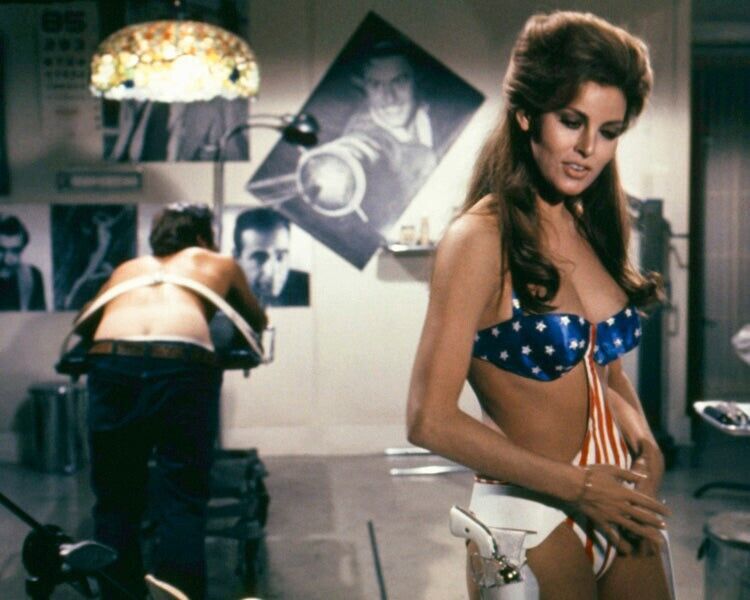
“I was interested in how they were going to do this movie and then I heard through the trade that Anne Bancroft (after the success of The Graduate, 1969) had turned it down. So I thought, hmmm, I wonder what they’re going for. A little bird told me to call Dick Zanuck (head of 20th Century Fox) so I called Dick, who I was in contract with, and asked what kind of actors they were looking for in this role. I was thinking if a guy was going to change his sex and wanted to be like a movie star kind of girl, don’t you think he might want to look like me? And he said, oh my god, that’s a thought, let me talk to David – that was David Brown (later, producer of Jaws, 1975) and I’m sure Helen Gurley Brown (his wife and editor-in-chief of Cosmopolitan) got in on it too. And then I did get the call and they asked me to come in and talk to them and they gave me the role.
“I had not seen the script, it’s true. As much as I loved doing Myra, I was kind of disappointed in the outcome of the movie because the narrative never did really string together. It was very disjointed and it didn’t really tell the story of Myron the film critic who was enamored of all the very very strong swashbuckling women of the golden age of film from Joan Crawford to Bette Davis and Myrna Loy.
“He wanted really to be one of those superwomen and I think that’s where the superwomen thing started because it was women then who used to go to the movies. They used to bring the guys to the movies. That was the way it went then more than it does now…The dialog was both male and female and I felt like now I’m playing the girl’s part. Rex Reed is playing Myron and there’s really hardly any relationship between the two. They’re not one person so there’s no idea of the duality and nature. One minute she likes girls and the next minute she likes studs and the older men are just to use and abuse.”
Asked about how she developed her character, Raquel replied: “The real thing – I know this is going to sound very shallow – but Theodora Van Runkle (who had swept to national fame by starting a fashion trend with her outfits for Bonnie and Clyde, 1967) did these beautiful period costumes which did emulate all of the great film stars…I felt these clothes kind of evoked this attitude.
“I did want to meet Mae (West). I did go out and research her and find out all about her and it turned out she had never made a color movie before. I asked for an audience. (In her apartment) I noticed all her furniture was white and also noticed all these 25-watt pink bulbs (to keep the room dim).”
Raquel had observed of movie stars, “There’s a screen persona and a real side. Mae didn’t have a real side. She was wearing a long peignoir and lots of eyelashes. This was noon. She didn’t bring the chimps out (she was rumored to have a menagerie of them…and young men, and neither were in evidence).”
(On set) “The other thing that got to me a little bit was that Mae never worked before 5pm. Also she never really moved by herself. (The limousine that had driven her to the studio) also brought her on to the set. I kissed her hand and one false fingernail fell to the floor and then I thought I’m getting a vibe, I think she’s a man. She refused to appear in the same frame as me. At 77 (Mae’s age) all bets are off and you’re not going to be able to doll it up that much.”
While stars being able to veto a director and perhaps refuse to work with certain other stars was still a perk for the highest-paid movie actors, Welch discovered that Mae West had a very distinctive unheard-of perk. She had costume approval. Van Runkle had designed a Garbo-esque black dress that Raquel was looking forward to wearing. But when it came time for that particular scene she discovered it had been “confiscated….nobody got to wear non-color (West was always dressed in white) except Mae.”
“Very early on (I realized) this isn’t Gore’s book. Nobody’s going to undertsand it…they hired Michael Sarne who’s only claim to fame was Joanna (1969), a visual montage kind of thing and that’s what he did to this movie. The fact that it had dialog was secondary. He used to carry round this little rectangular box and he used to say, I’ve got this little box for you, Raquel.
“It was sad fun, I didn’t want to make a movie that didn’t make any sense. I thought we were going to make something that was revolutonary. I did think it was kind of a landmark that said it’s very likely that world culture will change from this point on.”
You can catch this interview and another one discussing The Three Musketeers on Youtube.


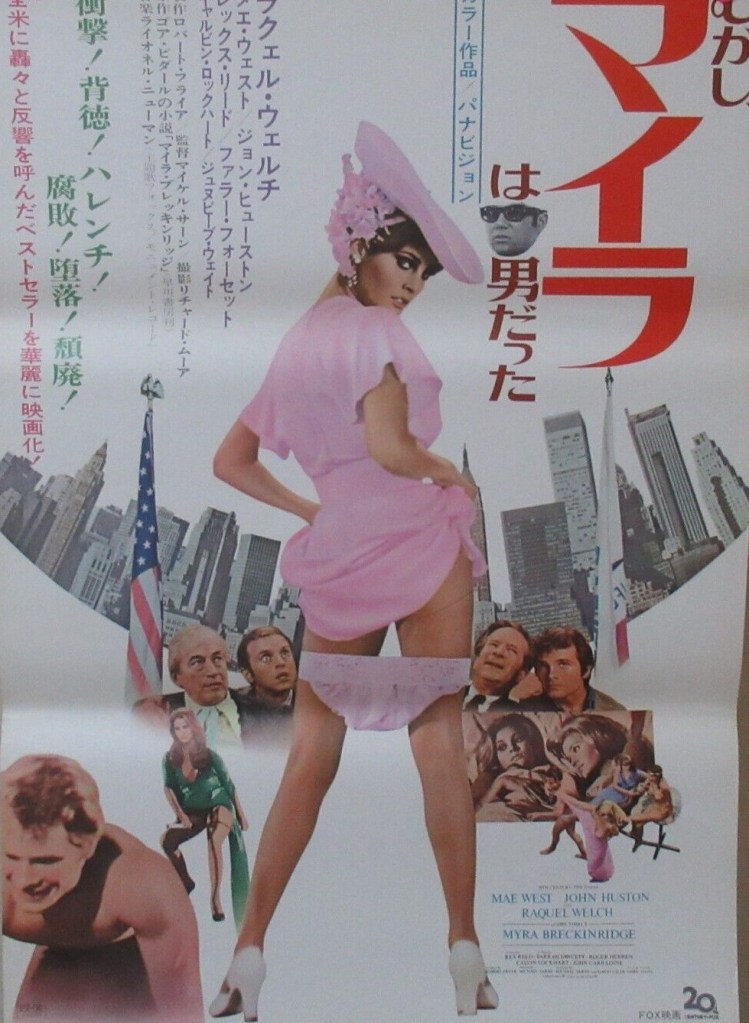
 The Magnificent 60s