Selling James Bond: Part Two – Pressbook for “Thunderball” (1965)

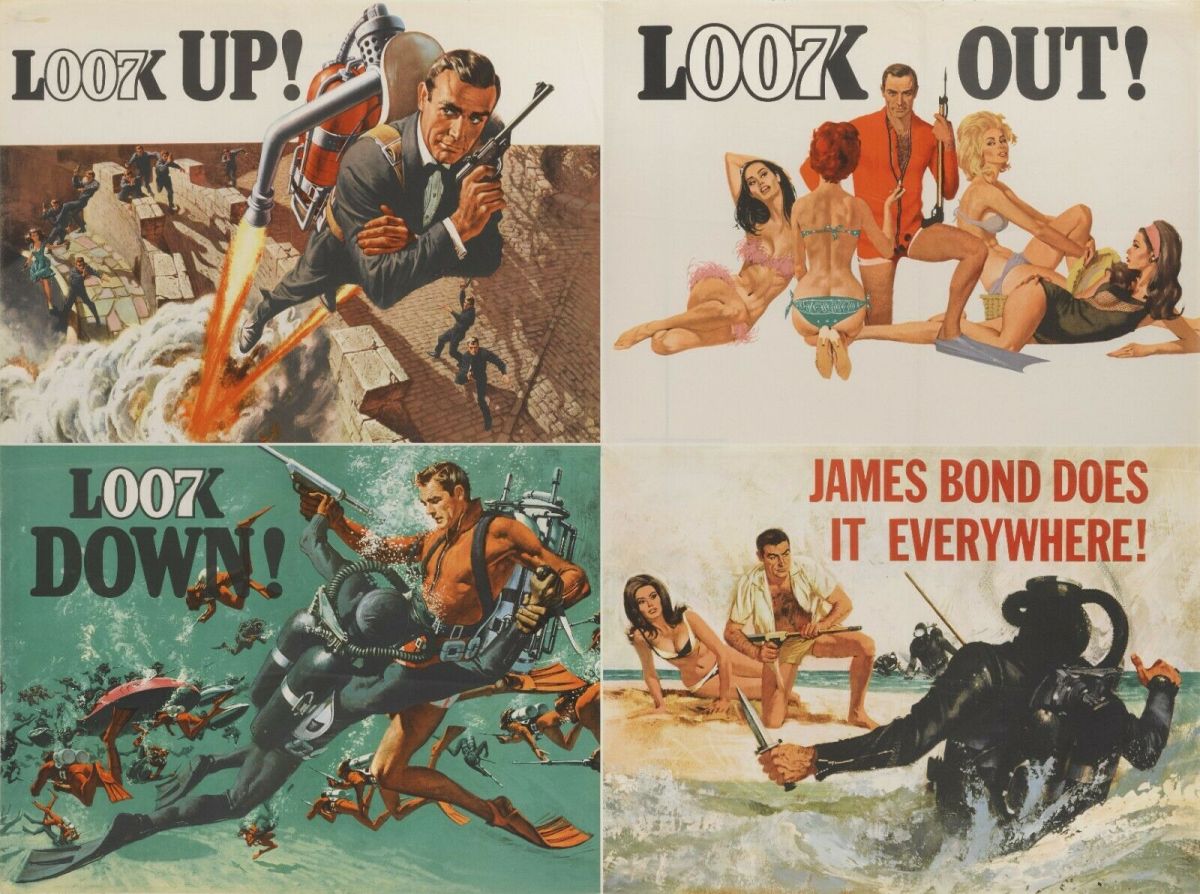
Wooing the audience was no longer required after Goldfinger (1964) had broken the box office bank. Thunderball, claimed producers Cubby Broccoli and Harry Saltzman, was “the hottest merchandise campaign you have ever handled” as the first four pages of the Pressbook went to show. No longer was there a retailer free-for-all with companies which had nothing to do with endorsements jumping on the Bondwagon.

The potential for promotional tie-in was so high that retailers and manufacturers were willing to spend a fortune to become involved and, in so doing, provide a massive spread of free advertising. Colgate had an entire line of toiletries for men including after shave, shaving lotion, deodorant, and talcum powder, each item branded with the 007 logo with Colgate investing in a massive advertising campaign aimed not just as men but the women who buy for men.
Shoe-wear manufacturer Endicott Johnson set up a nationwide contest through the Montgomery Ward chain of stores. Customers were invited to participate in a free sweepstake and store managers were encouraged to become active in promoting Thunderball at sales points throughout their shops.

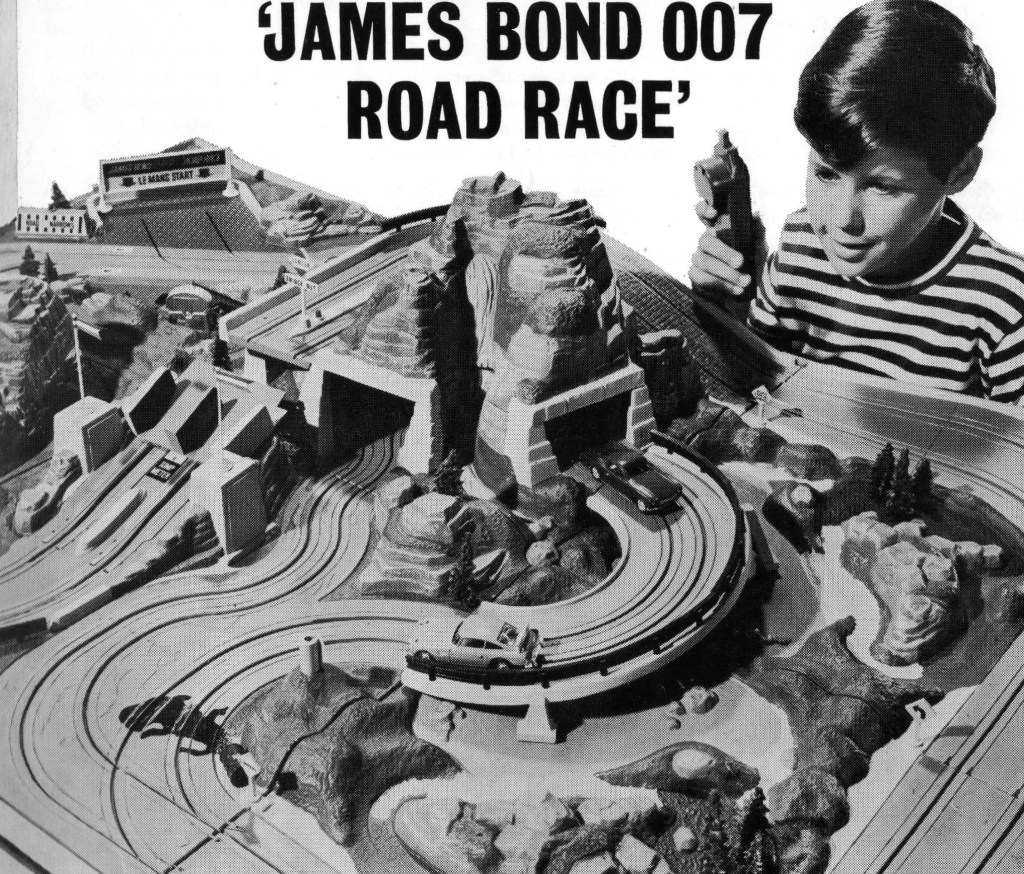
Toy manufactuer A.C. Gilbert had devised a James Bond 007 Road Race which would be promoted in the biggest marketing campaign in Sears Roebuck history to 60 million homes. The catalog would feature a five-page spread. “Beatles fans will be reached through a TV buy that Sears has made advertising the Road Race on ABC-TV’s Beatles Cartoon Show.” Adlers Slacks was the exclusive licensee for James Bond 007 Boys Slacks – with two hidden pockets. Revere Knitting Mills was promoting four sweaters “as worn by James Bond.”

Other licensed products included The Official James Bond Secret Agent 007 Shooting Attache Case, Harry Diamond sports shorts with the Bond logo, Allison tee-shirts and sweat shorts, bubble gum and trading cards from the Philadelphia Chewing Gum Corp, and a walkie-talkie set from Gabriel. In addition, Weldon was selling “007 Pyjamas – Go to Bed Dressed to Kill,” Voit manufactured underwater equipment, Spatz advertised its trenchcoats in Playboy, Trimount clothing range included items for men and boys, and Milton Bradley had four board games and six jigsaw puzzles.

So for the first time in history, exhibitors had to do nothing to attract customers, no zany attention-grabbing gimmicks required, because the massive cross-promotional campaign devised by the producers ensured that potential moviegoers could hardly go anywhere without coming across something alerting customers to the movie.

All this was in addition to the normal standard promotional tools such as original soundtrack album and paperback movie tie-in. Tom Jones had released a single and six other artists had brought out instrumental singles and albums. Trade magazine Cash Box noted that the Bond name signified “something big in the worlds of film and music…many labels have themed LPs after the valuable James Bond Agent 007 image.” Signet had brought out the movie tie-in paperback with artwork on front and back covers.

The bulk of the Pressbook was taken up with advertising and information about the licensed products leaving just three pages for the editorial section. By now of course Sean Connery was a big box office star so he received considerable coverage, explaining that he had been chosen for Dr No as a result of a London newspaper poll. There was space too for the movie’s playgirls – former Miss France Claudine Auger, villainess Luciana Paluzzi best known to American audiences through the Five Fingers television series, Molly Peters and a return for Martine Beswick who had appeared in From Russia with Love.

Not surprisingly, the Aston Martin DB5, which had caused a sensation in Goldfinger, also returned. The customised version cost $45,000 (worth $400,000 today), compared to the usual price of $13,000, and came complete with twin Browning machine guns, tire slashers, revolving number plates, radar screen, ejector seat, and retractable bullet proof shields.

Selling James Bond – Pressbook for “From Russia with Love” (1963)

United Artists had two concepts in mind when it came to marketing the second in the James Bond series From Russia with Love (1963). The first, and quite audacious notion, was to tell anyone who hadn’t seen Dr No (1962) much they had missed. Producers Cubby Broccoli and Harry Saltzman reckoned 69 million moviegoers across the world had seen Dr No, but America only accounted for a small fraction of that total. So their mission was to ensure that American audiences did not miss out again on the “throbbing world of hot-blooded excitement.”

To target that marketplace, the adverts were more like a relaunch, not a sequel, and the taglines began with “Meet James Bond, Secret Agent 007.” And then, “For those unlucky few who missed Dr No…You are unprepared for the sophisticated mayhem and polished lovemaking. The James Bond bug has not bitten you. But take heart! There is still time to jump on the Bond bandwagon with the second James Bond adventure From Russia with Love. See it and we guarantee – you will be hooked for good.” The final exhortation: “Don’t you think it’s time you met secret agent 007?”

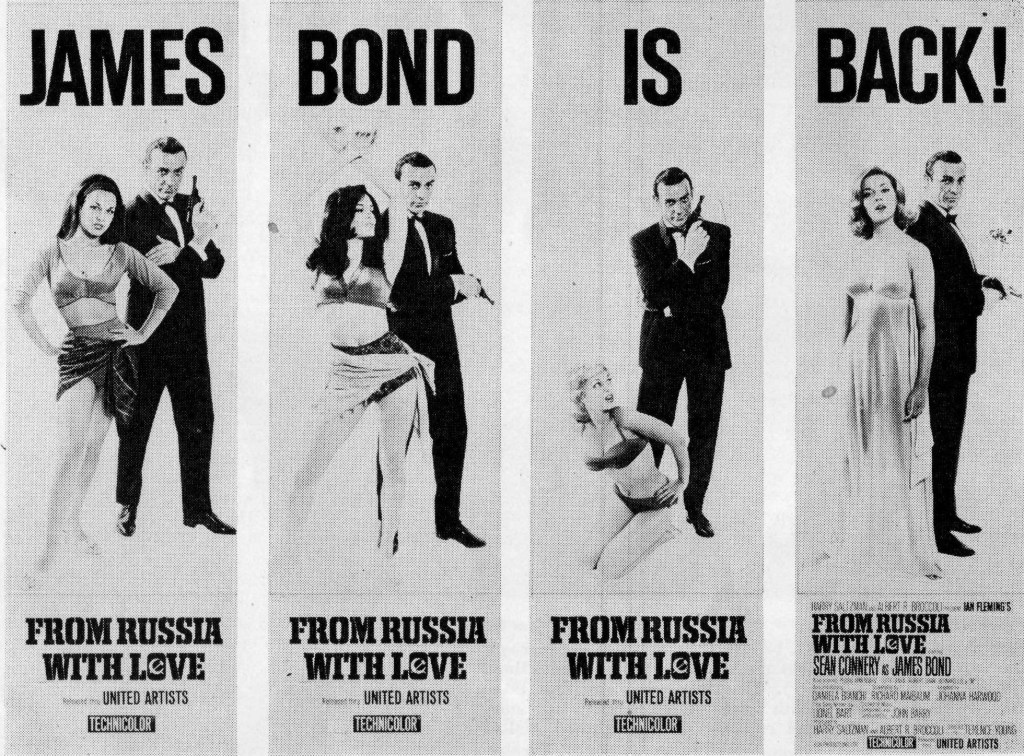
But of course James Bond already had some kind of fan club in the States. “James Bond Is Back!” screamed the alternative advertisements. For both, however, the emphasis was on the new. “His incredible new women! His new incredible enemies! His new incredible adventures!”

“Target: the unkillable James Bond 007. Blast him! Seduce him! Bomb him! Strangle him!” The tone of the adverts suggested something entirely new. While heroes in thrillers could expect to face danger at every turn, and while a romance might sweeten the pot, there would not be a selection of alluring scantily-attired women. “For those who saw Dr No, consider yourself fortunate. Now you are prepared for the further fantastic adventures of that master of intrigue and women, secret agent 007 James Bond, join him in his new thriller From Russia with Love.

To whet the appetite of local newspapermen there was a host of snippets. Oxford University had organized an 007 Society whose members included three lords and the heir to one of the the country’s largest department stores. While James Bond never uses a Windsor knot in his ties, Sean Connery does. Ian Fleming’s Bond novels had sold 30 million copies including six million of From Russia with Love. Four Istanbul mosques featured in the new film as well as an underground cistern a millennium old.

Door posters five feet high.

Beauty queens were always a good bet for coverage – Miss Universe runner-up Daniela Bianchi  won the role of James Bond’s girlfriend after a screen test and former Miss Israel Aliza Gur and former Miss Jamaica Martine Beswick played the fighting gypsy girls. Lotte Lenya was married to Kurt Weill who, with Berthold Brecht, wrote The Threepenny Opera. Sean Connery was fitted out by his own Savile Row tailor Anthony Sinclair and during filming got through ten customized shirts, eight suits, two top coats and a dress suit.

Highly sought-after these days in the memorabilia market are the door panels – measuring 20 inches x 60 inches – which exhibitors would stick to lobby doors but which could also be utilized as displays in stores. Signet brought out a movie tie-in paperback which came with its own promotional material. As there were already other books in the series, booksellers would be inclined to set up a Bond display. As well as the John Barry original soundtrack album, other artists recording material from the film included Matt Monro, Jackie Gleason, Kenny Ball, Al Caiola and Si Zetner, all creating promotional tools.

“Bondmanship” was the overall name given to lifestyle items worn by Bond or which he might wear so tie-ups with fashion stores and retailers were encouraged “no direct endorsement is necessary.” So, for example, restaurants were encouraged to offer “ a menu good enough for James Bond.” It didn’t matter that Bond did not wear a manufacturer’s shoes, ties or suits in the film, just that he might wear them if they were of sufficient quality.

The marketeers came up with a simple stunt: send a set of keys to a newspaper, turn up the next day with a dispatch box handcuffed to your wrist, open it and find inside various promotional items. Or the keys don’t open the case and you need to send for a locksmith. Either way it was important to have a photographer to hand.

Discover WordPress

A daily selection of the best content published on WordPress, collected for you by humans who love to read.

The Atavist Magazine

by Brian Hannan

WordPress.com News

The latest news on WordPress.com and the WordPress community.