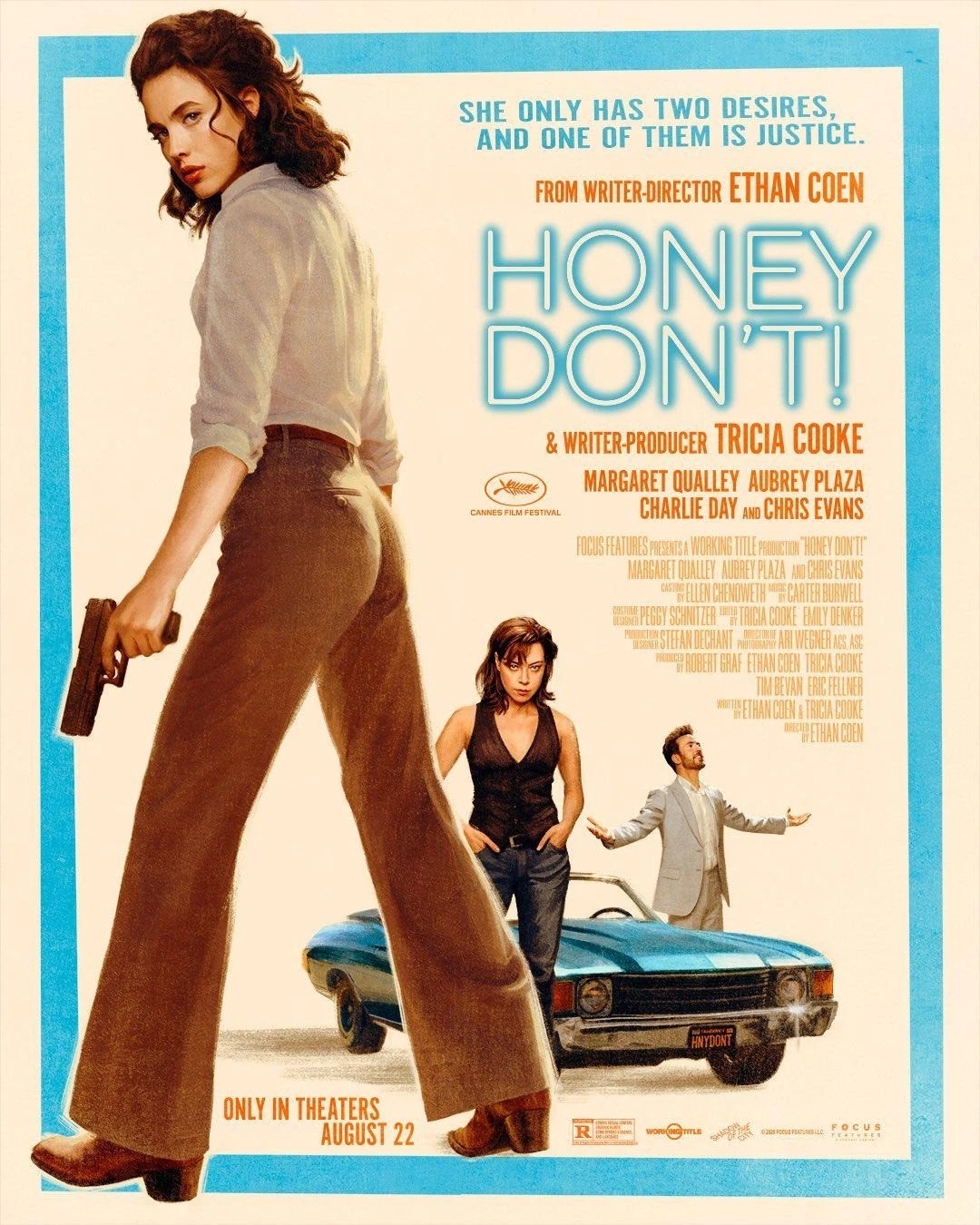
Honey, Don’t! (2025) ** – Seen at the Cinema

Had I still been in the magazine business I would have welcomed this with open arms because it would have provided an ideal headline – “Honey, Don’t Go.”

I’m not sure what Ethan Coen (True Grit, 2010) thought he was making and even if it was a shaggy dog story as often were the tales he concocted with his brother this has turned out more like a dog’s breakfast. Which is a shame because it’s about time Margaret Qualley (The Substance, 2024) was elevated from indie product to mainstream. She’s certainly got a screen presence and if someone could only fit a movie around what she has to offer she’d be on her way.
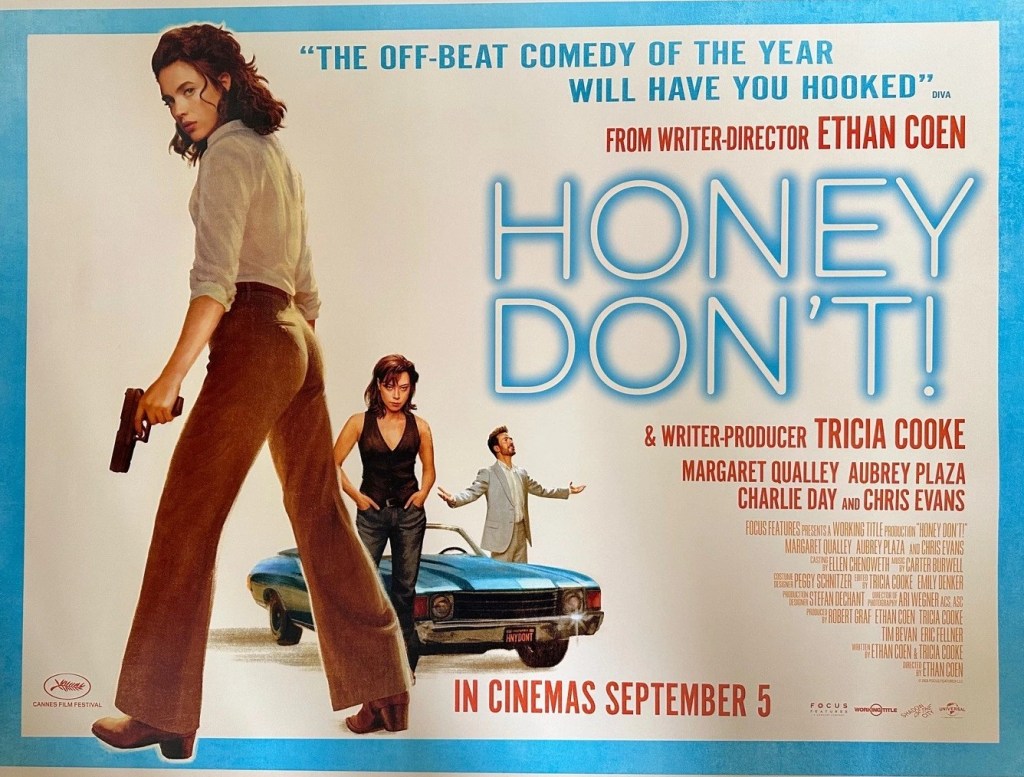
Excepting some salty dialog, this comes up short on every front. The narrative is so thin it’s disappeared down every convenient rabbit hole, the characters are equally lacking (though my guess is they’re meant to be slices of cliché, that’s the game) and there’s a deliberate emphasis on keeping emotion to the bare minimum.

The two main characters, private eye Honey Donohue (Margaret Qualley) and cop M G Falcone (Aubrey Plaza), congratulate themselves on being so completely self-centered that all dalliances are strictly confined to one-nighters, such restrictions imposed before the other person gets all weepy and emotional. Honey and MG, both being lesbians, are able to get away with such notions. Imagine a male attempting to classify all females as just too emotional.

I say Honey is a private eye but it’s kind of hard for her to keep clients because they keep on being bumped off before she can take any action. And when she does, she doesn’t prove much cop. In fact, she’s actually that old film noir fallback – the dupe. And she only realizes she’s been played for a patsy when she sees – another old fallback – two cups on a table (it’s an old-fashioned house hence the teacups).

It’s a strange construct. The audience knows what’s going on but poor Honey is kept in the dark and at the climax it looks very much like she’s setting herself up to be the dupe again.

So what the audience knows that Honey doesn’t is that a woman who died in a car accident has had a distinctive ring stolen by a woman on a moped, Chere (Lera Abova), who in another old-time fallback can’t pass a pool without skinny dipping. The ring has a logo that ties in with that of the religious scam being run by uber hunk preacher Rev Drew Devlin (Chris Evans).who uses the church as a cover for some drug-running for Chere and to provide him a harem of submissive females.

A sub-plot that then becomes a main plot sees Honey putting in some time helping out her aunt’s wayward daughter Corinne (Talia Ryder) though you suspect she’s there just to let Honey beat the bejasus out of her niece’s abusive boyfriend.

There’s also an old creepy homeless fella hanging around that starts out as a red herring, looks as though it could dovetail into an emotional scene, but then shies well clear of that because, well heck, Honey doesn’t do emotion.

I’ve got a sneaky feeling that the director wasn’t trying to make a Coen Bros movie so much as a Tarantino one. There’s a helluva lot riding on the word “Macaroni” for example. And the application of lipstick. And there’s a helluva lot of nudges towards the hardcore – in the way of sex not music – a dishwashing scene and a bar sequence come to mind.

Sure, Honey snaps off a few one-liners but mostly you’re going to remember her sashaying along in a tight skirt and clackety high heels – which may well have the director’s intention for all I know.

This feels like a clumsier retread of Drive-Away Dolls (2024), a similar dive into lesbian-led crime, also starring Qualley, directed by Coen and co-written by Tricia Cooke, who performs the same service here.

More a collection of mismatched sequences with a myriad of oddball characters none distinctive enough to make you sit up than anything in the way of a coherent plot.
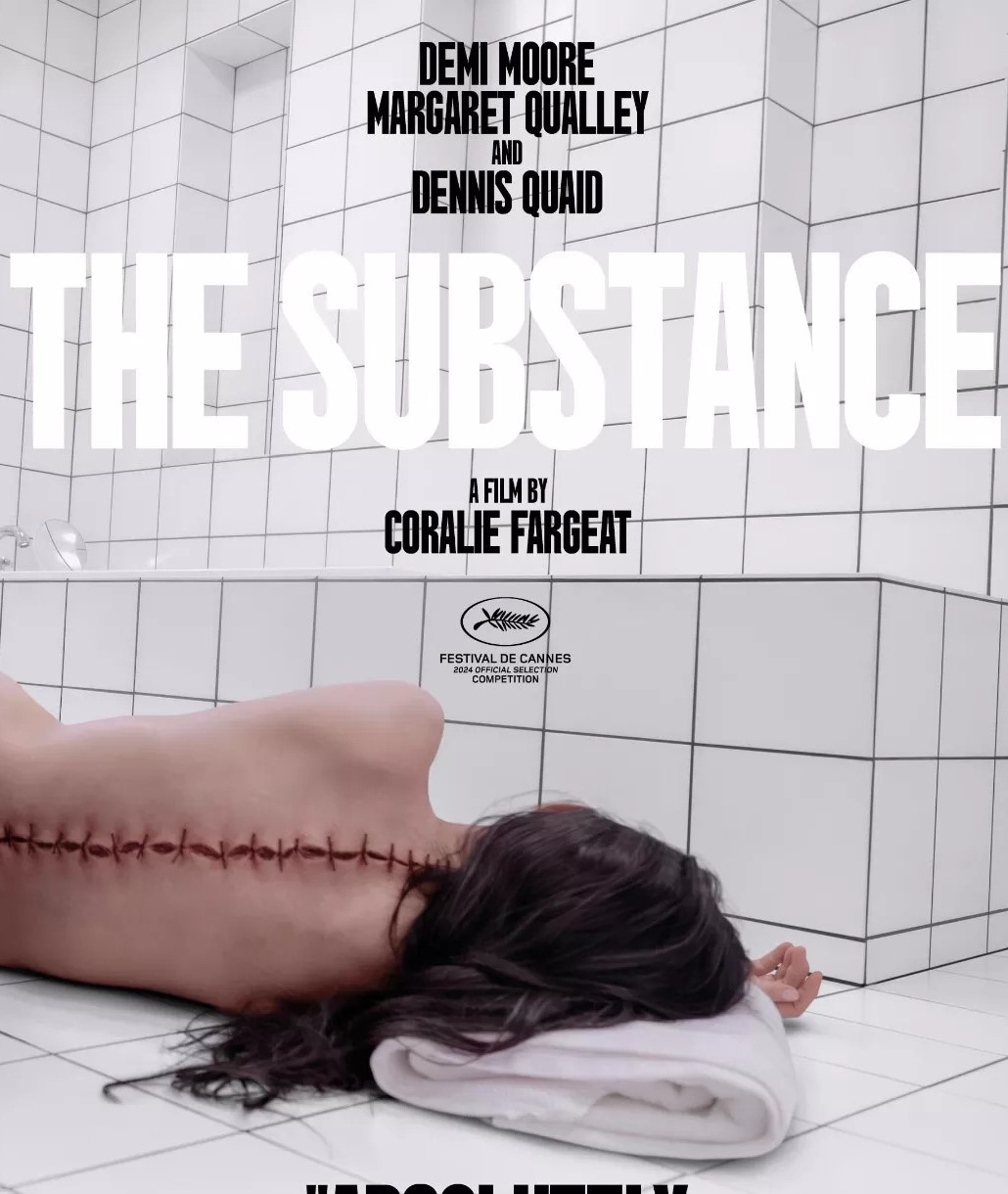
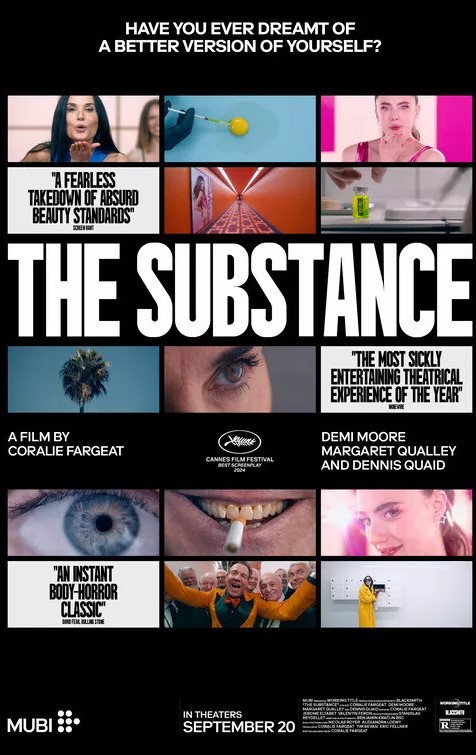
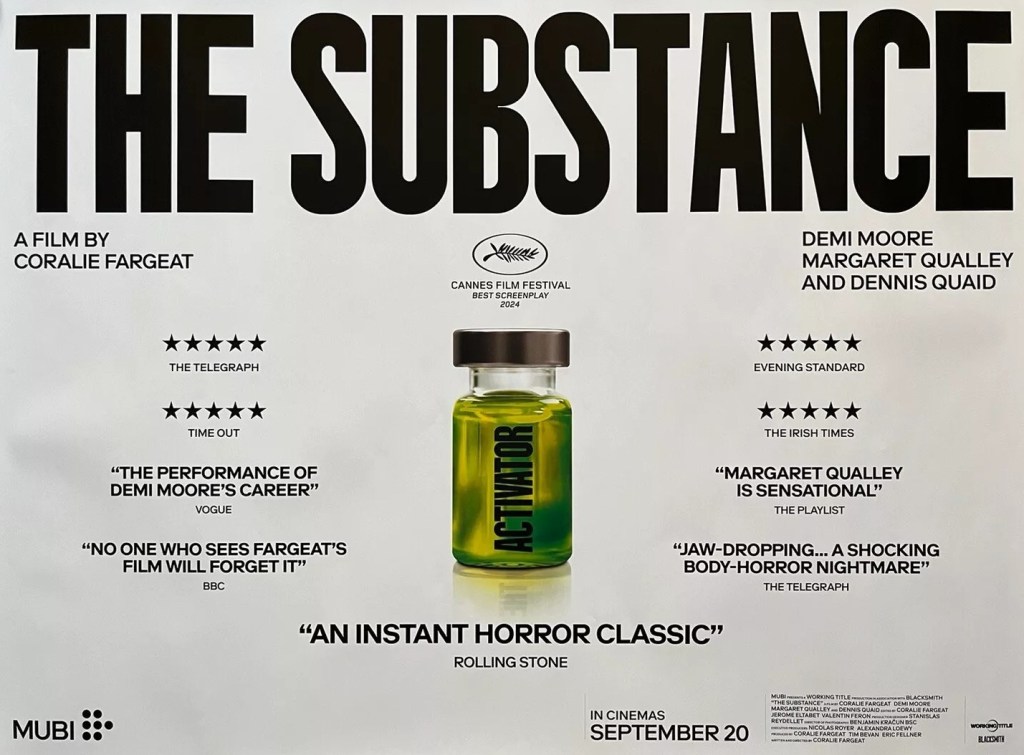
The Substance (2024) **** – Seen at the Cinema

Like Tar (2022) suffers from stylistic overkill and outstays its welcome by a good 30 minutes, but otherwise a perfect antidote to Barbie (2023). While not entirely original, owing much to the likes of The Picture of Dorian Gray and The Stepford Wives and the doppelganger and split personality nrrative nonetheless a refreshing take on the ageing beauty syndrome. Shower fetish might be a homage to Brian DePalma and except that the movie is directed by Frenchwoman Coralie Fergeat (Revenge, 2017) we might be lambasting its rampant nudity for misogynistic reasons.

On the plus side, everything else about it feels new. The whole story plays out like a demonic fable, the participants only caught out because, in their greed, they refuse to play by the rules. But like all the best horror films this occupies its own world. Whoever offers this free drug and the chance to relive your life through the best possible you is a monosyllabic voice at the end of a telephone. Not only is there gruesome rebirth but a stitching-up process. The black market drug at the center of the tale can only be accessed in a deadbeat part of Los Angeles by crawling under a door, but then, suddenly we’re in a pristine room and the various constituent parts of the substance are laid out on the Ikea model with easy-to-follow instructions.

After surviving a horrific automobile accident, onetime movie star Elizabeth (Demi Moore), reduced to breakfast television exercise guru, is passed a mysterious note by an incredibly good-looking young man that takes her down this particular rabbit hole. Like Eve’s forbidden fruit or Cinderella’s toxic midnight, there’s a catch to reliving her beautiful youth. She must switch back “without exception” to her original persona every seven days.

Of course, that’s too much to ask, and as the double named Sue (Margaret Qualley) steals minutes then hours and days the effect is seen on Elizabeth, a monstrous aged finger appearing in her otherwise acceptable hands first sign that these rules cannot be broken. Warning that there are two sides to this singular personality goes ignored. Instead of acting in concert each prt of the split personality conspires againt each other until entitlement spills over into abhorrent violence.

Apart from the initial rebirth squence, and the toothless section, the best scenes are more toned down, in one Elizabeth is faced with an alternative future, the other when she re-does her make-up four times for a date, unable to decide on which face she wishes to present.

Demi Moore (Disclosure, 1994) is being touted as a shoo-in for an Oscar nomination, but that’s mostly on account of her willingness to appear without makeup and for long sections without clothing. I’m not convinced that there’s enough heartfelt acting beyond the bitterness that was often her trademark. Margaret Qualley (Poor Things, 2023) isn’t given much personality to deal with except for exuding shining beauty and horror when it starts to go wrong.

All the males are muppets, it has to be said, wheeler-dealer Harvey (Dennis Quaid) the worst kind of obnoxious male. But this doesn’t feel much like a feminist rant but a more considered examination of refusal to accept oncoming age. Everyone has the kind of vacuous personality that’s endemic in presenting the best face (and body) to the viewing (television, big screen) public.

The movie plays at such a high pitch that most of the time you can ignore the deficiencies, but the 140-minute running time is at odds with hooking a contemporary horror audience and the gore at odds with hooking the substantial arthouse crowd required to generate the returns needed to pay back acquisition rights. None of the characters has any depth, little backstory, virtually nothing in the way of the usual confrontation with others in their lives, but then Elizabeth already lives a life of isolation, clearly lamenting her longlost fame and the attention it brings.

This won at Cannes for the script and  not the direction and that feels about right. Great idea in ultimately the wrong hands, too much of the repetition that was so annoying in Tar and the determination to make every single shot different, a movie beaten into style every inch of its running time.

Coralie Fergeat has a triumph of some kind on her hands, but one that might struggle, due to excessive length, to find an audience. Not sure, either, why tis is being sold as comedy-horror, a peculiar sub-genre in the first place to make work, but I don’t remember laughing once.

However, like Saltburn (2023) this has a good chance of attracting the young crowd via word-of-mouth, the kind who are just waiting to find their own cult material.

Both facinating and repellant.

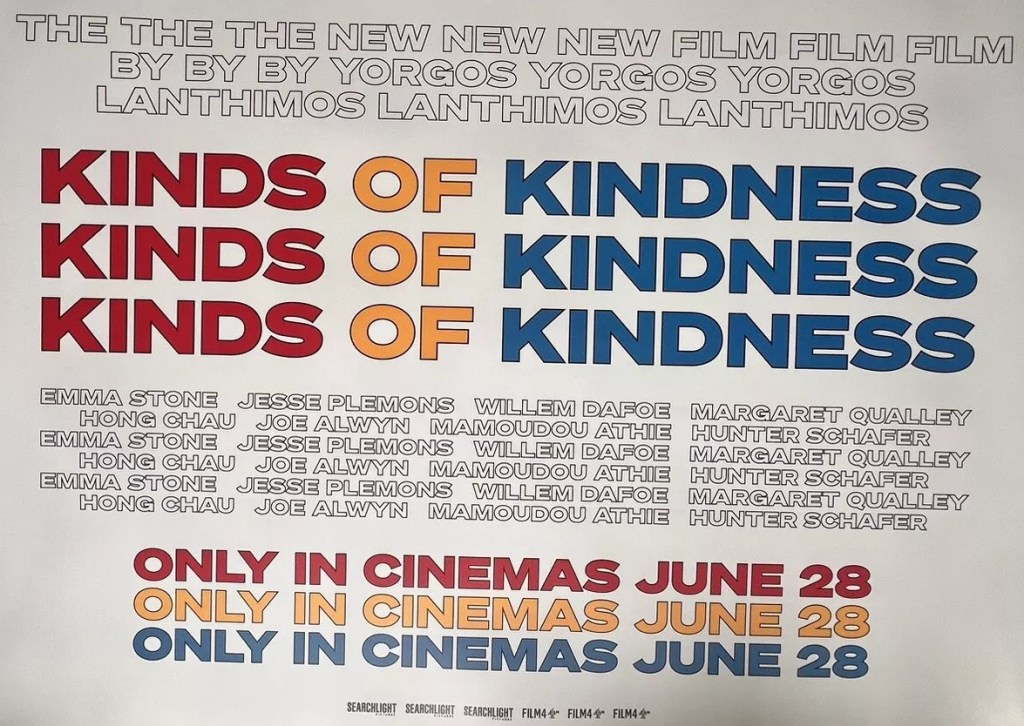
Kinds of Kindness (2024) *** – Seen at the Cinema

Wonder if director Yorgos Lanthimos (Poor Things, 2023) was tempted to go full tilt batshit arthouse boogie on this one and run it all as one big picture rather than setting it into neat episodes, the opposite of what Kevin Costner has done – and been lambasted for – in Horizon (2024). What a riot it would have been if critics had been set the jigaw of trying to work out what part the several main actors were playing at any given time. Am sure that would had had critics out of their seats at both ends of the appraisal syndrome.

As it is, the Dogma-esque notion of the the main actors each essaying three different roles doesn’t work. We all know they’re pretty good actors – Emma Stone (Poor Things) a two-time Oscar-winner. Willem Dafoe (Poor Things) a four-time nominee, Jesse Plemons (Civil War, 2024) nominated once – so they’re hardly needing to prove anything, least of all that they’re versatile. Would have been much better as an all-star (in arthouse terms) cast of nine actors and none of the episodic separation since the stories all take place in a similar disturbed Lantimos-esque world. In fact, you could have tucked the whole lot into Poor Things (2023) and not missed an artistic beat.

Sure, when you think of the episodes individually, it comes across as Twilight Zone-lite or Stephen King on an off day, with (except once) none of the satisfying resolution or alternately deliberating confusing endings. But when you run all the episodes together without any real differential it packs a lot more punch and the world is more fully delineated.

So you get a shipwreck survivor chopping a finger off to satisfy the mania of her husband and him preferring instead a whole leg though he’ll settle for a kidney. Same fella wants to check out old videos of his wife and they turn out to be wife-swapping ventures captured on film. A female jumps headlong into an empty swimming pool in order to facilitate some kind of superpower in her twin.

A cult revolves around determining contamination by licking skin. Their devotees derive mystical loyalty from drinking water into which their cult chief has dropped his tears. Sexuality is fluid, not just the wife-swapping, but bisexuality abounds, and within what might appear to be sexual freedom is a lot of coercive control. But if anybody’s going to get slapped around, it’s the men.

Did I mention the dogs controlling the planet? And a vet who’s too dumb to notice that the cut on a dog’s paw is far too clean to have come from an animal? And, in a riff from Sommersby (1993), the ill-fitting shoes that suggest an imposter. And that a husband is feeding his wife abortion pills?

This is all pretty much standard territory for Lanthimos. But where Poor Things took place is an all too unreal world, here everything would be legit – business, cops – except for the behavior of the characters.

So you wonder if, presented with the script, the main actors couldn’t decide which part they wanted and so Lanthimos just said, heck, play them all. And it’s true you’d have a hard time deciding which part each is best at although as a rule each actor is dominant in only two sections and less important in one. Personally, I’d go for Emma Stone as the shipwreck survivor going along with her husband’s madness in order to save their marriage. For Jesse Plemons I’d choose the businessman under complete control of his boss, down to the clothes he wears each, what he eats and at what time he makes love to his wife. For Willem Dafoe, I’d go for his creepy cult personality.

Just like Horizon, the length (164 minutes here) didn’t bother me. There was generally enough going on, what with all the twists, to keep interest high.  

This kind of has the feeling of one for Lanthimos rather than a more accessible one for a wider audience as instanced by The Favourite (2018) and Poor Things. The Academy might well respond to actors taking on more than one role though not quite in Alec Guinness/Peter Sellers fashion and if so the biggest nod should be in the direction of the under-rated Plemons.

Written by the director and regular collaborator Efthimis Fillipou (The Lobster, 2105).

Didn’t have me on the edge of mys eat, but I didn’t fall asleep either, and I certainly wasn’t fretting like some critics at the supposed waste of their valuable self-entitled time.

Discover WordPress

A daily selection of the best content published on WordPress, collected for you by humans who love to read.

The Atavist Magazine

by Brian Hannan

WordPress.com News

The latest news on WordPress.com and the WordPress community.