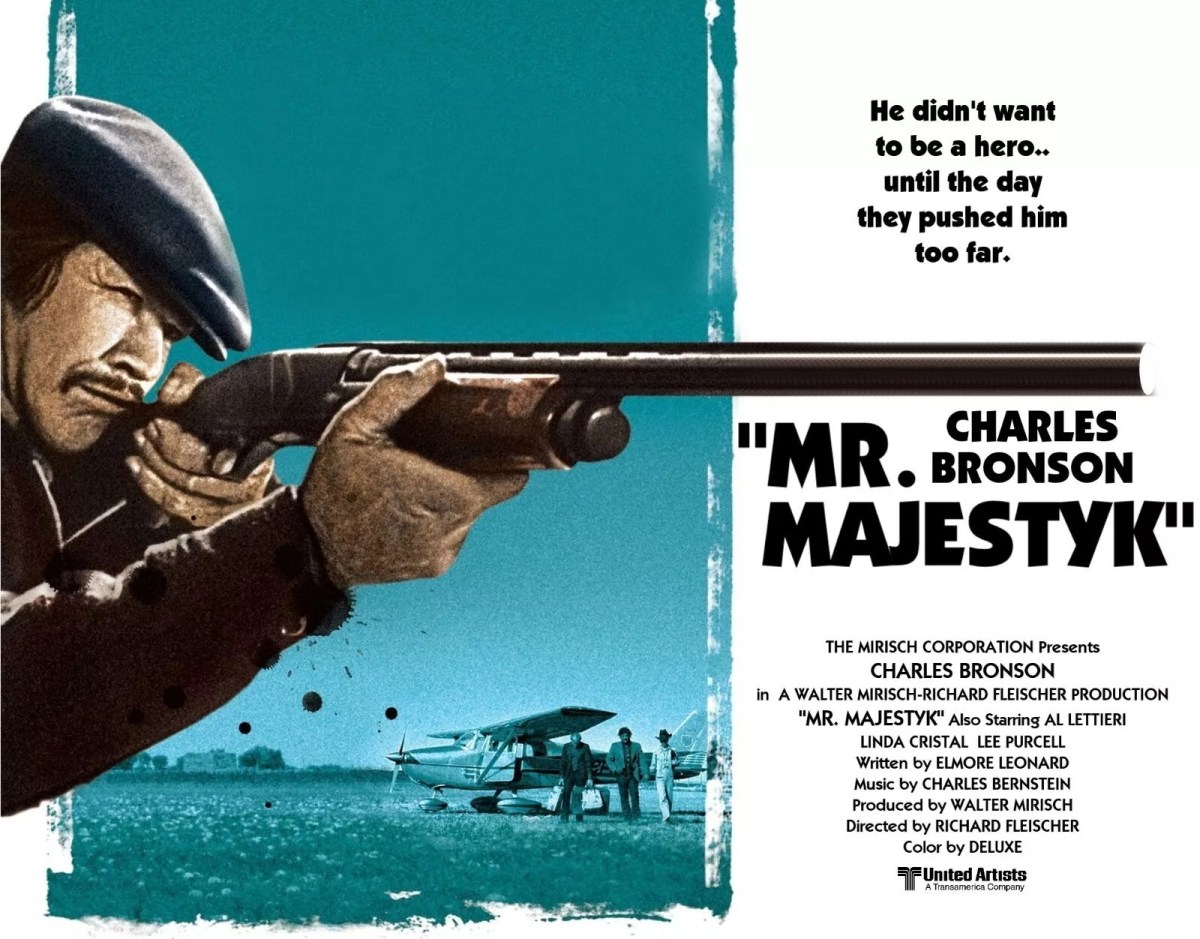
I interrupt the current program to bring you the hugely under-rated Mr Majestyk, now showing on Amazon Prime.
You read any critical assessment of the 1970s and if they talk about male actors at all it’ll be the “new wave” of Al Pacino, Robert DeNiro, Dustin Hoffman, Jack Nicholson, Gene Hackman, Oscar nominees/winners all. There’ll be nary a mention of the actors who kept the box office straight on a consistent basis for most of the decade. Clint Eastwood would come into the equation, but it wouldn’t be for Dirty Harry (1971) or Every Which Way but Loose (1978) but only when he flexed his directorial muscles. Charles Bronson never harbored any ideas of picking up a megaphone so he wouldn’t even have that saving grace.
Yet Eastwood and Bronson saved Hollywood before the big blockbuster like Jaws (1975) or Star Wars (1977) took off and for one specific reason. They attracted a global audience. When foreign receipts started to matter more than ever, these two delivered. And while the critically-adored actors dithered over choices and could scarcely be guaranteed to put out a picture a year, Eastwood and Bronson were dependable, occasionally ramping up output to three a year (1971 and 1973 for Eastwood, 1972, 1974 and 1976 for Bronson). They were old-school reliable performers. .
Mr Majestyk has been somewhat overshadowed because it appeared just before what some ill-informed observers deemed to be Bronson’s breakout picture, Death Wish (1974), and because it was helmed by the under-rated Richard Fleischer (The Boston Strangler, 1968) who never seemed to generate critical traction.
In fact, it’s a cracker – a pair of stunning car chases, full-on blow-away street battle, and the actor is one of his best roles. If anyone could play a farmer convincingly it’s Bronson, who looks as if he knows exactly what it’s like to put in a mucky day’s work (he was a miner). Vince Majestyk (Charles Bronson), in the watermelon line, falls foul of small-time organized crime in the shape of one of the most hapless hoods you’ll come across, Bobby Kopas (Paul Koslo). When Majestyk doesn’t take too kindly to Kopas trying to muscle in on the employment market, the farmer ends up in jail.
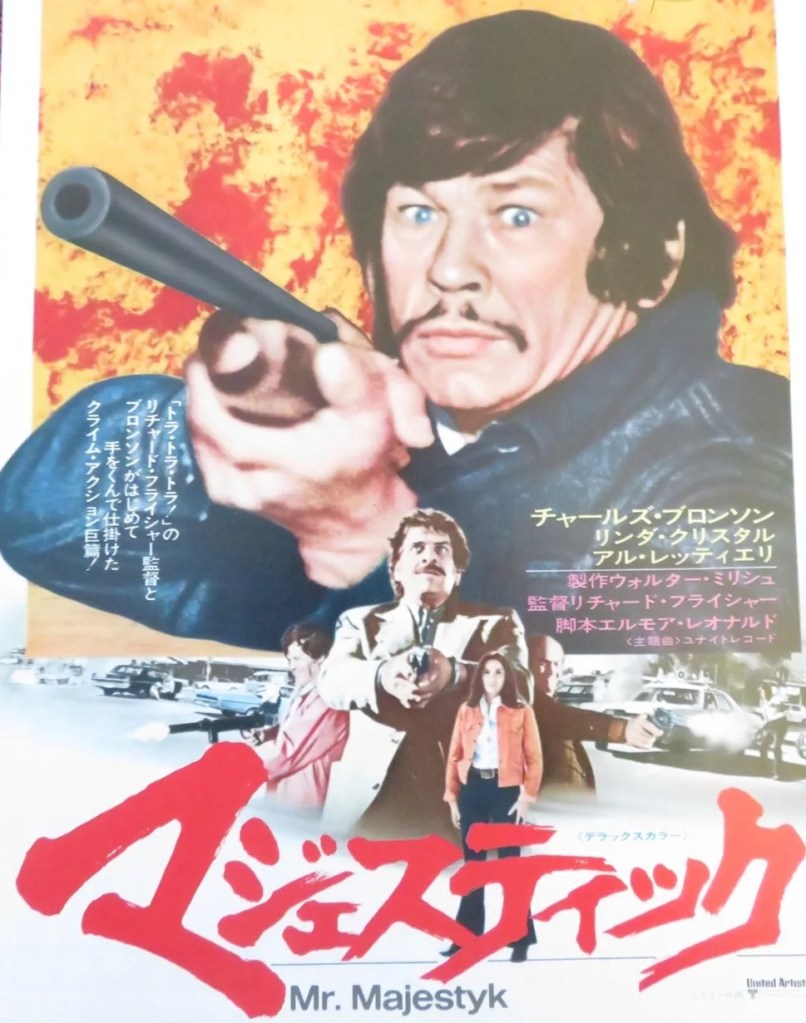
During a routine transportation, gangsters try to hijack Mob hitman Frank Renda (Al Lettieri) but despite going in all guns blazing the racketeers haven’t counted on Majestyk, who steals the bus, sees of the pursuing cops and robbers and hides out in a shack in the hills. He trades the mobster for the cancellation of charges against him by Det Lt McAllen (Frank Maxwell). But he’s duped by Renda’s backgammon-playing fashionable moll Wiley (Lee Purcell). On the loose, Renda is determined to get his revenge. The cops are happy to use Majestyk as bait.
Mexican Nancy (Linda Christal), a crop picker and union organizer, also enters the frame, and despite Majestyk, having recognized imminent danger, trying to stifle burgeoning romance, she keeps coming back. She’s a straightforward gal. “You want to go to bed with me, why don’t you just ask?”
But bait becomes bait-and-switch and soon it’s the gangsters who are on a wild goose chase, car passengers driven off the road during a wild chase over dusty mountainous country, others picked off by rifle until it comes down to a showdown at an isolated house.
While Majestyk has the muscle to give Renda an occasional slapping, he’s also got the sucker punch, duping the hoodlum time and again.
One of the elements that distinguishes this is that, apart from Renda, all the characters, good or bad, male or female, are soft spoken. Even Lt McAllen isn’t always chewing someone out.
Although the car chases have been compared to Bullitt (1968) and The French Connection (1971) they have much more in common with Fear Is the Key (1972) where we are miles away from slick city roads. Plenty opportunity for vehicles to sail through the air. Nancy proves something of find behind the wheel, and Vince pretty game in the back of the truck being bounced six ways to Sunday by her driving.
Outside the action, several excellent scenes – the gangsters shooting up the watermelon crop, headlights ominous in the dark, a crop-picker being smashed by a car, Kopas being put in his place by Renda. Not only is the romance in a low register, but Bronson is in a low key, resigned to what he cannot change, but taking charge with blistering speed when he can.
This was a deliberate change of pace in terms of characterization from Bronson following the more action-oriented Chato’s Land (1972), The Mechanic (1972) and The Stone Killer (1973). There’s none of the usual brooding menace. He’s a farmer, not a killer.
Despite a long stretch in The High Chaparral (1967-1971), this was the first movie in six years for Argentinian Linda Cristal who’s effective rather than a scene-stealer which the cool Lee Purcell (Kid Blue, 1973) definitely is in non-showy fashion. By contrast Al Lettieri (The Godfather, 1972) eats the scenery, which is his job, as he turns from cat into mouse.
More than ably directed by Richard Fleischer from an original screenplay by Elmore Leonard (The Big Bounce, 1969).
A must see.
 The Magnificent 60s