
The Critic (2024) ** – Seen at the Cinema

Can we get over all this “national treasure” (a favorite of Britain) baloney, please? If we’re going to drag our esteemed acting knights of the realm out of their armchairs (you notice I didn’t say retirement because actors almost never officially retire, Kathy Bates and Gene Hackman to the contrary) could we please give them something more than an opportunity to overact and turn themselves into ripe old hams at the age of (in this case) eighty-five. Sir Ian McKellen (Gandalf and Magneto to you and me) deserves better.

Because there’s nothing at all in this beyond Falstaffian monster Jimmy (Ian McKellen), the eponymous theater critic, relishing his power and taking revenge when’s on the verge of losing it. Frankly, if this was called The Tie-Pin Killer, the serial murderer in the book on which this is based, and Jimmy, as in that book, was relegated to a bit part, albeit a juicy one, it might have been a lot more interesting.
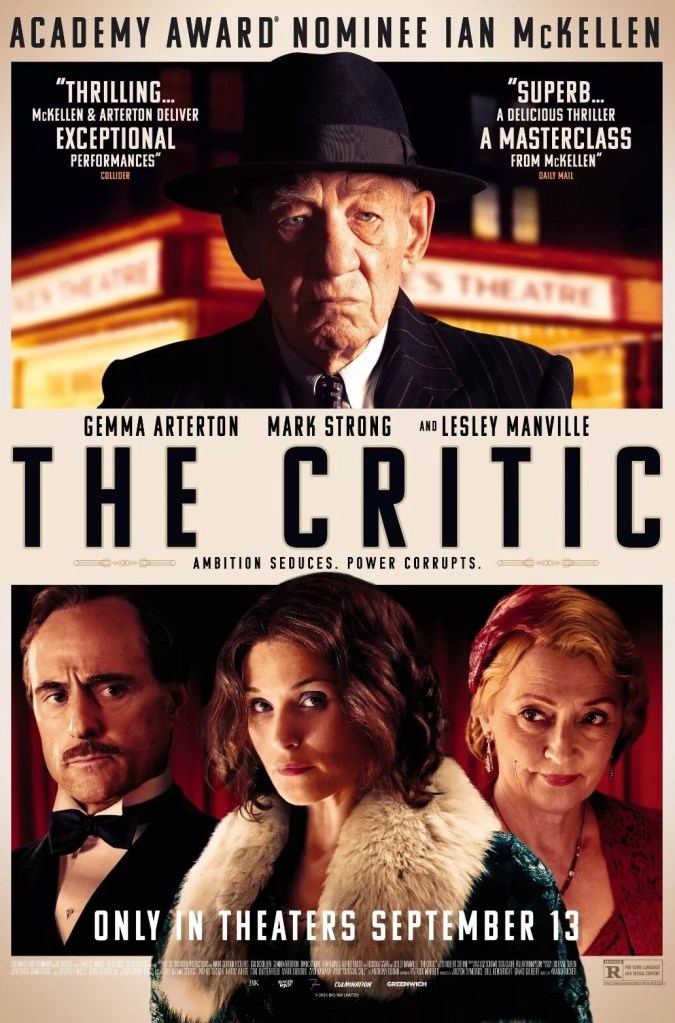
While it touches upon 1930s London Fascists and the plight of the homosexual (a criminal offence to participate) these are kind of tossed into the scenario as if to placate an audience who might complain this is very thin gruel indeed. Presumably, we are somehow meant sympathize with this cruel, odious, character because from time to time he finds himself confronted by blackshirts, who take a dislike to his black companion Tom (Alfred Enoch), who acts as his secretary and presumably not anything else because Jimmy prefers “rough trade.”

In revenge for being fired, he sets up actress Nina (Gemma Atterton) to seduce his employer David Brooke (Mark Strong). Blackmail’s the tool of reinstatement. Apart from general actor insecurity, it’s not entirely clear why Nina should be so determined to keep in Jimmy’s good books. There’s some unbelievable stuff about becoming attracted to acting through reading his articles, which seems quite bizarre since his nasty reviews would put people off going, as he proudly explains is one his aims.

So Nina prostitutes herself for a good review. Yep, must happen all the time. And despite her supposed success – these are, after all, West End plays she is starring in – she lives in a bedsit where hot water is rationed. But she is, romantically, in a bind. She’s just dumped her married lover Stephen (Ben Barnes) whose wife Cora (Romola Garai) just happens to be the daughter of Brooke.

And although Brooke’s wife is “bonkers” (though that’s very much on the periphery) he’s that old-fashioned upper class English gent who only feels shame at adultery when he’s caught out and then of course does the right thing which is to blow his brains out. Which leaves Nina racked with guilt which drives her, as it would, back into the arms of Stephen only for him (another adulterer with principles) to reject her on the grounds that she slept with his father-in-law. When Nina begins to talk about confessing to her role in conspiracy, what’s an upstanding chap to do but drown her in the bathtub?
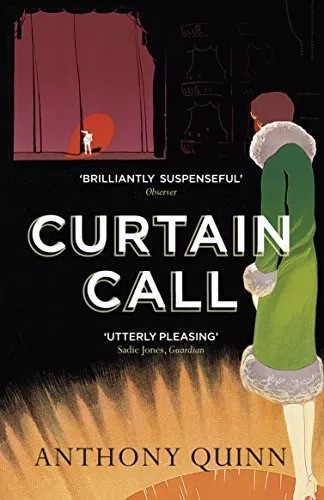
In the original book Jimmy was a minor character.

Crikey, and we complain about the plotting in the multiverse. This is just bonkersverse. Presumably, Oscar-nominated screenwriter Patrick Marber (Notes on a Scandal, 2007) happened upon Anthony J. Quinn thriller Curtain Call in which Jimmy exists on the periphery of the actual narrative though as a larger-than-life character and decided to forget the whole tie-pin killer thing and rearrange the tale so it revolved around McKellen in the hope nobody would notice, in the midst of McKellen roistering and boistering to his heart’s content, the lack of any sensible tale.

You could certainly have more easily hooked it on Nina, who falls into the Patrick Hamilton category of easily-led character on the edge with impulse inclined to cut her adrift.

If you want ham, McKellen’s your man, none of the subtlety which has impelled other performances. Gemma Atterton (The King’s Man, 2021) has a few moments tormented by conscience but the part is woefully underwritten. This is the reined-in Mark Strong (Tar, 2022) rather the one with the veins standing out on his neck. Lesley Manville (Mrs Harris Goes to Paris, 2022), potentially another future national treasure, has a brief role as does Romola Garai (Atonement, 2007).

Maybe wanting to burnish his artistic credentials, director Anand Tucker (Leap Year, 2010) is predisposed to the extreme close-up and for viewing a scene in extreme long shot through a corridor, window or door.

Jimmy would give have slated this.

Mrs Harris Goes To Paris (2022) **** – Seen at the Cinema

How is that the British, way down now in the rankings of global movie production, have come up with a successful genre all of their own – the national treasure. Maggie Smith and Helen Mirren to be sure first came to prominence in the same year, 1969, with The Prime of Miss Jean Brodie and Age of Consent respectively, but whereas Hollywood has turned its back on the ageing female contingent, the British film industry has wrapped its most famous stars in cotton wool and proceeded to give them roles they can take to the Oscar bank.

Mirren was in her early 60s when she romped home in The Queen (2006); you only have to say Downton Abbey and Smith, already two Oscars to the good, is regarded as screen royalty. And that’s before Judi Dench enters the equation, a few years older than Mirren when she nabbed the Oscar for Shakespeare in Love (1998). You can pretty much count on getting funding for any picture if you can rustle up any of this trio. Want to bring back the older crowd? Dangle these carrots!

Elevated into this category now is Lesley Manville, the 66-year-old star of the delightful Mrs Harris Goes to Paris. While largely escapist, there’s enough of a contemporary vibe, a Paris redolent of filth, the downtrodden going on strike, to provide an edge, and a narrative that continually punctures dreams any time fantasy looks like running away with itself. Set in 1950s London and Paris where the poor know their place, and are rigidly kept in it by the arrogant rich, but where aspiration can at any moment take flight.

Cleaner Mrs Harris, dreaming of buying a £500 dress – we’re talking the best part of £14,000 these days – scrimps and saves, and through a couple of more than fortuitous events, finds her way to the House of Dior where she is despised by haughty manager Claudine (Isabelle Huppert), adored by philosophic model Natasha (Alba Baptista) for having such aspirations, and manages to cast a spell, although not for the reasons expected, over rich widower the Marquis de Chassagne (Lambert Wilson).

There’s not much plot. She has to remain in Paris for a fortnight for fittings and whiles away the time helping along the romance between under-manager Andre (Lucas Bravo) and Natasha, assisted by their existentialist leanings, eventually overcoming hostility and putting everything to rights in the Dior empire. But you don’t need plot when you’ve got charm. The English notion of fair play initially comes a cropper when facing French egalitarianism out of whack, when the rich can jump the queue and basically make everyone jump to their tune. But when a character like Mrs Harris settles for second best you can be sure she’ll come up trumps. Whether it’s icing on the cake or to make a rubbish-strewn Paris more palatable, there’s a good ten minutes of oo-la-la devoted to parading the latest fashions.

Not content with conquering one city, Mrs Harris developed sequelitis and headed for New York.

And there’s not just a philosophical undertone – people not what they appear on the surface – but a feminist one, women holding the world together while men whistle. But by and large it’s joyous entertainment, a confection straight out of the Hollywood top drawer, a poor woman having her day in the sun through sheer strength of character.

Unless you’re British or a big fan of arthouse director Mike Leigh or noticed her Oscar  nomination in the largely unnoticed The Phantom Thread (2017) Lesley Manville will probably have passed you by. She nabbed a cult following as the dumped-upon lead in comedy series Mum (2016-2019) and picked up a wider audience as Princess Margaret in The Crown, but mostly she’s known for a certain kind of acting, where she can change expression 20 times in a minute without ostensibly doing anything different. Just like her predecessors, Smith, Dench and Mirren.

You can’t take your eyes off her, which is quite feat when she’s up against French screen royalty (perhaps a “tresor national”) Isabelle Huppert (Elle, 2016). Alba Baptista (Warrior Nun series) could well be the breakout star here though Lucas Bravo definitely runs her close. I saw Bravo in Ticket to Paradise (2022) and the characters there and here could not be more different. Ellen Thomas (Golden Years, 2016), Lambert Wilson (Benedetta, 2021), Anna Chancellor (For Love or Money, 2019) and Jason Isaacs (Operation Mincemeat, 2021) have smaller roles.

Director Anthony Fabian (Skin, 2008) adds deeper issues to a movie that was crying out to be all surface. He co-wrote the screenplay with Carroll Cartwright (What Maisie Knew, 2012) based on the classic Paul Gallico novel.

Discover WordPress

A daily selection of the best content published on WordPress, collected for you by humans who love to read.

The Atavist Magazine

by Brian Hannan

WordPress.com News

The latest news on WordPress.com and the WordPress community.