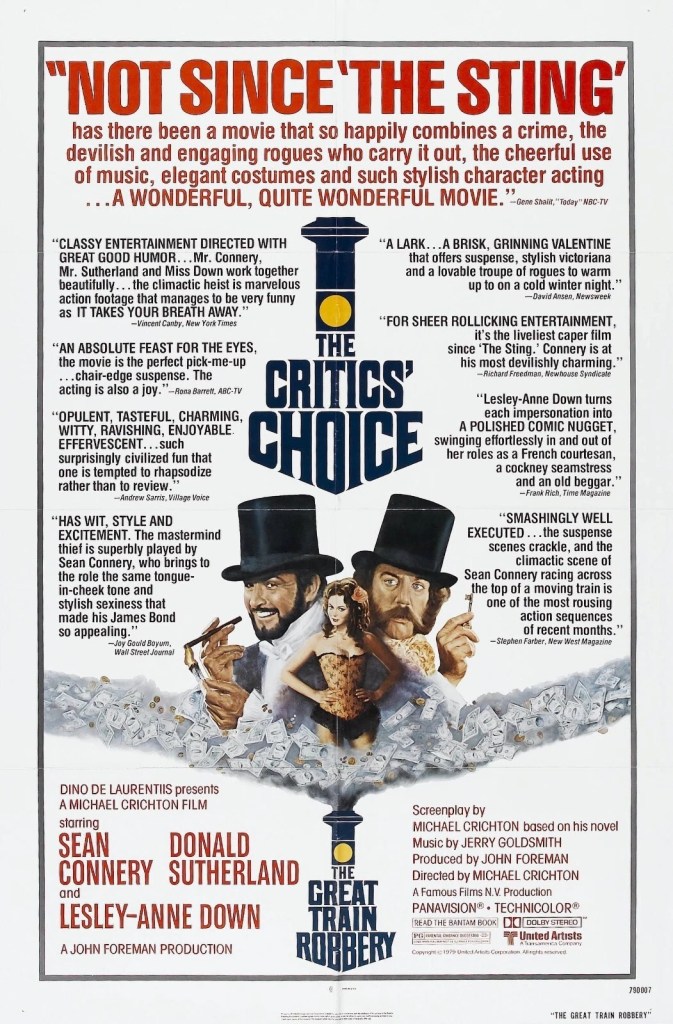
Brannigan (1975) ***

File under guilty pleasure. And bear in mind in the early 1970s there was no such thing as the police procedural, certainly not as we know it today, when cops have the benefits of DNA, increased forensics and computer technology. Hollywood in this era didn’t waste time with endless knocking on doors or collecting massive amounts of minutiae in the hope of uncovering a clue.

Generally speaking, cops of this period had two things in common. They were mavericks and they constantly fought authority usually represented by some dumb superior. Normally the narrative consisted of the character taking on the  persona of a bull in a china shop and thundering towards a main objective, the more set pieces to demonstrate said bullish tendencies the better, and if in the course of apprehending a criminal he can deliver a catchphrase such as “make my day” or, as here, “knock, knock,” so much the better.
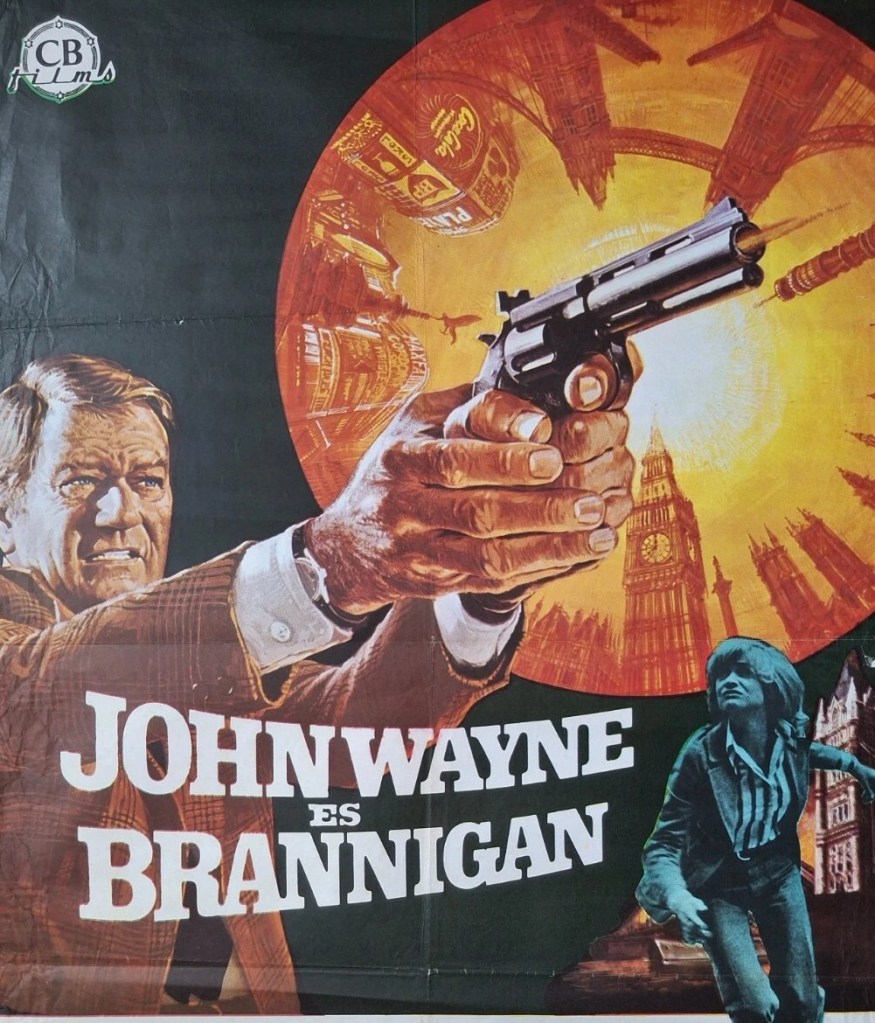
John Wayne had made eight westerns in a row and having turned down Dirty Harry (1971) ventured into the cop genre with McQ (1974) and came straight back for seconds here.

Brannigan (John Wayne) has been shipped over to London to bring back under the extradition treaty Mob gangster Larkin (John Vernon) which would be pretty straightforward except the Brits don’t keep such prisoners in custody – Larkin swans around in a white Rolls Royce – and in any case he’s in custody of another kind, having been kidnapped by some British hoods.

In terms of authority Brannigan battles the sappy Brits who won’t allow him to carry a gun and do things the Chicago way. Luckily, for the picture, top cop Commander Swann (Richard Attenborough) is not the standard stiff-upper-lip buffoon but as likely to pitch in when the fisticuffs begin. There are a couple of excellent car chases and one stunt of French Connection (1971) quality when two cars go sailing over the gap in a raised Tower Bridge. This is a London mixing glory and grit, posh residences and ancient buildings share screen time with rundown docklands. And the movie has the sense not to go all May-December on us and while a certain affection builds up between the U.S. cop and his driver Jennifer (Judy Gesson), it doesn’t teeter into unlikely romance.

The plot’s clever. While in a sauna having a massage Larkin is knocked out cold and bundled into a sweatbox by two apparent delivery guys and then smooth attorney Fields (Mel Ferrer) acts as the go-between, delivering Mob ransom money to the kidnappers, the price increasing with every failed rescue attempt, until the kidnappers are sitting on a cool million. Naturally, there’s some double-crossing and the cops have one tiny magic bullet to use to their advantage.

So mainly the fun is watching Brannigan charge around in a British china shop, mostly bypassing British rules. There’s a subplot involving a hitman hunting Brannigan and even when in a normal cop movie you might think, fair’s fair, the policeman should be able to defend himself with a weapon, that doesn’t equate with the British rules, so you have our hero able to point out that if he wasn’t armed to the teeth Jennifer would be dead, while Swann does his best to insist that it would be better for the young lass to end up on a mortuary slab than British cops go rampaging around with guns.

There’s some gentle fun in poking at British tradition – the obligatory wearing a tie in certain upmarket establishments – and in Swann having to translate to a waitperson Brannigan’s breakfast order.

Except when standing up for rules, Swann is great value, a good match for the American, both in tempering his ruthlessness, and matching him punch-for-punch in a brawl.

Apart from the action sequences, John Wayne is permitted to grow old gracefully, his dialog rarely filled with barbed retorts or salty words and there’s quite nice acting on the Duke’s part when he’s called upon to demonstrate his special skill, which is “reacting”.

Richard Attenborough (Only When I Larf, 1968) has a ball, and not before time, able to let some of the usual repressed intensity burst out. Judy Geeson (The Executioner, 1970) must have been delighted to find a part that didn’t involve her taking off her clothes and she’s afforded some of the best lines. John Vernon (Topaz, 1969) is his usual hardass but Mel Ferrer (The Fall of the Roman Empire, 1964) has a good stab at a bad guy.

Not in the same league as director Douglas Hickox’s Sitting Target (1972). Written by Christopher Trumbo (The Don Is Dead, 1973), William McGivern (The Wrecking Crew, 1968), Michael Butler (The Gauntlet, 1977) and William Norton (The Scalphunters, 1968).  

Erroneously tabbed as a box office disappointment, this was made on a budget of $2.6 million but cleared $7 million in rentals (the studio share of the box office) plus another $1.5 million from television.

Obviously, if you’re in the Clint Eastwood camp this falls short, but otherwise it’s enjoyable stuff.
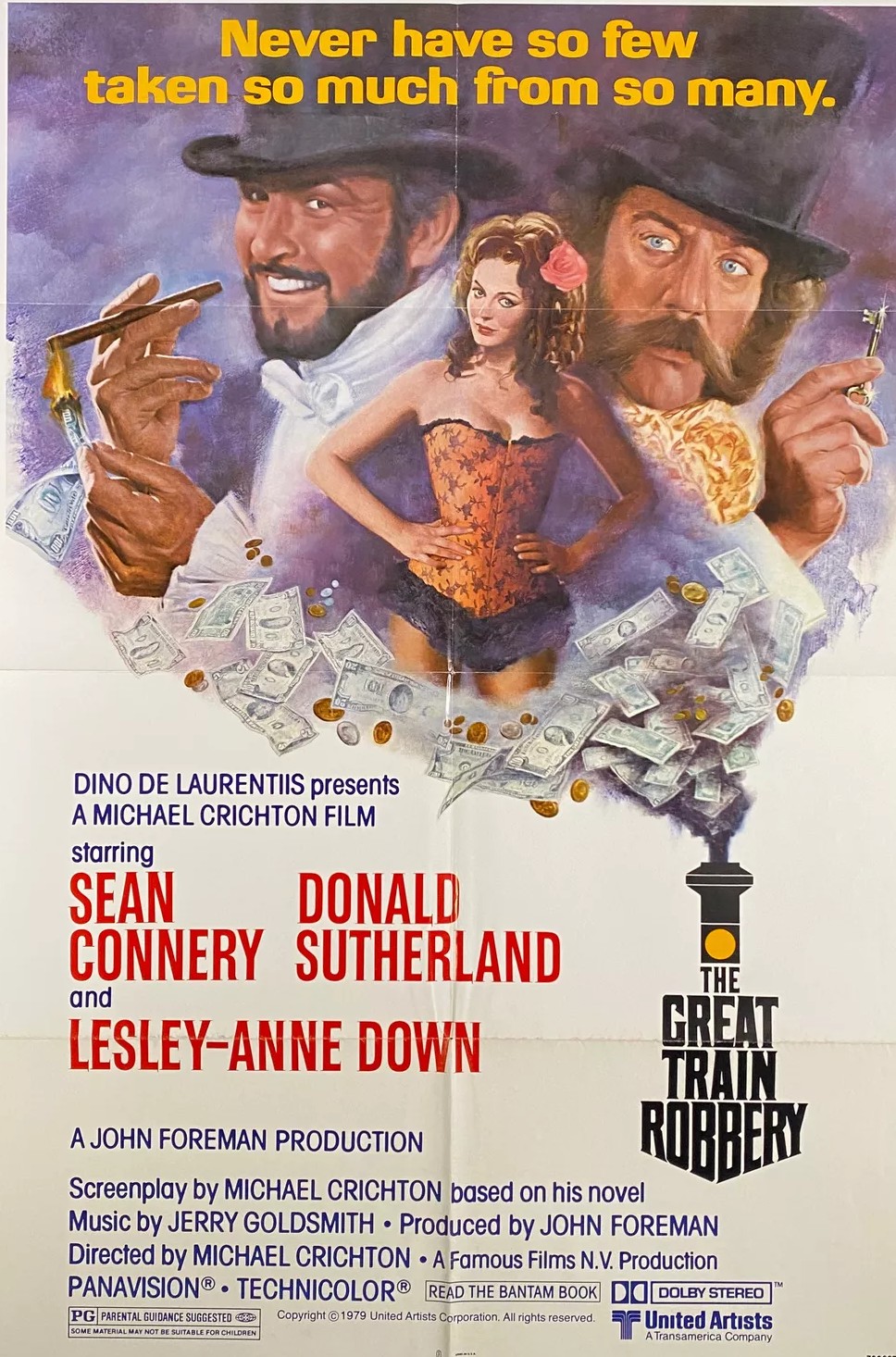
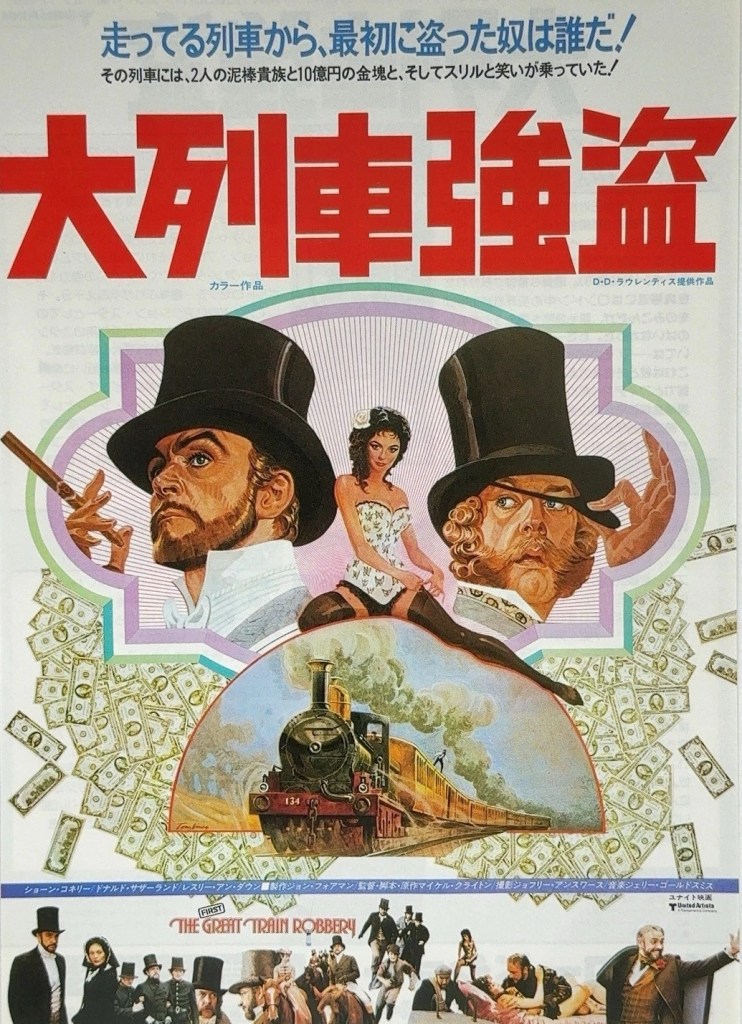
The Great Train Robbery / The First Great Train Robbery (1978) ****

Back in the day your IP was the star. And here Sean Connery (The Hill, 1965) is the essence of that belief. The camera homes in on him. He steals every scene with an effortlessness that takes your breath away even as co-star Donald Sutherland (Don’t Look Now, 1973), complete with bizarre sideburns and winks to the audience, is huffing and puffing to compete.

Come at it as the standard heist movie and you will struggle to enjoy it because it is made up of too many different components. But approach it from a different perspective, that of The Sting (1973) as one critic suggests, and it takes on a different complexion and the getting there becomes a whole lot of fun. The background, Victorian England of the 1850s, doesn’t help so much as the sets look like they’ve been plundered from Oliver! (1968) and dirtied up a bit.

It’s worth remembering that in an era when the Mission Impossible series has been constantly sold on Tom Cruise undertaking his own stunts that Sean Connery did something much more dangerous than anything attempted by Cruise which was to race along the top of a train travelling at 55 miles an hour.  

And if you need some contemporary analogy, look no further than the rich get richer and mostly through plundering. The ending presents the notion of a Robin Hood outwitting the forces of law and order to the acclaim of the public. But that would be to overlook the fact that chief thief Pierce (Sean Connery) is already so wealthy from previous nefarious dealings that he hobnobs with the rich, so accepted in their world of male clubs and high society that, like a financial trader, he is able to pick their pockets of vital information.

Though it’s not quite that easy. The target is a trainload of gold bullion heading for the Crimean War. And the two safes containing the dosh require four keys, each under the control of a different high-up official, requiring several separate audacious thefts. This involves some play-acting from the principals, dressing up in the main from female accomplice Miriam (Lesley Anne Down), clever duping by Pierce and old-fashioned burglary from pickpocket Agar (Donald Sutherland) who waves his fingers around like a demented Fagin, and whose main job is make wax impressions of stolen keys.

So Pierce pretends to be the ardent wooer of the daughter of one of the key holders, and Miriam essays a prostitute to relieve a key holder of the precious possession he wears around his neck. But the other two keys require a more professional approach which involves first of all the springing from prison of cat burglar Clean Willy (Wayne Sleep) to break into the guarded railway premises in a time-dependent operation.

But the cops get wind of the plan and increase security on the train, including adding a new padlock to the outer door. “Find me a dead cat!”, while not quite in the league of “The name’s Bond, James Bond” might well count as one of the best lines ever uttered by Sean Connery.      

Said deceased animal is brought in to supply the necessary stink for a corpse should the cops consider opening the casket containing Agar which is to travel on the train, providing the team with the necessary inside man. But Agar and Miriam as the weeping widow of the supposed dead man have very little to do compared to Pierce who has to climb on top of the train, racing along the speeding top, drop down the side in an improvised harness and pick the padlock, then do the whole thing in reverse.

I may be wrong, and I’m sure someone will correct me if I am, but if this wasn’t the first time running along the top of a moving train was employed in a movie it certainly set a new standard, especially in the willingness of the actor to carry out his own stunts.

Pretty much all that remains after that is the twists that see Pierce captured and then escape. You could pick a few holes in it if you wish. The fact that after Pierce swapping coats (the one that had lain beside a dead cat for hours and provided sufficient stink to convince the lawmen) with Agar, nobody noticed the smell seems unlikely. The same would apply to bank manager Fowler (Malcolm Terris) who fails to spot that the widow he shares a compartment with for the entire journey is the prostitute who duped him, though that prospect does increase the tension.

If you’re expecting a standard heist movie then this takes way too long to come to the boil, but if you go along with the conceit and enjoy the playing especially of Sean Connery and ignore the mugging of Donald Sutherland it is in the forefront of the best robbery pictures.

And it’s worth noting the little gems in Connery’s acting. There’s a scene where Lesley Anne Down is berating him for making her become a prostitute (implicit is her fear she might actually need to have sex with the client). He’s eating an orange. Ignoring her complaints as just part of the job, he offers her some of his fruit as if his main worry is being seen to be rude hogging the fruit to himself.

Connery proves exactly why you hire a star. He carries the picture. There’s a lightness to his overall performance, notwithstanding the few times he needs to take a tougher line, that makes the film a joy. Whereas Donald Sutherland is either too heavy-handed or overacting. This proved a breakthrough role for Lesley Anne Down (British television’s Upstairs, Downstairs, 1973-1975).

Director Michael Crichton (Westworld, 1973) cuts himself too much slack in the first half of the picture which could have been considerably tightened up but comes into his own with the tension and twists of the heist and he has the good sense to rely on Connery’s interpretation of Pierce. He also wrote the script based on his own novel, a fictionalization of the actual original robbery attempt.

There already had been an incredibly famous Great Train Robbery in Britain in 1963, hence the need to differentiate this from that by inserting the prefix “First” to the advertising in Britain.

Great fun and worth a watch.

Discover WordPress

A daily selection of the best content published on WordPress, collected for you by humans who love to read.

The Atavist Magazine

by Brian Hannan

WordPress.com News

The latest news on WordPress.com and the WordPress community.