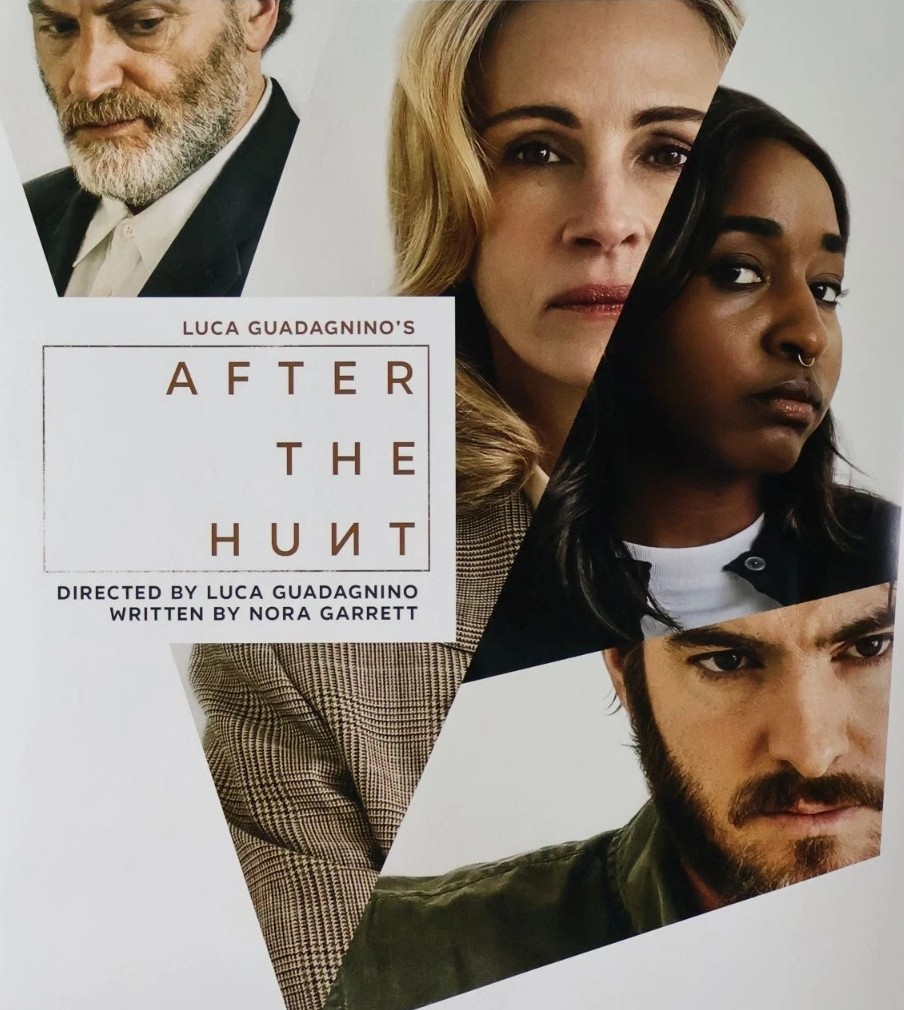
Don’t you hate it when directors want to have their cake and eat it? Effectively, this is a fairly humdrum MeToo thriller but looks like it’s written by a dozen op-ed columnists taking aim at half a dozen targets, populated by little more than cliche characters, wrapped up in a fog of pretension, and spectacularly sabotaged by a deus ex machina ending that no amount of Oscar-baiting can salvage.
Large gobbets of narrative are missed out, theoretically so we make up our minds about the characters but in reality because the director can’t make up his mind where he wants to go. When the director can’t make up his mind how to frame a scene he resorts to showing us hands.
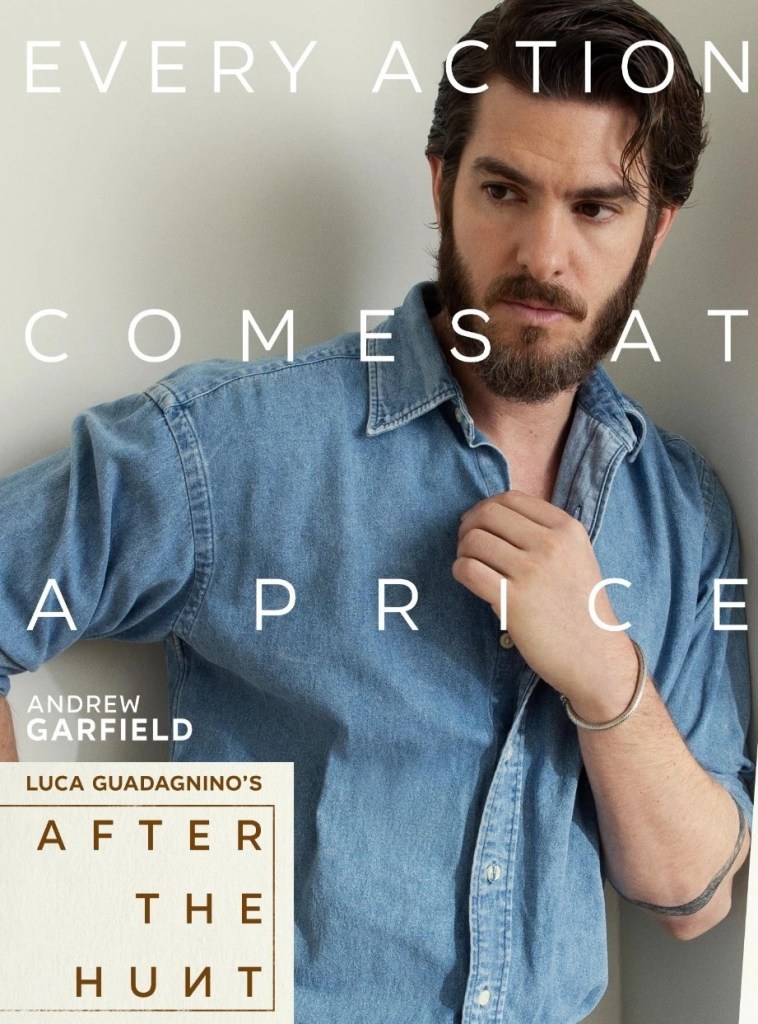
So here’s the myriad scenarios at play. Married alpha female Alma (Julia Roberts), pushing 60, a philosophy professor, adored by her students, with whom she flirts at will, is battling a pushing-40s singleton rival Hank (Andrew Garfield), adored by his students, with whom he flirts at will, for a coveted tenure at Yale. Quite why Alma, at her age, hasn’t achieved tenure before is never explained. To help heat things up, Hank has the hots for the older woman.
Wealthy gay student Maggie (Ayo Edebiri) claims Hank raped her and he’s fired. Pressure is brought to bear on Alma to back Maggie. But there’s a twist. Or theoretically, there’s a twist. Hank is about to expose Maggie as a plagiarist so she’d use any excuse to get rid of him. Theoretically. And this is one of the many ways in which the picture ties itself up in knots because Maggie doesn’t know about Hank’s suspicions.
Maggie also knows Alma’s big secret because hunting in a toilet cabinet for toilet roll she finds taped to the underside of a shelf an envelope containing stuff that might (it later transpires) allow Maggie to happily set Hank up on the assumption Alma would take her side.
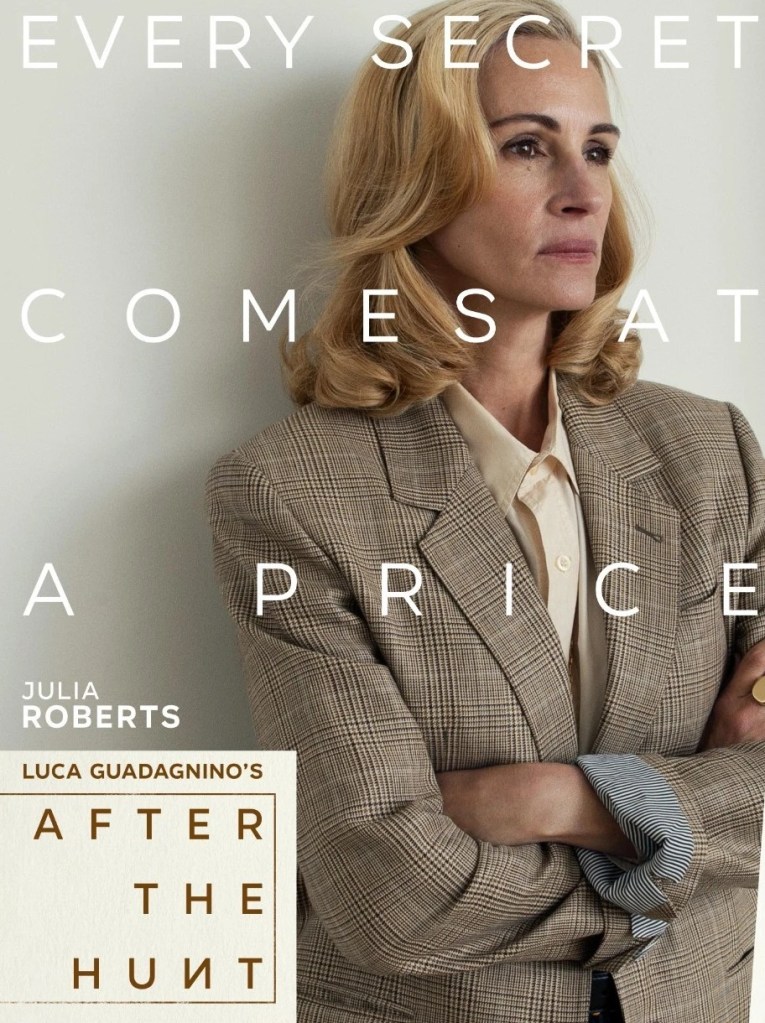
This he said/she said plays out to a mess of philosophy. The screenplay takes potshots at each generation in turn, the older one represented by Alma, the next one represented by Hank and the entitled younger contemporary one represented by Maggie who take up vicious arms against anyone who oppose their limited point-of-view, i.e. the cancel culture generation.
But there’s something wrong with Alma. She takes a couple of pills first thing in the morning and is prone to collapsing in pain. But being the philosophic sort, she’s a stoic and doesn’t tell faithful husband Frederik (Michael Stulbarg) and is popping other pills at other times. But she’s committed the grievous sin of not fully endorsing Maggie and the pupil has stirred up her friends to arms.
Given Alma’s been caught stealing a prescription and is hauled before the departmental authorities, it seems she’s for the high jump. But, lo, suddenly she’s handed a miraculous get-out-of-jail-free guard. Surrounded by baying students, she collapses. Naturally, this being the social media generation, this encounter is filmed. Turns out Alma has perforated ulcers. And the outcome is that the students end their opposition to her (in case, presumably, they are blamed for causing said collapse), and the department decides that stealing prescriptions can be swept under the carpet, so she gains tenure, Hank is cast out into the wilderness and Maggie transforms herself into a MeToo poster girl for Yale.
But that’s not even the barmiest part. Alma’s big secret is that, as an underage teenager, she was seduced by an older man. She only exposed him when he dropped her for another woman and he committed suicide. Despite common sense telling her that she was not to blame, she persists in wallowing in guilt, viewing the man who abused her as the victim of her wiles. Which just goes to show you can study Kierkagaard and philosophers till the cows come home but if it suits a barmy director’s narrative purpose you will end up being presented as dumb as all get-out.
So this all plays out against a backdrop of philosophical gibberish and Frederik’s jealousy of the attention lavished, by males and females alike, on his charismatic wife.
When a marketing team goes down the Oscar-bait route – see Dwayne Johnson and The Smashing Machine – and claims stunning acting is the reason for seeing a movie devoid of the more essential audience engagement you know you’re in for a rough ride.
Sure, both Julia Roberts (Ticket to Paradise, 2022) and Andrew Garfield (We Live in Time, 2024) have dumped their usual cuteness but it’s not enough to save the picture. Ayo Edebiri (Omni Loop, 2024) is left with no choice but to over-act. Directed by Luca Guadagnini (Challengers, 2024), written by Nora Garrett in her debut.
I saw four movies in two days and in all honesty Gabby’s Dollhouse best fulfilled audience expectation.
This is not just a complete dud but way past its meager theatrical run is going to annoy the hell out of everyone as marketeers and critics try to position Roberts as an Oscar contender.
The worst kind of lazy filmmaking.

 The Magnificent 60s