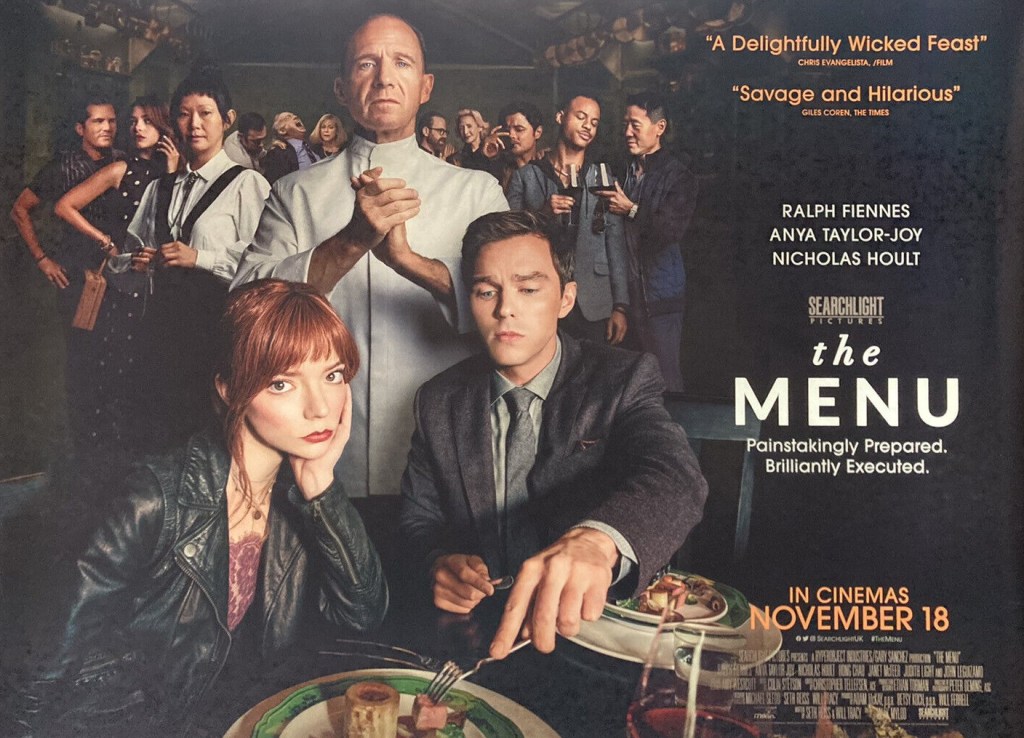
Violent Night (2022) **** – Seen at the Cinema

Just about hits the balls-eye (sorry, bulls-eye) but falls short through miscalculating its target audience. A little bit of rejigging in the inevitable sequel could see this shine. Roughly, Die Hard meets Home Alone. That’s putting it a bit crudely, but swap skyscraper for billionaire’s mansion and a little boy for little girl and you get the drift.

What gets this very much over the line are the little bits of magic, as appealing as they come, and Santa has a get-out clause (literally, and no pun intended) because in dire emergency he can vanish up any nearby chimney and though he’s aware there’s magic involved he has no idea how it’s done. Plus he has a scroll to hand, a cribsheet that separates the good from the bad.

Bad moon rising? Less of the ho-ho-ho and more of the bah humbug and it just goes to show that a man and his hammer should never be parted.

Home Alone defensive techniques have escalated since Macauley Culkin’s day, and though “You Filthy Animal” is referenced young Trudi (Leah Brady) has a mouthful of real cuss-words, plus nails her weapon of choice. It’s cleverly done how she links up with the inebriated self-pitying Santa (David Harbour) and there’s a grimace-inducing finale – the true spirit of Xmas and all – that sails close to the wind for a hardnosed thriller but par for the course for a soppy Xmas saga.

So that’s really the only problem. The picture can’t quite make up its mind in which direction it’s headed. Hard-ass with a soft center is clearly the aim, but there’s just too much gore to pull that off. Sure, some of the killings are comic, but they’re helluva bloody too. And there’s a weird backstory – even weirder than John Wick’s assassin commandments that shalt not be broken – involving (I think) something to do with Vikings and a guy who can’t die, not exactly a zombie because he’d already be dead, and thankfully he doesn’t need blood to slake his thirst, but still he’s been around for a millennium, though, truth be told, the actual date Father Christmas first appeared is not exactly set in stone.

On the other plus side, the family whose home is being invaded by villainous “Scrooge” (John Leguizamo) – color and city pseudonyms all taken by previous fictional gangsters – are just plain venal, toadying up to ruthless matriarch Gertrude (Beverly D’Angelo) whose vault bulges with gazillions of illicit dollars. Her potential heirs, Jason (Alex Hassell) and Alva (Edi Patterson), are a cringe-worthy pair. While Jason at least is attempting to sever connections to malicious mama, Alva has named her son Bertrude in a bid to curry favour.  And when push comes to shove, most of that family will sacrifice every last one of their nearest and dearest.

So, basic story, family in the sh*t, drunken Santa and little girl to the rescue.

There’s some clever twists. Jason isn’t quite the dolt you think, Alva’s macho boyfriend-cum-actor turns out to have muscular chops while Jason’s partner Linda (Alexis Louder) is quite the vengeful one.  

Endearing to the last, Trudi channels her inner Macauley Culkin with a side-serving of her grandmother’s ruthlessness and, taking Home Alone as her template, effectively slices and dices her opponents. And my guess is that’s the vibe the producers were chasing – fun slaughter. They don’t miss by miles, but they do miss. And an audience that would have happily lapped up the outrageously vicious Trudi will probably not relish the rest of the gory goings-on while a John Wick audience will feel hard-done-by that even a sliver of cuteness has penetrated their hardcore world.

And it’s that rarity, an action comedy with a good few belly laffs rather than the usual situation where you see what they’re trying to do but don’t actually burst out laughing.

David Harbour (Black Widow, 2021) isn’t left to carry the picture but his cynical manner, catchphrases, and surprisingly gentle approach certainly bring it home. Leah Brady, graduate of the Umbrella Academy (2022), is New Wave Cute, soft with a hard center. Beverly D’Angelo (National Lampoon’s Vacation, 1983) can;t believe her luck at sinking her teeth into such a vicious character.

Director Tommy Wirkola (Hansel and Gretel: Witch Hunters, 2013) just about gets it right, especially unusual to be able to marry action and comedy, working from a screenplay by Pat Casey and Josh Miller who co-wrote Sonic the Hedgehog (2020) which was also a matter of getting the balance right.

Great fun all round. Not sure what the title would be for a sequel but look forward to it.
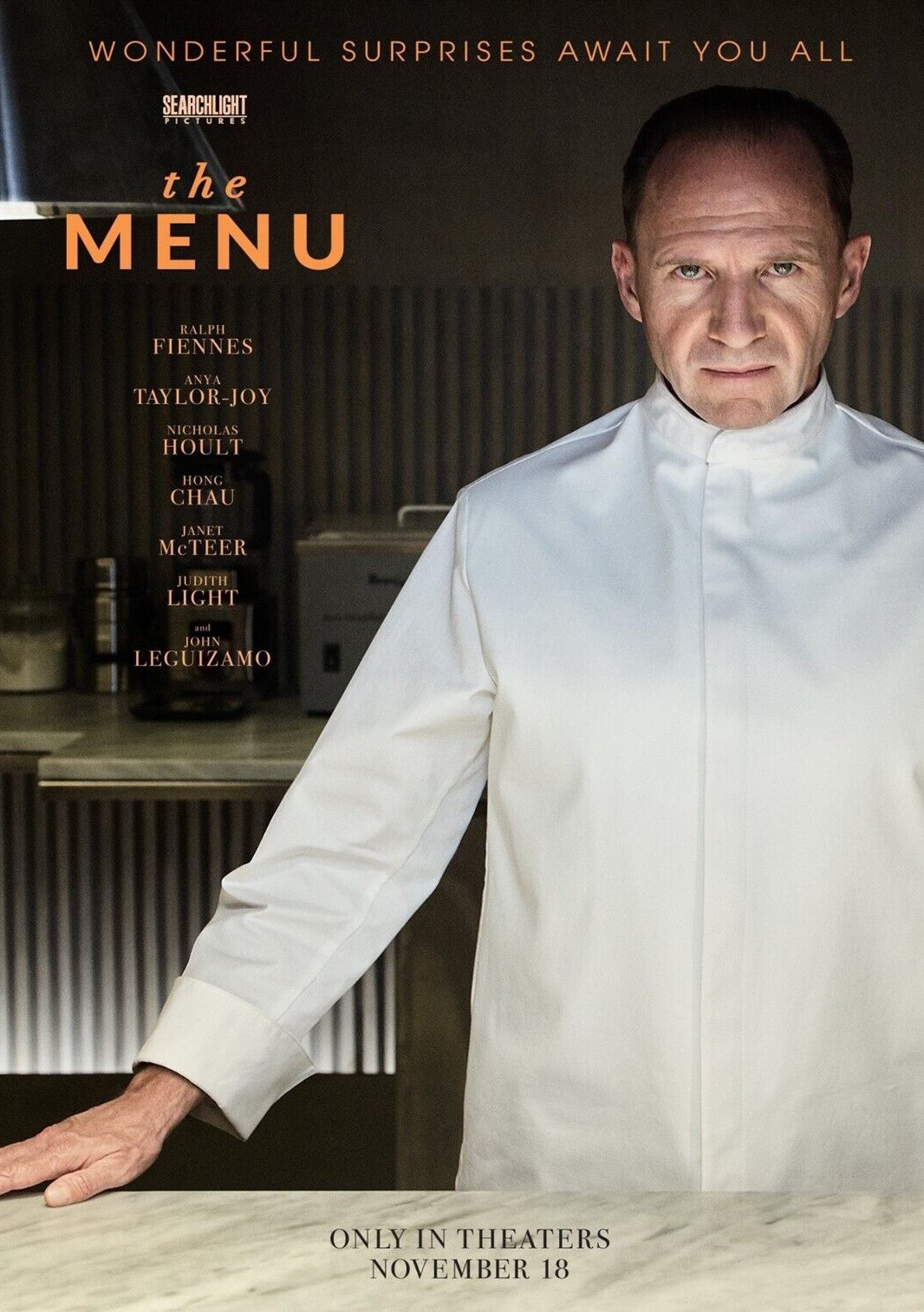
The Menu (2022) ***** – Seen at the Cinema

Hitchcock would have adored the apocalyptic flavour of this quasi haunted house psychological thriller. Setting aside its intellectual pretensions this is pure pedal-to-the-metal material. You never know what’s going to happen next in a tense environment created by dictatorial celebrity Chef Slowik (Ralph Fiennes) in whose eyes the entitled are likely to get their just desserts.

In most thrillers of this nature, the assorted bunch of potential victims usually attempt some kind of fightback, and they’re usually younger and sexier, but this crew are trapped in the headlights because they find it impossible to believe they could possibly be in the middle of a revolution.

The beauty of their dilemma is that Chef is trapped, too, by his desire for fame, suffocated by pursuit of perfection, but yet, as they soon come to realise, accepting punishment for his own sins (attempted rape for one). You might be fooled by the trailer into thinking there is a way out, if only a perilous one, but that’s a bit of a red herring, and as the tension grows you realise it’s heading for an incredible conclusion.

Only the rich can afford to visit this expensive restaurant on a secluded island. Most of the guests aren’t even interested in the food – that’s one strike against them – but for the experience of having said they’d been there or to, as is the prerogative of the wealthy, be pampered within a whim of their life, or to find something minute to complain about, a niggle guaranteed to cause grief.

Creepy though they are, Chef’s thunderclapping hands that demand guest attention, the cries of “Yes, chef” from his slave-like adoring workers, the detail of high-falutin’ cooking, history and ecology lessons, a ramrod sergeant-major of a maitre’d Elsa (Hong Chau), and occasional ironic twists – a bread course that contains no bread for example – are mere hors d’oeuvres for the main event.

Chef knows a tad too much about his guests’ peccadilloes – infidelity, financial irregularity – for their liking and as the evening out begins to turn into a cul de sac and shocking incident follows shocking incident, cowardice and lack of the kind of retinue that could come to their rescue, the guests can only watch as they are served up on a platter to a madman’s ideology.

Certainly, the format is exceptionally cinematic, sequences chapterized as menu courses, and the intellectual discussion that divides the world into the servers and the served well observed, but driving the thriller engine is the most refined nutcase this side of Hannibal Lecter, a thin-lipped specter at a feast of his own devising , a creator at the end of his tether, seeking revenge on those who quibble with his talent. And yet there is something  universal about this individual, a man scrabbling so hard to stay ahead of the game that he is almost on a par with Arthur Miller’s famed salesman. Is Chef doing much more than the culinary equivalent of “riding on a smile and shoeshine?”

The guests are the usual high priests of pamperdom, food critic Lillian (Janet McTeer), movie star (John Leguizamo) planning to revive his career by fronting a food show, simulating orgasm with every taste, a trio of young financiers, a couple who have come several times but can’t recall a single dish they’ve eaten, and foodie Tyler (Nicholas Hoult) accompanied by a mysterious woman Margot (Anya Taylor-Joy) who turns out to be in a different branch of the service industry.

British director Mark Mylod (Ali G in Da House, 2002, anyone?) has learned from helming episodes of Game of Thrones and Succession how to match reaction to incident. As much as Chef is in control in the restaurant, Mylod is in control of exactly what we see. There is none of the over-acting that appears to come with the territory, certainly no screams or titillation, not a whiff of cleavage, the usual recourse of a horror film run out of ideas, though, as with that genre, it is the sexually compromised who suffer first.

Mylod’s tight rein ensures shock is just an element of the overall effect, rather than its signature dish, and that all the ruffley-truffley culinary dialog only serves to heighten morbid  sensation.

Ralph Fiennes (The Forgiven, 2021) may well have delivered a career-best performance it is so constrained. Given equally little room to manoeuvre, little time for eye-rolling or exacerbated action, Anya Taylor-Joy is back to her The Queen’s Gambit (2020) best, while Nicholas Hoult (Those Who Wish Me Dead, 2021) adds sly deviance to  a screen persona that plays on innocence. It’s an astonishing screenwriter debut for television writers Seth Reiss and Will Tracy.

As it happens, I’m very familiar with the lives of chefs, having spent three decades working with them, initially as a cossetted observer, as journalists often are, being the fawned-upon editor of Caterer & Hotelkeeper, the hugely profitable industry trade weekly in Britain, with massive sales at a time when print was the dominant media, so much so that during my time we produced a world record (for a weekly) issue of 524 pages. But when I later set up the Scottish Chefs Association, whose board comprised all the top chefs in the country, and its offshoots the Scottish Chef Awards and a cookery school for chefs, I became privy to the fears and wonders of the cooking business. So I can attest to the fear and loathing for some customers and most critics, who seemed determined in the days before social media to spoil anything they could, or demand preferential treatment.

Certainly, the restaurant is a unique kind of business, food being cooked to order, “a la minute” as the saying went, and customers disrupting a tight ecology by simply turning up late, or early, or not at all. Customers were prone to theft, teaspoons in particular replaced on a titanic scale, and the litany of complaints could outweigh a Bible. Then, as now, reputation was everything, and could be destroyed by a food critic or word-of-mouth. It wasn’t just chefs who sought perfection, but customers, any deviation from expectation harshly dealt with.

Successful chefs with investors would find that somehow they saw little share of the profits. Chefs minus investors lived a precarious existence. Good reviews would  bring in bad customers, the kind who pored over every detail, like Tyler wanting to share their paltry culinary knowledge with the expert, needed extra attention, and came to say they had been there. But I can sympathise with Margot who felt she was being experimented upon rather than fed and can recall several times buying fish and chips immediately after dining in a Michelin-starred establishment.

I remember, too, industry astonishment that celebrity-chef-du-jour Anton Mosimann began the day by walking round the kitchen shaking hands with every chef, no matter their rank, rather than starting off their day with a rant. Kitchens are organised on a brigade system, obedience imperative, no questioning of authority. But rather than derogating talent as occurs here, many top chefs proved apt talent-spotters. The Roux Brothers, for example, created a magnificent template, finding backers among their appreciative wealthy customers for the young talent in their kitchens, which resulted in a new generation of chefs setting up in business without the usual financial woes.

In Britain and Europe, however, perfection could be achieved. If you reached the highest standards set by the Michelin Guide inspectors and were awarded the coveted three stars, the highest culinary accolade that could be bestowed, you had reached the top of the tree. You couldn’t relax because one or more of the stars could be taken away, but the kind of personal obsession that afflicts Chef here would be lessened. However, since very few chefs hit the three-star mark you have hundreds if not thousands beavering away trying to achieve it.

Discover WordPress

A daily selection of the best content published on WordPress, collected for you by humans who love to read.

The Atavist Magazine

by Brian Hannan

WordPress.com News

The latest news on WordPress.com and the WordPress community.