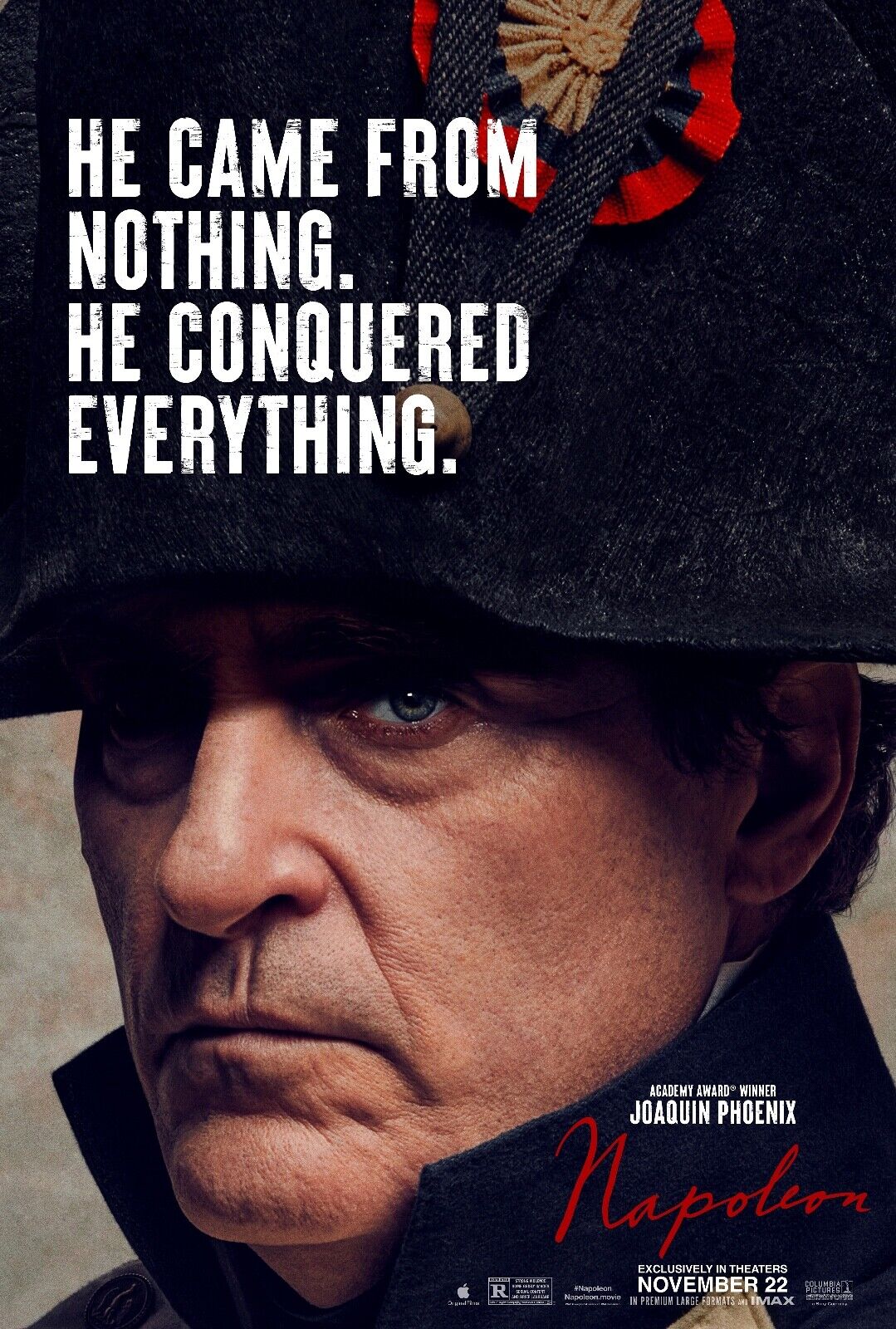
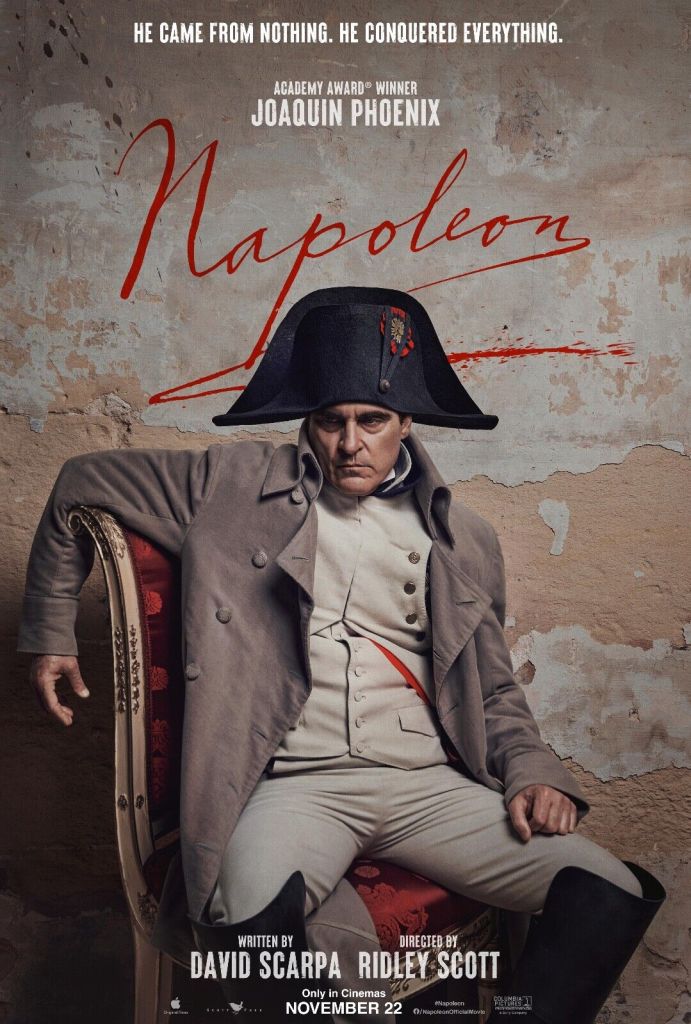
Napoleon (2023) ***

I come at this with a disadvantage since I’m all Napoleoned-out what the various Abel Gance projects and that of Stanley Kubrick. So I suffer from over-familiary with the subject matter. Most of the audience won;t have viewed a Napoleon movie in their lifetime, but I’ve already sat through six-seven hours of this material.

In the end length defeats them all, the magnitude of the task of encapsulating an extraordinary career ends up as a mad dash through history. Setting any deliberate distortions aside, those scenes fictionalized for dramatic effect providing directors with a free pass, it’s just too much to find a central thread on which to encompass the man. Here, Ridley Scott makes a good stab at using romance as that glue, but it’s hampered by the great emperor (Joaquin Phoenix) being such an oaf in terms of seduction. Although he is as ruthless as any dictator whose risen from poverty to the absolute heights.

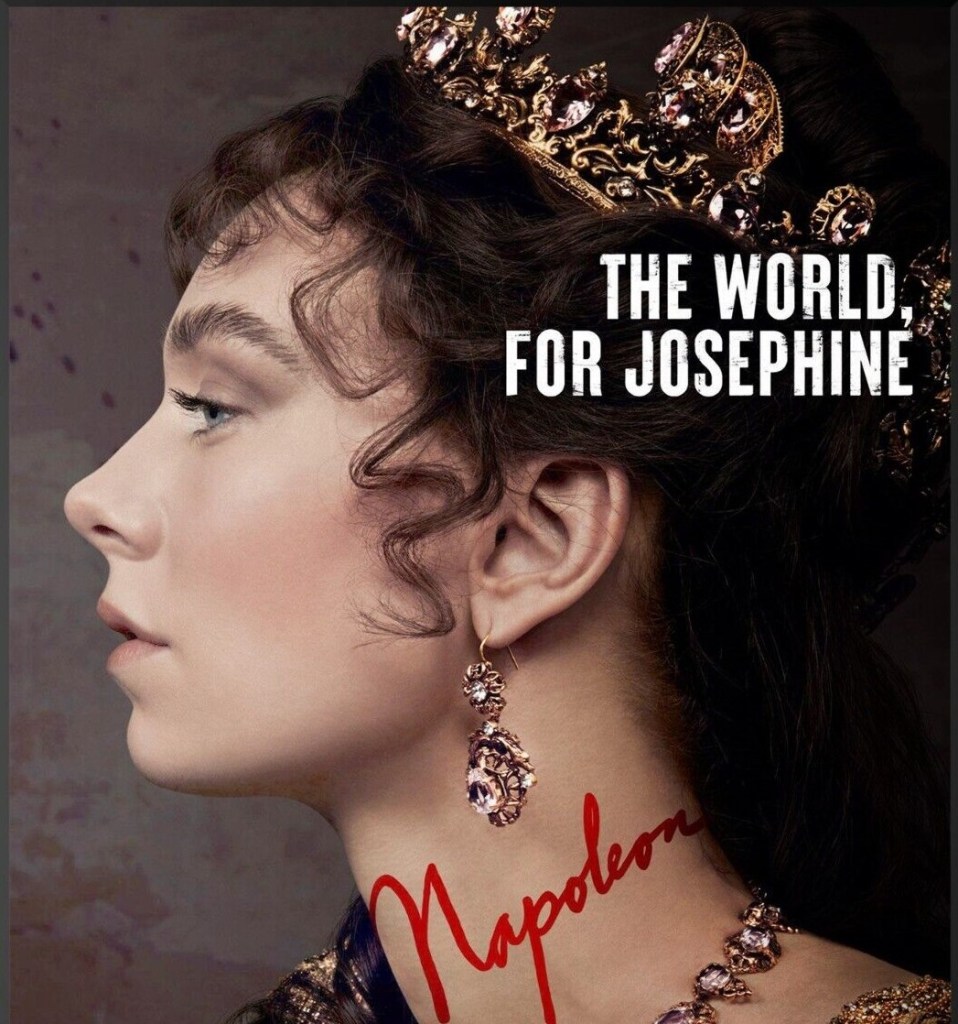
On the other hand, Josephine (Vanessa Kirby) is shown as a more complex character in more complex times, effectively taking up with this oaf for mercenary reasons, her clever plan only coming adrift because she cannot provide him with an heir. I doubt if that many among the audience are looking for an actual history lesson, which is just as well, because it feels, in part because of length restrictions, that this is inevitably going to come up short.
Little is made of the political situation in a world terrified of the revolution that changed France seeping into the countries of Europe. Theoretically, Britain was a democracy, but in reality it was ruled by an elite land-owning cabal, with poverty as rife as in France. Every other country in Europe had an unelected monarch. So Napoleon didn’t so much intend to conquer Europe from power lust but prevent his country being attacked by those who feared an end to the status quo.

Of course, if you had included more history you would have to accommodate an endless stream on one-line characters trying to explain the situation. Scott makes more use of subtitles to provide the audience with its historical bearings but still isn’t afraid to simply fall back on the Austerlitz trick of using protocol to announce a new one-line character.

In terms of actors, this has more the feel of a mini-series than a movie. Hardly anyone of box office significance and being weighed down with British character actors, virtually nobody is on screen long enough to make a mark. Certainly, none command the screen the way the veterans of the old-style all-star cast like Ralph Richardson (Khartoum 1966) or John Gielgud (Becket, 1964), and I’m sorry but Rupert Everett as the Duke of Wellington is sorely miscast.

Anyway, you could go through this entire picture pulling it to pieces, instead of concentrating of what does work. Napoleon’s insecurities contrast nicely with his rampant ambition and arrogance and every now and then someone delivers a historical bon mot. As annoying as it is, I doubt if many males of the period gave any thought to female pleasure during sex, so Napoleon’s amateur love-making can be ignored.
Except for the verbal sparring with Josephine, it’s the military duels that bring this up to scratch at least within the Ridley Scott canon. The taking of Toulon, the bloody putting down of the royalist revolt and Austerlitz are the outstanding scenes, though anybody who has dared to sit through Abel Gance’s Austerlitz might not come out thinking the frozen ice splintering is quite as novel as it might appear.

I’m guessing that the four-hour version planned for streaming might fill in some of the holes, but I’m worried that, like Austerlitz, it will be more of the boring stuff, a potted history filled out with more balls and costume-heavy scenes. If this is all the insight into the life of Napoleon that $200 million buys, then it will take another streamer with even deeper pockets to make a serious dent at tackling the full story of Napoleon.

I usually go back to see a Ridley Scott film at least once – I saw The Martian (2015), Gladiator (2000) and American Gangster (2007) four times each in the cinema – but I’m not sure this holds the same attraction. The director’s cut of Kingdom of Heaven (2005) even with a miscast Orlando Bloom totally transformed that movie so I’m hoping the longer version here might achieve the same. But the latter had a marvellous score, which I had bought as a CD and was a virtual earworm for me, whereas the music here is an uneven as the picture.

I’d love to give this a better score, especially as it may be the director’s last cinematic outing, but it’s too disappointing.

Time – or lack of it – does not sit well here.
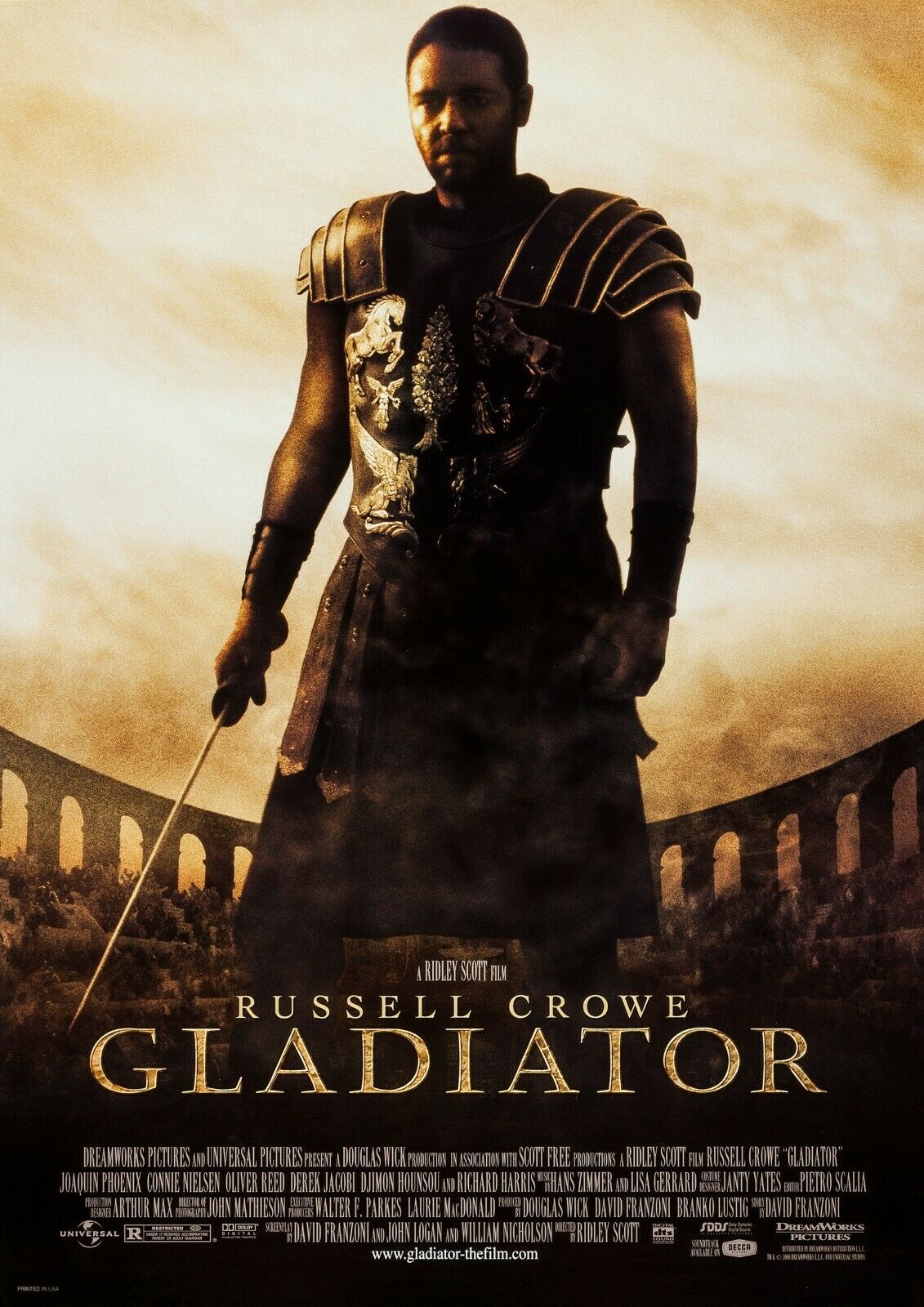
Gladiator (2000) *****

As well as being first in the queue to see The Gladiator on original release over two decades ago and enjoying countless viewings since on DVD and television, the chance to see a big-screen revival (as part of this week’s cinematic triple bill) was not to be missed. There’s always some worry in going back to see a movie you adored that time will have caught up with it or that the big screen will magnify flaws. Instead, this was a pure blast, one of the greatest epics of all time and definitely one of the most brilliant scores.

I always feel kind of sorry for people who’ve only see this kind of picture on a small screen – no matter how big your television it comes nowhere near the cinematic experience. I’m not even sure why it was showing on the big screen – the 20th anniversary has passed so maybe the draw was the upcoming British Father’s Day.

If you’re quick, you will be able to see it until June 17 at the Showcase cinema chain in the U.K. This is a new 4K print. It may run longer if it picks up sufficient demand.

Director Ridley Scott was in something of a career lull after the highs of Blade Runner (1982) and Thelma and Louise (1991) and his previous historical adventures – The Duellists (1977) and 1492: Conquest of Paradise (1992) – had been box office duds, so this was a considerable big-budget gamble for Dreamworks and Universal.

Few historical epics begin with action. Directors tended to want to build up the various characters before any battle got under way. But apart from a few seconds of an idyllic pastoral setting establishing how much Roman General Maximus (Russell Crowe) wants to get back to his Spanish farm, we are immediately, with foot-tapping music by Hans Zimmer, into one of the best battles ever filmed, not just for the tactical detail, and the sense of danger – an emissary is returned missing his head – but the ferocity of the action.

Backgrounding this is politics. Dying Emperor Marcus Aurelius (Richard Harris) distrusts his son Commodus (Joaquin Phoenix) and want to make Maximus the power in Rome. The reaction of Commodus is to smother his father and murder his rival. Maximus escapes but ends up a slave in a gladiator camp in North Africa and eventually returns to Rome plotting revenge.

Into the mix comes Commodus’s sister Lucilla (Connie Nielsen) who had romantic yearnings for Maximus in the distant past and various senators plotting to remove Commodus from office. The story basically shifts from dramatic action in the arena to outside intrigue with Maximus being seen as a man who could potentially unseat the emperor.

But Ridley Scott has such a fine eye for everything, genuine locations mix in brilliantly with CGI, the action sequences are astonishing, and emotions are kept at a peak. Even when the main narrative pauses here and there to allow philosophic and patriotic speeches they are so deftly written they often amount to the best pieces of dialogue in the picture.

Few movies have as many memorable lines. Sample: “what we do in life echoes in eternity;” “death smiles at us all, all we can do is smile back;” “people should know when they are conquered;” “father to a murdered son, husband to a murdered wife, I will have my vengeance in this life or the next;” the “little bee” sequence;  and the lines that ended up as taglines on the advertising posters” a general who became a slave, a slave who became a gladiator, a gladiator who defied an emperor.”

While he could easily have let the action speak for itself and who would not have welcomed more battles with Roman foes or more combat in the arena – and many other movies with a character in a similar predicament have succumbed to that temptation – Scott ensures that the tensions between the characters are never lost. So Commodus is driven both by wishing to please his father and desiring an incestuous relationship with his sister. Lucilla is torn between protecting her son (Spencer Treat Clark), her growing attraction to Maximus and trying to keep her brother at bay while plotting against him. Maximus, who has no head for politics, finds himself involved in intrigue as a way of gaining revenge on Commodus.   

Nor does Scott get bogged down with too much exposition or the intricacies of character as has often been the downfall of epics. The story has been whittled down to essential conflict.

It’s hard to pick a winner from the various action scenes – the opening clash in the forests of Germania with snow beginning to fall; the first gladiatorial combat where Maximus takes control; a small band of gladiators fighting what seems a losing battle against chariots; Maximus being unexpectedly attacked by tigers in the arena; or his climactic fight with Commodus.

And there are substantial cameos for British stars – Richard Harris, Oliver Reed, David Hemmings – who have lost their box office luster but not their acting ability. Connie Nielsen was a revelation.

Russell Crowe became instant superstar with his majestic portrayal. His name had already been on the lips of Oscar voters, having been nominated the previous year for The Insider (1999), but he took the Best Actor Oscar here. Although the film was named Best Picture Ridley Scott lost out – unfairly I felt – in the Best Director category to Steven Soderbergh for Traffic. (How do the two films compare now, I wonder). Joaquin Phoenix and Hans Zimmer were also nominated and the movie also picked up nominations for cinematography and screenplay (David Franzoni, William Nicolson and John Logan.) All told it won five Oscars and seven nominations.

This was the climax to my cinematic triple bill this week and since it also included Nobody and The Father, it could well turn out to be one of the best days I have ever spent at the cinema.

CATCH-UP: I reviewed The Fall of the Roman Empire (1964) a while back and if you compare both pictures you can clearly see how much Ridley Scott owes a debt to the previous film.  

There’s a company called Park Circus – http://www.parkcircus.com – which has the rights to show on the big screen virtually all the old movies made by Hollywood studios and it’s worth checking out whether this might be coming your way soon.

Discover WordPress

A daily selection of the best content published on WordPress, collected for you by humans who love to read.

The Atavist Magazine

by Brian Hannan

WordPress.com News

The latest news on WordPress.com and the WordPress community.