American Fiction (2024) *** – Seen at the Cinema

I thought we were in for a treat when our hero is told not to be rude to anyone important. Kick ass, here we go. Nope. Worthy but dull. One part cosmic joke, three parts soap opera, only relieved by the kind of subdued acting that’s become very much the contemporary Oscar-nominated trend (see The Holdovers, Oppenheimer). And with a narrative thrust that is, unfortunately, laughable. I grew up in Glasgow, Scotland, which for generations lived under the cloud of No Mean City, a portrayal of the city as gangster heaven, and we are nothing on what Hollywood did to the Native Americans so, spare me, anyone saying they have been unfairly treated by any part of the media.

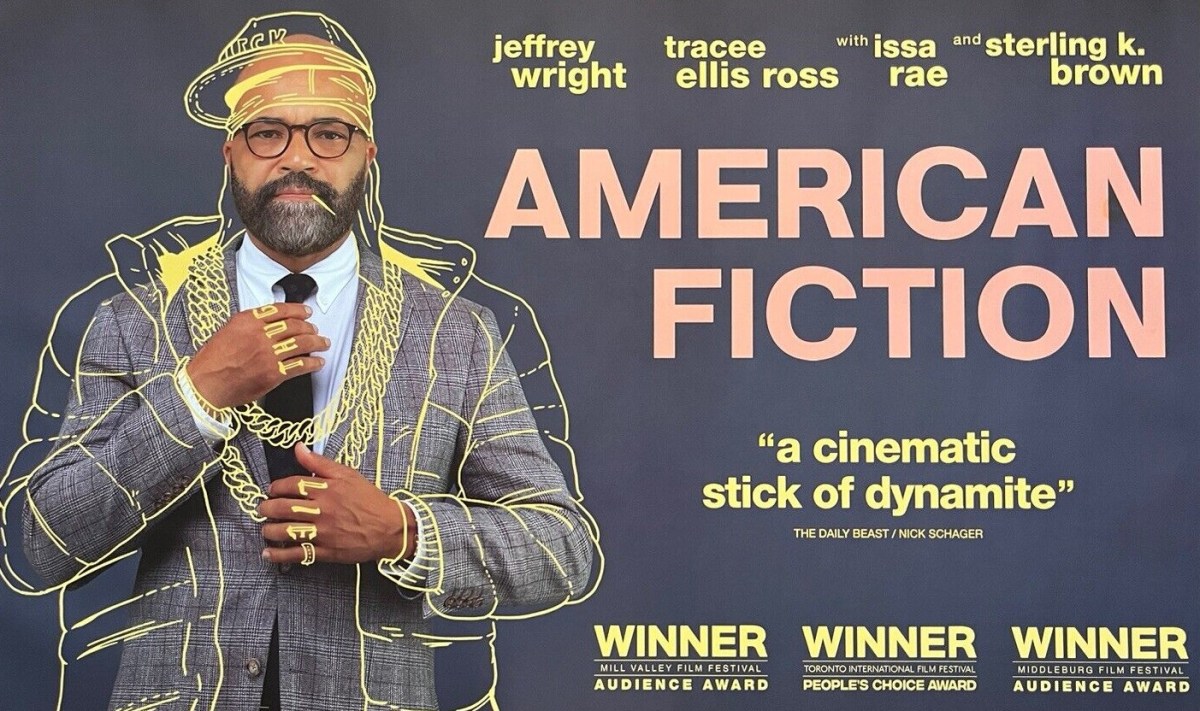
Let’s get the soap out of the way first. Monk (Jeffrey Wright) is an out-of-fashion literary novelist eking out a living as a English professor whose students are on the verge of cancelling him. He hives off to the family home where he discovers – discovers! – his mother (Leslie Uggams) is suffering from Alzheimer’s, brother Clifford (Sterling K. Brown) is gay and a coke addict and his sister Lisa (Tracey Ellis Ross) is so ill from heart disease she drops down dead in front of him.

When his latest novel is rejected he decides he will rip off current bestseller Sintara Golden (Issa Rae) and write a book in gangsta patois. Lo and behold it works and what began as him cocking a snook takes on a more serious dimension when he is offered a $750,000 advance. And guess what, suddenly his principles go hang, and not because he’s just a greedy skunk like everyone else but because he’s been handed a get-out-of-jail-free card in that how, otherwise, with a divorced coke addict brother more interested in his latest lover and a dead sister – both I hasten to add high up in the medical profession, sister a consultant, brother a plastic surgeon – is he going to pay for his mother’s care. So he goes along with the gig and the problems multiply as he lives the hypocrisy he claims to abhor.

The idea of someone duping the publishing industry is hardly new. Bestselling British literary author William Boyd sent in a novel under a pseudonym but written in his own style that had attracted a gazillion sales and that was rejected. Polish novelist Jerzy Kosinski sent in one of his own award-winning novels without a word changed and had that rejected. So the publishing industry, like Hollywood and like the media, is just too easy a target unless the weapon is a lot sharper than this.

And hopefully this is a short-lived trope (Argylle went down a similar route), but we see his characters come alive in front of him and play out terrible scenes from his joke fiction.

Source novel.

Yep, so someone is making a point, that Black Literature has lost its way and why can’t Black authors be heralded for writing about ancient Greece (obviously not in your typical blood-sex-and-thunder fashion) or other arcane subjects or even, as shown here, take as their subject matter well-off university-educated rather than poverty-stricken characters and explore their issues (the same as everyone else’s since you’re asking).

Outside of Monk who spends most of the time locked in his head with a bit of light relief with fan-turned-lover Coraline (Erika Alexander), the only person who doesn’t take this stuff seriously is the sister who died too soon, deflating our literary hero by telling him his books come in handy for steadying loose table legs. Debut offering by writer-director Cord Jefferson based on the novel Erasure by Percival Everett.

Kept afloat, just, by Jeffrey Wright (No Time to Die, 2021) mainlining on repression but that’s about it.

Asteroid City (2023) **** – Seen at the Cinema

“Up to his clavicle in whimsicality,” is the best I can do. While acknowledging that quote is not mine, I should also make clear it could apply to any Wes Anderson picture. He strikes me as critic-proof. With a hard core of fans, whether his movies enter box office heaven depends on the oldest and most elusive of marketing tricks: word-of-mouth.

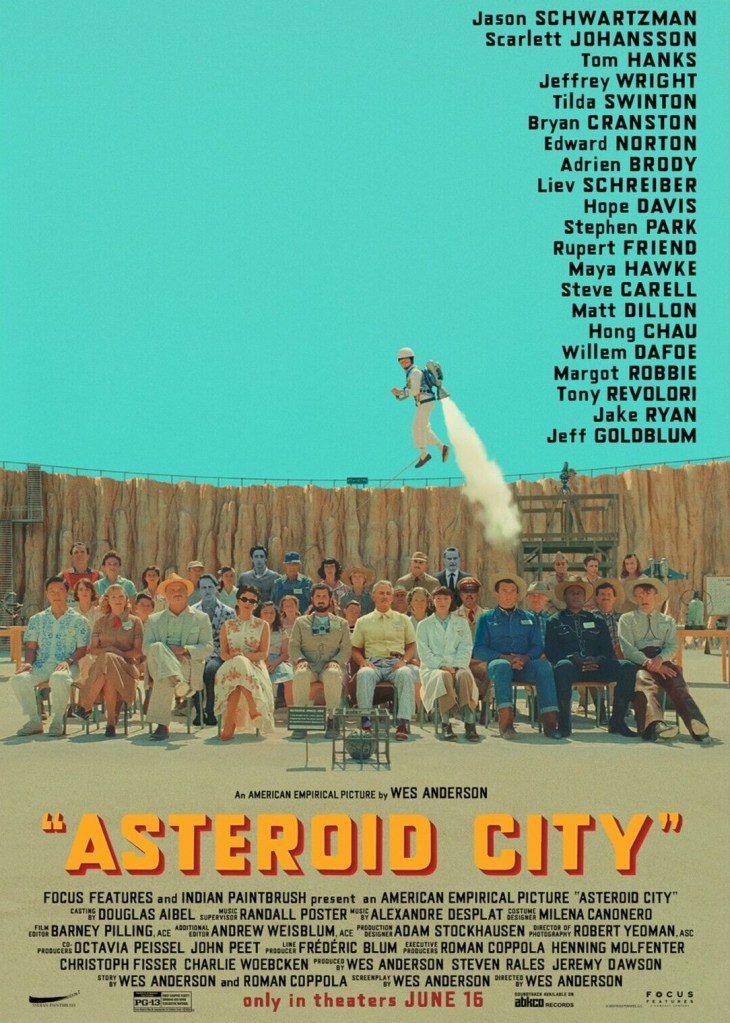
I am going to be telling everyone to go-see without really being able to explain why they should. I might not be able to describe the plot without putting everyone off. I might get the plot wrong. Ostensibly, it’s about a bunch of disparate characters coming together in the titular city (pop: 87!!) to celebrate in the mid-1950s the gazillionth anniversary of the landing of an asteroid, a pock-marked rock about the size of a giant watermelon.

The motley crowd includes scientists, U.S. Army representatives, schoolkids taking part in a science competition, sightseers and some characters stranded there and, halfway through, an alien who commits the heist of the century, though unlike most caper pictures there’s none of the usual pre-robbery set-up.

While Anderson has a consistency of outlook that delights/bewilders/infuriates critics, he has a stunning sense of originality. He doesn’t repeat himself and reveals an astonishing freshness when it comes to the myriad methods employed to tell a story. At least here, the narrative is, roughly, straightforward not breaking off into various routes (or even cul de sacs) as in his previous outing The French Dispatch, which struggled in the old word-of-mouth department but which I adored.

To help me along here with what the film was all about I looked up the lead review in Imdb. Not only was it no help at all, it was pretty dispiriting. Poor old Wes Anderson gets walloped for lack of plot. I couldn’t care tuppence for plot as long as I’m entertained. And I went along quite happily with the ultra-post-ironic (post-something anyway) notion that we were watching the filmed version of a famous play or possibly the situation which inspired the play but cutting between both and the actors in the movie version not only playing characters but dropping into their genuine personalities – or perhaps not, maybe these were the characters from the play.

And here, the last thing I want to do is put you off. So, yeah, if you think narrative isn’t just watching a bunch of people who’ve never met before interact, a category into which I guess you would chuck movies as different as The Towering Inferno (1974) and Titanic (1997), and think they have to be gathered for a doomsday scenario, and ignore the likes of Bus Stop (1956) then just go ahead and talk yourself out of that rare sighting on the Hollywood hills, an adult movie with nary a superhero (discounting said alien of course, whose back story might include super-heroism for all I know) involved.

This might just be one long litany of jokes, but why would you complain about that? Anyway, for the sake of anyone who has come here for a proper review, here goes.

Grieving widower Augie (Jason Schwartzmann) is unexpectedly stuck in Asteroid City when his car goes into meltdown. His three young children think they are auditioning for Macbeth, constantly casting spells and intent on burying their mother’s ashes, contained in a Tupperware bowl, in the desert, and generally acting weird. His equally widowed father-in-law Stanley (Tom Hanks), dressed as if coming straight from the golf course, turns up to pretty much tell him how much he dislikes him. Augie has a short affair with movie star Midge (Scarlett Johansson) while her science-minded daughter gets to experience first love and proves a whiz at some extremely complicated memory game that I might have played when young but can’t remember the name of or which could equally be a Wes Anderson invention.

Please sir, that’s as much plot as I can remember. Various other characters appear, flitting in and out, and don’t behave as you might expect. Oh, some do, there’s a hotel owner selling plots of real estate, but there’s also the apparently straight from Central Casting General Gibson (Jeffrey Wright) whose speech sounds more like an elevator pitch for a novel. See, I told you, explaining it won’t help. You just gotta go see it.

You might spend the whole picture rubber-necking, spotting stars in cameo roles, but except for Edward Norton and to some extent Tilda Swinton none of them are doing what they are famous/infamous for. Maybe Wes Anderson has a constant queue of A-list applicants for small roles just because a) they get to play someone completely different from normal and/or b) they get to work with the great man.

Roman Coppola (Moonrise Kingdom, 2012) was drafted in to help write the screenplay maybe just so the director can get to share the blame if it’s a critical dog.

Go see.

Did I already say that?

The French Dispatch (2021) **** – Seen at the Cinema

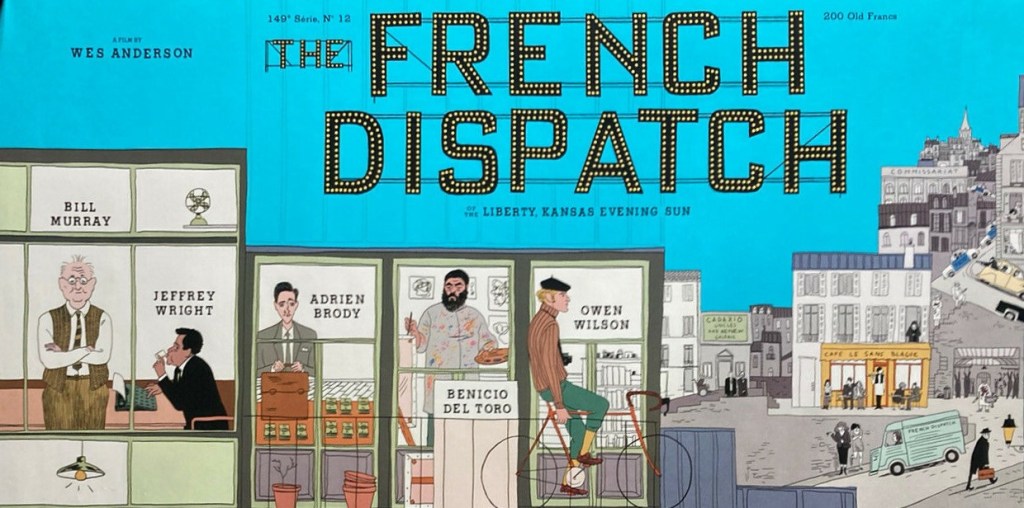
It can only be ironical that Wes Anderson’s wonderfully idiosyncratic, evocative, often hilarious, picture – featuring ex-pats writing for an American magazine in the style of the New Yorker – is located in the French town of Ennui (translation: “boredom”) because it is anything but, a continuous stream of imaginative and inventive scenes, settings and characters. Where other directors make aspects of history their own (Ridley Scott, David Lean) and others lay claim to greatness by inverting genres (Quentin Tarantino), Anderson’s genius lies in creating worlds nobody else could lay claim to. Although this particular film covers just a triptych of tales, you can easily imagine Anderson has another hundred or so stories at his fingertips, all contained in his own unique universe.

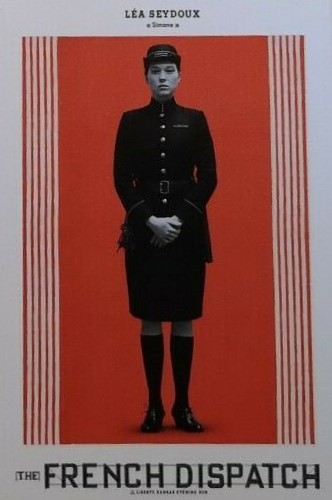
You can see why actors queue up to work with him for he allows them to develop highly-individual characters far removed from their denoted screen personas.  Some like Timothy Chamalet, Benicio del Toro, Jeffrey Wright and Lea Seydoux take advantage of this freedom to conjure deliciously realised human beings, while others such as Owen Wilson and Tilda Swinton let the opportunity slip or appear  in the picture so briefly (Elisabeth Moss, Henry Winkler, Bob Balaban) as to make little impact. Even headliner Bill Murray, who bookends the show, is given to more inventiveness than usual, breaking up his usual deadpan  delivery to make an occasional emphatic point.

While mostly this zips along, when Anderson occasionally stops for breath the effect is electric, for example a static camera taking in the back of a tenement through which we see by virtue of various windows a waitperson’s exhausted ascent. Mostly, the tales follow their own internal logic, but when forced into a genre corner, such as a shoot-out, Anderson resorts to pure zest. And while the narrative is mostly driven by voice-over, this takes on different aspects, from a loquacious raconteur (Jeffrey Wright) to a droning lecturer (Tilda Swinton).

Clearly planning to keep one step ahead of critics who claim his movies run out of steam, Anderson heads off that issue by filming three short unconnected stories. Del Toro and Seydoux head up the best item which sees a psychotic murderer embark on an artistic career that hooks art dealer (Adrien Brody).  Those who expect Anderson to spring surprises might still be taken aback when it transpires that the nude model (Seydoux) of the prisoner (Del Toro) is in fact his gaoler. Having opened a box of twists, Anderson continues in this wild vein. Narrators attempting to impose a semblance of normality generally find themselves at odds with their subject matter. In the second tale, as off-beat a student revolutionary as you could find, Chamalet breathes as much life into the character as he appeared stultified in trying to create a real person in the misfiring Dune (2021). Crime is not usually best served best by asides and droll self-importance but Wright, in the final story, manages to tie up in knots what should a taut kidnapping tale.   

If you come looking for star turns by Bill Murray and Oscar-winner Frances McDormand, you will be sorely disappointed but if you willing to settle for an energetic, fresh, nostalgic take on an imaginary France, with plenty laugh out loud moments, you should come away well satisfied. Of course whether the French will feel as insulted as by television show Emily in Paris remains to be seen but I’m sure the Hungarians did not take The Grand Budapest Hotel (2014) too literally.

I notice that this received a platform release in the States and broke per-cinema box office records in the process and I wonder what might have been the fate of The Last Duel (2021), regardless of its budget, had it opted for a similar launch approach.

Discover WordPress

A daily selection of the best content published on WordPress, collected for you by humans who love to read.

The Atavist Magazine

by Brian Hannan

WordPress.com News

The latest news on WordPress.com and the WordPress community.