Behind the Scenes: “The Nightcomers” (1972)

Marlon Brando’s box office cachet had crashed. He hadn’t made a picture in two years following the flop of Queimada/Burn (1969) which had followed his debilitating box office trend of most of the decade. While his stock remained high enough to headline such big budget numbers as The Chase (1966) and Reflections in a Golden Eye (1967), thereafter confidence in his marquee value tumbled. Apart from Queimada, he had only been signed up for Night of the Following Day (1968), another loser.

But that last picture had brought him into the orbit of independent producer Elliott Kastner (Where Eagles Dare, 1968) who had been a friend of director Hubert Cornfield (Pressure Point, 1962) when they had both worked as agents at MCA. “Although he was crazy,” recalled Kastner, “I loved his writing and his drive.” Kastner was a fan of Cornfield’s earlier movies especially as they had been delivered on short time schedules. “I wanted to do something with Marlon Brando and he wrote Night of the Following Day.” 

Brando still had clout in Hollywood. His three-picture deal with Universal obliged the studio to pony up for any (financially viable) projects he put to them. Kastner was delighted to hop over from his base in London to the French location and although the movie continued the actor’s poor reception at the box office, the producer enjoyed the experience.

Brando wasn’t averse to the “resting” that most actors endure, stints of unemployment between gigs. So when the actor approached Kastner to work with him again, it took the producer by surprise. “Marlon wanted to do a film,” said Kastner, “which was unusual for Marlon because he hides from work. He wanted to do a film in Europe and he loved staying at my house in the country. I talked to (Brando’s agent) Jay Kanter (who later became Kastner’s business partner) about it and we gave him a screenplay called The Nightcomers…that Michael Winner wanted to direct.”

Kastner had liked Winner’s output and was equally attracted to the fact that he also worked fast. Winner was contemptuous of directors who shot too much footage, especially “coverage”, filming a scene from too many different angles. But he was also a very fast editor. He took an editing caravan with him on location, and after the day’s filming ended at 6pm he spent the next two hours watching rushes and another two hours after that editing. His editor Freddie Wilson said,” His speed of decision in the cutting room saves a great deal of time and money.”
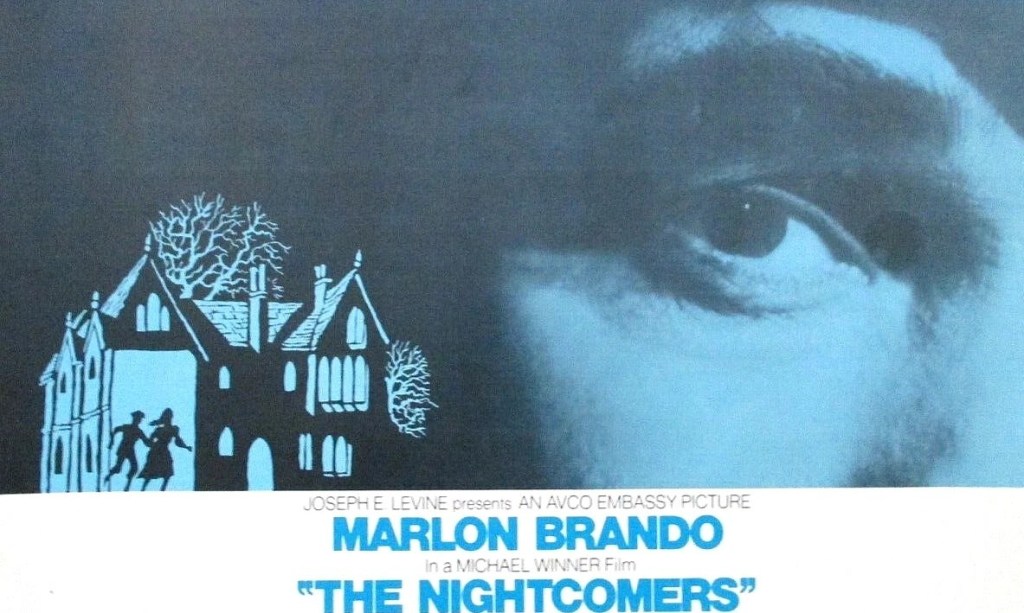
Winner had been sitting on the screenplay by Michael Hastings for some time. “No one was rushing to finance it,” remembered Winner, until Brando showed an interest. Winner arranged to meet the actor at his “modest Japanese-style house” in Los Angeles. However, insurance proved a sticking point following payouts for Quiemada.

“On a personal level,” recollected Kastner, “I thought he (Winner) was a bully with waiters. He was really nasty to people beneath him. I didn’t have much (personal) respect for him but he was very amusing.”

Due to scheduling conflict Vanessa Redgrave (Blow-Up, 1966) turned down the role of Miss Jessel. Winner also offered the part to Britt Ekland (The Double Man, 1967) provided she could bring some financing to the project. In the end, remembered Kastner, “Michael wanted to cast this girl with this big bust who was a halfway decent actor.” Neither Redgrave nor Ekland could compare in the bust measurement department to Stephanie Beacham, so clearly chest size was not a priority.

Kastner reckoned Brando “would bring plenty of poetry” to the project. It was remarkably cheap even for a star of Brando’s fading attraction. The budget was $686,000, of which Kastner received $50,000 as a producer’s fee plus 30% of the profits. Winner deferred his fee, only paid if the movie made money. At that point, Kastner was leading the way in finding funding outside the studio system. Funding for When Eight Bells Toll (1970), for example, was entirely sourced from an American businessman. For The Nightcomers, Kastner located investment of $100,000 from a company called Film & General Investments. Universal was involved through its contract with Brando – paying him his $300,000 salary for this picture to count as the final one on his contract, but declined to distribute the picture. For another producer, this might have been enough to kill off the project, but not for Kastner, who, following his current practice, intending to sell the completed film to a distributor.

As far as Kastner was concerned the movie went into immediate profit. Joe Levine of mini major Avco Embassy, still riding high after the success of The Graduate (1967) and The Lion in Winter (1968), ponied up $1 million for the worldwide rights plus a share of the profits. But Avco also limited its exposure, selling a 40% share to businessman Sigmond Summer for $1 million. (Judging from later legal documents, Universal retained some financial interest in the picture).

Brando had decided Quint was Irish. To learn the dialect, Brando and Winner got together with a group of Irishmen in the back room of a pub, one whom became the actor’s dialog coach on location.

The six-week shoot, on locations in Cambridgeshire, Britain, with Sawston Hall doubling as the mansion, began in January 1971. There was another reason for the speed of the shoot. Winner had contracted with United Artists to make Chato’s Land (1972) and there was no time to spare between the movies. Over 100 actresses auditioned for the role of the female orphan. Winner, seeking “someone over 18 who looked 11,” selected Verna Harvey (she also won a role in Chato’s Land).

Although Winner had gone to some expense to set up a private dining room for the star at Sawston Hall, Brando preferred to eat with the crew. According to Winner, despite Brando’s fearsome reputation, he knew all his lines, immensely patient with his young inexperienced co-stars, concerned about the crew, and, as importantly, arrived on time and even watched rushes, a rarity among the profession. Brando used earplugs to prevent distraction from extraneous noise. During the shoot Francis Ford Coppola flew over to spend time discussing the script of The Godfather with Brando.

Brando initially refused to have stills taken of him during the sex scene and only gave in after considerable persuasion, though he kept his wellington boots on. He wanted to leave the drunk soliloquy to the end of shooting. Though he was actually drunk after consuming a lot of Scotch, “he remembered his lines immaculately…(and) also matched his hand movements and body movements, which is very important in movies,” explained Winner, “because if you have to cut different bits of film together if the body or hands or arms are in a different position you’re in trouble.” 

Jerry Fielding didn’t record his score until July during a three-day session with an orchestra of 80 at Cine Tele Sounds Studio. Despite his editing prowess, Winner realized his final version didn’t work. “The first cut was too fast. For a moody period film I’d just messed up. I put back seven minutes (of footage) and spent another three weeks getting it right.”

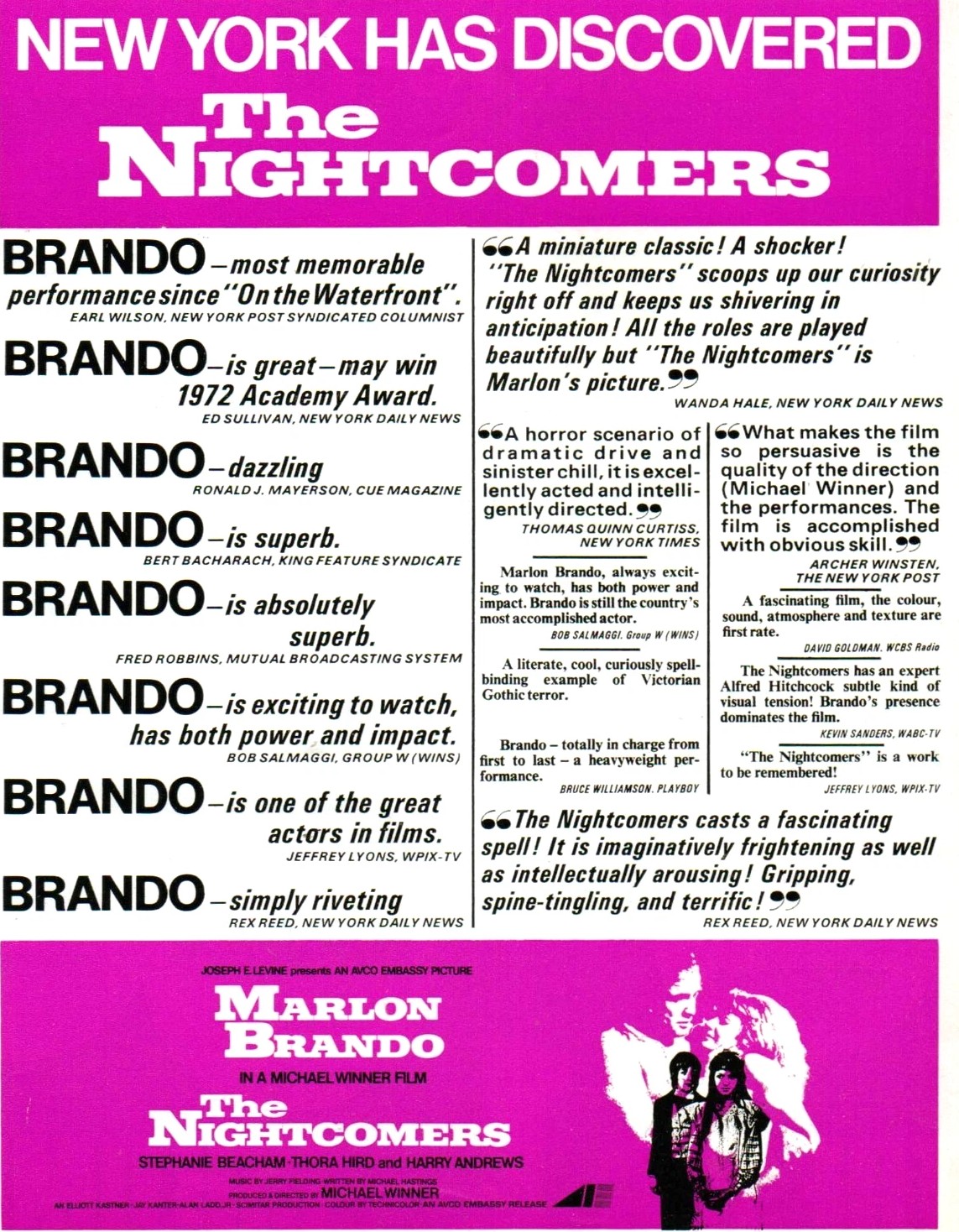
Thanks to its world premiere at the Venice Film Festival alongside the likes of Sunday, Bloody, Sunday (1971), it was touted, perhaps unwisely, as an arthouse picture, rather than majoring on the sex and violence. While Variety tabbed it a “grippingly atmospheric thriller,” only two out of the five most influential New York critics gave it the thumbs-up.

A distribution deal was not struck till the end of 1971. Rather than potentially riding along in the slipstream of The Godfather (1972), which was already attracting huge hype, Avco decided that it was better to come out before the Mafia picture than risk being swamped in its wake. But there was confidence in the project. “Joe Levine thought the film was so brilliant we didn’t have to wait for The Godfather,” related Winner.

It launched first in America, opening in February 1972 – beating The Godfather to the punch by a month – at the 430-seat Baronet arthouse in New York. The opening week of $20,700 was rated “nice” and held well for the second week before plummeting to $11,000 in the third week. It was yanked after six weeks.

By the time it spread out into the rest of the country, The Godfather rollercoaster was well into it stride, but the early release had not particularly gathered any pace and in the aftermath of the Coppola movie it was certainly buried. It opened to $6,500 in Boston compared to The Godfather’s second week of $140,000. There was a “scant” $39,000 from 13 houses in Los Angeles, a “modest” $4,000 in Louisville though $5,000 in San Francisco was rated “brisk” and the same amount in Washington “snappy.

Initially, at least, Britain appeared more propitious. It opened in key West End venue the 1,400-seat Leicester Square Theatre to a “loud” $24,700 and though it dropped $10,100 in the second week, the third and fourth weeks improved on the second. Eight weeks into its West End run, when it was still pulling down $13,300, The Godfather put it to the sword with a record-breaking $191,000 from five West End houses. After that pummelling, The Nightcomers managed only three further weeks.

In fact, the movie did surprisingly well, especially overseas. Total rentals came to $1.69 million, a clear million-dollar profit on the negative cost. While less than half a million came from the U.S., and only $160,000 from Britain, the overseas market kicked in the bulk of revenue – $986,000 – possibly because it was released after The Godfather (1972) rather than, as in the UK and the US, before. In the run-up to and in the wake of The Missouri Breaks (1976), it was included in Brando perspectives at the Museum of Fine Arts, where it was presented as a “novel film…lost in the shadow of The Godfather,”  and Carnegie Hall. But an attempt at commercial  reissue proved disastrous – a “weak” $1200 in Pittsburgh.

Except from a financial perspective, Kastner wasn’t especially impressed, calling it “grim, boring, contemptuous of story, oblique.” Viewers, including me, beg to disagree.

SOURCES: Elliott Kastner’s Unpublished Memoirs, courtesy of Dillon Kastner; Elliott Kastner Archive, courtesy of Dillon Kastner; Michael Winner, Winner Takes All, (Robson Books, 2004); “Production Review,” Kine Weekly, January 23, 1971, p10; “Not So Young,” Kine Weekly, May 22, 1971, p16;“Jerry Fielding,” Kine Weekly, July 17, 1971, p10; “Michael Winner,” Kine Weekly, August 13, 1971, p10; “Nightcomers to Avemb,” Variety, January, 19,1972, p5;  “New York Critics,” Variety, February 23, 1972, p35; “Picture Grosses”, Variety, 1972: February 23-April 26, June 7-14; July 19- Sep 27; “Broadway,” Box Office, February 9, 1976, pE2; “Museum of Fine Arts,” Box Office, October 18.
Behind the Scenes: “Secret Ceremony” (1968)

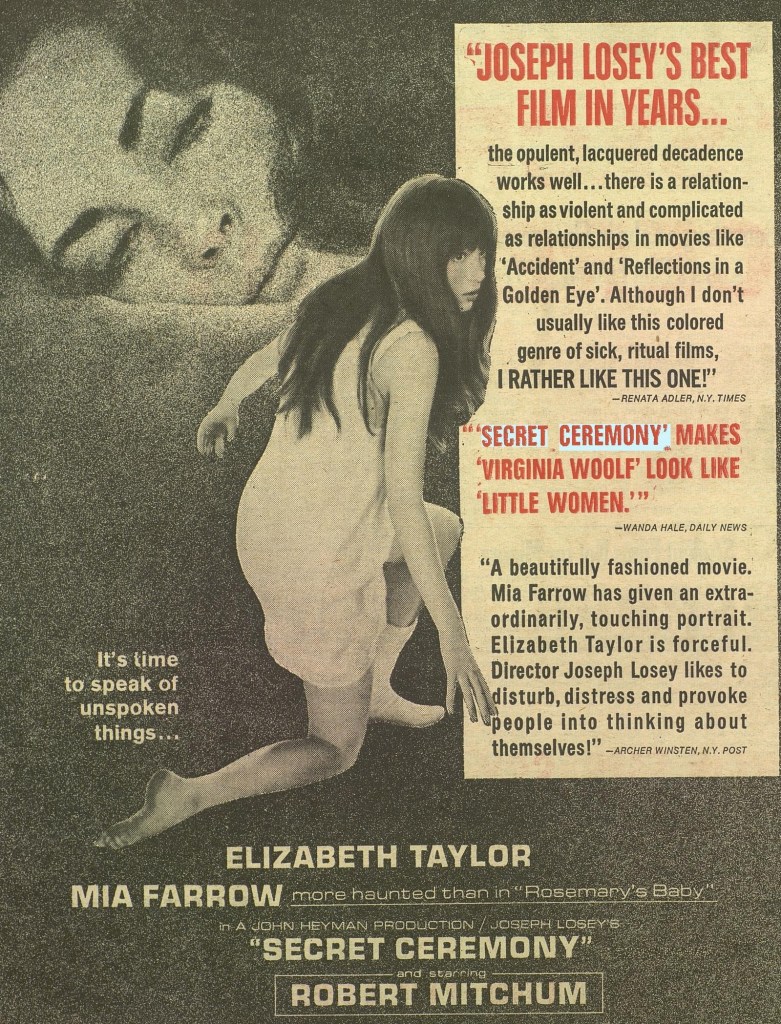
I was probably as surprised as anyone to discover that far from being a flop, Secret Ceremony was in fact a hit, taking $3 million in rentals in the  U.S., ranking among the Top 20 foreign movies at the French box office, and hitting the target in Italy, Germany and Australia. Yet, outside of France, it was universally derided by the critics.

Joseph Losey (The Servant, 1964) held the unusual position of being a cult director working in Britain. He was the “object of a vociferous cult….his following grown in scope and size with each new film” and, conversely, as his popularity among the arthouse fraternity increased, he attracted more critical ire. Courting popularity by entering the spy genre with Modesty Blaise (1966) and linking up with the Elizabeth Taylor/Richard Burton box office colossus for Boom! (1967) seemed to go against the critical grain. Losey ascribed the critical coruscation Boom! received as less to do with the merits of the film itself than “people using the opportunity to launch personal attacks on the Burtons.”

Boom! had been packaged John Heyman, who coupled acting as agent for Burton and Taylor with being the producer, not necessarily a good combination. Universal was convinced it had “Virginia Woolf in color,” a reference to the previous enormous hit, although the box office told a different story. Jay Kanter, Universal’s London production chief who greenlit the project, commented: “When the Burtons were involved a lot of my judgement was colored by the magnitude of the star she (Taylor) was considered to be.”

So it was something of a surprise to find Losey and Taylor teaming up again for Secret Ceremony. Of course, it may have been the money, Taylor at this point still holding out for a million-dollar purse. Heyman said, “We were regarded as whizz-kids just for making two consecutive films with Elizabeth Taylor and bringing them in under budget.”  

Losey’s world reflects a “highly selective form of naturalism.” Except for Accident (1966), from Sleeping Tiger (1954) through to Secret Ceremony, Losey worked with the same design consultant/production designer Richard MacDonald whom the director treated as a sounding board, to “test (ideas) and reject them in the telling.” This is a director for whom “patterned exoticism is extraordinarily precise.” A more important collaborator had been playwright Harold Pinter who had fashioned The Servant (1963) and Accident, bringing to both films his distinctive ear for dialogue. He was hardly required for Boom! whose screenwriter was the even more famous playwright Tennessee Williams (A Streetcar Named Desire, 1951) and for Secret Ceremony Losey went elsewhere for his screenwriter.

Losey was among the string of American talent who taken refuge in Britain in the wake of the anti-Communist hysteria of the late 1940s/early 1950s – others included producer Carl Foreman (The Guns of Navarone, 1961), and directors Cy Enfield (Sands of the Kalahari, 1966) and Edward Dmytryk (Mirage, 1965). By the time of Secret Ceremony, Losey had been working in Britain for nearly a quarter of a century and established himself as a director of distinctive vision, a critical fave in his adopted homeland, wildly appreciated by the French, with an occasional box office home run.

But although regarded as a British film-maker, Losey made Secret Ceremony – and Boom! for that matter – exclusively with Hollywood money, the budget 100 per cent supplied by Universal, that studio having decided that anything coming out of Britain would appeal to younger audiences. There was an untapped pool of talent available in British television who could be hired for substantially less than their U.S. counterparts. In three years Universal’s London production unit, headed by Jay Kanter, spent $30 million on a dozen projects. The biggest budget was allocated to Boom! with $3.9 million followed by $3.5 million to The Countess from Hong Kong (1967) starring Marlon Brando and Sophia Loren.  The Night of the Following Day (1968) cost $1.5 million as did Fahrenheit 451 (1967) and Three into Two Won’t Go (1968). Secret Ceremony came in at $2.45 million.

Robert Mitchum and Joseph Losey went way back to a time in Hollywood when both were working their way up the RKO ladder. As well as Losey, Mitchum had been friends with many who would fall foul of the blacklist including screenwriter Dalton Trumbo, Dmytryk and Howard Koch (Casablanca, 1942). When Mitchum’s dalliance with drugs brought him a jail sentence, Losey visited him and brought him chilli from a famed restaurant.

Mitchum was recommended for the role in Secret Ceremony by Roddy McDowell, a friend of Taylor, who had been working with the actor on Henry Hathaway western Five Card Stud (1968). Mitchum received the job offer while on holiday in Mexico. For two weeks’ work he would earn $150,000. The role itself was scarcely onerous, drawing on aspects of the loathsome character he had created for Night of the Hunter (1955), but it did require an English accent of some kind and to his amusement Mitchum found himself on the telephone, like a salesman listing available product, going through the variety of accents he bring to the part.

Whether it was almost having to sell himself to the director or some previous incident, Mitchum and Losey did not resume their friendship. In fact, their relationship was the polar opposite. “He was very unpleasant,” recalled the director, “it was extremely hard for me to work with him.” Losey never found the source of Mitchum’s contempt. “In some curious way I must have made some mistake with him; I don’t know what it was.” Even attempts to recall Mitchum’s collaboration with Charles Laughton on Night of the Hunter failed to break the ice. Losey believed that Mitchum played tough to mask “an intense sense of failure.”

Mitchum wasn’t above sneaking away from the set. On one occasion taking himself off to visit old friend Robert Parrish, he knocked back some tequila and complained about the movie. On the Holland section of the shoot, Mitchum got into a food fight with a hotel diner. In the end, Losey was so disturbed by Mitchum that he was grateful when he departed as per contract despite the fact that some scenes had not been shot, including, according to the actor, the bathtub sequence, which would have accentuated the incest theme rather than the hint of lesbianism. Mitchum’s epitaph to the movie was that he talked Mia Farrow out of True Grit (1969) claiming Hathaway was a terror to work with.

The bath scene turned out to be the cause of some marital anguish. The set was cleared for its shooting of the scene after Taylor froze on emerging from her dressing room to see so many people gathered. But this was hardly Taylor at her beautiful best as she had been gaining weight. Even so Losey filmed her at times as though she was the grand Hollywood star with hair framing her face and the camera glimpsing her cleavage, but at other times her weight was a source of determining her character, when she eats with her mouth full and belches.

Halfway through filming Taylor was afflicted by severe physical pain and she was rushed to hospital for a hysterectomy, an operation that lasted over three and a half hours. Complications followed the surgery and she was given drugs that caused her to hallucinate. Writing in his diaries, Richard Burton noted: “This is the first time I’ve seen a loved one in screaming agony for two days, hallucinated by drugs, sometimes knowing who I was and sometimes not, a virago one minute, an angel the next.” She went from commanding him to leave the room to crying out for him to return. Sometimes she believed she was on board their yacht, other times that a film was playing on the switched-off television set.

The loss of her uterus may have affected her performance since in the film she plays a mother who has lost a child and in reality was a woman who had lost the ability to have another child.

The film exacerbated the tensions in the Burton-Taylor marriage. It was usually Taylor who was the one who had to keep a watchful eye on her partner in case he strayed. In this case, ironically, it was Burton who exhibited the jealous streak. The way Losey had whispered in the actress’s ear to build up her confidence during the bath scene while getting rid of extraneous crew found its way back to Burton who misinterpreted the action as intimacy.  “My wife and Joe Losey are having a professional love affair,” he claimed. He spent a lot more time than usual on the set of his wife’s film. He even offered to take on the Mitchum role.

Losey had long been fascinated by a strange-looking house in West Kensington, London, and managed to hire it for the shoot. Debenham House in Addison Road, between Holland Park Avenue and High St Kensington, is one of a handful of truly Gothic London buildings. The church used was in Little Venice, St Mary Magdalene in Rowington Close, also in London, and the antique shop was located at the corner of St Stephen’s Mews and Westbourne Green. When the production shifted to Holland it was to the coastal town of Noordwjik with use made of the Grand Hotel there.  

By the time the film opened, Taylor found herself in the middle of a storm over foul language (“gutter talk” in Variety parlance) for which she was seen as the “chief exponent.” It was an ironic position for Taylor to find herself in given her expletive-ridden performance in Who’s Afraid of Virginia Woolf (1966) had not only been critically acclaimed and a huge box office hit but seen as helping to break down the censorship barriers. However, it appeared that the “urination expression” and a word that was prefixed by “bull” were beyond the pale and Variety proclaimed that it was “evidently assumed that if a star of her (Taylor’s) magnitude can be gotten to speak the words, everyone else – actors, actresses, distributors, exhibitors and the public – will be accustomed to strong lingo in pix.” It was hardly coincidence that on the same day that this article was the leading story on the trade paper’s front page that inside six out of seven New York critics gave Secret Ceremony a drubbing, the exception being Renata Adler of the New York Times who called it Losey’s “best film in years.”

Even producer Heyman had his doubts about the material. “It should have been the story of two people who need and trust each other,” he said, “until one leans on the other a little bit more than she should. Unfortunately, the kind of sympathy which Losey shows for people in real life was absent from the relationship which is what I think made it unacceptable.” He summed up, “A cold picture.” (This has the taint of someone trying to work out why the film was a critical failure because otherwise I think Heyman got it exactly right for the movie I saw I did not view as cold nor unacceptable.)

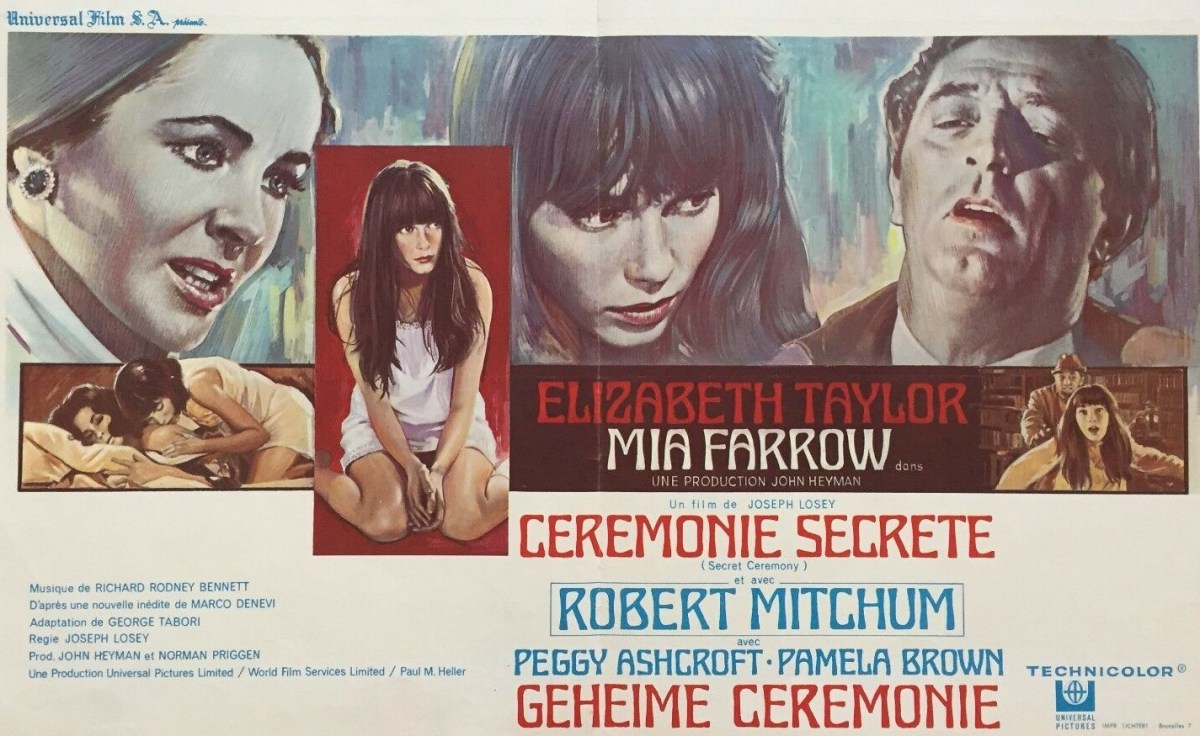
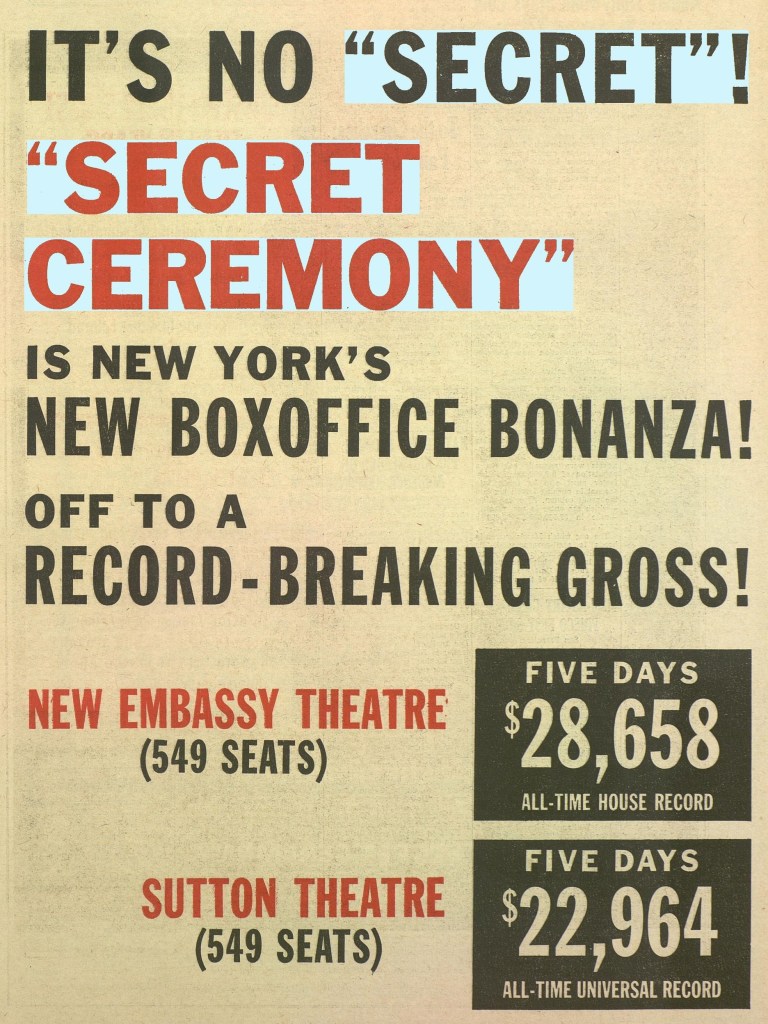
And neither, strangely enough, did the public. Although making a poor showing in Britain, it was not a box office disaster. That was averted by astute marketing, the potency of the stars and a public who, not for the first time, ignored the critics.  The movie broke records when it opened at the New York arthouse pair, the Sutton and the New Embassy, and further afield in cities like Dallas. Arthouse success would have been anticipated but nobody would have expected that when it went wide in New York the second week improved upon the first. As well as a decent showing in the States, it hit the ground running around the world, and “ought to be credited” as one of Universal’s “most successful pictures from either domestic or foreign source.” In the French box office rankings, it placed above The Detective (1968) and Hang ‘Em High (1968) and just below The Thomas Crown Affair (1968). Acclaimed by that country’s critics, the Academie du Cinema named it best foreign film with Taylor and Farrow taking the gongs for best foreign actresses.

When Universal sold the movie to television for $1.25 million, a fee which certainly provided the picture with a decent extra profit margin, fourteen minutes were cut out and replaced by a 500 lines of extra dialog and a filmed discussion of the psychological issues raised, prompting Losey to demand his name be removed, claiming it “exactly reversed the meaning an intention of my film.”

SOURCES: Lee Server, Robert Mitchum, Baby I Don’t Care, (Faber and Faber, 2001) p169, 232, 509-512; Sam Kashner & Nancy Schoenberger, Furious Love, (JR Books, 2011)p240, 242-243,2; Alexander Walker, Hollywood England, (Orion Books, 2005) p200, 345, 354-257; “Screen: Secret Ceremony,” New York Times, October 26, 1968; “Joseph Losey Following Has Grown,” Box Office, October 28, 1968, pE1;   “No End to Gutter Talk,” Variety, October 30, 1968, p1; “N.Y. Critics This Week: Ouch,” Variety, October 30, 1968, p12; “Secret Ceremony Sets House Mark at Sutton, New Embassy,” Box Office, November 4, 1968, pE2; “Secret Ceremony Setting New Records in Dallas,” Box Office, January 13, 1969, pSW1; “This Week’s N.Y. Showcases,” Variety, February 5, 1969, p9; “Jay Kanter,” Variety, February 26, 1969, p78; “Kanter No Martyr,” Variety, March 19, 1969, p26; “Ceremony, Z Nab Kudos,” Variety, May 7, 1969, p107; “French Filmgoing,” Variety, January 28, 1970, P27; “Paris First Runs,” Variety, April 29, 1970, p76;  “Losey Wants His Credit Blipped from Vidversion of U’s Secret Ceremony,” Variety, September 16, 1970, p70; “All-Time Film Rental Champs,” Variety, October 15, 1990, pM184.

Discover WordPress

A daily selection of the best content published on WordPress, collected for you by humans who love to read.

The Atavist Magazine

by Brian Hannan

WordPress.com News

The latest news on WordPress.com and the WordPress community.