Frankenstein (2025) **** – Seen at the Cinema

I came at this with a bucketload of reservations. First was the length. I grew up with versions of this tale that were around a good hour shorter. Ninety minutes seemed to be the ideal length not a stonking 150 minutes. Secondly, I’m not a huge fan of director Guillermo del Toro and excepting Pacific Rim (2013) – an outrider in his portfolio – and The Shape of Water (2017) felt his reach was not matched by his grasp. He was the kind of director whose work I was supposed to like and invariably responded less well than I had expected. And third of course was, even with the trend for reimaginations and remakes and in the hands of a “visionary director” (a vastly over-used term), I had seen this story so often before I wondered what else he could bring to it.

So I was very pleasantly surprised to find an emotionally satisfying thoroughly enjoyable work that did not outstay its welcome. Moreover, it doesn’t rely on the tropes of outraged villagers carrying torches and as far as I can gather without me going back to the sacred text whatever changes have been made to the original appear logical and true. Both the creator and the monster at various points will touch your heart.

One of the aspects I most enjoyed was the creation. The detail involved was in keeping with heist movies where robbers work out their plan in minute detail or war films where the audience is filled in on the strategy and tactics involved in battles as though they were adults who could understand the importance of long scenes of dialog rather than treating them as children who preferred to go straight into the action regardless of whether they understood what was going on or not.

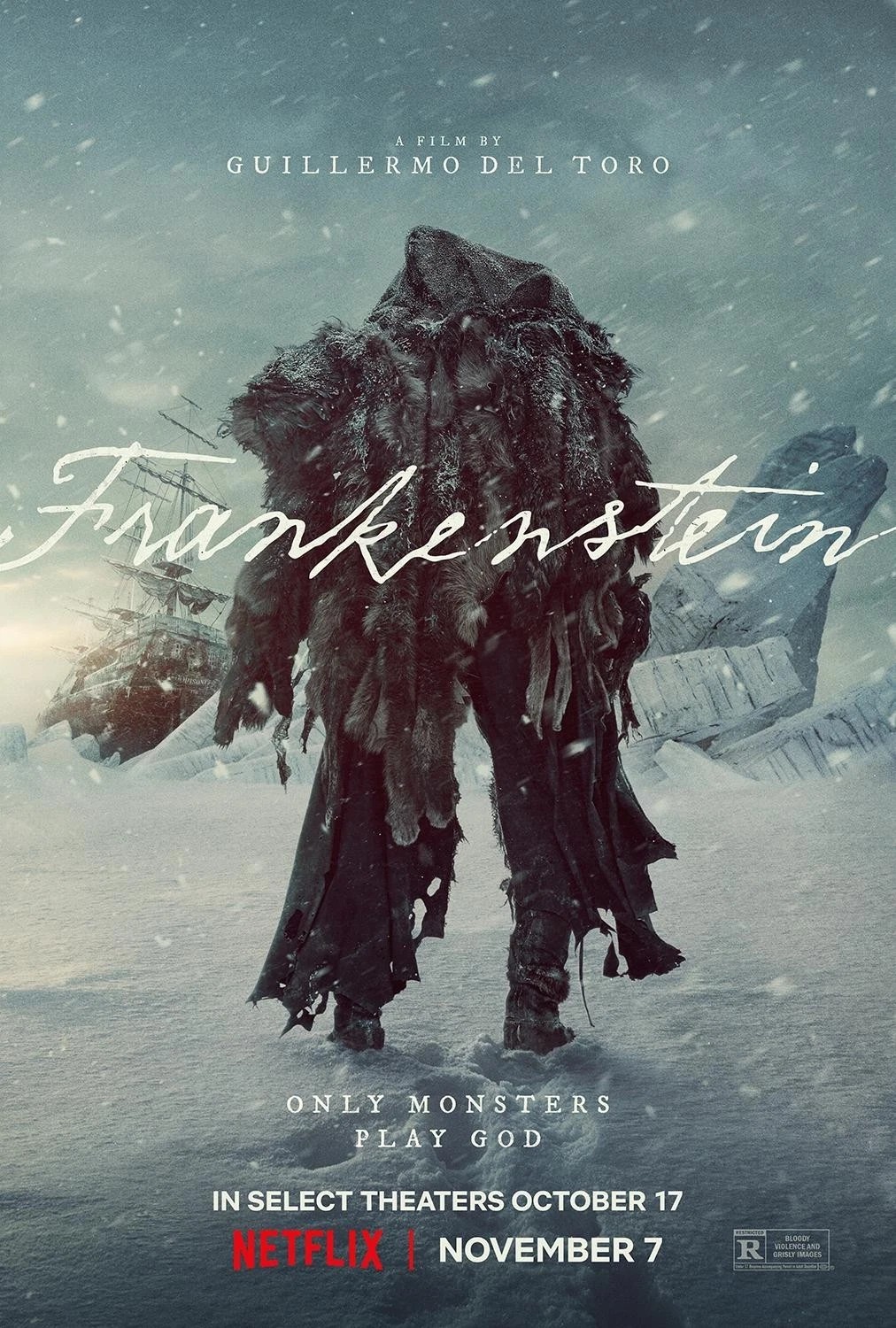
Here, we begin in the Arctic where an exploration vessel trapped in ice comes upon a very ill Victor Frankenstein (Oscar Isaac) who is being pursued by the monster (Jacob Elordi) of his creation.

Then we’re in flashback mode. Victor is son of a famous but tyrannical surgeon (Charles Dance) whose adored mother dies in childbirth giving birth to a more favored brother William (Felix Kammerer).

Then we shift to a medical disciplinary court where Victor is on trial for his experiments in reanimating corpses, for playing God in a society where the Supreme Being was still considered in charge of everything on Earth. But no matter how clever the corpse appears, capable of apparently playing catch, the case goes against him and his dreams, and career, would be in tatters except for the intervention of wealthy arms dealer Harlander (Christoph Waltz), uncle of Elizabeth (Mia Goth) the fiancée of William.

She’s intellectually advanced for a woman of the era, studying insects, and more than a match for Victor and for a while it looks like we’re in for an awkward love triangle. Meanwhile, Victor is harvesting bits and pieces of fresh corpses from battlefields and stitching them together in a way that maintains the body’s unique nervous system while Harlander happily stumps up the enormous cost.

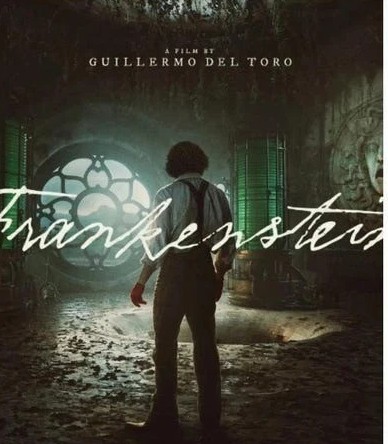
The experiment, which takes place in a remote castle and costs the life of Harlander, is a success but given the monster’s size (Jacob Elordi) Victor keeps him in chains in the castle’s vast cellar. But he soon becomes exasperated by the creature’s lack of intellect, speech limited to repeating his creator’s name (and his own as it turns out).

When Elizabeth discovers the creature, she falls in love with it and turns against the scientist and keeps the gift of a leaf the creature has given her pressed inside the pages of a book. Since the creature is fit for no more than a circus exhibit rather than acclaimed as an experiment, and needing someone to blame for Harlander’s death, Victor fits up the monster, blaming him for setting fire to the castle.

Victor escapes, takes refuge in a cottage where he is educated by a blind man, and discovers his own emotions. Hounded out of there, he sets out to find Victor who is attending his brother’s wedding. The monster’s plea for a female companion is derided by Victor and in a melodramatic moment he accidentally shoots Elizabeth. The monster carries the dying woman out of the wedding pieta style.

So the hunt is on. Victor flees to the frozen north and eventually when the monster engineers a confrontation, he is able to attempt reconciliation with his creator.

The question asked – who is the monster? The creator or the result of his tampering with nature?

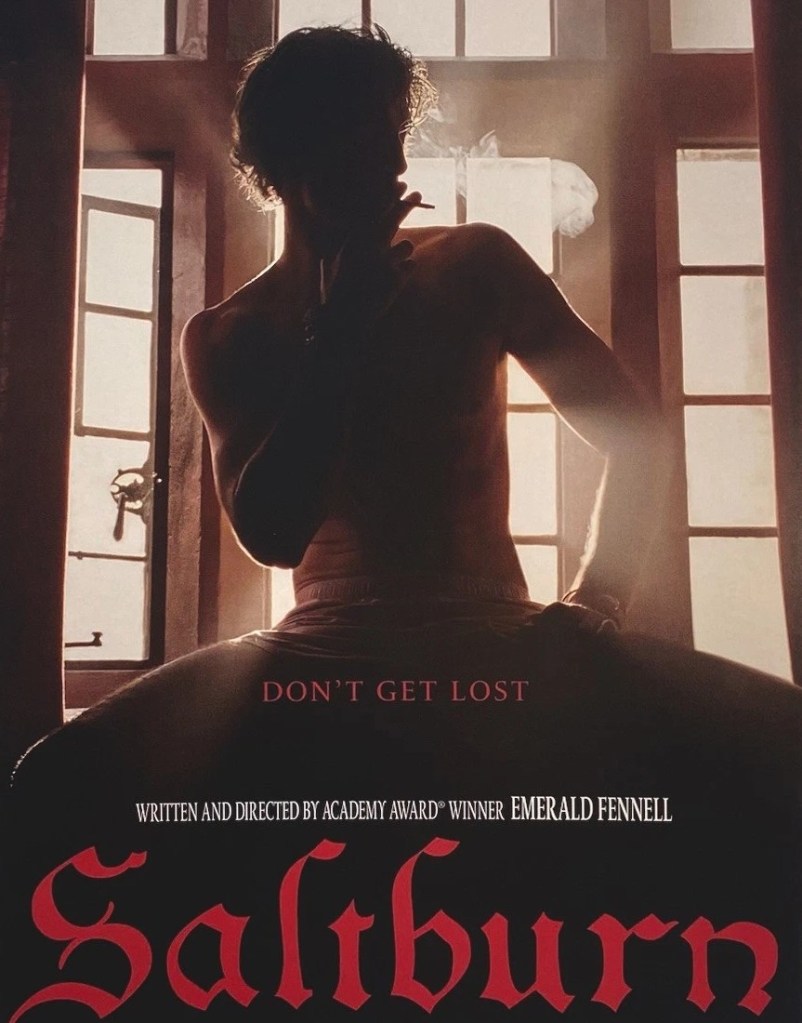
The acting is top notch, Jacob Elordi (Saltburn, 2023) should have walked off with the acting plaudits except that Oscar Isaac (Dune, Part One, 2021) elicits our sympathy and then our horror and Mia Goth (Maxxine, 2024) excels in a role where she is not called upon, as so often before, to overact. As far as Christoph Waltz (No Time to Die, 2021) and Charles Dance (The First Omen, 2024) are concerned their roles are minor variations of characters both have played before.

Praise is very much due to writer-director Del Toro for not losing my interest for a minute.

Since this is a Netflix production I could have saved myself a few bucks and waited till it appeared on the small screen. But unlike other big budget works by “visionary” directors, this will work very well on the smaller screen because, despite some arresting visuals, it’s essentially a chamber piece involving a handful of characters.

The highest praise I can give any director of an epic is the ability to not lose my interest for a single minute. So all praise Del Toro.

On Swift Horses (2025) *** – Seen at the Cinema

Authentic story stymied by unlikely plot. Set in a post-Korean War American when the United States is still a land of opportunity even for blue collar workers but sexuality and other forms of self-expression are stifled and the homosexual world is only accessible through secret codes. Married Muriel (Daisy Edgar-Jones) hankers after something of the wilder life apparently enjoyed by the brother Julius (Jacob Elordi) of her staid husband Lee (Will Poulter). Truth be told she hankers after an illicit relationship with Julius.

Muriel harbors two other secrets. Firstly, she wants to gamble, a notion that would never gain approval from her husband, who accounts for every penny in his bid to own his own home and thus move up in society. Secondly, she has lesbian tendencies and gradually, encouraged by the self-confidence generated through successful betting at the racetrack, she assumes a different persona, surprisingly capable of making the first move.

Lee is aware of his brother’s proclivities, though these, too, are measured in guarded tones. Julius lives “in another world”, not just the low-down hustling and gambling and earning a living as a gigolo and card cheat. His homosexuality is repressed but his barriers are broken down by Mexican hustler Henry (Diego Calva). But while Julius is willing to settle for a life of energetic sex with Henry, his lover has greater ambition and plans to move up in society via the scam route.

Muriel’s affection for Julius is not hampered by the fact that he constantly steals from her, pocketing the cash she sends him for a bus fare home, burglarizing their house while they sleep. And while she is happy to indulge in a casual affair with gay neighbor Sandra (Sasha Calle) she’s not whole-heartedly committed to that lifestyle. And it’s hard to see just how committed she is to Lee – the horde of cash she wins at the racecourse she keeps hidden from her husband even though it would miraculously ease their upwardly mobility.

While Muriel negotiates the hidden world with some care – gay people of both sexes meet at a certain hotel or come together under the guise of a book club – Julius is less wary and is beaten up and robbed a couple of times.

This isn’t quite the lush America of 1950s Hollywood with women bedecked in colorful dresses and enjoying cocktails, but there’s still satisfaction to be had in hauling yourself up and owning a tract of land and your own house. And it’s still down’n’dirty. Casinos spy on customers through two-mirror mirrors set in the ceiling and beat the life out of anyone caught cheating.

What wins your heart is the yearning. Muriel is caught in a half-world, even when she finds a willing lesbian partner she still aches for a heterosexual whirl with Julius. And Julius who believes he has found a safe sexual haven with Henry discovers that the latter’s naked ambition will destroy their tryst.

What doesn’t work are the fairy tale aspects. Julius isn’t a particularly good card cheat, a hidden ace or a partner at another table providing him with illicit advantage at the poker table. You’d expect he’d be rumbled quite easily. But the plot says no.

Similarly, Muriel enjoys an unbelievable good run on the horses, able to turn tips overheard from customers in the diner where she works into winning bets. Pretty quickly, and without a stumble, she has amassed a stash of $20,000. As if.

The ending doesn’t work either, Julius galloping on a horse (yep!) from San Diego to Las Vegas – a distance of some 350 miles (that’s some horse!) – after he realizes that, in fact, his heart belongs to Muriel, whose marriage has at last broken up, and she’s decided to follow her heart and become a gambler.

It leaves you wondering what kind of relationship they would have, a lavender marriage, where both are free to indulge in other aspects of their sexuality, no doubt living high on the hog from her racetrack winnings and his cheating at cards.

It looks to me like the director has bottled out of the third act, the one where supposedly they are the person of each other’s dreams and manage to make a life together as happy gamblers, until one or other decides that a person of their own sex is more fulfilling ultimately than a person of the opposite sex.

You didn’t need the barmy plot for this to work. And in fact it’s the barmy plot that gets in the way of it working. Both Julius and Muriel are entirely believable in looking for a love that dare not speak its name but can yet be easily located if you can follow the codes or if your gaydar is sufficiently developed.

Oddly enough, the most heart-breaking scene is the one before the barmy galloping. On the message board inside a gay meeting place are notes revealing the heartbreak caused not just by the dashing of love’s hopes but the destruction of marriages by men unable to conceal their secret desires.

The acting is uniformly good, though Jacob Elordi (Saltburn, 2023) thanks to his vulnerability, wins by a nose from Daisy Edgar-Jones (Twisters, 2024). But Will Poulter (Warfare, 2025) and Diego Calva (Babylon, 2022) also score points. Movie directing debut from Daniel Minahan from a script by Bryce Kass (Lizzie, 2018) based on the novel by Shannon Pufahl.

While you have to admire the actors for taking a gamble on this project – Elordi and Edgar-Jones are down as executive producers so they might also have taken pay cuts. But it has been  an unmitigated financial bomb. Even the leanest movies these days appear to cost upwards of $10 million and this has barely touched the $1 million mark in global box offices. I attended the only daily screening at my local multiplex and there was only one other person in the audience. It probably deserves better and might have an afterlife on a streamer.

Enjoy the performances and ignore the plot.

Triple Bill of Duds: “May December” (2023) * / “Saltburn” (2023) ** / “A Forgotten Man” **

The selection process for my weekly Monday visit to the cinema has sorely let me down. I never refer to reviews in advance, not wishing to learn anything, however inadvertently, about the story. So, I went into this arthouse trio – all showing I hasten to add at my local multiplex – with high hopes.

May December

I find it impossible work out how anyone, least of all a brace of Oscar-winners like Natalie Portman (here listed as producer) and Julianne Moore, could seriously consider making a movie about someone convicted of child sex abuse. In this case, I guess, the excuse is that because it’s a woman it’s either a) understandable or b) excusable. But if the subject was a male sex abuser I doubt if he would be given the same latitude.

This is one of those films that would have been far better dealt with as a documentary where the facts can be treated more straightforwardly rather than deliberately clouded by fictional elements and sympathetic treatment. Supposedly, the audience is provided with perspective since the movie revolves around an actress Elizabeth (Natalie Portman) doing preparatory  work 20 years after the event as a prelude to playing the character in a television movie.

The fact that Gracie (Julianne Moore), the married woman convicted of having sex with a 13-year-old boy, denies that she committed any crime, maintaining a) that it was true love and b) that she was the victim, that the boy was “in charge” and the seducer, seems a very deliberate attempt to muddy the waters. Especially, when it becomes clear that the boy, Joe (Charles Melton), now of course a man, has been forced to bury his true feelings about the subject.

With the usual showbiz entitlement, Elizabeth sees nothing wrong with disrupting what is, on the surface at least, a reasonably happy family, forcing the children of this relationship to come to terms with the fact that at least one of them was born from an illegal coupling.

Not to mention the damage this will do to the innocent children of the couple on whom the story was based, Mary Kay Letourneau (since dead) and Vili Fualaau. That Elizabeth turns out to be pretty creepy herself – explaining to a shocked teenage audience that she gets aroused during sex scenes and seducing Joe – seems to be an attempt at mitigation (oh, look, we all do crazy things once in a while!).

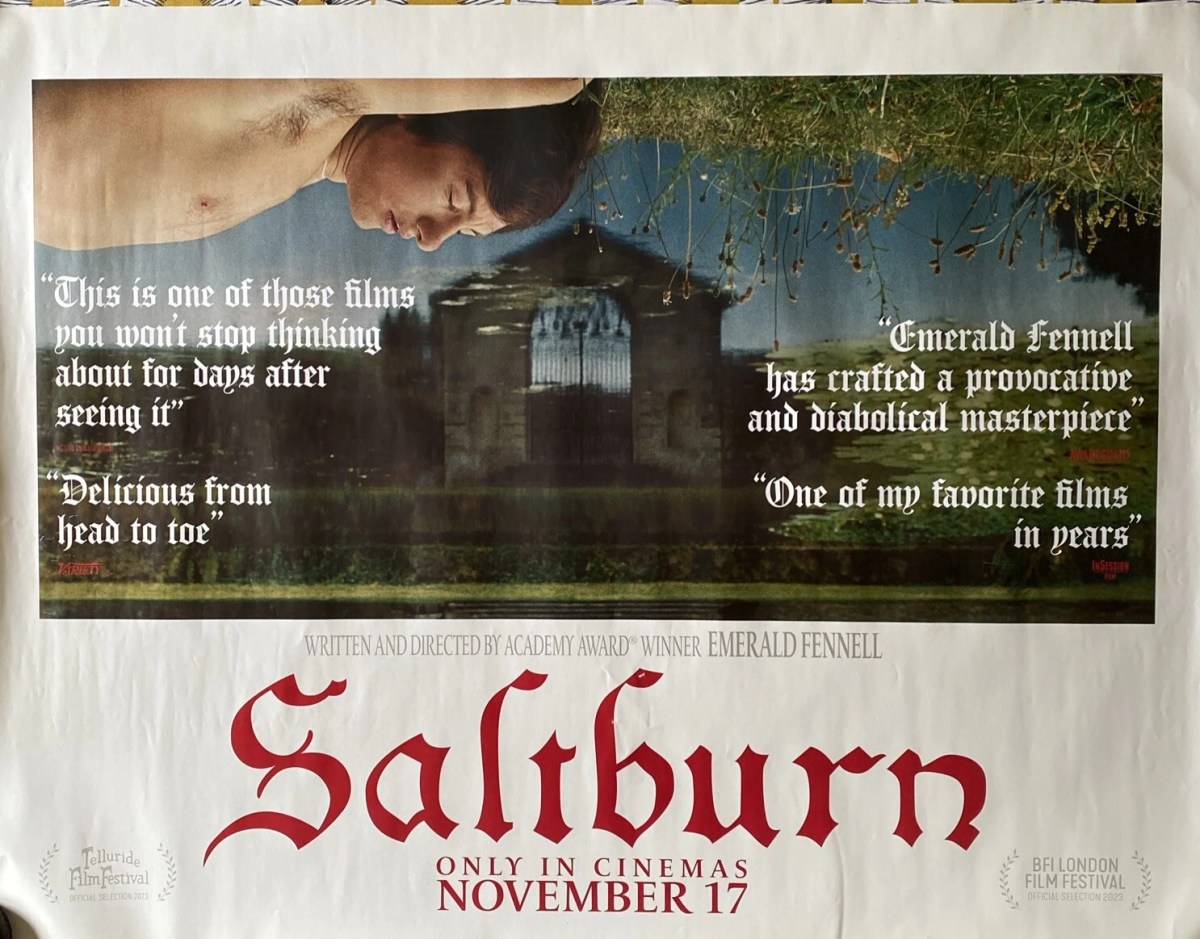
Saltburn

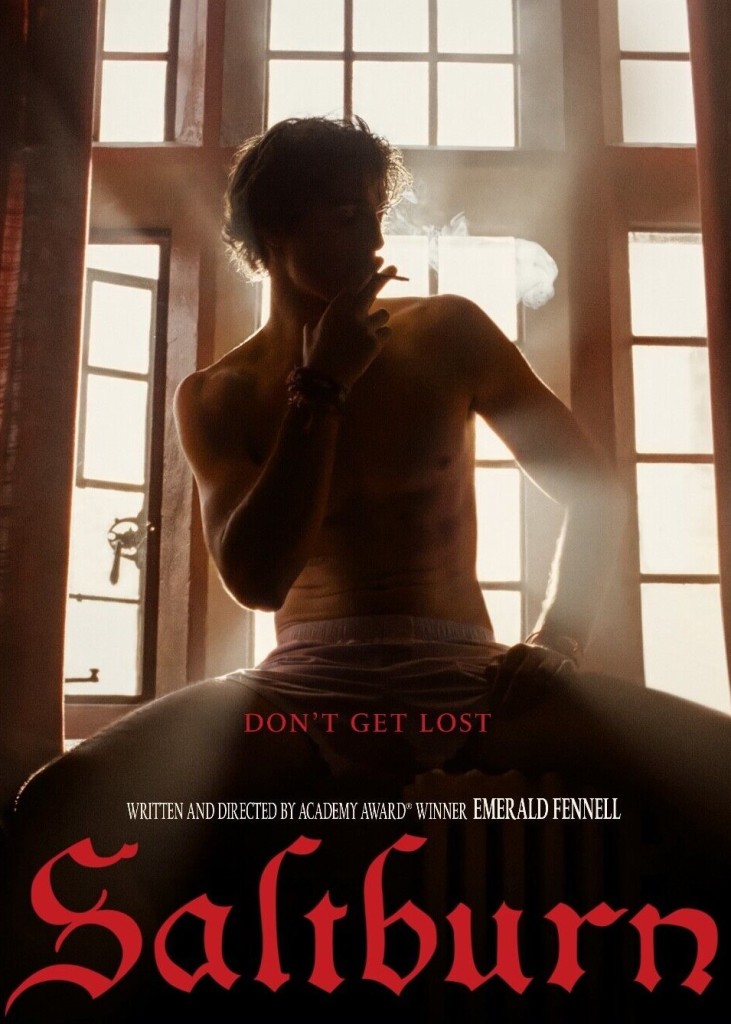
Brideshead Revisited Meets Carry On Downton Abbey. Wouldn’t surprise me if that’s the way it was actually pitched, it’s just so uneven, veering through several different styles without ever finding a target. The shock elements are, unfortunately, just risible. Via the trailer this appeared to be a moody, atmospheric picture about entitlement, the downside, if you like, of Downton.

Instead, it’s just plain barmy, which might well have worked if its take on the bizarre had been consistent, but, really it’s a contender for the coveted So-Bad-It’s-Good Award with Rosamund Pike odds-on to nab a gong for Best Maggie Smith Impression. .

Oliver (Barry Keoghan) is supposedly a scholarship student at Oxford, coming from a sinkhole estate in Liverpool, parents drug dealers etc etc. Out of his depth, by chance he latches on to sex god Felix (Jacob Elordi) and is invited to spend the summer at the latter’s stately home complete with sneering butlers and demonic family all graduates of the Over-Acting Academy.

Turns out we’ve not been watching Downton Abbey at all, but The Usual Suspects, Oliver not an innocent little bookworm but an extremely malevolent character who manages – in the absence (luckily) of post-mortems – to bump off the entire family in order to inherit (don’t ask!) Saltburn in order to, in a bizarre nod to Risky Business, dance naked through it.

The only reason it gets any points at all is Jacob Elordi, who exhibits tremendous screen charisma, and because the barmy extremely self-centred and out-of-it Rosamund Pike does elicit a few laughs and maybe, courtesy of Richard E. Grant, has a haircut to enter some kind of Hall of Fame.

Couldn’t find a poster for “A Forgotten Man” so thought I would temper proceedings
with this old British poster for a seaside resort.

A Forgotten Man

This wants to say something important about the neutrality stance of Switzerland during the Second World War. But unless you live in Switzerland, you won’t have a clue what it’s trying to say. And if you thought The Crown was off-the-wall in summoning up the ghost of Princess Diana, wait till you start counting the number of ghostly apparitions here of young Swiss chap Maurice (Viktor Poltier), whom the protagonist Henrich (Michael Neuenschwander), while Swiss Ambassador to Berlin during the war, failed to prevent being executed.

I’ve no idea if this aspect is based on a true story. Either way, fictional or not, it’s a preposterous central conceit. Supposedly, Maurice had been arrested for trying to assassinate Adolf Hitler. Theoretically, we should all be applauding his actions. He should get a free pass for trying to rid the world of a monster. But, in reality, how would you expect an Ambassador to go about pleading clemency for one of his citizens who tried to murder the ruler of Germany?

There’s clearly some angst about the fact that Switzerland managed to emerge unscathed after a war which left the rest of Europe in turmoil. But it’s pretty hard to summon any sympathy for anybody, least of all the director because whatever point he’s trying to make is made so obliquely it fails to register. That it gets any points at all is due to its brevity and that, as the first movie in my self-selected triple bill, I came out of it in a far better mood than the other two.   

Discover WordPress

A daily selection of the best content published on WordPress, collected for you by humans who love to read.

The Atavist Magazine

by Brian Hannan

WordPress.com News

The latest news on WordPress.com and the WordPress community.