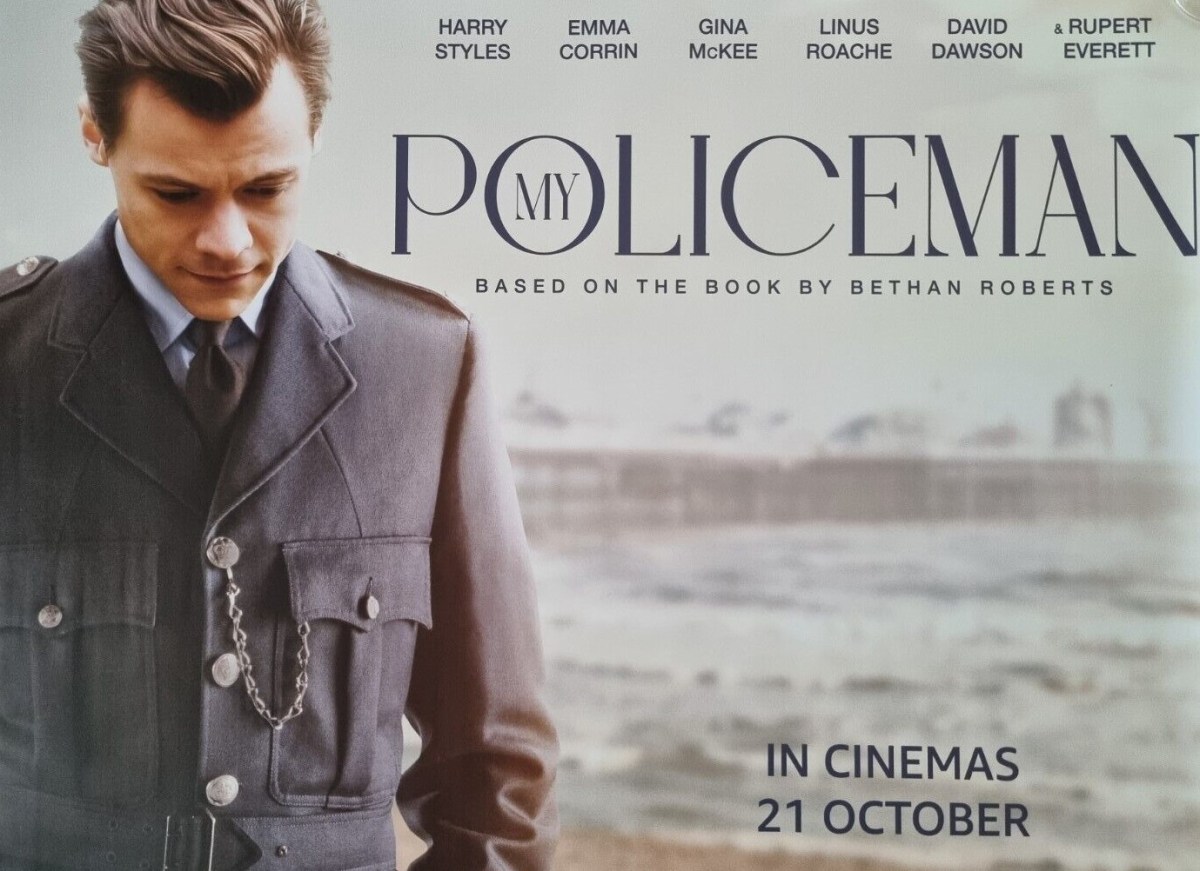
Understated love triangle set in the 1950s with perfectly-pitched performances and punctured by reticence, repression and regret. Not that I check reviews before I venture into a cinema but I gather this has been poorly-received, perhaps because it’s funded by Amazon, which has no great record in making movies, and partly, I guess, because it’s headed by pop star-turned-actor Harry Styles, credited with giving Don’t Worry Darling (2022) an unexpected, and for some, unfai, box office push.
But I found this to be solid stuff and despite the tragic outcome no overtly dramatic acting (unlike Emily for example), the whole enterprise pared down, soulful more than anything, and all the better for it. Mostly, it takes place in flashback.

In the 1990s, a stroke-ridden Patrick (Rupert Everett) is given accommodation in the household of married but childless Tom (Linus Roache) and Marion (Gina McKee). Tom resents the intrusion although they were all best pals back in the day. Gradually, we find out why, but the movie begins in low-key fashion, the young Tom (Harry Styles), a policeman, and Marion (Emma Corrin), a teacher, hooking up with all the innocence of that era at the beach. Tom teaches her to swim, she introduces him to art.
Turns out Tom has an arty buddy, Patrick (David Dawson), the slightly older museum curator. Soon they are a threesome, attending concerts and eating out, and while Marion appreciates Patrick’s appreciation of the finer things in life, she’s more at home with the more ordinary Tom. While he’s a bit hesitant about making advances towards her, eventually he plucks up the courage to ask her to marry him.
The movie flips between the 1990s featuring the older trio and the 1950s with young bucks in love. And part of the movie’s attraction is the innocence, it takes a while to work out what’s going on, or more correctly for the audience to be told what’s going on, which is that Tom has fallen in love with Patrick. But he is also in love with Marion and wants children and a proper family, so the suggestion that in marrying her he is seeking the perfect disguise for his sexuality is never pointedly made. Mostly, we get his confusion. Remember this is the 1950s when homosexuality in Britain was a crime that could result in a stiff jail sentence.
Gradually, Marion begins to suspect Tom has leanings and there’s a wonderful scene where she confesses this discovery to her best friend only to be told the friend is a discreet lesbian. Does this suddenly make the friend a completely different person, Marion is asked.
Of course, it’s only going to end in tragedy, and even then it’s an ongoing one, the older Tom unable to admit his preferences, married to the stoic Marion, and clearly agonising over the life he could have led had he been bolder earlier on.
I thought this was very delicately done. The scene where Tom shows his true feelings by his finger almost absent-mindedly stroking Patrick’s neck and his subsequent awkwardness at what then transpires as he comes to terms with his own suppressed emotions is subtly done.
I’m surprised Harry Styles has had such a rough ride over his performance. Perhaps I was out of the loop in the brouhaha of expectation. I thought he captured very well the character’s uncertainty regarding his sexuality, the knowledge that career (bachelors found it hard to get promotion in the police) and marriage could be jeopardized by an illicit action too many. This could not be a more different performance than the alpha male of Don’t Worry Darling. From his initial behavior I half-expected a rom-com where shyness is gradually overcome, but the implicit danger ensures we steer clear of such territory.
Emma Corrin (Netflix’s The Crown) comes across very well as the equally shy young woman of her time, anxious to appear not too forward, unaware of what to expect from the sexual side of marriage, remaining innocent until her wrath takes hold, and clearly willing to make do for the sake, in that very English manner, of appearances. David Dawson, in his first starring movie role, is excellent, rarely letting anguish get the better of him but far from the camp cliché.
Rupert Everett (The Happy Prince, 2018) is the surprise turn, the virtually mute stroke victim, enduring the torture of living in the same house as his former lover who consistently ignores him. Gina McKee (Lies We Tell, 2017) and Linus Roache (A Call To Spy, 2019) are good as the mismatched couple, though I’m not sure I believed in her final action, a shade too romantic a gesture for a wife who one way or another has kept her husband in thrall for 40 years.
Michael Grandage (Genius, 2016) should be applauded for his sensitivity, for coaxing superb performances from his younger actors, and for falling into the trap of overloading the picture either with a sense of doom or of overplaying the dangers of the lifestyle. Ron Nyswaner (Philadephia, 1993) adapted the book by Bethan Roberts.
Well worth seeing and at last Prime might have something decent to watch.


 The Magnificent 60s