
It took three attempts by different producers before Birdman of Alcatraz finally hit the screens. After the novel by Thomas E. Gaddis was published in 1955, Ingo Preminger, brother of director Otto Preminger, a year later was first to throw his hat in the ring – on behalf of director Joshua Logan.
Logan was on a roll, Oscar-nominated for Picnic (1955) starring William Holden and lining up Marilyn Monroe for Bus Stop (1956). Explained Preminger, “I knew Joshua Logan was looking for something off the beaten path for a personal project…(and found) exactly what he was looking for in the controversial novel.” Given Ingo’s track record – he wouldn’t produce his first film until Mash (1970), admittedly a smash – it was small wonder he didn’t make it to first base.

Twentieth Century Fox, under the aegis of Buddy Adler, had the movie on its schedule until abruptly dropping the project in 1958 when he failed to secure the cooperation of the Federal Bureau of Prisons. In fact, the Feds actively opposed the production, feeling the oxygen of publicity for the prisoner was undeserved.
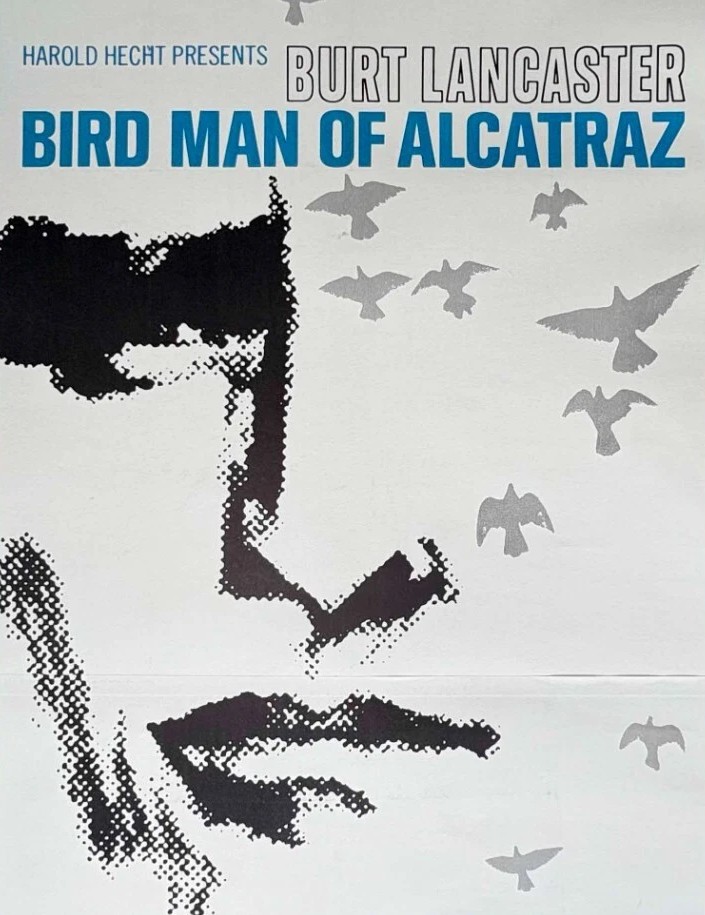
Next up was accomplished independent producer Harold Hecht, who had formed a partnership with Burt Lancaster – Apache (1954), Trapeze (1956), The Unforgiven (1960). He was no more successful with the prisoner authorities – denied permission to shoot in Alcatraz or Leavenworth. But at least with Lancaster on board, he had a marketable commodity. Although he had a close relationship with United Artists, Birdman of Alcatraz was initially set up at Columbia and while shot on that studio’s backlot it was released through UA as a part of a 46-film three-year production package promising to be “as diverse, offbeat and box office” as previous offerings.
Lancaster had abandoned the actioners which had made his name and moved on to more challenging pictures. These days you’d call it virtue-signalling as he took on subjects as varied as evangelism (Elmer Gantry, 1960), juvenile delinquency (The Young Savages, 1961) and the Holocaust (Judgement at Nuremberg, 1961).
Neophyte Stuart Millar was brought in as director. He had set up in partnership with former agent Lawrence Turman (The Graduate, 1967) with a deal to make six movies in three years. His tenure at the helm didn’t last long and eventually he moved sideways to take on the role of producer. (He didn’t land a directing gig for another decade).
Though Lancaster had his eye on Jules Dassin (Never on Sunday, 1960), next in line was Charles Crichton (The Lavender Hill Mob, 1951) but he didn’t last long either. A decidedly odd choice, he fell foul of Lancaster’s impatience and was quickly replaced by John Frankenheimer (Seconds, 1966), one the new breed of directors emerging from live television, and who had made his debut on The Young Savages. Frankenheimer, going through a divorce, was reluctant to set foot in Los Angeles, and was lured there on another pretext by the actor who announced that, having just seen a cut of Young Savages, he was ideal for Birdman.
Not only was Frankenheimer he intent on revolutionizing the movie business, but he had the notion that he could reinvent television. After the demise of television’s Playhouse 90, he planned to set up a “creative stock company” of his former television colleagues and make two-hour programs for the small screen with the aim of helping “the medium out of its degradation.” He expected to win the backing of the likes of Arthur Penn, George Roy Hill, Delbert Mann, Ralph Nelson, Robert Mulligan and Sidney Lumet, who would all become major figures in Hollywood, as well as significant writers like Rod Serling and Horton Foote.
More pertinently to the project at hand, he intended to transition from mere director (i.e. gun for hire) to producer (in charge of his own career) and learn to function at “the business end of production” and to that extent was seeking overseas finance and lining up a $1 million adaptation of William Styron’s 1951 novel Lie Down in Darkness (never made) and Flowers of Hiroshima (never made). “Frankenheimer meant a new voice just at the time Lancaster needed it.”
Lancaster embarked on the picture as a campaign to free Stroud, who by now had served 40 years of a 50-year sentence in solitary confinement (a record). Obsessive by nature, the actor excelled himself, immersing himself in a study of Stroud’s books, letters, coverage of the case and penal law. Despite the enormity of the obstacles, Lancaster thought the movie and its attendant publicity would persuade the authorities to release the prisoner. Nor was Stroud much help. “Stroud will not kowtow,” said Lancaster, “He will not make polite amends for what he has done.” He was impressed by the fact that “Stroud took a miserable unnatural existence and yet made it a meaningful thing.”
While the actor saw Stroud as rehabilitated through his ornithology, the Feds begged to differ, viewing him as a double murderer who was a danger to society. Lancaster turned down other more lucrative work – though still managing to squeeze in a $750,000 payday for Judgement at Nuremberg – in order to “tinker and groom this very uncommercial” picture.
Writer Guy Trosper (One Eyed Jacks, 1961) was hired to make the character, within a realistic framework, as appealing as possible.
The film was budgeted at $2.65 million though that included some of the losses incurred on The Sweet Smell of Success (1957) and The Bachelor Party (1957) It proved a major collaboration between actor and director. “We blocked scenes,” explained Frankenheimer, “We decided to do the whole business of building the birdcage, of finding the first bird, of working with the birds – everything.” The movie was made in sequence to aid the ageing of the character. Lancaster didn’t wear a bald cap. His head was shaved halfway to the back and each gray and white hair was added individually
Lancaster spent two weeks rehearsing with 2,000 canaries imported from Japan as well as sparrows, until he could persuade the birds to hop onto his hand and peck at birdseed. To assist the recalcitrant birds, feathers were clipped so they couldn’t fly away. The method of achieving the scenes where the birds got sick and dropped from their perches was achieved by pouring lighter fuel down their throats.
The original cut ran four-and-a-half hours. The first half of the picture was rewritten and reshot. Editing would last another three months. Prior to release, Lancaster began his campaign to win Stroud a release, touring the country, addressing groups and journalists. He walked out of a television interview with Mike Wallace. Issues arose about Stroud’s homosexuality and the public opposition to Lancaster’s campaign soon derailed it.
United Artists planned an experimental release for the movie. Instead of going down the tried-and-tested route of the movie opening in big cinemas in big cities and working its way down stage by stage to the fleapits, A wanted to open the picture in as many houses as possible in new York in what it dubbed a “Premiere Showcase” (I’ve written about this elsewhere).
In one of those quirks that trade journalists pick up, it was noted that there was an ornithological cycle – on the path to release or in production were Bye, Bye, Birdie, To Kill A Mockingbird, The Sweet Bird of Youth, The Birds and Birdman of Alcatraz. The movie managed to see the inside of a jailhouse but only for a screening at Wayne County Jail in Detroit. Relations with the prison authorities otherwise remained frosty – Stroud was denied gifts and cards sent to him by stars and crew of the film.
Simultaneous with screenings at the 1094-seat Astor on Broadway and the 550-seat Trans-Lux 85th arthouse, UA opened the movie in eight other New York theaters (a process known then as daydating). The haul was $490,000 over three weeks. Stage two was an immediate moveover to 54 houses which locked up $196,000 in five days. Elsewhere it attracted the type of business expected of a prestige drama, not a prison movie as such. It finished the year with $2.2 million in rentals (the studio share of the box office gross) – enough for 27th spot on the annual chart – though observers reckoned it might be good for another $1 million or so once the effect of the ~Oscars (it was nominated for four and Lancaster was named Best Actor at the Venice Film Festival) kicked in.
It was successful overseas, ranked 25th of all the movies released in Italy over a two-year period. (Interestingly, in the same list poorer performer at the domestic box office The Notorious Landlady and The Counterfeit Traitor came eighth and 13th respectively, It was televised in October 1964.
SOURCES: Kate Buford, Burt Lancaster, An American Life, (Aurum,2008) pp 207-210; “Clips from Lots,” Variety, June 13, 1956, p24; “Banks Read Titles,” Variety, June 20, 956, p13; “Feds Veto Alcatraz,” Variety, October 19, 12958, p3; “Stuart Millar,” Variety, October 12, 1960, p17; “New York Sound Track,” Variety, November 23, 1960, p4; “Feds Not Helpful,” Variety, December 7, 1960, p19; “Cruel and Unusual Punishment,” Variety, February 15, 1961, p2; “Playhouse 90 Alumni Band Together,” Variety, March 8, 1961, p25; “If Changes in UA Plans Due,” Variety, October 18, 1971, p7; “To Be Creative Not Enough,” Variety, February 11, 1962, p11; “Homosexual Question Raised at Birdman Feed,” Variety, May 2, 1962, p2; “Audubon Influence,” Variety, May 2, 1965, p3; “Birdman Jail Screening,” Variety, July 4, 1962, p64; “Frankenheimer Thinks Out Loud,” Variety, July 18, 1962, p13; “Premiere Showcase,” Variety, August 22, 1962, p7; “Big Rental Pictures of 1962,” Variety, January 9, 1963, p13.
 The Magnificent 60s