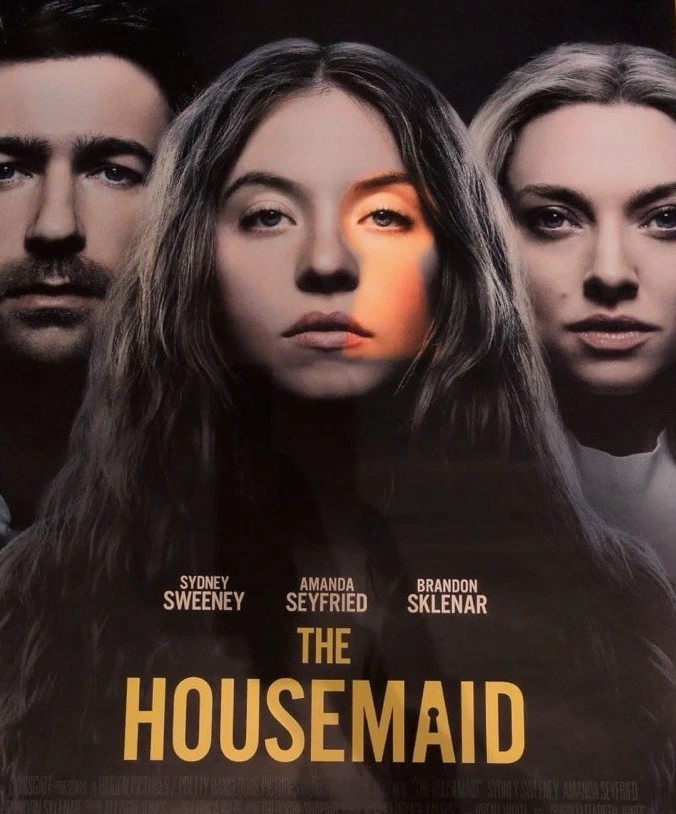
Now that Hollywood is waking up to the surprise hit of the season – worldwide gross now pushing $300 million – it’s equally surprising to discover just how much work went into converting a bestseller with a very enticing hook into a runaway success. The pitch is a stunner – abused wife grooms housemaid to take her place and, potentially, put her abusive husband in his place.
Screenwriter Rebecca Sonnenshine (The Keeping Hours, 2017) does a quite superb job of tailoring the bestseller by Freida McFadden. It would have seemed, on the face of it, with such a killer premise, you wouldn’t have to do much tampering. But you’d be wrong. What Sonnenshine removes and adds and touches up are a template for the art of screenwriting.
Major changes: the climax is completely changed and the role of handyman Enzo (Michele Morrone) considerably reduced, especially the icky section where our valiant housemaid Millie (Sydney Sweeney) looking for a no-strings-attached one-night-stand comes on to Enzo only to be rejected; and the screenwriter takes the “privilege” line that doesn’t appear until well into the book and brings it in much earlier, to add gentle menace.
Minor changes: just about everything.
The filling out begins at the start. In the book, there’s very little detail regarding the job interview and the grandeur of the house except that it’s grand. Here’s what Sonnenshine adds – the “W” on the gate, the display of enticing food that employer Nina (Amanda Seyfried) lays on for a prospective employee, the emphasis on the obnoxious child Cece (Indiana Elle) as a potential ballerina, the cops rousting Millie when she’s asleep in her car. Here’s what Sonnenshine immediately removes: the attic is smaller in the book, tiny, compressed, more ominous; an immediate warning from Enzo; and we don’t learn right away that Millie is a killer.
If you want to know the difference between taut narrative and drama, follow Sonnenshine. In the book, Millie meets husband Andrew (Brandon Sklenar) and child at the interview. In the film, it’s on her first day on the job when Cece introduces herself as the most obnoxious child, taking the new employee to task right away.
Other simple changes: in the book Millie starts work the next day, in the film she starts immediately following the job offer. In the book, Millie arrives overloaded with baggage that Nina doesn’t offer to help carry, in the film she brings very little and Nina does offer to help.
Major change: the heirloom plates. That’s pure Sonnenshine invention. They don’t appear in the book, and husband Andrew’s mother (Elizabeth Perkins) is scarcely in sight.
Sonnenshine also dumps Millie’s apparent first big mistake. In the book Millie makes Cece a peanut butter sandwich only for Nina to go ballistic because the child is apparently allergic. That’s too obvious a schematic and Sonnenshine opts for something better.
Right away, over the “dirty glass” issue, Sonnenshine brings in the first use of the “privilege” weapon long before as I said I was used in the book and never by the child. But she takes out the point about Millie’s glasses / contact lens. In the book this is a contentious issue – Nina accuses Millie of lying over wearing contact lens and glasses.
Also Nina gives her old clothes to Millie very early on whereas Sonnenshine dramatizes this so that it’s seen as an apology.
It’s Sonnenshine who adds drama to Millie’s visit to her probation officer and gives the probation officer the icky line asking Millie about her sex life. Nor, in the book, is Andrew mad keen on Stanley Kubrick’s Barry Lyndon (1975). That’s another Sonnenshine touch, to fill out Andrew’s character. “Hot saint” is another of Sonnenshine’s lines. In the book it’s Andrew who suggests going to the Broadway show, not Nina, so that’s a nice gesture rather than with Nina, another apology. I should also point out that in the book Nina is about 50lb heavier than in the film. The ballet isn’t so dominant, either, Cece in the book attending a range of classes.
In the book, Andrew and Millie don’t get separate rooms at the hotel. They are all over each other in the cab to the hotel. It’s Sonnenshine who adds the dramatic urgency and ratchets up the tension in that in the film Millie tries to avoid intimacy and it’s only when she thinks she’s been fired by mobile phone that she falls into Andrew’s arms.
The film’s killer twisty line of “did you learn to cook in prison?” is better than the book’s “what’s prison food like?” Sonnenshine’s other big switch is that in the book Millie’ in juvenile detention not a scholarship kid as a private school when she commits murder. In the book Nina’s discovery of the Playbill program for the Broadway play is more discreetly done. But Sonnenshine turns it more dramatic with Nina coming down the stairs holding the magazine.
Nina’s immediate revenge in the book is to have Millie suspected of shoplifting after an anonymous phone call to a supermarket. Again, in the film it’s ratcheted up, Millie arrest for stealing her boss’s car and handcuffed and more roundly humiliated that provides the grounds for Andrew to chuck his wife out. The book cuts Millie out of the confrontation between husband-and-wife which results in Nina leaving.
And the book has no equivalent to Nina howling in her car apparently in despair at being chucked out, nor, in a marvelous twist, once we discover what hell awaits Millie, to cutting back to that scene and Nina turn that wail into a whoop of delight at being free.
Nina having to compensate for not getting her roots done by pulling a hundred strands of her hair out twice is in the book. But since the book didn’t include anything to do with priceless heirloom crockery, Millie’s first punishment is, frankly, a lot less interesting. Millie has to balance a stack of heavy books on her stomach for hours at a time. Honestly, that’s nothing, and visually zero, compared to having to rip your stomach open with the sharp end of a broken piece of crockery, which must be one of the most horrific scenes committed to celluloid.
And it’s not a cake knife left in the attic deliberately by Nina that allows Millie to escape, it’s the remains of a pepper spray that had formed part of one of Nina’s punishments. Stabbing someone in the neck with a knife versus blinding them with a pepper spray – what’s the more visual? You don’t need me to tell you.
His punishment in the book is rather long-winded especially bearing in mind that there’s no heirloom plates and assorted crockery to up the ante. So first of all in the book, Millie tortures Andrew by making him bear the weight of the books for hours at a time. It’s only days later, in fact, that in the book Millie instructs Andrew to pull out a tooth. Bear in mind, too, there’s been no lead-up to this, not in the book, which is why the screenwriter places such emphasis on his teeth and smile.
Sonnenshine tosses away the book’s ending. And you can see why. It’s not remotely cinematic. Sure, Nina returns to help. But in the book little help is needed. By the time Nina returns several days later, Andrew has already starved to death, or dead by dehydration, technically. That would be more easily explained to the cops given the problems with the door and Andrew in the house alone except in the book Millie has had her fun and made him pull out four teeth.
So, Sonnenshine opts for another course of action. He’s not dead when Nina returns. She makes the mistake of thinking it’s Millie locked in the attic and inadvertently frees her husband and then after some coming and going Millie pushes him over the banister and down about 50ft to his death.
Sonnenshine adds a happier postscript, Nina giving Millie $100,000.
I read the book after I saw the film so I was amazed at the quality of the script, the changes, the omissions, the additions and especially the nuances, the rounding out of every character. I doubt if anyone voting for the Best Adapted Screenplay Oscar ever reads the source material and that will probably count against Rebecca Sonnenshine come next year’s awards when virtue-signaling will probably win the day once again.
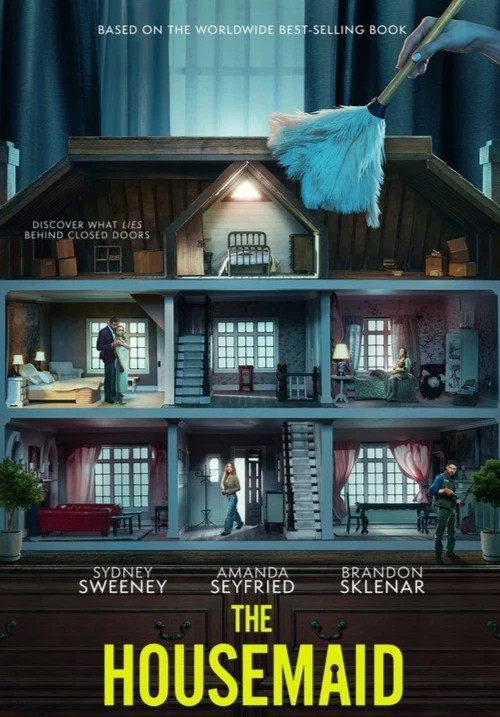
Other additions by the screenwriter: the toy troll, and therefore Cece stealing it from Nina’s bedroom, the creepy dolls house, and therefore Cece playing with it.
Much as I enjoyed the plot-heavy book, I enjoyed far more what the screenwriter made of it and I think Sonnenshine has played an enormous role in making the film such an appealing attraction.
The movie’s still going to be playing for weeks now, so if you get the chance check it out.

 The Magnificent 60s