Behind the Scenes: “Breathless / A Bout de Souffle” (1960)

The story of Breathless is usually told from the triumphant perspective of director Jean-Luc Godard, expressed in messianic terms as the young Frenchman who saved the turgid movie industry and inspired a new generation of filmmakers. For star Jean Seberg it provided partial redemption and a sharp plunge into a harsh reality.

Where she had been at the mercy of Otto Preminger in her previous two films, Saint Joan (1957) and Bonjour Tristesse (1958), and for all that she loathed aspects of that experience, she was still in the Hollywood system, where a whole phalanx of people attended to your needs. Preminger had had enough of the woman he believed he could turn into a star. Both movies had flopped, her acting talent questioned.

It’s generally understood that Preminger dumped her and sold her contract to Columbia. But the antipathy went both ways. Her husband, lawyer Francois Moreuil, approached Preminger to negotiate a release from her contract. She might have wished just to be set free for nothing but given Preminger’s investment, not just salary when she wasn’t working but all the build-up that went into turning an unknown talent into a star, that was never on the cards. So, he passed her on to Columbia, to whom he was contracted, and which would take her on as a favor.

But Columbia had little idea what to do with her either. As far as that studio was concerned she was far from the finished article, a long way away from stardom. The best she could hope for was a supporting role in a prestigious production, rebuilding her career under a more sympathetic director. That appeared the most likely outcome when her name was linked to a supporting part in Carol Reed’s Our Man in Havana (1959) starring Oscar-winning Alec Guinness and Maureen O’Hara. But she wasn’t even auditioned.

When Columbia finally found something for her to do it was in the low-budget British-made The Mouse That Roared (1959), leading lady to Peter Sellers, his first as star. After that though, as far as Columbia was concerned, it would be a tumble down the credits in the American Let No Man Write My Epitaph (1960) starring Burl Ives. The British film set had none of the highwire tension of a Preminger film. She was taken acting lessons which restored some of her confidence after the mauling she had taken from Preminger.

As luck would have it, while awaiting a summons from Columbia, she was ensconced in Paris in a romantic idyll with Moreuil, who had vague notions of turning to film direction and had therefore made the acquaintance of the Cahiers du Cinema gang of critics who harbored the same dream. That brought him into contact with Godard, who was, much to her surprise since her performances had generally been lambasted, a big fan.

She was impressed by his short Charlotte et son Jules starring former boxer Jean-Paul Belmondo. Her role in his debut feature, said Godard, was based on the character she had essayed in Bonjour Tristesse. “I could have taken the last shot of  Preminger’s film and dissolved to a title ‘Three Years Later’,” he explained. Still, even though there was nothing on the horizon from Columbia, she hesitated.

Godard was an unknown quantity, there was no script, and making a movie outside the Hollywood comfort zone would be a trial, a miniscule budget – $90,000 – scarcely a fortieth of that of a Preminger picture – would ensure no retinue of assistants. She would be largely on her own. Tippi Hedren had felt the same cold shock when she maneuvred herself out of her Hitchcock contract and discovered that rather than being waited on hand-and-foot by the industry’s best costume designers she had to wear her own clothes for her first job, in television.

Financially, Godard was in bad shape. Without a name – Belmondo scarcely counted – the film would be abandoned. In the absence of anything else, she signed up. But first she needed Columbia’s approval. The studio was offered $12,000 for her services and half the worldwide rights but when they stalled her husband pulled a fast one, announcing that since he was rich (untrue) Seberg need never work again and threatening that she would simply retire.  Columbia took the money and ignored the rights, which cost them several million dollars.

Seberg was paid $15,000 – around $5,000 a week (the shoot lasted 23 days) – a hefty sum for an ingenue if you took that as a potentially weekly rate ($250,000 a year), but even if that was all she earned it was still six times more than the average U.S. employee was paid in a year. That was still an improvement on the $250 ($13,000 per annum) paid by Preminger in 1957.

But there was a dramatic switch in power politics. With Preminger, she kowtowed, doing what she was told, failing to stand up to the director. On Breathless, she had no trouble expressing her views and wielding her power. She walked off the set on the first day of shooting after a disagreement with Godard. That was resolved by the director chasing after her. A couple of days later she was ready to quit.

And she argued vehemently against his interpretation of her character’s actions in the final scene. Godard wanted Patricia (Seberg) to steal the wallet of Michel (Belmondo) as he lay dying. She refused to do it on the grounds that it was not in character, but later explained that it was more personal, she did not want to play a thief on screen. She had reservations about taking off her clothes for the sex scene, resolved by the couple being hidden under the bedsheets and Seberg remaining full clothed. And if she fancied a day off – a considerable indulgence on a film on so tight a deadline – she took one. Godard saved face by allowing everyone a day off.

Cameraman Raoul Coutard observed, “She didn‘t let herself be pushed around but she did cooperate.” And without the normal armada of backroom staff attending to make-up and ensuring she looked her best in every scene, Coutard fell back on the fact that she was imply photogenic and did not require the full Hollywood treatment to look her best.

Perhaps the guerrilla style of movie making appealed. Instead of rehearsals with a script set in stone and lines learned weeks in advance, Godard made up the film as he went along, turning up in the morning with a students’ notebook filled with ideas and dialogue. At times there was no written script, Godard speaking lines and the actors repeating them.

Although at one stage after a spat he threatened to deny her a close-up, in reality budget restrictions –  a close-up would require filming a scene several times over – put paid to most of those. The scene in the car where the camera focuses on her an example of taking clever advantage of circumstance as the sequence, in its daring, appealed to the avant-garde.

But Godard did take the trouble to ensure that Patricia was true to her origins. As an American, her character should not speak fluent French, but make mistakes here and there, especially with gender. “It became much more colloquial and much more foreign in a way,” she said.

And much as she hated the way Preminger had imposed his ideas so strictly upon her, when left to her own devices, thanks to Godard’s improvisational style, she was at a loss. “She was very disabled because there wasn’t a script,” explained Francois. When she asked Godard for directions he would tell her to do what she wanted. Eventually, assuming the film was a mistake and would flop, she decided to “sit back and have fun.”

Although under time pressure, that was a less frightening experience than having a hundred pairs of eyes fixed on her as she spoke lines according to the Preminger dictat. But she had to come to terms with just how far down the production ladder she had fallen, a café toilet doubling as a make-up room, her wardrobe purchased from a discount store.

Godard’s inventiveness knew little bounds. For the final tracking shot, the director was pushed along in a rented wheelchair. The shot of the Champs-Elysess came from employing a postal cart. Filming began on August 29, 1959 and most of the film was shot consecutively.

Innovations included extensive use of the jump cut, hand-held camera and low lighting. Although deemed an arthouse movie by the rest of the world, Breathless opened at a commercial chain of cinemas in Paris where it was an instant hit, selling a quarter of a million tickets in its first four weeks.

While Godard and Belmondo basked in a critical and commercial triumph, for Seberg it was only part-redemption. Except at the end of the decade she was never the leading lady in big Hollywood productions, but she became an acknowledged star of French cinema, a couple of years later the third-highest paid actress  in France, earning $1,750 a week ($91,000 a year).

SOURCE: Garry McGee, Jean Seberg: Breathless, Her True Story (2018), pp60-68.

Breathless / A Bout de Souffle (1960) ****

I’m conscious of puncturing a sacred arthouse cow. While applauding the cinematic bravura of Jean-Luc Godard’s debut feature that launched the French New Wave, what are we to make of a leading man who is a sexist pig? Michel (Jean-Paul Belmondo) refers to women repeatedly as “dogs”, complains about their driving skills, accuses them of cowardice, steals from them, forbids them to see other men, chases after them in the street to lift their dresses, constantly gropes his sometime girlfriend Patricia (Jean Seberg), and boasts of other sexual conquests.

While attempting to ape hero Humphrey Bogart, he hasn’t a shred of that star’s romantic inclination, all his energy directed towards getting sex from the nearest available female with nary a notion of love.  He’s not just hard-boiled, he’s hard work, as close to the despicable males of Guide for a Married Man (1967) as you could get.

I’m no proponent of woke, but I guess audiences these days who happily accept him as thief and murderer will draw the line at his attitude to women. I found myself squirming at times at being asked to swallow this amoral character in what was otherwise a homage to the Hollywood B-picture. And it says a lot about the directorial skills that he ends up with any audience sympathy at all. And part of that certainly comes from his proximity to the more existential-minded arty Patricia. Not for the first time are we asked to re-examine our instinctive reaction to a charming thug because a sympathetic woman in either loving him or appearing to offer him understanding provides a conduit between audience and character, asking us to see him from her less judgemental perspective, no matter how misguided that might be.

You can see the connection between the Cecile of Bonjour Tristesse (1958) and Patricia here but it’s hardly as clear-cut as Godard suggests. Patricia has qualms not just a nice comfort blanket of guilt. She’s not, as Michel wishes, some kind of sidekick or accomplice. He fails  to unlock her criminal tendency as Clyde would later in the decade with Bonnie in Arthur Penn’s gangster picture. But, just as Cecile rids herself of a rival in Bonjour Tristesse, Patricia finds it relatively straightforward to turn in to the police a man for whom she has no feelings and who would prove, without the parachute of love, an irritation in her life.

Certainly, Michel is the quintessential bad guy but with entitlement issues. He wants it all, or nothing. If Santa came knocking, top of his wish list would be death. He’s a dab hand at stealing cars, can whack anybody over the head, and not above rifling through a girlfriend’s purse. But, essentially, he’s the delinquent who never grew up and Patricia is one of the many saps he’ll try to con throughout his life.

But, in fact, if you were making this today, the angle would be different. It would be the vengeful woman, as epitomized by Jenna Coleman in television mini-series Wilderness, relishing the prospect of being tagged a “bunny boiler” or predatory wolf. Much as Patricia is happy to spend some time with Michel while working out her feelings towards him, given that he is the father of her unborn child, she is far from the soft touch he imagines, betrayal in her genes.

I’m guessing budget issues contributed to much of the cinematic bravura. It’s much cheaper to eliminate close-ups, and to film outdoors where light is less of an issue than indoors, and where nobody’s bothering to seek civic approval to shoot. So, there’s certainly a freshness, a boldness, the kick in the pants that stuffy Hollywood with its insistence on certain procedures required.

The camera is restless, not just in the tracking shots (especially the famous final one), but in bobbing around, as if questioning just what was the Hollywood obsession with nailing everything down, keeping it fixed, as if the camera was merely a tool rather than a means of directorial expression. And Godard does bring to exceptional life characters who would otherwise be passersby, dreamers who are more likely to fail than succeed, who try to provide themselves with codes as if that will assuage inner doubt.

Except for her self-preservation instincts and urge for independence, there’s every chance that Patricia would end up the dissatisfied housewife, especially with baby in tow. Michel is a dumb criminal, not the heist genius of so many other movies. Cocking a snook at authority  might be the only true freedom he ever attains.

I’m not sure this was part of Godard’s thinking, but it’s plain to me that Michel’s biggest problem is crossing over into the real world. The minute he comes up against a woman who lives an ordinary life, albeit with elevated expectation, he comes a cropper because she doesn’t subscribe to his limited world-view. It’s not exactly a clash of cultures, because, in reality, she’s every bit as vicious as him. If she loved him, it might be a different story. But as with Jenna Coleman in Wilderness, fail to safeguard that love and it’s curtains.

Without doubt a singular earthquake of cinematic proportions, freeing up a generation to filmmakers to challenge the hierarchy, but requiring reassessment in view of its dubious attitude to women.

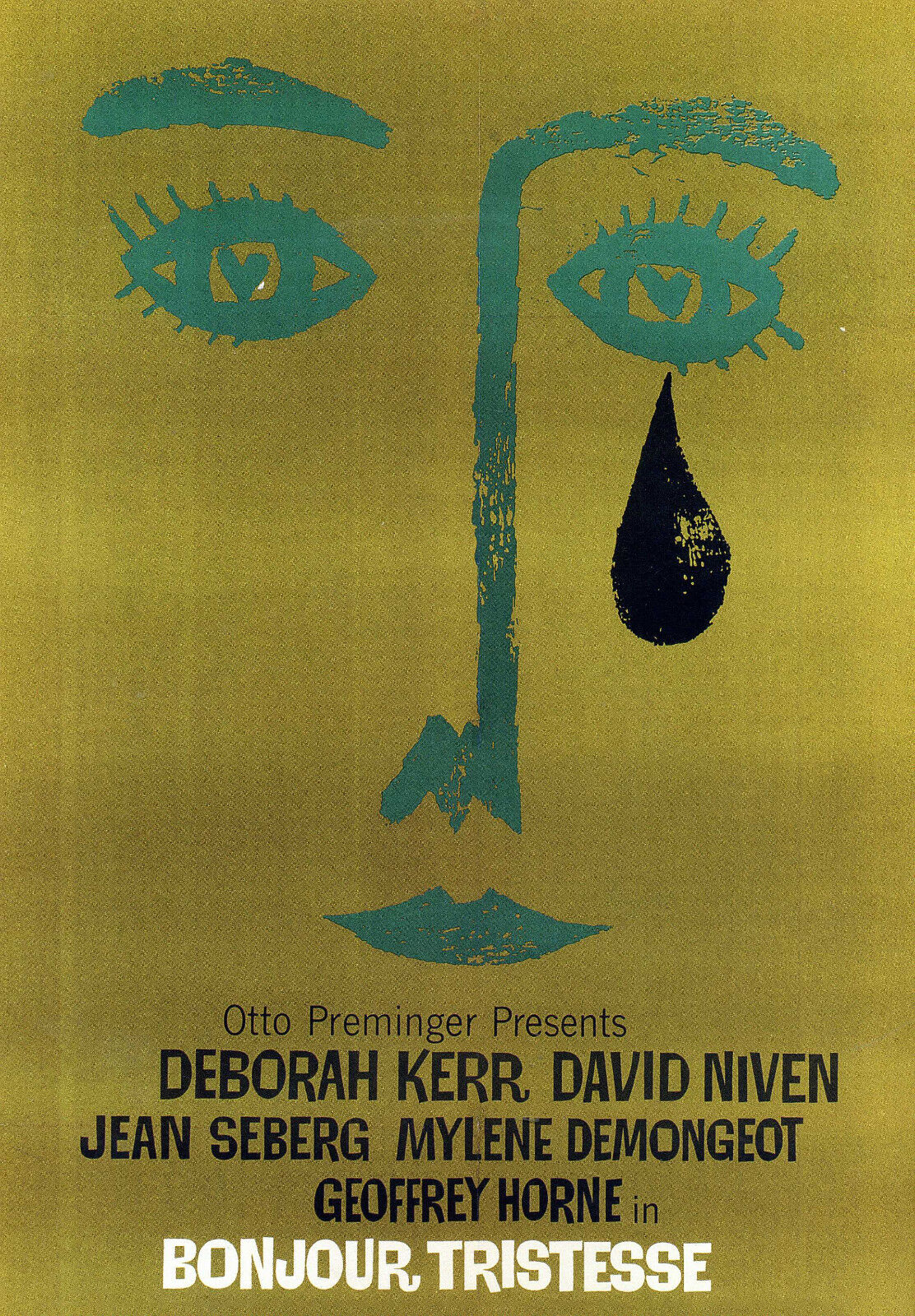
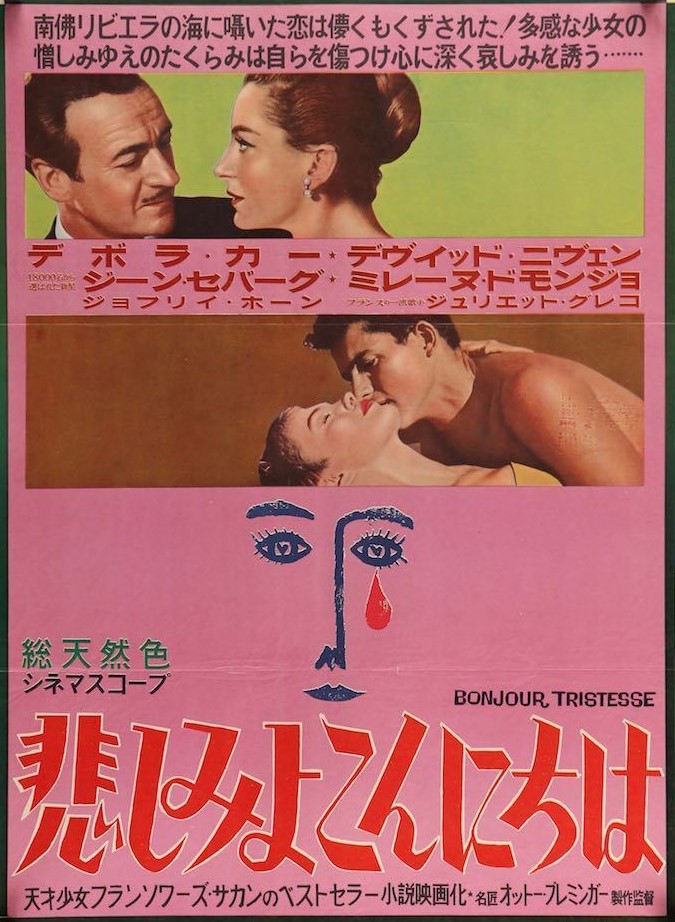
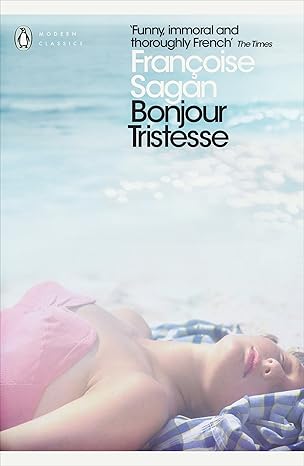
Behind the Scenes: “Bonjour Tristesse” (1958)

Otto Preminger was initially beaten to the punch, rights to Francoise Sagan’s 1954 bestseller already sold to Ray Ventura, forcing the director to ante up $150,000 a year later to retrieve them. The director started working on the script with S.N. Behrman (Quo Vadis, 1951) but, dissatisfied with the result, turned to Arthur Laurents (Rope, 1948), who was permitted to complete his screenplay without any interference.

Shooting began in July 1957 in Paris and locations included Maxim’s and jazz club La Hachette where Preminger filmed Juliette Greco singing the title song. The main locale, a villa in Le Lavandou in the South of France, was rented from French publisher Pierre Lazareff.

By casting Deborah Kerr (The Night of the Iguana, 1964) and David Niven, who had starred in The Moon Is Blue (1953) as principals, it was officially turned into a British production, providing access to Eady Levy monies, although it was shot with a French crew who proved largely hostile to the director’s personality and went on strike on the second day. Due to a scheduling misunderstanding, Niven and Preminger got off on the wrong foot.

But the chief victim of the director’s ire was Jean Seberg, star of his previous effort – and substantial flop – Saint Joan (1957). While not entirely happy with the neophyte’s performance in her debut, he decided to give her the benefit of the doubt. “I refused to believe that I was so wrong and the critics so right, that this girl was so completely devoid of talent,” he complained, offering her a second chance. “He showed a faith in me nobody expected him to show,” commented a grateful (at the time) Seberg.

But Preminger soon regretted his decision. “I don’t like the way you talk, walk or dress,” he told her. Unable to get a better performance from her after four or five takes he would just give up. At one point, she was drenched with buckets of water for a scene where she was emerging from the sea. However, that scene only took seven takes, something of a triumph for Seberg. And it’s worth noting that seven takes was nothing for Preminger if he really wanted to make an actor suffer.

If you think the movie takes a very melodramatic turn, the screenplay toned down much of the book’s melodrama and especially its more serious overtones. Preminger stuck to the script. He invented camera movement and blocking during the day’s rehearsals rather than arriving at the studio with fixed ideas. To allow the camera to move more freely, the floor of the set was treated with gelatin. He relied on only a few takes, expecting the actors to deliver what he wanted, so in some respects it was no surprise he reacted badly when Seberg failed to follow his instructions, although as a last resort he knew he could always cut to another actor.

Niven and Kerr both braced the director about his treatment of Seberg, telling him “to lay off this girl, because she’s had it, and if you continue, we don’t want to keep working. ”

The movie was completed at Shepperton Studios in England. The last shot of the film took an entire day to shoot, Cecile removing her makeup with cold cream in front of the mirror and tears form. Preminger wanted “the face to remain a child’s face.” Two days of flashback shoots had to be re-done as they had by mistake been processed in color rather than black-and-white

Preminger should have been a happy man. He was falling in love with costume coordinator  Hope Bryce, a model who had worked with Givenchy, and in due course she became his third wife. Ditto, Seberg, who had fallen for lawyer and nobleman Count Francois Moreuil – a relationship that also ended in marriage – and as a result of the romance grew more relaxed on the set and “didn’t let Preminger’s demands bother her.”

Opinions differ regarding Seberg. Arthur Laurents deemed her “a shrewd cookie, I don’t care what they say about her.” Deborah Kerr averred: “I think any other woman would have collapsed in tears or walked out, but she took calmly all the berating and achieved a very interesting and true Sagan-type heroine.” Co-star Mylene Demongeot said, “For a while she had everything in her hands to have a successful career.” From Seberg’s perspective she viewed Preminger as a father figure, with the attendant hate that often comes with that.

Demongeot, however, fought fire with fire, calmly warning the director he would get a heart attack if he kept on yelling at her. Standing up to him and occasionally dissolving into fits of laughter at his instructions kept him at bay. She saw a different side of the director,  although tagging him as “ a nasty man,” she also recalled him as “a very funny, intelligent man…and he could even be charming…outside of work.” Seberg and Demongeot had become friends after the American had stayed with the French actress and her husband in order to learn the lines of French required for her role.

After filming ended, Preminger’s current wife Mary Gardner sued for divorce and Twentieth Century Fox threatened to take him to court for repayment of $60,000 for a film bever made. Preminger sold Seberg’s contract to Columbia. “He used me like a Kleenex and threw me away,” said Seberg. But, interestingly, it was only after that relationship ended that she took acting lessons.

In truth Seberg’s Hollywood career never recovered although she enjoyed a brief mainstream revival a decade later through Paint Your Wagon (1969) and Airport (1970). Hollywood has its revenge on Preminger. After the failure of Skidoo (1968), Paramount chief Charles Bluhdorn exacted “a very slow death” on the director.

NOTE: There’s an update to this called Part Two which is published on Oct 19, 2023. When I did this original article I didn’t have my normal online access which permits me to check through trade magazines. Because I received a query about box office I decided, once the online issue had been cleared up, to check that issue and in the process I uncovered so much fascinating information I took a second stab at it.

SOURCES:   Chris Fujiwara, The World and Its Double, The Life and Works of Otto Preminger (Faber and Faber, 2008) pp210-217;  Eric Braun, Deborah Kerr ( W.H. Allen , 1977) pp164-165; Garry McGee, Jean Seberg, Breathless, Her True Story, (2017) pp42-48.

Bonjour Tristesse (1958)*** – Seen at the Cinema at the Bradford Widescreen Weekend

You might be forgiven for wondering why Otto Preminger, a past master at film noir, did not simply adapt the source novel by Francoise Sagan by tilting the material in that direction. After all, Preminger had helped create the genre with Laura (1944) and followed up with noir trilogy Whirlpool (1950), Where the Sidewalk Ends (1951) and Angel Face (1952).

The purported saving grace of the Sagan novel is the main character’s guilt at the disaster she triggers, although, from another perspective that could be viewed as author cunning, employing acceptance of culpability to render her more sympathetic. In other words, she gets away with it, and that’s a completely different twist.  

Whereas, in another world, she would be doing jail time or at least undergoing psychiatric care, her action appears to make her even more independent, discarding men at whim, turning into the character whom Jean-Luc Godard would use as the inspiration for Breathless (1960).

The tale is told in flashback, allowing a peppering of grief into what otherwise would be a straightforward story of spoiled little rich girl Cecile (Jean Seberg) plotting to rid herself of interloper Anne (Deborah Kerr) who has disrupted the perfect life she shares with doting father Raymond (David Niven).

In some respects it applies a coming-of-age template to all the main characters, adults as well as young required to adjust to the consequences of love and alter their behavior. It’s not just the teenage Cecile who’s spoiled – nothing to do but laze in the sun, swim in the sea and attend parties and night clubs – but Raymond, a charming philanderer/perfect cad, new girlfriend on tap, the beauty of current one, Elsa (Mylene Demongeot), undercut by her propensity to blister under the sun and despite her overall shallowness a mathematical whiz in the casino, a skill which would probably allow her to dispense with her apparent dependence on an older rich lover.

Into this cosy set-up arrives, by an accident of timing, old flame Anne, a successful couturier, whose mental fragility is disguised by an outwardly strong character. Her presence is accepted until Elsa is sent packing and Raymond proposes marriage. Anne makes the fatal mistake of overdoing the maternal, seeking to rein in Cecile, instructing her to chuck her boyfriend Philippe (Geoffrey Horne) and spend her time studying. It says a lot about Anne’s character that she couldn’t have more seriously miscalculated not just Cecile’s character but that of Philippe, who, intending to become a lawyer, seems a sensible choice for a boyfriend.

So, Cecile hatches a plan to bring Elsa back into Raymond’s orbit knowing that fidelity is scarcely his strong suit. Oddly enough, this kind of plotting, especially given the South of France atmosphere, would play better as a standard rom-com ploy, daughter trying to push father in the direction of preferred lover.

Instead, it exposes the cracks in Anne’s psyche and drives her to suicide. But since no one is aware, and Elsa too dumb ostensibly to recognize the part she plays, of the machinations, Cecile gets off scot-free, and in reality using the guilt to make her appear more sympathetic. This probably worked better in the Sagan novel which, with a first-person narrative, allows the author to form the other characters in a manner that makes Cecile’s actions more understandable or at least acceptable, nudging the reader towards sympathy rather than repulsion.

Whatever way the story is pitched, it doesn’t really work. All the characters, save Elsa, are exposed as inherently fragile, unable to accept change and/or reality. The suicide seems a mundane narrative ploy. Raymond is never presented as the love of Anne’s life and her death  seems an incredible over-reaction, intended to give the story a more dramatic climax.

However, the characters are all well-drawn and the vivacity of the French lifestyle brings the picture to life, but hardly suited to Preminger who, by this stage, had a tendency to look for a bigger issue to chew over.

Jean Seberg (Moment to Moment, 1966) never managed a successful Hollywood career but this film was a big hit with emerging French filmmakers, and she was a far bigger box office attraction in France. The iconic short haircut and Givenchy attire seemed to present her as a latter-day Audrey Hepburn, but it was her screen independence that appealed more. Deborah Kerr (Prudence and the Pill, 1968), portraying a complex character, would be the pick of the actors except David Niven (Prudence and the Pill) exerts effortless charm and in terms of screen splash you could scarcely fault the effervescent Mylene Demongeot (The Singer not the Song, 1961).

Preminger, as ever, toys with convention. It’s the present day that’s shot in black-and-white rather than the past. Just as he rid John Wayne of his trick of breaking sentences in two in In Harm’s Way (1965), here Deborah Kerr is revealed without make-up, her freckled face providing her with an innocence. He had some fun with the house servants, apt to glug champagne, literally, behind their employer’s back. Arthur Laurents (Rope, 1948) wrote the screenplay.

Not quite sure how it ended up at the Bradford Widescreen Weekend since although it is in Cinemascope it was not one of that process’s more outstanding champions. Nor why it was introduced as Deborah Kerr’s movie when as far as the public was concerned the star was Jean Seberg. Nor even why Kerr was deemed a “Queen of Scope” since you could apply that term to virtually every female star who appeared in the 1950s in Cinemascope (20th Century Fox), VistaVision (Paramount) or Panavision (MGM).

If this were made now, there would be a scene at the end where Cecile tips the wink to the audience and enjoys rather than feels guilty about her clever ploy.

The Young Girls of Rocheforte / Les Damoiselles de Rochefort (1967) **** – Seen at the Cinema at Bradford Widescreen Weekend

In effervescence and color palette a close cousin to Barbie (2023) with the bonus of being able to call on one of Hollywood’s greatest hoofers, Gene Kelly, in a surprise cameo. He swoops and sways like he was Singin’ in the Sun. And he’s just the icing on the cake in this exuberant throwback to 1950s Cinemascope but with the sensibility of a 1940s musical in which dreams are delivered after a few minor setbacks.

Throw in a long-lost love, an affair that literally went south, an artist who has painted his ideal woman, a couple of literal-minded running French jokes – a woman called Madame Dame and a young sailor whose departure is immi-Nantes – and given the overall light-hearted treatment you would have to treat the presence of a sadistic murderer as being in the comedy vein.

Twins blonde Delphine (Catherine Deneuve) and brunette Solange (Francoise Dorleac) make a living running a music class. Delphine dreams of meeting the ideal man, having already rejected gallery owner Guillaume (Jacques Riberolles) and not too keen on itinerant carney (George Chakiris), while Solange wants a career as a composer, befriending music shop owner Simon (Michel Piccoli) who can put her in touch with old buddy and now renowned pianist Andy (Gene Kelly).

As you might expect the narrative is driven by misunderstandings and meetings choreographed by the minute to fail. This is the kind of film where an actor playing the role of a piano player is not expected to learn to play the piano, just stare into space as though channeling an internal muse or glancing at the sheet music.

There are songs by the dozen – possibly too many (27 singing or dancing sequences), more like a continuous ballet than a traditional musical – but none we’re still humming today, not like tunes from West Side Story (1961), The Sound of Music (1968) or Funny Girl (1968) – though “The Twins Song” probably comes closest. That’s not to put down Michel Legrand’s inventive score, but perhaps to suggest a cultural/language divide. Outside of Danielle Darrieux (Loss of Innocence / The Greengage Summer, 1961) , the singing voices were dubbed, even that of Gene Kelly who lacked the range for the material.

And probably you don’t need to worry about the quality of individual songs as you’ll be swept along by Jacques Demy’s infectious direction. Most of the dancing style reflects West Side Story but with a lighter edge. And it takes little or nothing for characters to burst into song or dance, sometimes that activity going on spontaneously in the background of another scene.

Set in the real seaside town of Rochefort in France and making use of genuine locations, the action kicks off on an unique type of bridge as the carnival comes to town. While not strictly a feminist endeavour, men are mostly put in their place, overtures rejected, marriage offers turned down and bad employers shown the door.

The appearance of Gene Kelly, who hadn’t worn his dancing shoes in more than a decade, gives this an enormous fillip as his classic style shows the others just how it’s done. But it’s the lightness of touch, as well as being able to plumb a well of emotion, that gives this film its grounding, Deneuve and Dorleac as well as Darrieux carrying the movie. George Chakiris (Diamond Head, 1962) looks more at home here than in any film other than West Side Story.

Jacques Demy and Michel Legrand had teamed up previously for The Umbrellas of Cherbourg / Les Parapluies de Cherbourg (1964). Catherine Deneuve (Mayerling, 1969) and Francoise Dorleac (Genghis Khan, 1965) were sisters. Tragically, Dorleac was killed in a road accident prior to the film opening.  

But the whole enterprise is so effortless and appealing you can’t help being drawn in.

Love Is A Ball (1963) ***

Three main characters playing against type and a feisty, independent, woman are the main pleasures of this conspiratorial rom-com that takes a while to get going. The main obstacle is the subplot involving the education of a klutz, impoverished French Duke Gaspard (Ricardo Montalban), who needs brought up to speed on the niceties of fine dining, horse-riding and dancing in order to represent a decent catch for American heiress Millie (Hope Lange).

So that keeps ex-racing driver John (Glenn Ford), fallen on such hard times he’ll accept a job as chauffeur, confined to the background for the first third of the movie. That is, until he works out that his employer Etienne (Charles Boyer) is a professional matchmaker who makes a living marrying off poverty-stricken aristocrats to wealthy women. However, he poses as a charmer who happens through his connections to put women in contact with eligible men without letting on that he takes a hefty commission or that his clientele is financially illiterate.

But the cunning Etienne realizes that in order to get close to Millie he has to exploit the  weakness of her over-protective uncle Dr Gump (Telly Savalas) for gourmet food. All these complications create delay in getting on with the will-they-won’t-they romance of Millie and John.

Millie, channeling the adventurous spirit of the likes of Amelia Earhart, is car mechanic, wannabe racing driver and neophyte ballet dancer, so not quite the hapless rom-com female. And she’s pretty good at putting John in his place when he lacks the necessary subservience, giving him a tight deadline to wash her family’s huge fleet of cars, and forcing him to wear a despised chauffeur’s cap.

Meanwhile, Gaspard is causing problems of his own, not just by his complete ineptitude, but by falling for Etienne’s secretary Janine (Ulla Jacobson). So it’s hitches all round especially as Millie and John spend all their time upsetting each other, so much so that, determined to get married to please her grandmother, she’s on the brink of marrying the next clod in Etienne’s line-up.

To be honest, the script is a bit of a mess and in sticking to it director David Swift (The Interns, 1962) hasn’t quite been able to play to the movie’s strengths – and making more of them – rather than trying for what amounts to not much more than an ensemble piece. What lifts the movie is watching the usually steadfast and take-charge Glenn Ford (Rage, 1966) being put through the wringer by the heiress and forced to swallow humble pie any time he has had more than enough.

Next up is Telly Savalas (The Scalphunters, 1968) who totally switches his mean if not downright villainous screen persona to portray a character who dithers over epicurean delights and turns into a happy individual as long as his appetite is sated.  A Jolly Telly is indeed a sight to be savoured.

Lastly, we have Ricardo Montalban (Sol Madrid, 1968), again an actor who errs on the tough-guy side, another of the take-charge fraternity, who always appears completely in command. It’s a bold career move for him to chuck that persona into the mixer and let it spin round a hundred times a minute till he comes out looking frazzled.

Hope Lange (A Pocketful of Miracles, 1961), who had a sporadic career as a female lead, and was at the time involved in an affair with Ford, is excellent as the adventurous headstrong spirit clad in overalls but less convincing as the glamorous heiress especially when simpering.

The screenplay, based on the novel The Grand Duke and Mr Pimm, looks as if it wanted to head in too many heads directions at once, was by Swift and Frank Waldman (Inspector Clouseau, 1968). Farce, at which Waldmann later excelled (he wrote the trio of 1970s Pink Panther films), seems is not a good fit for rom-com.

Worth seeing for Glenn Ford, Telly Savalas and Ricardo Montalban all thumbing a nose at their screen personas.

Secret World (1969) ****

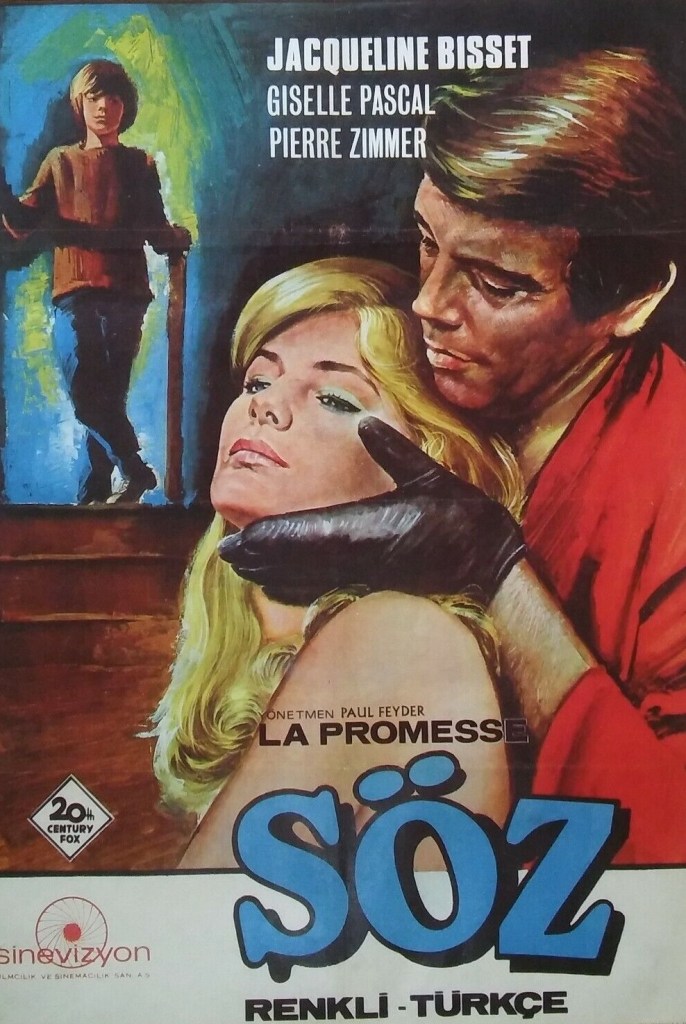
Jacqueline Bisset is the big draw here. After breaking into the Hollywood bigtime with female leads in The Detective (1968) and Bullitt (1968) she put her newfound marquee weight behind a low-budget French arthouse picture.  But ignore the marketeers best efforts to present this as malevolent in the style of The Innocents (1961) or the illicit template of The Nightcomers (1971) or Malena (2000).

No children were corrupted in the making of this picture. Instead, it’s a slow-burn thoughtful exposition of a child coming to terms with loss and a young woman discovering she is more than a mere sexual plaything. Any explosive drama comes from father-son rivalry but mostly it’s a reflective, absorbing movie that follows twin narratives, the attraction of the orphaned introspective 11-year-old Francois (Jean-Francois Vireick) to the English mistress of his uncle Philippe (Pierre Zimmer) and the damage her arrival causes to a fractured household.

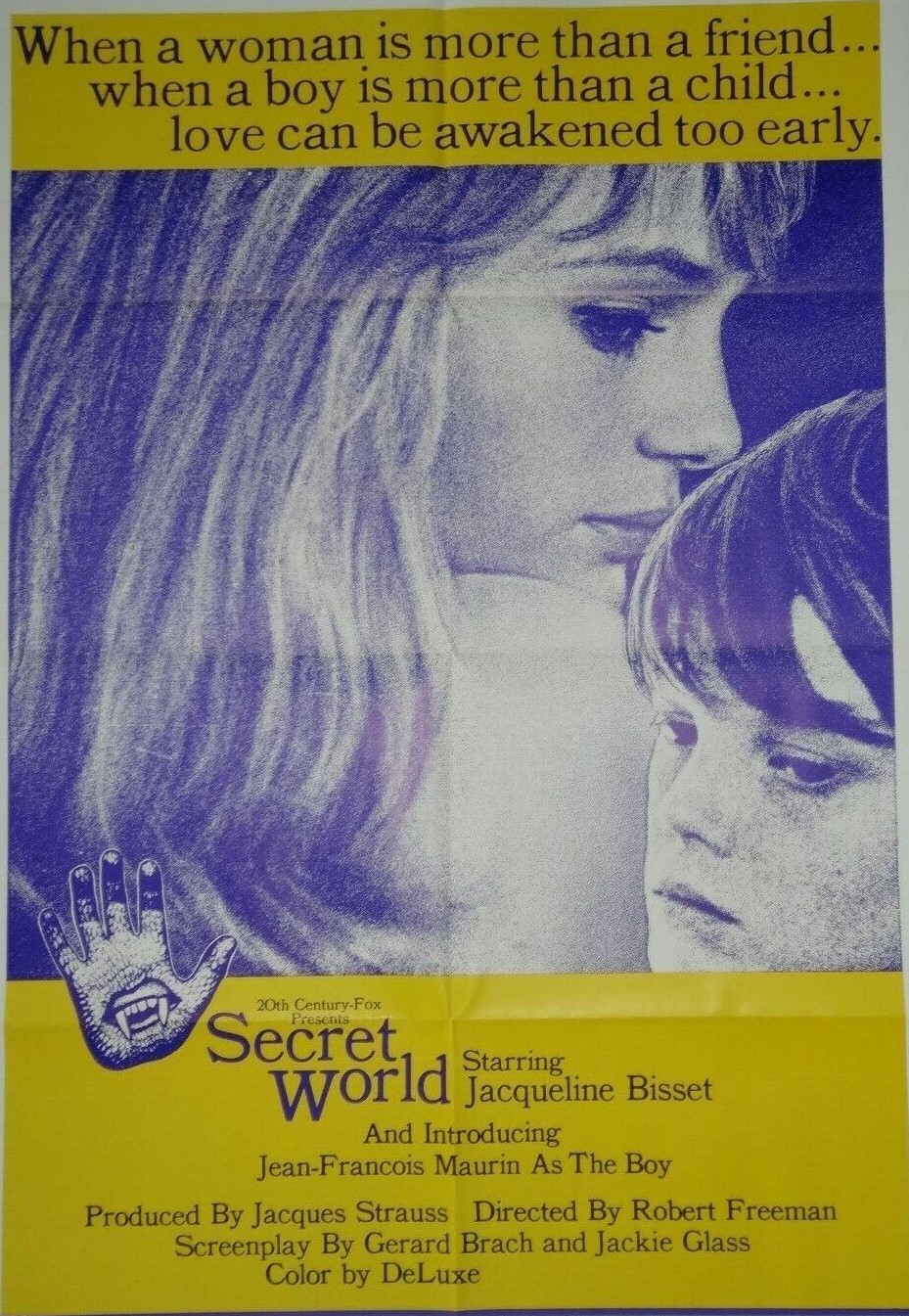
The leather glove oveprlays its hand in the poster, suggesting a great deal more sexuality
than is actually the case, but nonetheless – and take this as subtle – creates
an element of ambiquity about the demure Wendy.

Astonishingly, given its arthouse credentials – long takes, glorious cinematography, brooding close-ups – this was the final film for both directors (no idea why there were two) Paul Feyder (in his debut) and a sophomore effort from Robert Freeman (The Touchables, 1968). Given a screenplay by regular Polanski collaborator Gerard Brach (Wonderwall, 1968) and an intrusive heavy-handed score, you get the impression of two separate movies struggling to fit a single canvas.

On the one hand, you’ve got a perfectly acceptable romantic intrigue, Philippe and son Olivier (Marc Porel) fighting, sometimes metaphorically (games of chess etc), sometimes physically (a punch-up), over the woman, passed off as the daughter of a wartime colleague, and a wife Monique (Chantal Goya) refusing to stand on the sidelines, switching hairstyle to blonde and employing various wiles to prevent the affair. While the male rivalry is overt, the wife’s manipulations are more subtle.

On the other hand, you’ve got the lonely boy, who indulges his imagination, spinning tales of monsters in a lake and spies in the vicinity, mostly ignored by his relatives, hiding out with a pet rabbit in a treehouse, occasionally filching small items, creating a crown out of a stolen brooch and pieces of tree bark. There’s a lot that’s presented without explanation. For example, a couple of months after his parents died in a car crash that he alone survived, he mopes around in a jumper full of holes, either a sign how little his adoptive parents care for him, or perhaps the item of clothing he was wearing the day his mother died.

You can view his behavior – creeping into Wendy’s room at night when she’s asleep – as creepy or just the hankering of a small boy after a substitute mother. But mostly, he lives a life of wistfulness, longing for what he once had, unable to fit into a household split by various emotions. When he snips a lock of Wendy’s hair, or snaffles a bottle of her perfume, it’s to add to his little box of mementoes rather than from any underlying sexual motive. And it’s hard to view his growing feelings for Wendy as early stirrings of sexual attraction. When at one point he falls asleep on her bosom, you couldn’t interpret that as anything more than maternal instinct.

That’s not to say there isn’t tension. But that’s almost entirely played out in the context of father, son and wife. Francois is a welcome gooseberry defusing the unwelcome attentions of Olivier, whose overtures Wendy constantly thwarts. Olivier, well aware of the role Wendy plays in her father’s life, mocks his mother’s attempts to hold onto her errant husband. Wendy, meanwhile, abhors the role she is forced to play, the trophy mistress, and reacts in maternal fashion to the lonely child.

Excepting the intensity of the father-son relationship, the screenplay underplays while still developing character more fully than you might expect.. The child is as manipulative as his aunt in finding ways to spend time with the object of his affection.

Mostly, this has been dismissed as a poor example of the French arthouse picture or as a Bisset vanity number or for illicit elements than never catch fire. But, in reality, it’s a superb character study set in an unromanticised French countryside – rats need shooting, for example, massive tray of cheese served up for dessert rather than the grand wine cellar you might imagine a chateau to contain, or clothes or other ostentatious examples of wealth.

There is so much that is incisively ordinary. Philippe insists on measuring the boy’s height.  Monique drops her chilly façade to help the newcomer get rid of a wasp. The arrogant Olivier loses all credibility when he runs away from a gang. The children play out childish rituals. Francois douses the rabbit in Wendy’s perfume so he can keep the smell of her close.  

The secret world here is four-fold, the one Philippe foolishly and brazenly attempts to maintain, the one Olivier hopes to possess, the one Francois enjoys and the idyll from which Wendy is shaken out of.

The direction is very confident, none more so, oddly enough, than in the only sex scene, which takes place primarily off-screen, although with the lascivious involvement of a leather-gloved hand.

Rich in detail, supremely atmospheric, well worth a look.    

Army of Shadows/ Les Armees des Ombres (1969) ****

The antidote to the gung-ho World War Two picture. Scarcely any action and certainly none of the French Resistance swagger of The Train (1964) or the popular uprising of Is Paris Burning? (1965). Instead, sombre realism as Resistance leader Gerbier (Lino Ventura) dodges capture in a country pitted with collaborators. Nor is the underground portrayed in heroic fashion, their methods of revenge every bit as pitiless as the occupying forces.

Told in documentary style and based on the real-life exploits of characters taking the battle to the enemy, it’s backroom stuff, Gerbier organising his Resistance cell, meeting with other leaders. But his life is fraught with tension, as he attempts to dodge capture, with little success, it has to be said.

The film opens with Gerbier in captivity, an internment camp, where he is betrayed by an informer. While being transported to Paris, he escapes. His first action, revenge. With three colleagues, in an ordinary Marseille house where use of a gun will give them away, they strangle to death an informer. It’s not pretty.

Some join up for the risk like Jardie (Jean-Pierre Cassel), others maintain a more orderly, outwardly uninvolved, almost philosophic, lifestyle, like his older brother Luc (Paul Meurisse) who turns out to be the “Big Boss” of the Resistance, prominent enough to be transported by submarine to London to meet French leader-in-exile De Gaulle.   

Little of what they organise works out. Betrayal a constant, not just from collaborators, but from a fellow member who could be compromised by having a vulnerable child or parent. When one of the Marseille stranglers, Felix (Paul Crauchet) is captured, and likely to crack under torture, Mathilde (Simone Signoret), Gerbier’s assistant, comes up with a daring plan involving Jardie giving himself up so he will be imprisoned with Felix and, at the pessimistic end of expectations, can provide him with a cyanide pill, while the most optimistic outcome is three members disguised as Germans infiltrating the jail and sneaking him away.

The plan fails and Gerbier is subsequently arrested, imprisoned, his execution only denied by a daring rescue attempt – the only kind of typical war picture action. But then Mathilde becomes a liability and is executed.

It’s a cold-blooded kind of film and depicts with far greater realism the endeavors – failure outweighing success  of an underground operation during the Occupation. They don’t have the training for the job and their effectiveness is always open to question. Although British and American films might be filled with characters volunteering for dangerous missions, those are activities in isolation, not a commitment to a lifestyle that most likely would end in torture and death, endanger family and friends and leave you living in a sewer of suspicion. This presents an unvarnished truth. Not only are you expecting at any moment the Germans will pounce, there is a constant dread that the Resistance will be undone by their own actions, a plan too ambitious, someone cracking up, firing squad the most likely result. There’s nary a sniff of glory.

The big budget roadshow – The Longest Day (1962), Battle of the Bulge (1965), The Battle of Britain (1969) et al – while covering in some aspects the dangers of war were for the most part fist-pumping patriotic achievements, not this sneaking around, undercover stuff where missions were low-key, and the protagonists rarely in charge of their own destinies.

As far as French critics were concerned, the release timing was off, the film arriving in the wake of the 1968 riots and with De Gaulle in political trouble due to the Algerian situation. So it flopped with critics and audiences alike, and although it found a receptive audience in the U.K. in the late 1970s, it was denied release in the U.S. until 2006, by which point politics could not cloud opinion, and it earned rave reviews.

Lino Ventura (The Sicilian Clan, 1969) on top form is run close by Simone Signoret (The Deadly Affair, 1967). Jean-Pierre Cassell (Is Paris Burning?) comes closest to comic book heroics but even that is eventually reined in.

Everyone is helped by a screenplay by Joseph Kessel (The Night of the Generals, 1967), himself a member of the Resistance,  that is light on melodrama and overwrought dialog and concentrates on getting done the job in hand, no matter how unsavory. Equally notable is the lack of grandstanding, of glorious finish, of the Hollywood convention of redemption.

Director Jean-Pierre Melville (Le Samourai, 1967) , also a Resistance fighter and with a hand in the screenplay, brings to bear film noir sensibilities and the cold-bloodedness that informed a previous oeuvre tending towards gangster pictures.

A very bold undertaking of the most dour kind that deserves appreciation.

Behind the Scenes: “The Loss of Innocence / The Greengage Summer” (1961)

Director Lewis Gilbert’s career was at an impasse. He had made his name primarily in a string of typically British stiff upper lip World War Two pictures including Reach for the Sky (1956) and Sink the Bismarck! (1960). It will come as a surprise to many British people to learn that virtually no British movie, not even the WW2 films that were big hits domestically, made any impact at the U.S. box office, Sink the Bismarck! a rare exception.

Ferry to Hong Kong (1959) starring Orson Welles had flopped  and WW2 comedy Skywatch/ Light Up the Sky (1960) had died the death.

British director Victor Saville, who had made a name for himself in Hollywood with Greer Garson sequel The Miniver Story (1950) and Kim (1950) starring Errol Flynn, had turned producer, purchasing the rights to the bestseller by Rumer Godden (Black Narcissus, 1947).

Saville had entered into a partnership with veteran independent producer Edward Small (Solomon and Sheba, 1959) who had a deal with United Artists. The duo had three films on their slate, the others being movie version of The Mousetrap (delayed due to the length of a stage run that still prevents it being turned into a movie) and Legacy of a Spy (never made). Cary Grant was initially touted as the lead for Loss of  Innocence.

When that deal foundered, it shifted from UA to Columbia after the intervention of British producer John Woolf (The African Queen, 1951),  a relation of Saville, who had an ongoing relationship with Columbia. The script found its way to Kenneth More (Sink the Bismarck!) still a highly-rated draw at the British box office. He had to lose weight for the role. Later, Gilbert intimated he was not right for the part and would have preferred Dirk Bogarde.

More’s wife Mabel was friends with Gilbert’s wife Hylda  and it was at the former’s suggestion that Lewis was roped in. Gilbert was initially wary of working with Saville who, although highly respected as a director, had a reputation of being difficult to work with. A director turned producer was all too likely to have ideas about the direction rather than sticking to the production side. As it turned out, Savile “didn’t interfere at all.”

Hayley Mills (The Family Way, 1966) was first choice for the female lead. Her Disney contract was not exclusive and at 15 she might have been ideal casting. But such a role would almost certainly impact on her future with Disney.

Mrs Gilbert was instrumental in the casting of Susannah York (aged 21) having called her husband down the stairs to see the young actress in a television production of Arthur Miller’s The Crucible. As it happened, Saville was on the same page, also having witnessed that performance, calling the director the following day to suggest York. Coincidentally, the Gilberts had been invited to dinner with Sylvia Syms, female lead in Ferry to Hong Kong, only to find York was a guest. Auditioned for the role of Jos, the oldest of the four sisters stranded at a chateau in France after their mother is taken ill, York won the part.

“The hard part to cast,” according to Gilbert, was Hester, Jos’s younger sister, wise beyond her 14 years “who can see trouble where Jos couldn’t.” Contrary to received wisdom, the bulk of children who attended stage schools were working class. “Their parents needed the income. Middle-class parents, preferring their children to be properly educated, discouraged them from going to stage schools.”

In consequence, the bulk of the girls turning up for auditions spoke Cockney whereas the part called for a “nicely-spoken girl.” Just as Gilbert was about to give up on the process, he received a phone call from an agent, promising a new discovery. “Her name was Jane Asher…a pretty 14-year-old with long red hair.”

Other casting gambles didn’t work out so well. Seeking a young man to play a French gardener, Gilbert hit on the notion of hiring a real Frenchman, having found a young lad with curly hair who appeared just right for the part. The only problem was – he couldn’t speak English. But it didn’t seem so insurmountable since he was cast three months before shooting began. But when the cameras rolled “he was unintelligible.”

Gilbert surmised that “someone so chaotic as that curly-haired Frenchman would never amount to anything.” He was wrong. The man was Claude Berri, later the highly successful screenwriter and producer of Jean de Florette (1986).  

The movie’s original title –  The Greengage Summer – caused a massive problem. Naturally, it was expected that greengages (plums) would feature prominently in the background. But there were no greengages thanks to a blight that had ruined the harvest all across France. As a consequence, British greengages were used, removed from their sacks by the thousands and sewn onto trees by the art department.

Susannah York created another problem when, in her naivety, she decided that the most authentic way to play drunk was to be drunk. Gilbert tried to dissuade her, explaining that the scene would go on all day not just last five minutes and in order to play a drunk you needed your wits about you. York ignored the advice and a day’s filming was ruined. Filming, split between England and France, began in August 1960.

Although it received “extraordinarily good notices” in both Britain and America it failed to light a spark with audiences in either country. Gilbert’s retrospective assessment, citing previous movies like Billy Wilder’s  Love in the Afternoon (1957) with Gary Cooper and Audrey Hepburn and Sabrina (1954) with Bogart and Hepburn, was that “very few films where you get a young girl in love with an older man have ever been successful.”

SOURCES: Lewis Gilbert, All My Flashbacks (Reynolds and Hearn, 2010) p207-210; Kenneth More, More or Less, (Hodder and Stoughton, 1978);  Roy Fowler, “Interview with Lewis Gilbert,” British Entertainment History Project; Philip K. Scheuer, “Saville to Resume Producing Career; Godden Novel First of Three,” Los Angeles Times, November 3, 1958, pC13; Richard Nason, “Small and Saville Planning Dear Spy,” New York Times, October 7, 1957, p47; Stephen Vagg, “Movie Star Cold Streaks, Hayley Mills”, Filmink, March 19, 2022.

Loss of Innocence / The Greengage Summer (1961) ***

The alternative title assumed nobody in America knew what a greengage was – it’s a type of plum – but the new title was actually pretty apposite. Until then director Lewis Gilbert had been known mostly for Second World War pictures like Reach for the Sky (1954) and Carve Her Name with Pride (1955) so this was a considerable change of pace, and filmed on location in France.

Joss (Susannah York) takes center stage as a girl on the brink of womanhood who experiences powerful emotions for the first time – love and its perpetual bedfellow jealousy – as well as rite-of-passage experiences like getting hammered on champagne. She is the oldest of four siblings stranded in a French chateau when their mother takes ill.

Left to her own devices, she promptly falls for the suave and much older Eliot (Kenneth More) who has interceded on their behalf when the hotel owner is against putting up with a bunch of motherless children. Matters are complicated because Eliot is having an affair with chateau owner Zizi (Danielle Darrieux) and by Joss attracting the attention of Paul (David Saire), a hotel worker closer to her own age. In short time, the situation is brimming over with suppressed emotion.

Hester (Jane Asher), suddenly aware of the romantic havoc being wreaked by her older sister, is going through her own transformation, jealous that the unrequited love of Paul is not directed towards her, her emotions flying off the handle when she triggers a violent altercation with a local lad.

Despite the distributor’s best efforts – the tagline promises “A Summer of Evil” – by modern standards this is a gentle tale, but not without a harsh undercurrent. York is superb as she undergoes a transformation from uncertain schoolgirl to a woman realizing the power her beauty can exert. She flares from child to adult and back again in seconds.

The main U.S. poster and this one seem determined to add seediness to the tale.

Susannah York (They Shoot Horses, Don’t They, 1969) had won her big break after a sparkling performance in a small role in Tunes of Glory (1960) and she floats effortlessly between chalet school pranks and more serious misdemeanors including drunkenness.

Sometime child actor Jane Asher (still better known as Paul McCartney’s girlfriend or for her cakes rather than stunning turns like Deep End, 1970) also achieves a career breakthrough and you could argue that she edges out York in a role that calls for more balance.

Kenneth More (Sink the Bismarck!, 1960) was at his charming best in the kind of affable role he had generally moved away from, but his character has a darker side. More importantly, as an older adult infatuated with a young girl, he manages to steer well clear of any inherent  creepiness. There is no sense of him exploiting the situation, rather trying to guide the young woman in the art of love.

The dialogue is surprisingly good and Danielle Darrieux (better known as one of Darryl F. Zanuck’s girlfriends rather than for the likes of Romain Gary’s The Birds Go To Die in Peru, 1968) is convincing as an aging beauty willing to do anything to hold onto her man.  There is an interesting under-developed subplot too dangerous to explore at this point in the decade of the hotel manager Madame Corbet (Claude Nollier) clearly being in love with Zizi.

The young Elizabeth Dear (The Battle of the Villa Florita, 1965), making her debut, also enhances her career and British character actor Maurice Denham (Danger Route, 1967) has a small role. 

Lewis Gilbert’s subtle direction set his career on a new course that would ultimately deliver an Oscar nomination for Alfie (1966).  The Howard Koch (The Fox, 1967) screenplay draws heavily on the source novel by Rumer Godden, an expert in the suppressed complexities of female life, best displayed in Black Narcissus (1947) and The Battle of the Villa Florita

The scenery is a bonus as are the snatches of provincial French life. All in all, an engaging piece of work, with Susannah York delivering a star-is-born kind of turn.      

Discover WordPress

A daily selection of the best content published on WordPress, collected for you by humans who love to read.

The Atavist Magazine

by Brian Hannan

WordPress.com News

The latest news on WordPress.com and the WordPress community.