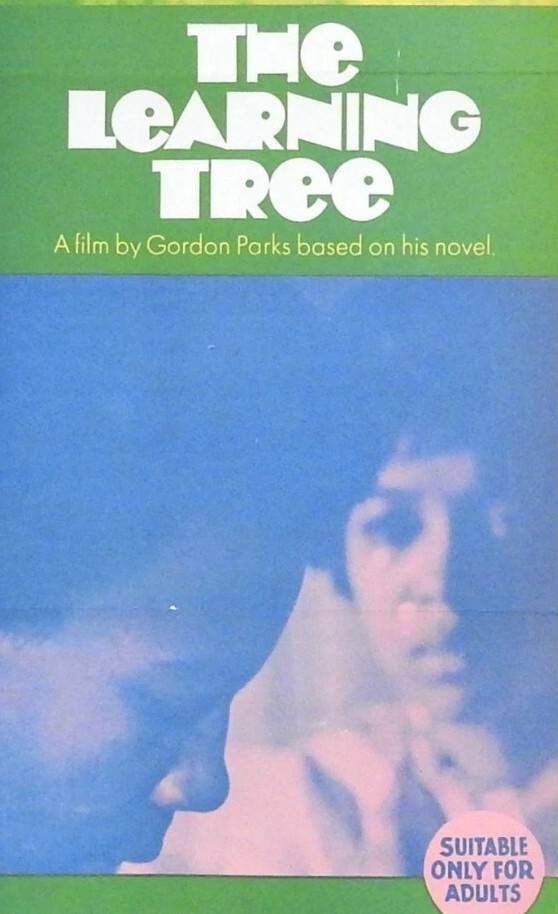
I am indebted to one of my regular correspondents, who goes by the name of “Fenny100,” for the following “Behind the Scenes” report:
The working title of the picture was Learn, Baby, Learn. Based on his 1963 autobiographical novel, The Learning Tree, it marked the feature film debut of Gordon Parks, who was the first African American staff photographer for Life magazine. With the making of The Learning Tree, Parks became the first African American to direct a major theatrical motion picture. Parks had previously directed “several short film subjects and two one-hour features for National Education Television” (New York Times, 2 April 1968). The project was five years in the making (Variety, 17 April 1964), the writer-director in talks with producers interested in optioning his book. Two independent producers first acquired film rights (New York Times, 17 August 1969) but they were unable to raise the necessary funds. Another producer allegedly offered Parks $75,000 to adapt the script, with the stipulation that he must rewrite the black characters as white. Parks declined.
At some point, Bob Hope’s daughter, Linda Hope, was interested in producing the adaptation, (Variety, 7 November 1968). Parks’ friend, filmmaker John Cassavetes (Shadows, 1958), introduced his work to Kenneth Hyman, an executive at Warner Bros.—Seven Arts, Inc., which ultimately funded the production, although Cassavetes accidentally gave Hyman a copy of Parks’ 1966 memoir A Choice of Weapons rather than The Learning Tree. Hyman became enthusiastic about working with Parks and reportedly struck a four-picture deal with him within a fifteen-minute meeting. The Warner Bros.—Seven Arts deal (Variety, 1 April 1968) referred to Parks as “the first negro in film history to direct a major feature for a major film company.”
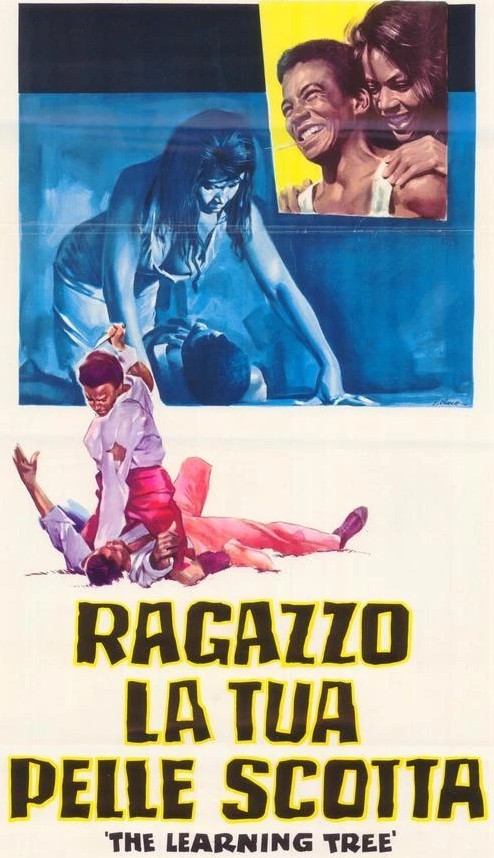
Also a well-respected musician, Parks was set to write the score, which (Variety, 12 July 1968) entailed a four-movement symphony. The production budget was set at slightly less than $2 million (Variety, 25 June 1969) and Parks was slated to receive twenty-five per cent of any profits (Los Angeles Times, 19 October 1969).
Principal photography was scheduled to begin on 30 September 1968 in Parks’ hometown of Fort Scott, Kansas, (“Production Chart,” Variety, 27 September 1968). Problems arose when the film crew, including six African Americans, began shooting in the town (Variety, 7 November 1968), a report which implied that the difficulties arose from racial tension. A later article (Variety, 25 June 1969) noted that there were twelve black crew members, not six, and blamed the tension between locals and filmmakers on the fact that Fort Scott residents wrongly assumed The Learning Tree was a “dirty film.” Parks said that shooting there eventually worked well, and that the local Elks Club admitted African Americans for the first time at a party thrown for the cast and crew. Parks was given a key to the city by local officials, and “Gordon Parks Day” was declared in early November 1968.
Following five-and-a-half weeks in Fort Scott, cast and crew moved to the Warner Bros.—Seven Arts studio lot in Burbank, California, where another two-and-a-half weeks of principal photography was scheduled, beginning in mid-November 1968. On 11 December 1968, Variety confirmed that filming had been completed.
Although William Conrad acted as executive producer throughout the shoot, his name was removed from the credits (Variety, 19 June 1969), though it was later explained that Conrad had agreed to help but wanted no credit, since The Learning Tree was “Gordon’s story.”
In discussing the small contingent of African Americans on his crew, Parks said (New York Times, 17 August 1969), “I hired 12 Negroes to work on the production. It was a fight, because the Hollywood unions are all white, but I got enormous cooperation from Warners.” The studio hired a black electrician, Gene Simpson, for the first time in its history (Los Angeles Sentinel, 13 March 1969), while publicist Vincent Tubbs – the only black union head as the president of the Hollywood Publicists Guild – worked on the film. Parks’ son, Gordon Parks, Jr., acted as still photographer. Seven African American craftsmen worked on the film (Box Office, 28 October 1968).

The Learning Tree was first screened on 18 Jun 1969 at a Warner Bros.—Seven Arts press junket held in Freeport, in the Bahamas (Variety, 18 June 1969). Following its debut there, Variety (25 June 1969) suggested that Parks’ “viewpoint on America and its racial problems” in the 1920s-set film might be negatively received by “black militants and other radical types.” Parks contended that black militants had been purposely planted in preview screenings, and although they had sometimes laughed at inappropriate times, they had generally congratulated him for his accomplishment. Parks stated, “But actually, I don’t care what they think. This is my story. I believe that in the black revolution there is a need for everyone.”
Despite the film’s perceived innocence, it received an M-rating (suggested for mature audiences) from the Motion Picture Association of America (Variety, 16 July 1969). It was due to have its world premiere on 6 Aug 1969 at the Trans-Lux East and West arthouses in New York City (Variety, 30 July 1969). Early reviews were mixed. Although the studio had initially planned a slow rollout of the film in arthouse theaters, its success at the more commercial Trans-Lux West – and relative failure at the Trans-Lux East – indicated the picture would play better at larger, inner-city theaters (Variety, 10 September 1969). A new “playoff pattern” was devised to take advantage of its box-office potential at theaters known for action films and other commercial fare.
Within seventeen weeks of release, cumulative box office gross topped $1.327 million from just 27 theaters (Variety, 5 November 1969).
At Los Angeles at Grauman’s Chinese Theatre, where The Learning Tree opened on 20 August 1969, a large fiberglass sycamore tree – which the studio planned to donate to the Crippled Children’s Society of Los Angeles County once the film’s run was complete – was built around the box office (Variety, 18 August 1969)
The Learning Tree was the U.S. entry at the Edinburgh Film Festival running 24 August – 7 September 1969. It won the Blue Ribbon Award from the National Screen Council in the U.S. for the month of September. The film went on to garner accolades including the National Association for the Advancement of Colored People (NAACP) Image Awards for Best Picture (in a tie with Joanna, 1968) Best Director, Best Actress in a Feature (Estelle Evans), and Most Promising Young Actor and Actress (Kyle Johnson and Alex Clarke).
Parks received an Annual Achievement Award from the Foundation for Research and Education in Sickle Cell Disease of New York City; an Achievement Award from the city of Cleveland, Ohio, presented by Cleveland Mayor Carl Stokes on the 24 September 1969 Cleveland premiere; and a Certificate of Merit from the Southern California Motion Picture Council, which also named the film a “Picture of Outstanding Merit.”
On the commercial front, the picture was a solid hit, raking in $1.5 million in rentals (what the studio earns after cinemas have taken their cut) in the annual box office chart (“Big Rental Films of ’69,” Variety, 7 January 1970).
Parks received honorary degrees from Boston University and Fairfield University in Connecticut. A week-long Gordon Parks Festival, also featuring Shaft (1971) and Shaft’s Big Score (1972), ran at Kansas State University in 1973.
Twenty years after its release, in 1989, it became one of the first twenty-five films selected for inclusion in the Library of Congress’ newly founded National Film Registry.
 The Magnificent 60s