In cinematic terms director Richard Fleischer’s work on a Pearl Harbor project had begun in 1962, for a proposed movie called Zackary, the true story of an American spy living in Japan prior to the infamous attack. Fleischer signed a one-year contract with Dino de Laurantiis, the Italian producer behind the director’s previous movie Barabbas (1962). Italian screenwriters had a crack at the tale, then, in a foretaste of things to come, de Laurentiis turned to a Japanese writer whose idea of a screenplay was restricted to a document less than two pages in length. And so began one of the director’s periods in movie purgatory.
After Zackary was abandoned, Fleischer was put to work on four other concepts, none of which made their way to the screen. Worse, the pay-checks stopped coming and Fleischer sued Dino for a million dollars. Next up was The Nightrunners of Bengal from the bestseller by John Master for Samuel Bronston (El Cid, 1961). That, too, ended up in the courts.
If those rollercoasters weren’t enough, Fleischer revived his career with Fantastic Voyage (1966) and nearly sunk it with the financially disastrous Doctor Dolittle (1967), resuscitated his standing again with The Boston Strangler (1968) and dug another commercial hole with Che! (1969).
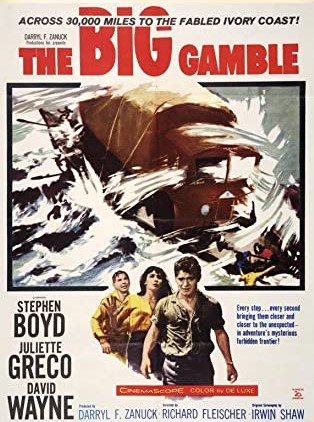
But he was the first port of call when producer Elmo Williams and his paymaster Darryl F. Zanuck, for whom Fleischer had made The Big Gamble (1961), decided on the biggest gamble in Hollywood history outside of Gone with the Wind (1939) and Cleopatra (1963). In some respects Fleischer was on board as makeweight. For the undeniable directorial star of the show was intended to be legendary Japanese helmsman Akira Kurosawa (Seven Samurai, 1954). Never mind that the vast bulk of the global paying public had never heard of him, let alone pronounce his name, Kurosawa undoubtedly represented a critical coup. American critics responsible for building appreciation of him in academic circles were unlikely to lambast him for working with Hollywood, especially as, in the even-handed manner of this project, Kurosawa would be telling the story of the attack on Pearl Harbor from the Japanese point-of-view.
In fact, it wasn’t so much one epic, as two parallel films, telling the tale from opposing perspective, edited together.
But just getting to the filming stage had required research of Cecil B. DeMille proportions. Dr Gordon Prang of Maryland University had spent years on the subject, interviewing every participant on either side. He broke down the research into a daily accounting of the year prior to December 7, 1961, and a second-by-second analysis of the day before the attack. Every incident used in the film came from this research.
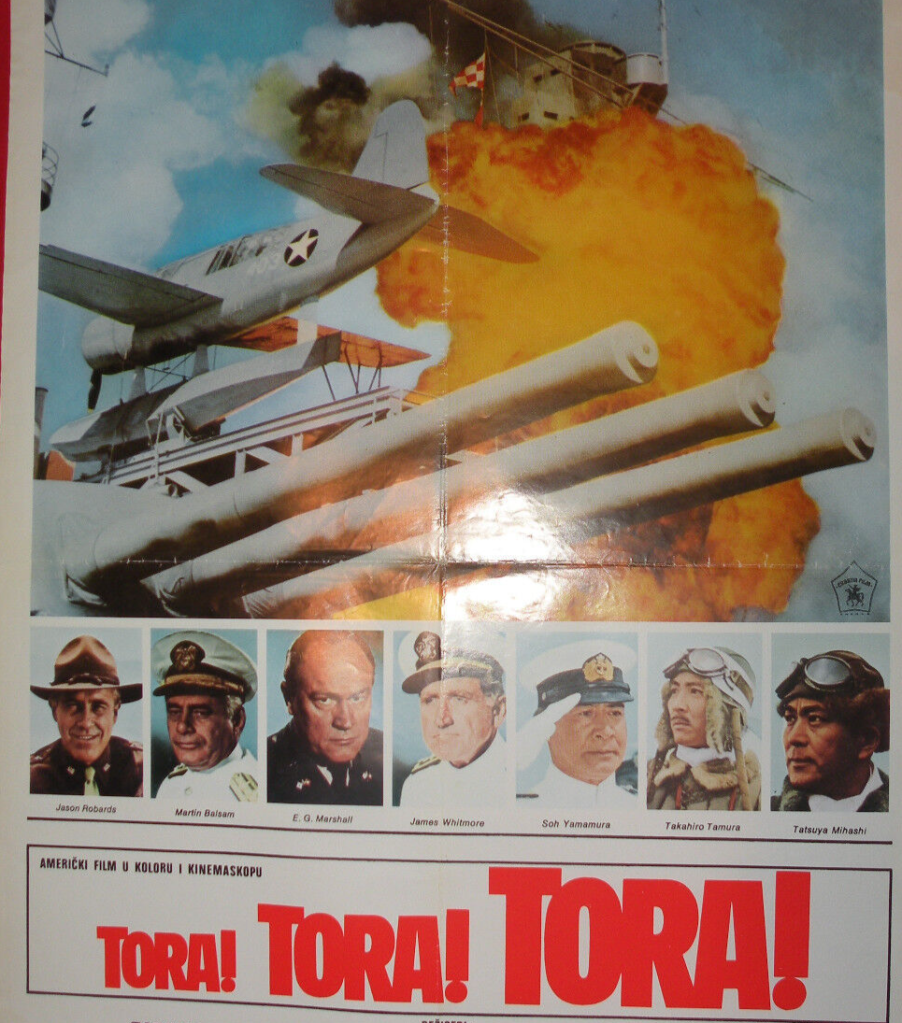
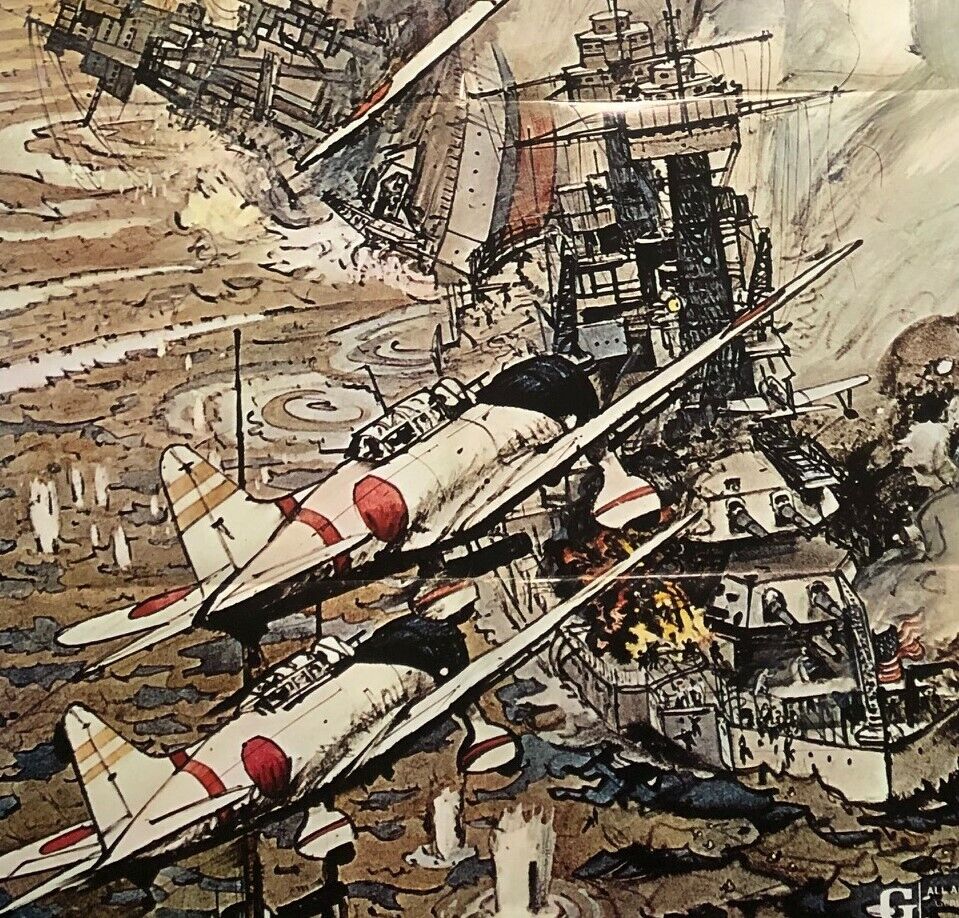
The bigger problem was assembling a Japanese fleet. Only one destroyer remained of the Japanese World War Two taskforce. The rest had been sunk. To do the movie justice, Twentieth Century Fox had to someow conjure up – just from the Japanese side – six aircraft carriers and the 353 aircraft they transported plus another 27 vessels that made up the escort. Whether the U.S. Navy would have been keen on lending a hand, it wouldn’t be much help either in providing the necessary material since most of its fleet from that period had long since been mothballed.
A million dollars was spent on a set that comprised half a battleship that could float and be towed. The rest was miniatures, but given the scale, most of these would come in around the 40-foot mark. There were 19 Japanese miniatures and 10 American.
There were no Japanese Zero planes either. So 28 Vultee AT-6 aircraft were stretched six feet and adapted to resemble the Japanese plane. The production team raided the country for Flying Fortresses, P-40s and VT-13s that could serve the purpose if reconditioned. Dozens of vehicles from the era period were rescued from junkyards and repaired, restored and repainted.
Coordinating the work of the two directors was always going to be the main problem. How would the styles fit? For the scheme to work did one of Fleischer or Kurosawa have to assume supreme commander status? It didn’t help that neither could speak the other’s language. The few meetings held between the two directors were entirely about the Kurosawa section of the screenplay. To Fleischer’s astonishment, at the rather aggressive nudging of Elmo Williams, Kurosawa made concessions.
Fleischer came up with the practical solution to melding the two separate movies. His suggestion was: don’t do it. He intended showing the Americans as sloppy and overly-relaxed while Kurosawa wanted to emphasize the spit and polish of the Japanese Navy. The contradictory approaches would make each section appear such opposites as to make the entire production seamless.
Surprisingly, the studio won some cooperation from the U.S. government in the shape of the loan of an aircraft carrier. But such goodwill did not go unnoticed and the studio was forced to repay the Defense Department $515,000 for its use. But, in general, the Government was not inclined to cooperate, wanting paid for everything they supplied. Off-duty soldiers and sailors were received standard Hollywood fees to act as extras. Every piece of machinery had to be rented. Tugs, Elmo Williams soon discovered, were available only at extortionate cost.
Water explosions were not only time-consuming but if the production encountered too much delay they become waterlogged and didn’t explode. Extras found it hard not to react to the explosions all around and just as difficult to wait for cues.
The biggest, most expensive and most spectacular, scene was the one battleship, the USS Nevada, that somehow managed to escape the harbor only to be attacked by dive-bombers. As mentioned, the only battleship constructed was only half-built. Part of what was missing were the engines. So it needed to be towed into position and allowed to drift on the current past five strategically-placed cameras with dozens of waters explosions synchronized to split-second timing. There were explosions on the deck, too, and stuntmen ready to be blown overboard. The planning and choreography required to show all hell breaking loose was staggering. The sequence was so expensive it would be impossible to re-stage.
Disaster on a movie set does not require everything possible to go wrong. Just one thing. In this case the ship got underway sooner than expected. With everyone on set working to sight cues, naturally they just did what was expected. Except it was unexpected. And the worst kind of unexpected. The water was ripped apart by explosions, the stuntmen were diving into the water, bullets and bombs were raining everywhere.
And the cameras had not turned an inch. The battle was half over before anything was photographed.
Fleischer and Williams had no alternative but to send their footage to the labs anyway. It would be processed overnight and screened the next morning to studio bosses. Fleischer expected to be fired. Luckily, they had filmed sufficient action for Zanuck to send a congratulatory telegram.
But the Fleischer experience – his section of the movie came in ahead of time – was nothing as bad as the Japanese one. Kurosawa hired business tycoons with no acting experience for “all but the leading roles” in the hope they would finance his next picture. He was as obsessive over detail as David Lean, shutting down production to repaint the set or replace a set of books on a wall. Kurosawa’s production also required a fake battleship, at a cost of $1.6 million. He built it wrong. The rate of filming was catastrophically slow. An unhappy atmosphere turned disastrous when the director turned on an assistant. The upshot was the most feted Japanese director of all time was fired.
Fleischer blamed the studio for forcing Kurosawa to work in the Hollywood manner, interfering with the work of a director who had achieved his fame by being autonomous. The only scene filmed by Kurosawa that ended up in the picture was that of the American ambassador in the US embassy in Tokyo.
Unsurprisingly, many took issue with the notion of making the film at all. In the U.S., Representative John M. Murphy called it “an affront to americans fighting in vietname…every ethical standard is besmisrched by the Hollywood-Pentagon hook-up to produce a film glorifying the Japanese attack on Pearl Harbor.2
One of the last 70mm roadshows and erroneously viewed as a financial disaster on account of its performance in the United States, in fact the movie made a reasonable profit from its global release and, of course, a fortune in the course of its lifetime, counting television, DVD and streaming.
SOURCES: Richard Fleischer, Just Tell Me When To Cry, (Carroll and Graf, 1993) p227-233, 273-287; “Controversy Boils Up As Tora! Opens,” Desfret News, September 25, 1970, p8C.
 The Magnificent 60s