Landman (2024) *****

The blue collar worker has not taken up much of Hollywood’s time. There was a movie  disdainfully called Blue Collar (1978) but the best pictures about people doing actual physical hard work was Five Easy Pieces (1971) about a fella who was putting in the long  yards to spite his old man and The Molly Maguires (1968) which was more about politics and anarchy. The British did it better, but concentrating on the monotony, in such ventures as Saturday Night and Sunday Morning (1960) and Gold (1974). though images of anyone  getting their hands dirty was fleeting

Generally, films about work are movies or television series about management (Wall St, 1989 or Succession, ) and/or a soap opera (Dallas). Most commonly, there’s a picture about farming – Grapes of Wrath (1940), The River (1984)– but there’s very little farming involved. You get a better idea of what it’s like to till the earth from the recurrent image in Gladiator (2000) when Maximus smells the soil.
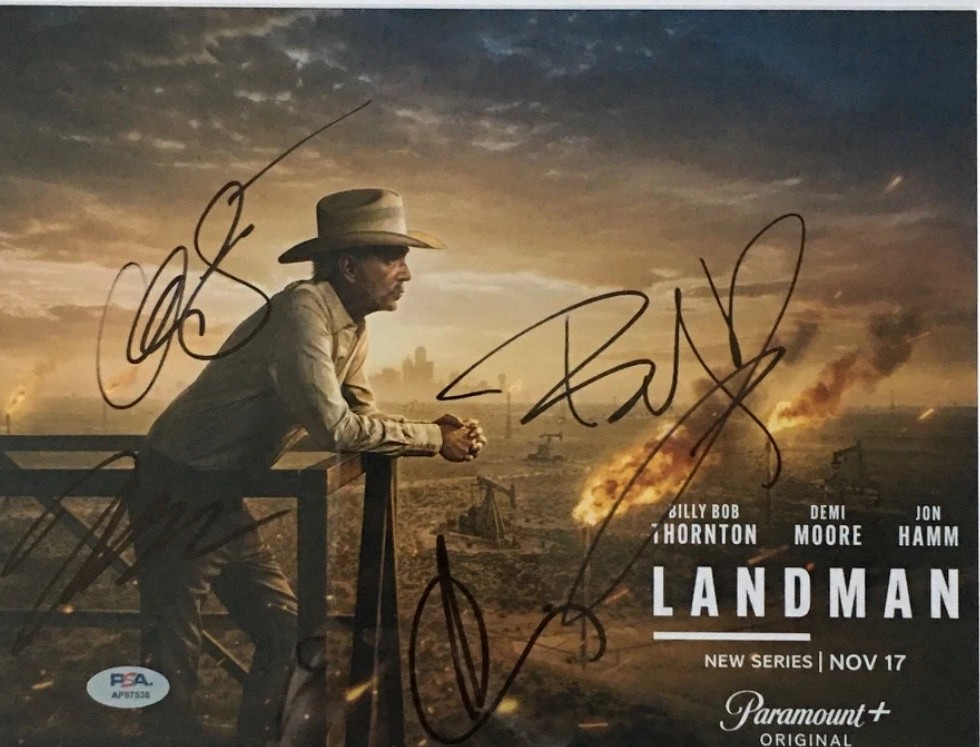
Until Taylor Sheridan came along and realized the immense dramatic potential of actual hands-on dirty work and rode Yellowstone (2018-2024) to enormous critical success and sufficient commercial endowment to be able to write his own ticket. I rarely buy DVDs these days, not because I’ve already got thousands of themd, but because that old impetus is long gone, the days when we desperately waited for a movie to turn up at the video rental store, one that you couldn’t otherwise get your hands on or missed on its cinema release, one that you wanted to own so you could watch it again and again.

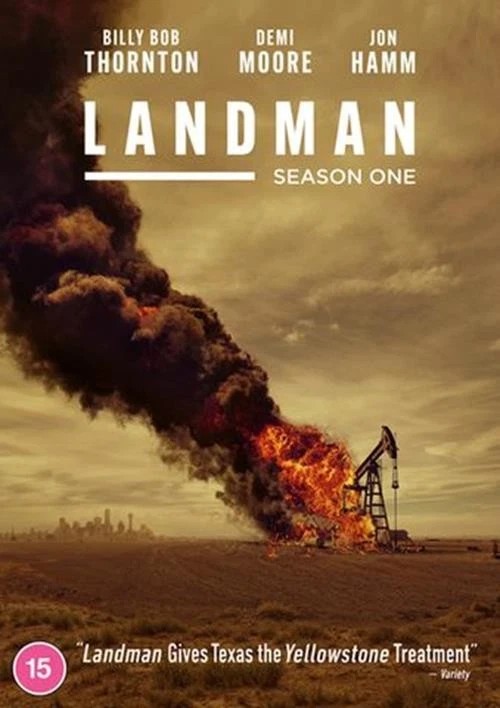
Now I tend to buy DVDs if I don’t have a subscription to a particular streamer. I did it for Yellowstone and I did it for this Taylor Sheridan enterprise Landman.

On the face of it, this might seem like another oil or big business venture where the emphasis is on wheeling and dealing and heirs fighting over money and how to spend it and everyone just the hell arguing because that’s instant drama. The element devoted here to wheeling and dealing is negligible, restricted to oil tycoon Monty Miller (Jon Hamm), one whisky away from a heart attack, at the other end of a phone getting agitated and taking out his frustration on anyone in sight.

Instead, it’s about very dirty work, the kind where workmen come home saturated in filth and the kind where you could in a flash lose your hand or your life. There have been four instantaneous deaths so far and I’m only at episode six of Series One. We’re not in the all-action Hellfighters (1968) business of quelling fires, but in the dull maintenance part of ensuring that wells with 35 years accumulated wear and rust are kept going.
I might have to buy into Paramount+ to catch the second series.
Don’t think I could wait for the DVD.

It’s the job of Tommy Norris (Billy Bob Thornton) to make sure these wells keep producing and all it takes is a stray spark or a moment’s lack of concentration and the coffins are mounting up. Along the way, we are brought up to speed on how the oil business works – or doesn’t.

Exposition used to be a hell of an issue for screenwriters until those Game of Thrones dudes invented “sexposition” where acres of naked flesh kept the audience awake through the dull stuff. Here, however, Sheridan manages something of a coup by having Monty or Tommy gush like oil wells while setting others right about the business.

This series kicks off with an oil tanker tearing along at 60mph crashing into small airplane that’s parked on a road to disburse its cargo of drugs. And that triggers two increasingly fraught, sometimes thrilling, elements. First, we’ve got the drug dealers seeking revenge and recompense. Secondly, you’ve got legal repercussions in the shape of the all-time Jaws of a lawyer Rebecca Falcone (Kayla Wallace) and how Tommy has to snake through the vagaries of the law, not, for example, pursuing thieves who steal the company’s planes or tankers to shift their ill-gotten gains because the law will invariably impound such items of transport for the couple of years it takes to get a case to court and because the drug dealers are only borrowing them for a short period and return them after use.

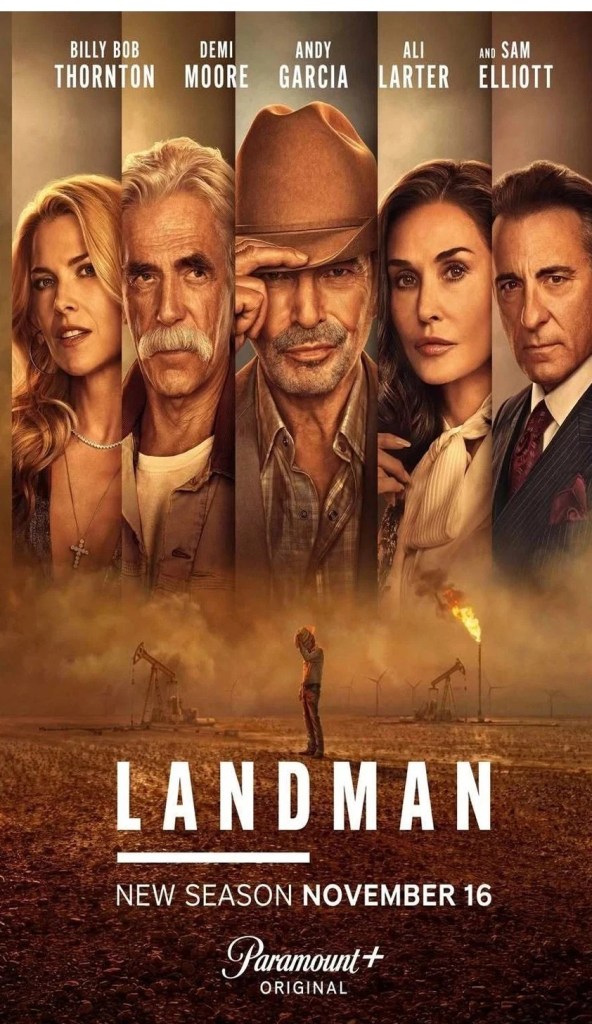
On top of that, Tommy is trying to blood son Cooper (Jacob Lofland) into the business, starting off as a roughneck, while turning up out of the blue are glamorous ex-wife Angela (Ali Larter) and daughter Ainsley (Michelle Randolph), who views philanthropy as a tax dodge.

There’s some terrific humor from Tommy’s housemates Dale (James Jordan) and, mostly in reaction shots, Nathan (Colm Feore).

You won’t have seen any of these storylines before, not even the returning wife and daughter, because all the characters are so original and the performances so powerful. Billy Bob Thornton (Bad Santa 2, 2016) has eschewed all his acting tropes, dumped the sarcasm and temper tantrums, and instead plays a weary debt-laden foreman who fails to resist the lure of his trophy wife.

I remember Ali Larter from such unchallenging fare as the original Final Destination (2000) so she is something of a revelation. While Angela is as vapid as any other trophy wife, majoring on shopping and looking good, actually she’s an education in how an ageing trophy wife stays the course. She is a fabulous cook, for starters, and she puts in the hours at the gym to keep trim. But she’s also a manic depressive and so her emotions spin on the toss of a coin, extremely charming, not to mention endearing, one minute, a venomous snake the next. This is a performance reverberating with depth that should qualify for an Emmy.

Jacob Lofland (Joker, Folie a Deux, 2024) is Gary Cooper reborn. The stillness, the reticence, and yet when necessary, taking no prisoners. He’s way out of his depth not just with the crew he’s landed with, but in unexpected romance with young widow Ariana (Paulina Chavez). But that’s not the last of the star-making turns. Kayla Wallace (When Calls the Heart series, 2019-2025) is phenomenal as the ball-busting lawyer eating up misogyny for breakfast and heading for a showdown with anyone in sight. Sassy Michelle Randolph (1923 series, 2022-2025) has many of the show’s best lines.

And that’s before we come to Jon Hamm (Mad Men series, 2007-2015) and Demi Moore in a more believable role than The Substance (2024). And the simple earworm of a score by Andrew Lockington (Atlas, 2024).

Truly original and riveting.
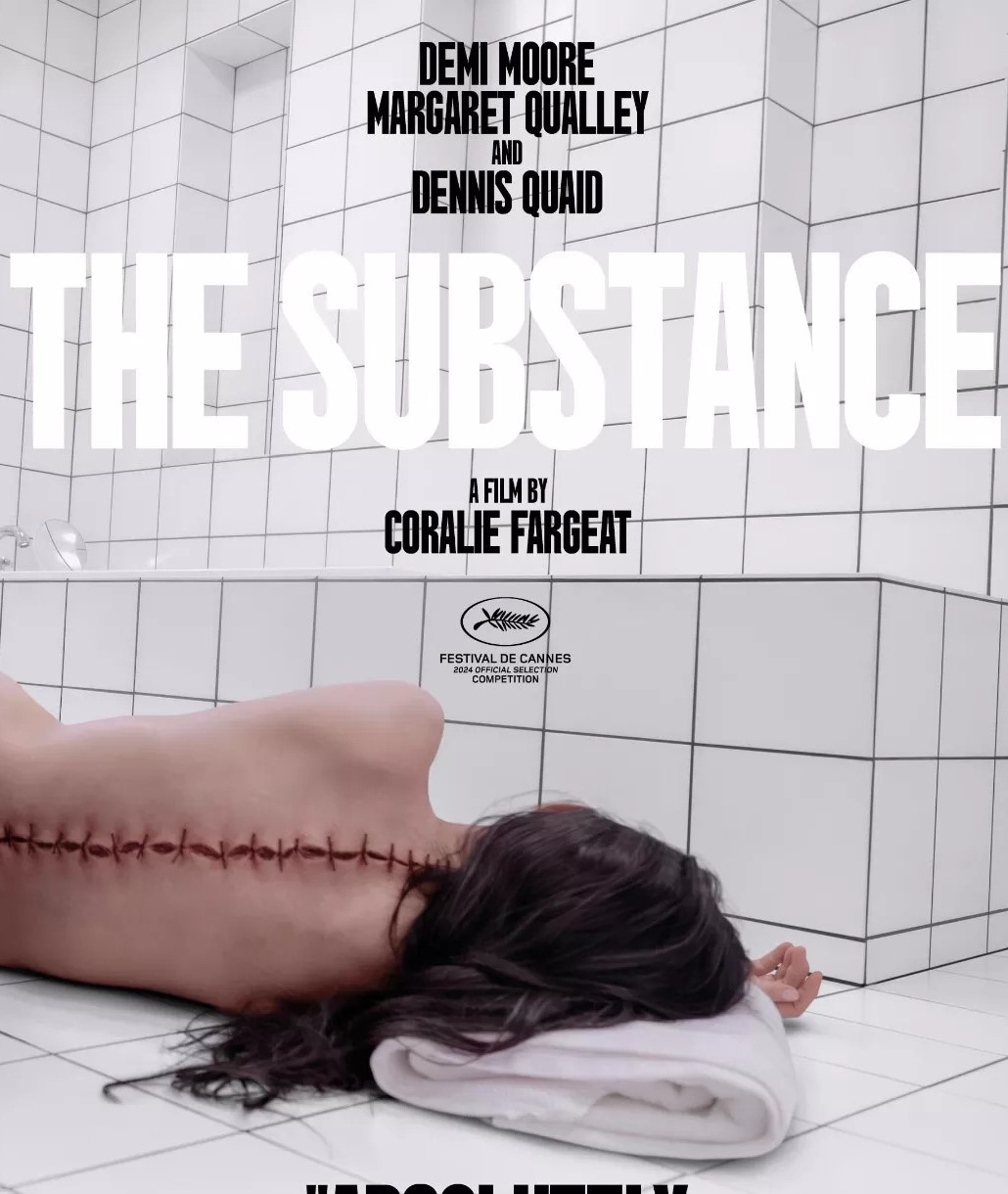
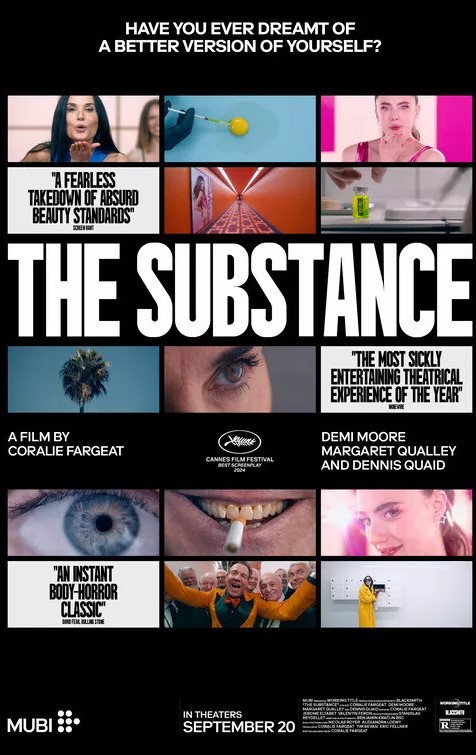
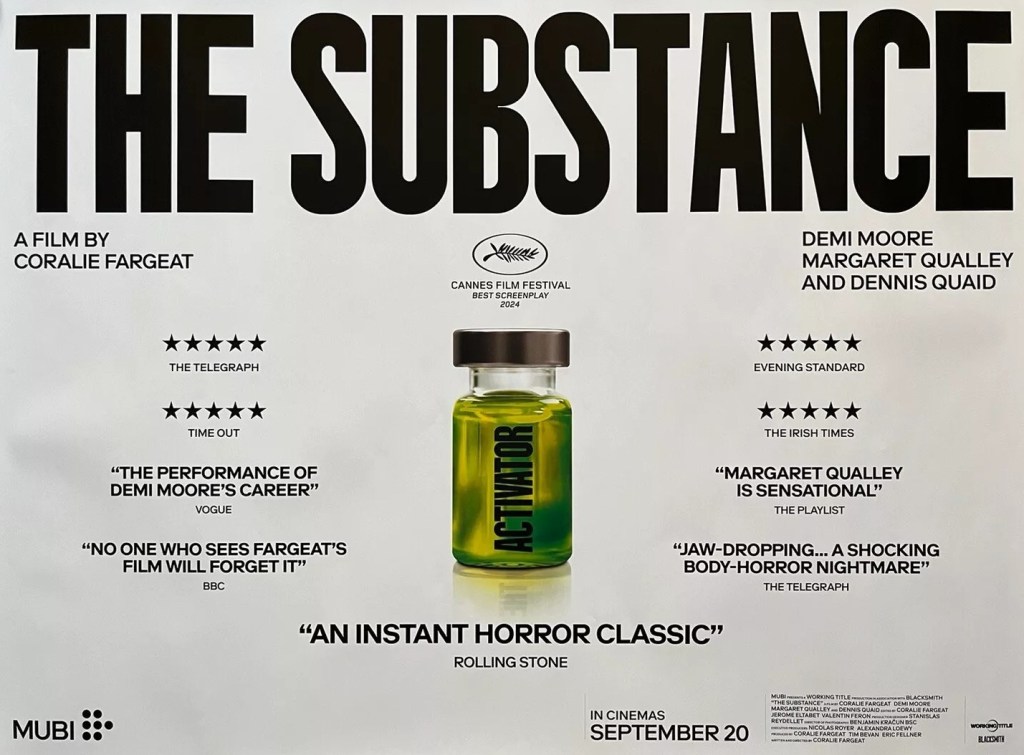
The Substance (2024) **** – Seen at the Cinema

Like Tar (2022) suffers from stylistic overkill and outstays its welcome by a good 30 minutes, but otherwise a perfect antidote to Barbie (2023). While not entirely original, owing much to the likes of The Picture of Dorian Gray and The Stepford Wives and the doppelganger and split personality nrrative nonetheless a refreshing take on the ageing beauty syndrome. Shower fetish might be a homage to Brian DePalma and except that the movie is directed by Frenchwoman Coralie Fergeat (Revenge, 2017) we might be lambasting its rampant nudity for misogynistic reasons.

On the plus side, everything else about it feels new. The whole story plays out like a demonic fable, the participants only caught out because, in their greed, they refuse to play by the rules. But like all the best horror films this occupies its own world. Whoever offers this free drug and the chance to relive your life through the best possible you is a monosyllabic voice at the end of a telephone. Not only is there gruesome rebirth but a stitching-up process. The black market drug at the center of the tale can only be accessed in a deadbeat part of Los Angeles by crawling under a door, but then, suddenly we’re in a pristine room and the various constituent parts of the substance are laid out on the Ikea model with easy-to-follow instructions.

After surviving a horrific automobile accident, onetime movie star Elizabeth (Demi Moore), reduced to breakfast television exercise guru, is passed a mysterious note by an incredibly good-looking young man that takes her down this particular rabbit hole. Like Eve’s forbidden fruit or Cinderella’s toxic midnight, there’s a catch to reliving her beautiful youth. She must switch back “without exception” to her original persona every seven days.

Of course, that’s too much to ask, and as the double named Sue (Margaret Qualley) steals minutes then hours and days the effect is seen on Elizabeth, a monstrous aged finger appearing in her otherwise acceptable hands first sign that these rules cannot be broken. Warning that there are two sides to this singular personality goes ignored. Instead of acting in concert each prt of the split personality conspires againt each other until entitlement spills over into abhorrent violence.

Apart from the initial rebirth squence, and the toothless section, the best scenes are more toned down, in one Elizabeth is faced with an alternative future, the other when she re-does her make-up four times for a date, unable to decide on which face she wishes to present.

Demi Moore (Disclosure, 1994) is being touted as a shoo-in for an Oscar nomination, but that’s mostly on account of her willingness to appear without makeup and for long sections without clothing. I’m not convinced that there’s enough heartfelt acting beyond the bitterness that was often her trademark. Margaret Qualley (Poor Things, 2023) isn’t given much personality to deal with except for exuding shining beauty and horror when it starts to go wrong.

All the males are muppets, it has to be said, wheeler-dealer Harvey (Dennis Quaid) the worst kind of obnoxious male. But this doesn’t feel much like a feminist rant but a more considered examination of refusal to accept oncoming age. Everyone has the kind of vacuous personality that’s endemic in presenting the best face (and body) to the viewing (television, big screen) public.

The movie plays at such a high pitch that most of the time you can ignore the deficiencies, but the 140-minute running time is at odds with hooking a contemporary horror audience and the gore at odds with hooking the substantial arthouse crowd required to generate the returns needed to pay back acquisition rights. None of the characters has any depth, little backstory, virtually nothing in the way of the usual confrontation with others in their lives, but then Elizabeth already lives a life of isolation, clearly lamenting her longlost fame and the attention it brings.

This won at Cannes for the script and  not the direction and that feels about right. Great idea in ultimately the wrong hands, too much of the repetition that was so annoying in Tar and the determination to make every single shot different, a movie beaten into style every inch of its running time.

Coralie Fergeat has a triumph of some kind on her hands, but one that might struggle, due to excessive length, to find an audience. Not sure, either, why tis is being sold as comedy-horror, a peculiar sub-genre in the first place to make work, but I don’t remember laughing once.

However, like Saltburn (2023) this has a good chance of attracting the young crowd via word-of-mouth, the kind who are just waiting to find their own cult material.

Both facinating and repellant.

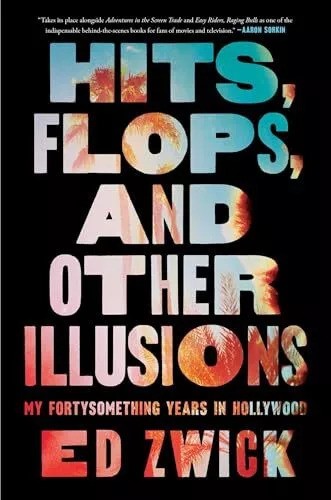
Behind the Scenes: Edward Zwick Uncensored

“I will never forget how casually Maria (Schneider of Last Tango in Paris fame) unbuttoned Joey’s shirt to hold her breast in one hand while eating a bagel with the other,” is just one of the memorable lines in director Ed Zwick’s (of Glory fame) memoir,  a very candid portrait of working in Hollywood. Glamor and grit ride side by side as he goes from being a celebrity-struck newcomer to dragging tears out of Harvey Weinstein, hearing all about Julia Roberts’s love life, endless battles on set with Brad Pitt, being offered a beer by Paul Newman in the star’s house and digging into the untapped emotional reservoir of Tom Cruise.

His mentor, director Sydney Pollack, allowed Zwick to observe as he prepped Out of Africa (1985). Pollack had a complicated relationship with Robert Redford. The star “was infallibly late.” Opposite personalities. Pollack was “voluble, excitable and punctilious” while Redford was “taciturn, laconic and laid-back.” Dealing with a proper star can be disconcerting. Asked what it was like to direct Barbra Streisand in A Star Is Born (1976), Frank Pierson said, “I wouldn’t know.”

Pollack offered Zwick sound advice about screenwriting. “Plot is the rotting meat the burglar throws to the dogs so he can climb over the fence and get the jewels, which are the characters.” Zwick’s first script, with writing partner Marshall Herskowitz, for Tri-Star, was a drama, Drawing Fire, about a Secret Service agent’s relationship with a corrupt cop. Dustin Hoffman wanted to play the lead. In conversation, Hoffman took “damn long to get to the point.” His involvement collapsed over his fee.

Jonathan Demme was originally slated for About Last Night (1986), an adaptation of David Mamet’s play Sexual Perversity in Chicago. When he pulled out, Zwick got the gig. If stars Rob Lowe and Demi Moore seemed very comfortable with the intimate scenes, that was because they had previously been an item. The movie did surprisingly well.

For a follow-up, Zwick passed on Thelma and Louise (1991) in favor of a different road picture, Leaving Normal (1992), originally set to star Cher and Holly Hunter. Jessica Lange entered the frame when Cher dropped out. After Hunter quit, Zwick signed up Christine Lahti and Meg Tilly. The picture bombed.

Next up was Shakespeare in Love with a script by Marc Norman and Tom Stoppard to star Julia Roberts who, as it happened, couldn’t help falling in love with her co-stars, that included by now Kiefer Sutherland, Dylan McDermott and Liam Neeson. To play William Shakespeare, she wanted Daniel Day-Lewis, sending him a card that said, “Be My Romeo,” but he was already committed to My Left Foot. Casting for her co-star was cancelled while she maintained that, actually, Day-Lewis had agreed. Only, when Zwick contacted him, that turned out to be fantasy.

With casting renewed, Zwick and Roberts saw, among others, Ralph Fiennes, Russell Crowe. Hugh Grant, Colin Firth and Sean Bean. But none clicked with the star, although oddly enough she later teamed with Grant in Notting Hill (1999). It could conceivably have gone ahead with Paul McGann. A full screen test was arranged. However, it was obvious at that point that Roberts hadn’t nailed her English accent. She quit, leaving Universal $6 million out of pocket.

The movie remained in cold storage for two years. Then Harvey Weinstein came calling. But not at the price Universal demanded. For the next few years, Zwick kept trying to interest actors with the requisite marquee heft such as Kenneth Branagh, Winona Ryder, Jude Law, even Mel Gibson and Johnny Depp. By coincidence, Ryder was best buds with Gwyneth Paltrow and showed her the script. Since Paltrow was Weinstein’s go-to actress, she convinced the producer to come back in. But the consequence of that was that Zwick was pushed out. Or so Weinstein believed, until he was sued. Which meant that when the movie was awarded Best Picture at the Oscars Zwick was on the stage.

Comments Zwick wryly, “ As I stand there…listening to Harvey’s prepared, saccharine, self-serving acceptance, it occurs to me to shove him over the edge of the stage into the orchestra pit. Faced with the choice of committing an act of violence before a worldwide audience of 100 million movie fans or false modesty, I make the wrong choice.”

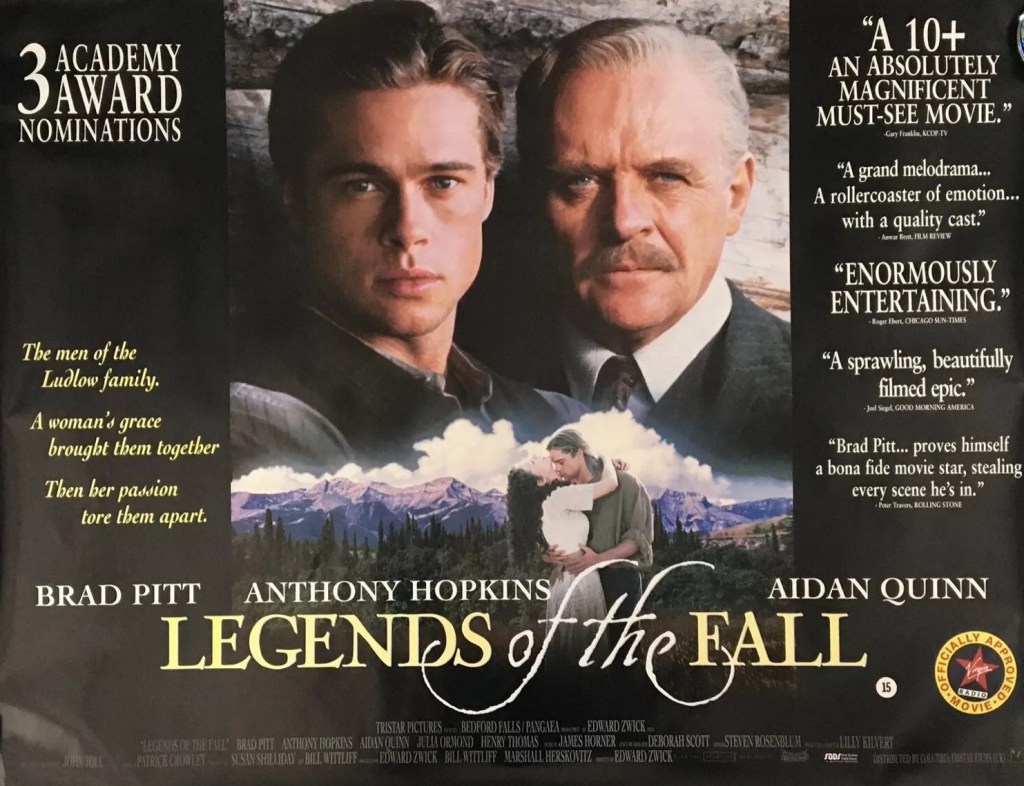
Alvin Sargent (Paper Moon, 1973) signed up for a “hefty fee” to adapt Jim Harrison’s novella Legends of the Fall (1994). Not only was he “maddeningly slow” but after a year’s work he “hadn’t been able to figure out how to do it.” William D. Wittliff (Country, 1984) was next to take a crack before Zwick called on Marshall Hershowitz’s wife Susan Shilliday – who had been story consultant and story editor on Zwick’s television show thirtysomething – to do a rewrite. Tom Cruise and Robert Duvall were briefly interested. Brad Pitt rode to the rescue.

“It’s not enough,” muses Zwick, “that a movie star be handsome; good-looking actors are a dime a dozen. And it’s not just the way the light and shadow plays on someone’s bone structure. It’s the unmistakeable thing behind their eyes, suggesting a fascinating inner life. We don’t know what’s going on inside their heads, but we definitely want to and that’s enough.”

Pre-production Tri-Star got cold feet and demanded Zwick knock $2 million off the budget. Instead, the director and Pitt halved their fees in exchange for a bigger backend. Four weeks before shooting was due to commence, they were short of a female lead, though Paltrow, among others, had read for the part, ending up with relative newcomer Julia Ormond (The Baby of Macon, 1993). Days before shooting, Pitt quit. Or tried to. He could go as long as he paid all the costs of preparation. So Pitt remained. After two weeks of shooting, Zwick was $1 million over budget, largely due to costume issues.

“There are all sorts of reasons an actor will pick a fight,” notes Zwick, and he had more than his fair share of them with Pitt. Although the movie’s resultant commercial success doubled both their salaries, they didn’t talk for a year – and never worked together again.

Denzel Washington didn’t want to do Courage under Fire (1996) until Zwick introduced the idea of Post Traumatic Stress Disorder, a new idea at the time. Matt Damon really did almost fall out of a helicopter. As Washington and Damon did a scene together “it was as if a spell had been cast over the set,” all watching the birth of new screen great. Screen improvisation isn’t all about fashioning new lines. It’s about an actor finding “emotion in an authentic way.” For the scene where Washington returns home, Zwick placed a bike along the walkway. Washington’s reaction to this unexpected obstacle was to pick it up and set it upright.

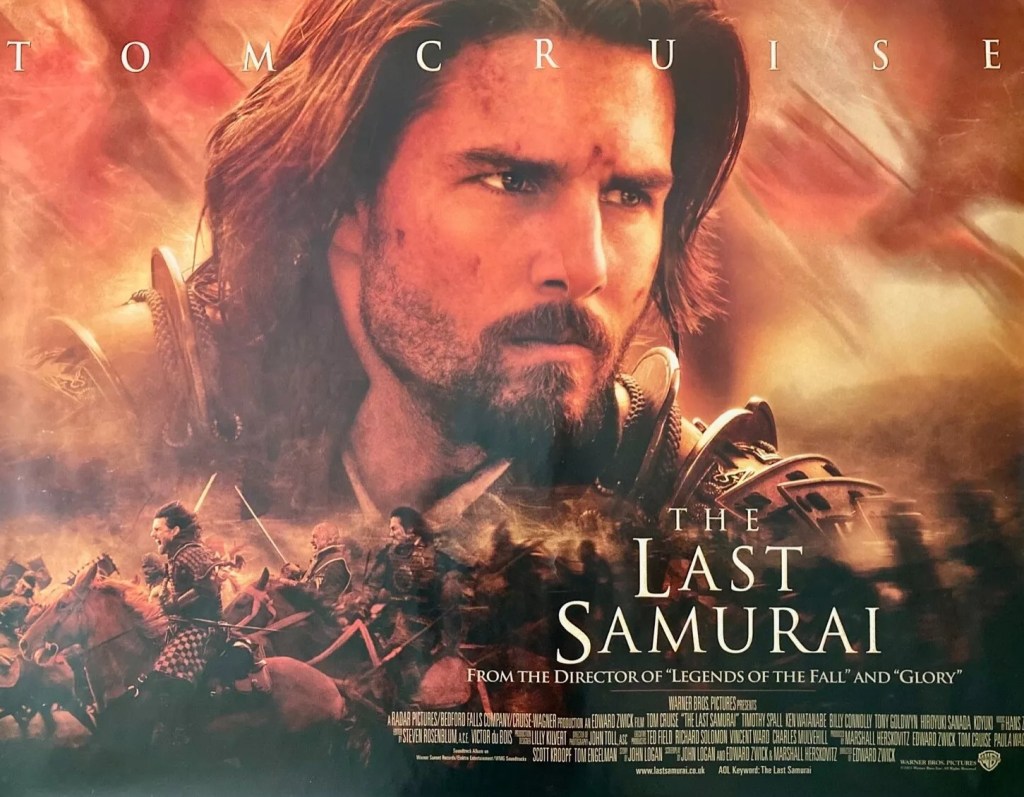
Tom Cruise originally passed on the John Logan script for The Last Samurai (2003) that Zwick felt was “still uncooked.” Uncooked or not, Russell Crowe, incidentally, was interested  in the Japanese lead. Zwick did a rewrite. Cruise liked the rewrite. “What struck me most as I got to know him was his insatiable appetite to keep improving.” Cruise was one of the actors whose involvement was an automatic green light for a studio. After completing another draft with  Hershowitz, Zwick got a call to go see Robert Towne (Chinatown, 1973). He went in dread. Towne “had an informal arrangement with Tom whereby he sometimes quietly rewrote his movies.” Instead of confrontation, Towne was encouraging. “Apparently, he just wanted to take my measure.”

There’s an animatronic horse – costing a million bucks – that appears for a few seconds in The Last Samurai in order for it to appear to the audience that in fact a horse was falling on Tom Cruise for a scene that would not have been possible, in the days before CGI, just with a stuntman. Zwick’s biggest problem on the picture was how to puncture Cruise’s self-assurance, get him to the “right emotional place…to touch some vulnerable part in him.” Zwick realized that simply asking the actor to go deeper wouldn’t work. It would look forced.

So just before shooting the critical scene, Zwick asked Cruise about his eight-year-old son, Connor. “I watched as he looked inward, and a window seemed to open and his eyes softened.” Zwick gently nudged him into position. “Go.”

Movie fans often wonder how a director gets into the movies. Usually, each tale is as odd as the last, a lucky break, meeting the right studio executive at the right time, coming across a studio hungry for your type of picture just at the ideal moment. Zwick has an odd an introduction. Living in Paris on a fellowship to observe experimental theater, he managed to creep onto the set of Love and Death (1975) and pepper Woody Allen with questions and he had a sneak preview of the Annie Hall (1977) script.

On returning to the U.S., he was accepted onto the American Film Institute’s director program. There were 26 pupils in the class, Zwick was one of six invited back for a second year. There, he struck up a lifelong friendship with Marshall Hershowitz. While studying, he read 10 scripts a week for United Artists, fell in with a merry band of more experienced Hollywood hands including Paul Schrader, Michael and Julia Phillips and Oliver Stone. After an improbable series of coincidences, he got  was employed as story editor for the tv series Family (1976-1980). Still aiming for a movie slot, he watched in horror as David Puttnam (Chariots of Fire, 1981) lasted for only six minutes of a private screening of Zwick’s 30-minute student film.

There’s not one of Zwick’s movies where he doesn’t regale you with an interesting anecdote about a star. More importantly, he provides insights into how movies are made, often touching on details that would not be obvious to anyone outside the business.

Ed Zwick, Hits, Flops and Other Illusions, My Fortysomething Years in Hollywood (Gallery Books) is available in print and kindle.

Discover WordPress

A daily selection of the best content published on WordPress, collected for you by humans who love to read.

The Atavist Magazine

by Brian Hannan

WordPress.com News

The latest news on WordPress.com and the WordPress community.