The Box Office Equalizer: Part Two

Variety’s revolutionary new box office tracking system, introduced in 1969, allowed it to include far more films in an annual assessment of performance. The “Annual Rentals” chart that appeared every January still covered how much of the box office pie was returned to studios and therefore gave a good indication of potential profit. But that was limited to only those pictures that met that chart’s criteria i.e. they had to return $1 million rentals. That usually meant only 80-odd films.

But now, in addition, from the computerized information gathered every week from hundreds of cinemas, Variety was able to give a pretty accurate estimate of the box office gross for ten times as many movies. In 1969, the survey covered 1,028 pictures. This wealth of information was of enormous value to exhibitors. Not only did it cover the obvious titles – the roadshows and those with top stars – but also the run-of-the-mill movies on which most cinemas now depended. In the current severe product shortage, reissues played a vital role. As did sexploitation.
Among films reviewed so far in the Blog annual grosses were shown for: They Night They Raided Minksy’s $1.9 million, Mafia picture The Brotherhood $1.9 million, Anthony Newley number Can Hieronymous Merkin Ever Forget Mercy Humpe and Find True Happiness $1.3 million, Hard Contract $1 million, Mayerling $980,000, Justine $536,000, Les Biches $391,000, Assassination Bureau $146,000, Fraulein Doktor $114,000 and The Sisters $50,000. (Multiply these figures by 50% for an accurate estimate of their rentals).

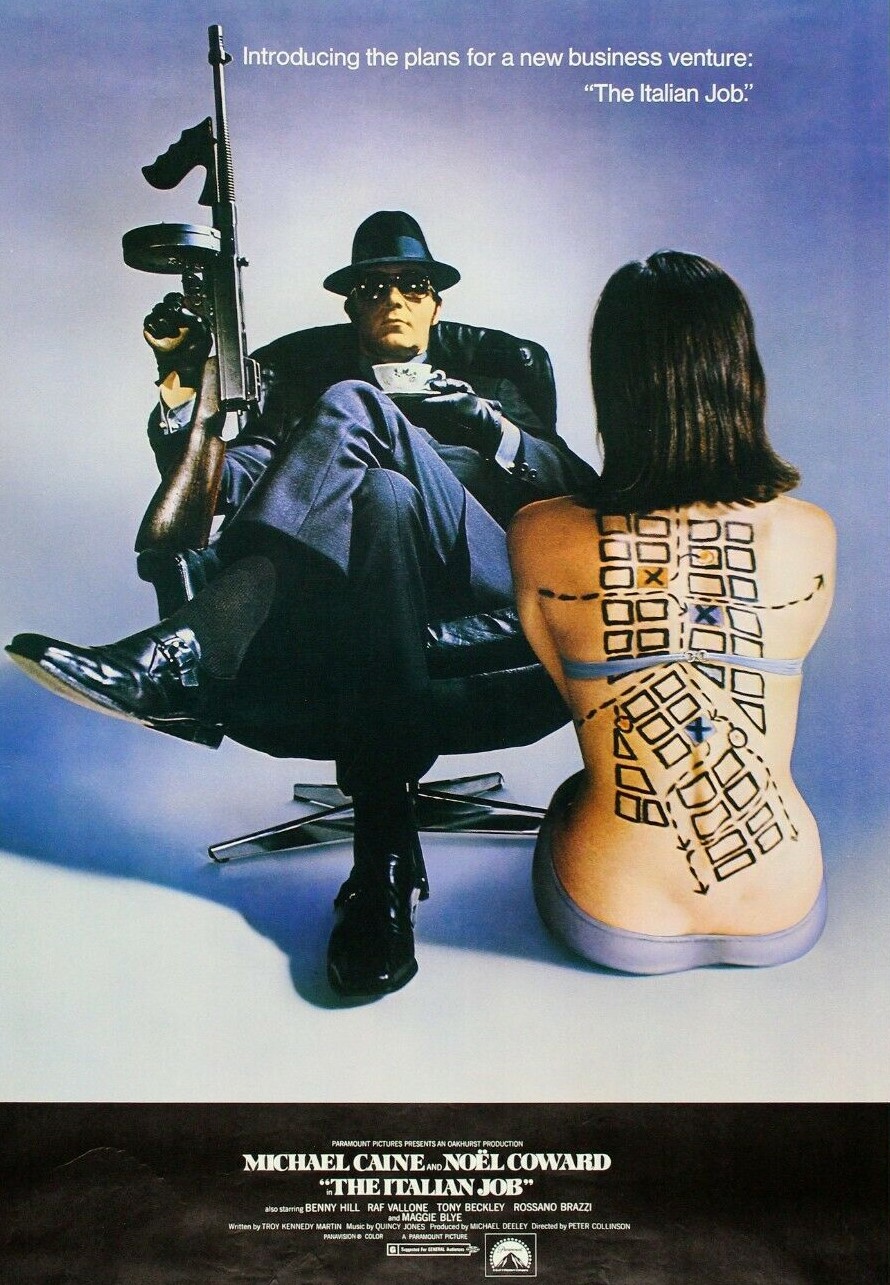
Other figures worth noting were: The Fixer $1 million, Secret Ceremony $1 million, The Italian Job $614,000, Marlon Brando in The Night of the Following Day $424,000, Shalako $78,000 and The Extraordinary Seaman $61,000. Bottom of the box office pile was motor racing documentary Hot Rod Action with just $1,000.

Given it was widely considered a flop, these are interesting figures for Hieronymous Merkin, rentals now estimated as being in the region of $2 million against a budget of $1.6 million – although other sources put the budget as low as $500,000 thus making it extremely profitable. Secret Ceremony had grossed $617,000 the previous year so its rentals would have approached $2.5 million, far more than was previously assumed. Fans of cult British thriller The Italian Job will perhaps be astonished how poorly it did in the U.S.

The top-grossing reissue was Bonnie and Clyde/Bullitt ($1 million) followed by a pair of Clint Eastwood double bills – A Fistful of Dollars/For a Few Dollars More ($912,000) and Hang ‘Em High/The Good, The Bad and The Ugly ($740,000). Also in the mix were Goldfinger/Dr No ($323,000), A Man and a Woman ($226,000), Belle de Jour/A Man and a Woman ($199,000), a revival of Lola Montes from 1955 with $148,000 and less successfully, from 1961, A Cold Wind in August with just $21,000.
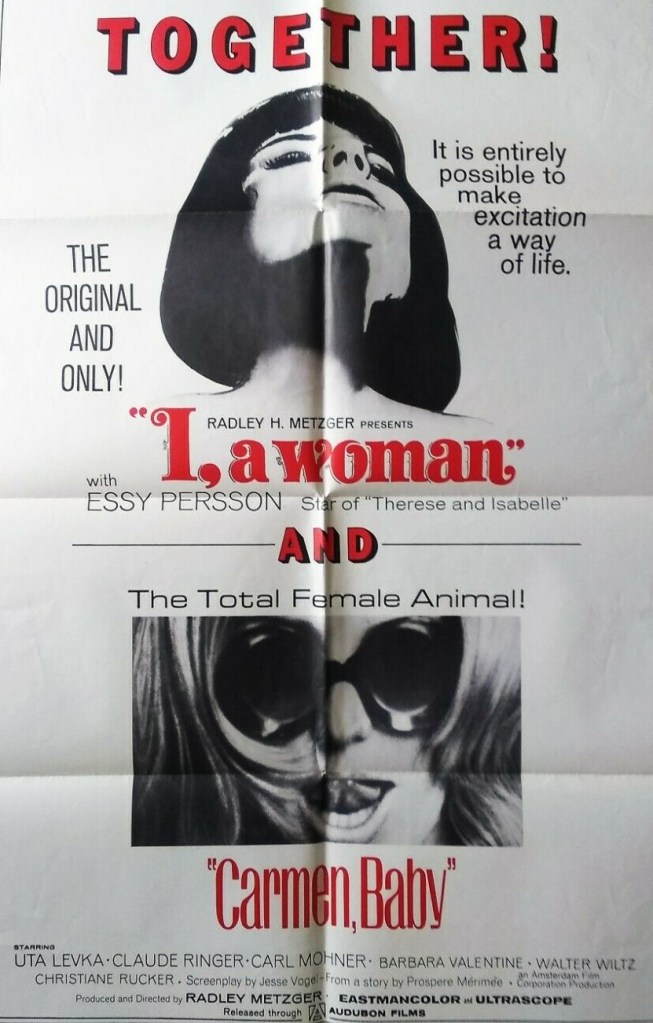
As previously noted, the impact of sexploitation was becoming more obvious. The biggest hit was The Libertine which crossed the $1 million mark followed by Camille 2000 ($868,000), Inga ($819,000) – bringing in three times as much as the previous year – Swedish Heaven and Hell ($458,000) and The Female ($279,000). Others charting included Vibrations, Without a Stitch, Erotic Dreams and The Sex Perils of Pauline. In addition, sexploitation movies were ripe for reissue, I, A Woman/Carmen Baby clocking up $363,000.

More importantly, what the chart did show and what the new weekly Top 50 was beginning to recognize was how often cheaply-made exploitation pictures held their own or even outgrossed big studio pictures for which exhibitors were often held to ransom. If ever there was a sign of the direction in which the business was now heading, this annual survey was it.

SOURCE: “Variety B.O. Charts’ 1969 Results,” Variety, April 29, 1970, p26.   

What If: When Harry Met Frank

Apologies for venturing outside my self-appointed remit of the 1960s but this is too good to ignore and the artwork above extremely rare.

It’s pretty hard to get out of our minds the vision of Clint Eastwood as the tough cop of Dirty Harry (1971) especially brandishing his .357 magnum and snarling lines like “Do ya feel lucky, punk?” It was such a high point of Eastwood’s career that it’s hard to see anyone else in the role.

But, in fact, Warner Brothers did. Long before Eastwood entered the equation the studio had Frank Sinatra lined up. If your notion of Sinatra comes from musicals like High Society (1956) or easy-on-the-eye Rat Pack ventures like Sergeants 3 (1963) or his Oscar-winning turn in From Here to Eternity (1953), you would be forgetting his harder-hitting roles in the later 1960s as a tough cop in The Detective (1968) and as private eye Tony Rome (1967) and sequel Lady in Cement (1968).

Nor was Don Siegel a shoo-in for the director’s chair. Warner had already assigned that task to Irving Kershner. The Sinatra-Kershner version got far enough up the production ladder for the studio to produce a piece of artwork with the actor in the title role – see above. This went out in an advertisement that appeared in Variety on November 9, 1970, under the headline “Now In Production Or In The Can (And In Theaters Soon)” suggesting the movie with Sinatra in the title role was pretty much a lock. Though what exactly was in the briefcase was anyone’s guess.

Other films advertised in the same spread were Rabbit Run with James Caan (also seen in this section of the ad) and Robert Altman’s McCabe and Mrs Miller (though under a different title). However, the photo of Sinatra with a briefcase was hardly inspirational and a far cry from the eventual Eastwood image that went with the picture. Whether Sinatra’s interpretation of the character was intended to be quite as tough and mean as that of Eastwood, we shall never know.

Books by Brian Hannan – The Gunslingers of ’69 – The Western’s Greatest Year

While Easy Rider was triggering a “youthquake” and Midnight Cowboy breaking censorship taboos, the western in 1969 hit a new peak. Or so I had thought for many years.

So I set out to see if my theory might have some truth in it. Four true masterpieces in The Wild Bunch, True Grit, Once upon a Time in the West and Butch Cassidy and the Sundance Kid – more than in any other single year – were helped along by a few others that for various reasons fell shy of greatness such as The Stalking Moon, Tell Them Willie Boy Is Here, and the hilarious Support Your Local Sheriff.

I watched the 40-plus westerns that were released in 1969 to write this book. New directors like George Roy Hill reinvigorated the western while veteran Sam Peckinpah at last found popular approval and the even more experienced Henry Hathaway turned his decades of skills onto True Grit.

Andrew V McLaglen fulfilled the promise of Shenandoah with the vastly underrated The Undefeated. Raquel Welch was anointed Queen of the Western. Old-timers John Wayne (True Grit and The Undefeated), Gregory Peck (The Stalking Moon and Mackenna’s Gold)and Robert Mitchum (Young Billy Young and The Good Guys and the Bad Guys) appeared in a brace of westerns each, as did newcomer Robert Redford. While Clint Eastwood and Lee Marvin tried their hand at a musical (the latter scoring a hit single) it was Jean Seberg who stole that show.

Taken as a whole, I found themes repeated again and again. The most obvious, of course, were allusions in one way or another to Vietnam. But pursuit and escape were other dominant themes, and the movies also took a good hard look at women’s rights, changing attitudes towards African-Americans (100 Rifles turned Jim Brown in an action star) and Native Americans.

Watching so many movies from a single genre one after the other I also became very conscious of how directors used the screen, Hathaway’s use of extreme long shot, for example, or McLaglen’s widescreen compositions. Of all the books I’ve written this was the most enjoyable to write because I had so much fun watching the movies.

The Unforgiven (1960) ****

Largely ignored at the time and since due to similarities to The Searchers (and not to be confused with Clint Eastwood’s Unforgiven)  this is worth a second look because it actually bears few similarities to The Searchers.

The overriding thrust (or threat) of the tale is, yes, forcible repatriation but this is a long way from John Wayne’s obsessive twenty-year hunt to kill an innocent girl. While it does ask questions about race and race hatred, it is as much an involving portrait of frontier life – breaking-in horses, cows on the roofs of houses, meals with friends – and a natural cycle of life, young girls bewailing their marital prospects, young men adrift in the wilderness agog at the prospect of visiting a town to see a saloon girl.

Audrey Hepburn plays a foundling, rumored of Native American blood, but brought up under the matriarchal gaze of Lillian Gish and fraternal protection of Burt Lancaster. But she doesn’t “play” a foundling, and certainly not someone unsure of her place in the world. She plays a skittish teenager on the brink of adulthood, on a spectrum between gauche and vivacious, who can’t make up her mind between a young suitor or an Native American horse expert and her suppressed feelings towards Lancaster. She is as apt to leap on an unsaddled horse as jump fully clothed into a river.

Lancaster has a more considered role than usual, a calming influence, sometimes an intermediary, sometimes taking control. Though some characters’ reactions to Native Americans are stereotypical, Huston does not go down that line.  Following the truism that action reveals character, there is a wonderful scene breaking in the horses: while white men struggle, being thrown off or otherwise injured, the Indian simply talks gently to the horse and climbs on board and rides it, revealing that Lancaster, who hired him, saw natural dexterity beyond the stereotype.

What caught my eye most was Huston’s fluidity with the camera. In many scenes, something interesting is developing in the background, in others characters move into frame or their reaction is momentarily captured as the camera busies itself on a more central activity. There are virtually no cutaways to subsidiary characters as you would find in Ford or Hawks. When an unarmed Lancaster confronts a small group of Native Americans at his ranch the camera tracks him as he goes out and then tracks him as he comes back, tension mounting as we wait for the Native Americans over his shoulder to possibly take action. 

The thoughtful and even-handed manner in which Huston handles the material is a bridge to his more mature later works. My only gripe was Lillian Gish’s very white face, as if she had never strayed from her silent film origins or never spent a minute in the sun. Otherwise, this is absorbing and rewarding stuff, and quite unlike anything else from the period.

Discover WordPress

A daily selection of the best content published on WordPress, collected for you by humans who love to read.

The Atavist Magazine

by Brian Hannan

WordPress.com News

The latest news on WordPress.com and the WordPress community.