The Prestige (2006) ****

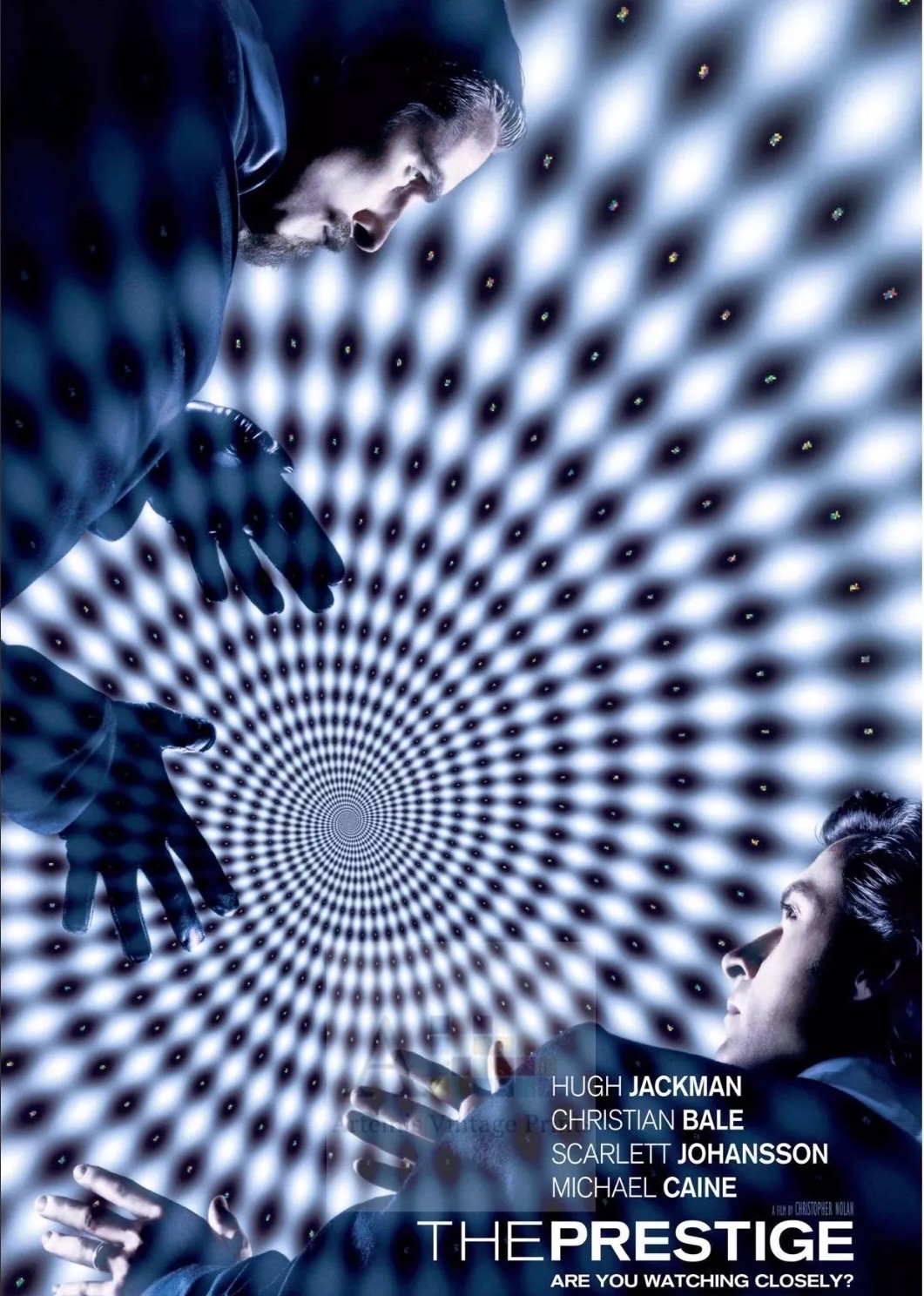
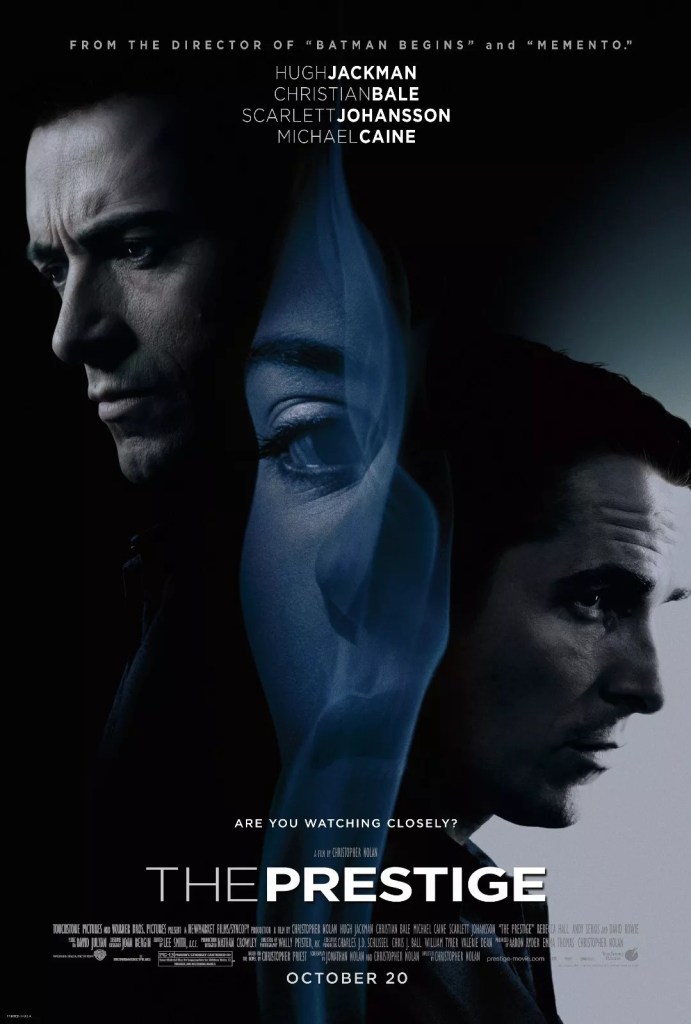
Christopher Nolan (Oppenheimer, 2023) revels in sleight-of-hand, if only by mixing up time frames, but even he isn’t intellectually smart enough to overcome the deficiency that ensured this picture failed to emulate the commercial success of all his other movies. And it revolves not around what you do to dupe an audience. An audience wants to be duped and isn’t so concerned if how the duping is achieved is never revealed, which is, of course, core to the business of the stage magician. Part of the success of this picture is that Nolan gives away stage secrets, even, if you were playing close enough attention, giving away the main reveal of one of the two dueling stage magicians.

But one of these revelations cuts so close to the bone the audience loses its sympathy for both the main characters, Alfred Borden (Christian Bale) and Robert Angier (Hugh Jackman). By the time we understand just how ruthless this pair are to the extent of risking marriage/romantic attachment for the sake of either getting one over on the opponent or maintaining the central deceit of their act, we have already become too squeamish to care overmuch. And the twists which come with increasing regularity which are supposed to take our breath away are defused by the ticking time bomb.
And the miscalculation pivots on who you can kill in a movie. Henry Fonda cold-bloodedly slaughtering an innocent child in Once Upon a Time in the West (1969) set a new high/low for onscreen barbarity, but that was excused because it demonstrated just what a villain this character was. Since then a virtual industry has grown up over inventing more creative ways in which people can be killed.

One of the standard ploys of the stage magician is to make a canary in a cage disappear in front of your very eyes only for said canary, minus cage, to reappear moments later to thunderous applause. Turns out the cage is collapsible and it vanishes into a space hidden in a table. The canary? It is squashed to death in the cage. It’s a different canary that magically reappears.

So all through the picture canaries are squashed, sometimes we see the cages being emptied of dead canaries, and workrooms filled with canaries waiting to be squashed.

What happens after this somehow pales into insignificance. Here we have a business that requires murdering God knows how many canaries every night of the year. It doesn’t take much intelligence among the easily duped moviegoer to work out how many canaries both magicians have ruthlessly despatched.

So when they get around to killing each other’s loved ones, or shooting off each other’s fingers or ruining each other’s acts, your stomach has already been turned and although the darkest of dark narratives has long been a theme of the movies, this, and not fitting into the exploitation B-picture genre where it would more comfortable reside, sucks the sympathy out from under the director’s feet and all his later sleight-of-hand, as ingenious as it is, counts for very little.
There’s certainly tragedy here and of the kind that only Shakespeare could conjure. In order to safeguard the integrity of his act – the secrecy paramount to its success – loving husband Borden is forced to pretend to his loving wife Sarah (Rebecca Hall) that he has a mistress, resulting in distraught wife killing herself. Though discreetly done, scarcely glimpsed in the final sequence, Angier has embarked on the murderous spree essential to concealing the mechanics of his famous trick, The Transported Man.

That it works at all, and splendidly to a large extent, is down to Nolan’s traditional time-shift sleight-of-hand and installing in the middle of this brouhaha the wise Cutter (Michael Caine) whose tempered diction brings the movie unexpected gravitas. When he speaks you tend to believe. The minute the other pair open their mouths you are suspect.

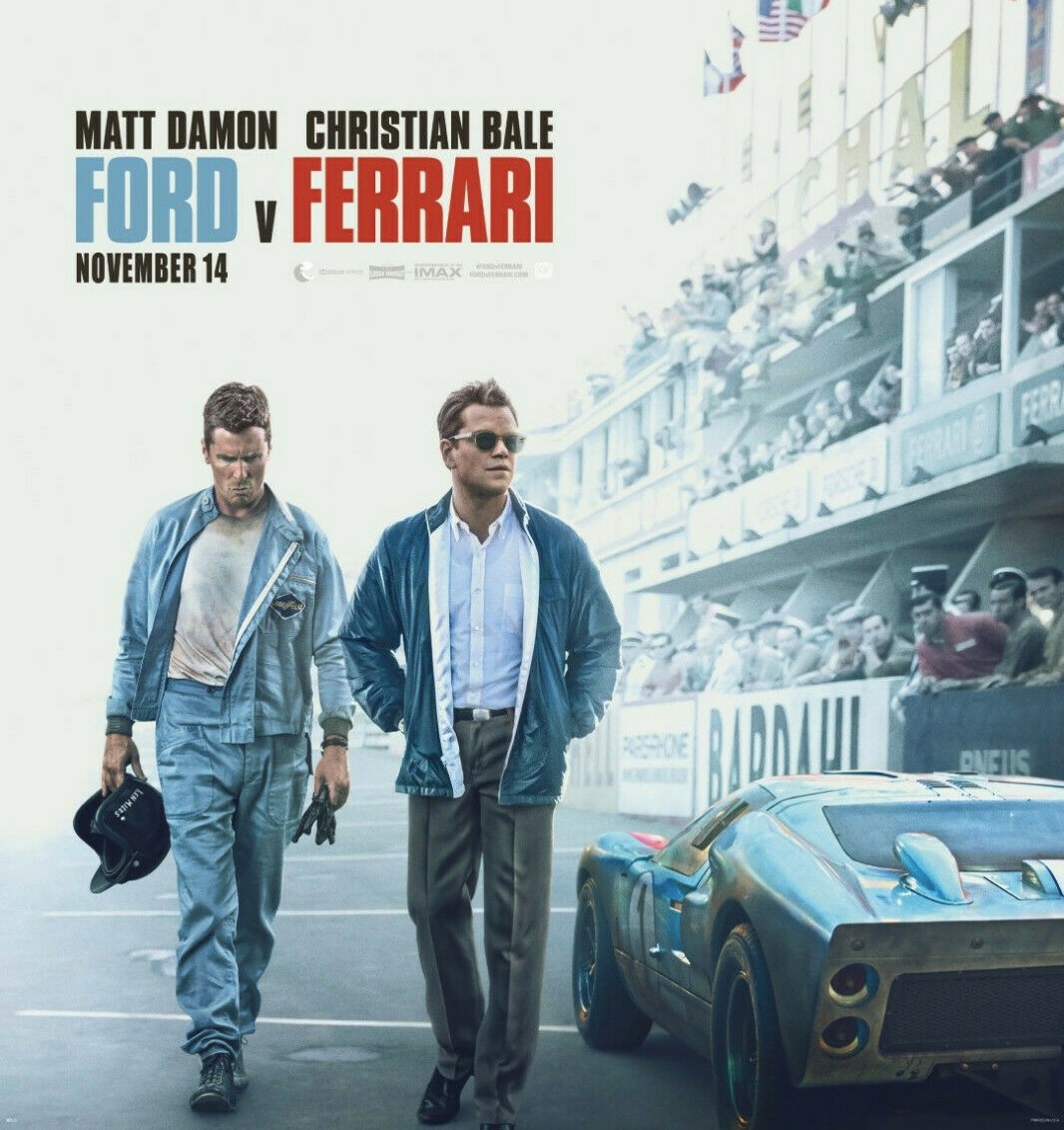
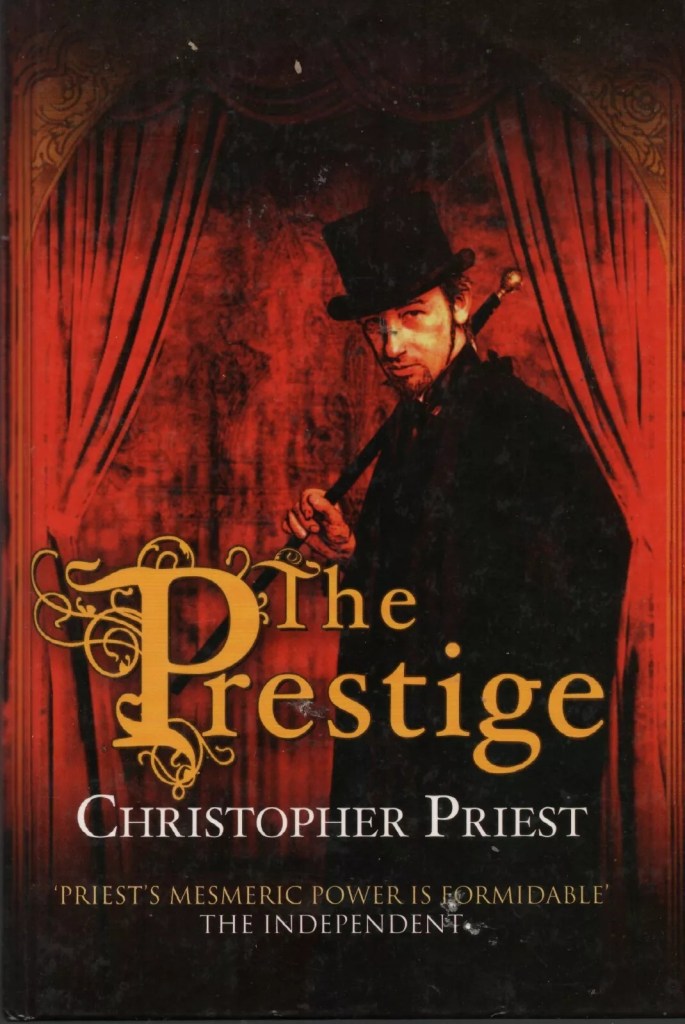
Just for his calmness Michael Caine (Interstellar, 2014) steals the picture from Christian Bale (Ford v Ferrari / Le Mans ’66, 2019) and Hugh Jackman (Deadpool and Wolverine, 2024). Rebecca Hall (Godzilla v Kong: The New Empire, 2024)and Scarlett Johansson (Fly Me to the Moon, 2024) are at opposite ends of the feminine divide, the former unable to cope with deceit, the latter manipulating it to her own ends. The director and brother Jonathan adapted the Christopher Priest award-winning novel.

Setting aside the canaries and the difficulties of presenting all-consuming obsession, this remains an intriguing work, possibly the darkest area into which the director ever ventured.  

Amsterdam (2022) **** – Seen at the Cinema

Shaggy dog story wrapped up in paranoia thriller. A shade overlong, with too many characters and too much plot but such flaws should not detract from that rare cinematic animal, a truly original movie. Brilliant screenplay, believable characters and superb acting prove an irresistible combination.

Though you can see why this sank like a stone at the box office, the all-star cast generally acting against type, idiosyncratic director given vast sums to play with, a tale that goes in too many directions at once, and the unconstitutional events of January 6, 2021, bringing this too close to home for fractured American audiences.

You don’t get this kind of writing much anymore. When individuals come together on a project – to save the world the most likely reason these days – their individuality is usually subsumed to the plot. Here, instead, the reactions of the characters remain distinct and no matter what is going on there is always time for individuality. And some of the invention is just deliciously insane, the nonsense songs for example.

Touching on the World War One aftermath of recovering from mental and physical wounds plus profiteering glee, a sense of a country racked by the Depression on the brink, mind-inducing experimentation of the political and pharmaceutical kind. A trio of war veterans, soldiers Burt (Christian Bale) and Harold (John Davidson Washington) and nurse Valerie (Margot Robbie) investigate a mysterious death, an illegal autopsy uncovering poison, only to find themselves framed for murder.

Burt is not a prime-time player according to wife Beatrice (Andrea Riseborough), and her wealthy family had dispatched him to the war in the hope he would return with bankable glory, but generally treat him as an unwanted black sheep. Valerie now makes art out of war debris, bullet shells and shrapnel, her charming brother Tom (Rami Malek) and his wife Libby (Anya Taylor-Joy) embedded in malevolence. Harold is a lawyer, for whom racism is a constant.

American and British secret service operatives, Norcross (Michael Shannon) and Canterbury (Mike Myers), float in and out. The moneyed business elite, despising White House incumbent Roosevelt, cast envious eyes at the dictatorial economic miracle of Mussolini in Italy.

On everyone’s dance card is General Dillenbeck (Robert De Niro), sought out by our intrepid trio and a mysterious cabal. All he has to do is make a speech at a veteran’s dinner. Make the right kind of speech and the trio are vindicated. Make the wrong kind and he could be assassinated.   

Like Chinatown (1974), Amsterdam is representative, a state of mind, but of freedom rather than endemic corruption. This is an intricate piece and a bit slow for today’s fast-paced generation and with more dialog than might sit well with a modern audience and flights of fancy that are far more original than anything you would find in the MCU. But it’s a hell of an intelligent thriller driven by a bunch of deadbeats.

It never goes down the obvious route. Instead of a love triangle – Valerie and Harold a pair – it’s an evocation of friendship. You don’t need umpteen clues to find the villains, they’re upfront, and they don’t think they are baddies, but cleverer people coming to the aid of the dumb masses putting too much blind faith in democracy. While this is based on a true story, in reality it’s based on the constant of the rich trying to get richer and the wealthy believing they are the best, even if unelected, candidates to run the world.

All that political stuff could have been a big turn-off if it had gone down the preachy route, but it doesn’t, instead it’s almost a miracle that it arrives at any conclusion given in whose hands the narrative has been placed. The Three Stooges would have done a better job of getting there quicker, but then you wouldn’t have had so much fun.

Not only are all the stars on their A-game but acting-wise it delivers some career-reviving turns not least from Christian Bale (Ford v Ferrari, 2019), devoid of a lifetime’s acquisition of irritating tics, John David Washington (Tenet, 2020) called upon to develop a character rather than an action-driven hero. I had to check the end credits to find out it was Mike Myers (Bohemian Rhapsody, 2018) playing the understated Canterbury and hogging the screen with none of the acting pyrotechnics that dogged previous attempts at mainstream work. Ditto Robert De Niro (The Irishman, 2019) and Rami Malek (Bohemian Rhapsody), no grandstanding this time round – don’t worry I recognized both from the off – and Anya Taylor-Joy finally delivering on the promise of The Queen’s Gambit (2020).

Margot Robbie (The Suicide Squad, 2021) is already on the rise and this will add to her growing portfolio of fascinating characters. And if you’re fed up watching any of these stars in brilliant form, there are other distractions in the form of Chris Rock (Spiral, 2021), Taylor Swift (Cats, 2019), Andrea Riseborough (The Electrical Life of Louis Wain, 2021) and Alessandro Nivolo (The Many Saints of Newark, 2021).

You often hear the term “visionary director” thrown about with indiscriminate regard, but this is the right kind of visionary, director David O. Russell (Joy, 2015) with his own way of seeing the world, and delivering it in distinctive fashion, with less of an eye on camera movement and more on dialog and motivation and staying true to a coterie of original individuals.  

I guess the money was spent on atmosphere, this is 1930s USA regurgitated in enormous detail. But you’ll forget the background, the costumes and sets, and be dazzled instead by the script and the acting, and the enveloping tale of friendship.   

Ford vs. Ferrari / Le Mans ’66 (2019) *****

So good that immediately on finishing a screening I pressed the re-watch button. But then this proved such compulsive viewing on original release that I saw it at the cinema four times in as many weeks. High-octane pedal-to-the-metal drama that easily takes the chequered flag from such illustrious predecessors as Grand Prix (1966), Le Mans (1971) and Rush (2103).

Astonishing racing footage is matched by a gripping narrative of ambition and revenge played out at the highest level by a quartet of terrific performances. Henry Ford II (Tracy Letts), humiliated by competitors in the domestic market and thwarted by his plan to take over Ferrari, decides to steal the Italian giant’s crown at Le Mans, the 24-hour race considered then the pinnacle of motor racing achievement rather than Grand Prix.

He hires Carroll Shelby (Matt Damon), the only American winner of Le Mans, who now runs a sports racing construction business and in turn he recruits maverick English driver Ken Miles (Christian Bale). Putting a spanner in the works at every possibly opportunity is oily Ford top executive Leo Beebe (Josh Lucas) who constantly shifts the goalposts because he’s just mean that way or to win commercial advantage. Driven as much by personality conflict as anything else,  the narrative pivots on Shelby shouldering the job of placating both big business and his maniac driver while outmanoeuvring all in sight to achieve his goals.

Jargon overload should be the kiss of death but that bold decision to involve the viewer in the minor and major technicalities of motor sport – proven and unproven techniques such as applying strips of paper to a car or battering the car boot with a hammer to increase its capacity and so comply with an arcane rule – pays off big time so that the picture can actually cover in greater depth the reality of running a racing team. Winning can be a matter of millimetres, tiny alterations amounting to massive differences during a race.

And it helps the narrative thrust that Le Mans is a single race rather Grand Prix or Nascar where over a season inevitably attention and excitement will sag. Other races are easily accommodated because they are vital to the end result, either in personal or technical terms. This is the ultimate battle against the odds, not just novice Americans taking on the big boys  of Italy, but the ageing driver needing to prove himself again and again and the constructor sometimes giving in, sometimes not, to big business.

It’s pretty difficult to retain audience involvement with the competitors masked up but (as Top Gun: Maverick would later prove) little works better than having your half-hidden driver (or pilot) reveal his emotions by talking to the machine, providing a commentary on the action, though Miles’s favoured expression of “giddy-up” may not qualify as a technical term.

Interestingly enough, the principals are all indifferent, not to say occasionally shady, businessmen, Henry Ford II laboring in the shadow of his father, the repair shop run by Miles shut down by the taxman, Shelby selling the same car over and over to multiple buyers. But this is a richness of character rarely seen in action films, flaws usually restricted to sexual or alcoholic peccadilloes. Nor is there any sign of the old trope of wife/lover unable to watch drivers race, and marriages/relationships buckling under that pressure. Instead Miles’ wife Mollie (Catriona Balfe) rejoices in his skills while Henry Ford II clearly has a string of lovers.

The contrast between the romance and the reality of speed is no better expressed than when Ford is taken for a spin by Shelby or between the devil-may-care and the safe than when Shelby takes control of an aeroplane.

So many internal obstacles, Beebe’s manoeuvrings for a start, remain to be overcome never mind complications on the track that it is pretty much one twist after another with one awful ironic twist left for the climax of the race.

Christian Bale (Thor: Love and Thunder, 2022)  picked up most of the acting plaudits, nominated for a Golden Globe, but I thought Matt Damon, Tracy Letts and Josh Lucas ran him close. Damon (The Last Duel, 2021) delivers a restrained performance that occasionally cuts loose to reveal the carefully camouflaged daredevil. Letts (Lady Bird, 2017), better known to me as a playwright, brings the right mixture of arrogance and power. One-time matinee idol Josh Lucas (A Beautiful Mind, 2001) eases back on the shit-eating grin and is one of the most self-righteous business bad guys you could encounter.

Sterling turns also from Jon Bernthal (Those Who Wish Me Dead, 2021) as Lee Iacocca (who later wrote a book about brilliant he was, although there’s little evidence of that here); Catriona Balfe (Belfast, 2021) and Noah Jupe (A Quiet Place, 2018) as her son. Special mentions for Ray Mackinnon (News of the World, 2020) as Shelby’s number two and Remo Girone (The Right to Happiness, 2021) as Enzo Ferrari.

Distinguished career as director James Mangold has enjoyed  – from Walk the Line (2005) and 3.10 to Yuma (2007) to Logan (2007) – this has to be the peak, brilliantly bringing the human side into a movie that could easily have concentrated on the machines. He drew on an equally brilliant screenplay by Jez Butterworth (Spectre, 2015), John-Henry Butterworth (Edge of Tomorrow, 2014) and Jason Keller (Escape Plan, 2013).

Thor (2022) **** – Seen at the Cinema

It was time someone took the piss out of the MCU. Just as well Marvel decided to do it for themselves. The result is a hoot.

Finding gainful employment for the universe’s dumbest superhero is no joke, but in a welter of visual and verbal gags the studio celebrates his stupidity. I was laughing from the outset and I didn’t stop and from the mad recaps to the giant goats, Thor (Chris Hemsworth) treating his weapons as if they had the power to upset him, his ignorance of the devastation he wreaks, and non-PC references to orgies and the size of his manhood, the inevitable Marvel save-the-world plot takes second place to humor.

Asgard has been turned into a tourist attraction, terrible actors perform sagas in tacky productions to entertain visitors, until Gorr (Christian Bale) the god-killer, having been allocated in normal mysterious fashion and in Excalibur-style the Necrosword, comes calling, kidnapping children, packing them off to the Shadow Realm as a means of luring Thor. Fortunately, lost love Jane Foster (Natalie Portman), unfortunately dying of cancer, reappears in his life, though, on the debit side, she steals his hammer, causing him to turn to his axe. There’s hammer hocus-pocus, the usual lengthy daft exposition, but that’s offset by Thor, sensitive soul that he is, feeling he has to woo the discarded axe.

Also recruited are Asgard king Valkyrie (Tessa Thompson) and stone-man Korg. First port of call, naturally, is Omnipotence City where all the top gods hang out, including Zeus (Russell Crowe), the top god of all. Unwilling to help them out when there are delectable maidens hanging on his every word and orgies to enjoy, Zeus foolishly picks a fight and loses his lightning bolt.

But that’s enough of the madcap fun. Now it gets serious in the usual annoying way, redemption and its alter-ego sacrifice required at every turn, as you try to keep up with the new ideas suddenly introduced, the Bifrost and Eternity, and have to remind yourself of the rules regarding the axe and sword and the various pitfalls awaiting the characters. But the first half has given the movie sufficient energy to woosh you through the second half.

I’m not sure of The Avengers recruitment policy and how Thor ever fitted in and it’s just as well his cohorts in this adventure, part of the way at least, are the equally demented Guardians of the Galaxy phalanx led by the vain and vainglorious Star Lord (Chris Pratt). I always felt the rest of the MCU mob, albeit they occasionally deliver a good quip or two, were just too serious a bunch, what with all the saving-the-universe-and-beyond malarkey whereas Thor and Star Lord are blood brothers, daft specimens, useless at romance and anything serious, good for nothing except a good scrap.

There are a whole bunch of stand-out comic scenes – Thor looking to Star Lord of all people for advice on matters of the heart, the goats leading the space craft crash-landing into a planet. Admittedly, excepting the serious bits at the end, this is far more light-hearted than anything else in the MCU and thankfully sticking to the one universe rather than the multi-universe departures of late.

Chris Hemsworth (Thor: Ragnarok, 2017) as usual is superb, just the right bombast and imbecility coupled with vulnerability and sweetness, his clipped delivery at odds with his befuddlement, his eve-of-battle speeches would have Churchill turning in his grave. But Russell Crowe (Unhinged, 2020), with his mangled Greek accent, matches him in the dumb stakes. Natalie Portman (Lucy in the Sky, 2019) makes a welcome return and Tessa Thompson (Passing, 2021) proves a good side-kick to both. Christian Bale (Ford vs. Ferrari, 2019) bring his malevolent A-game as a memorable villain. Watch out for cameos from Matt Damon (The Last Duel, 2021), Melissa McCarthy (Superintelligence, 2020), Luke Hemsworth (Death of Me, 2020) and Sam Neill (Jurassic World: Dominion, 2022).

Director Taika Waitiki (Thor: Ragnarok , who also voices Korg, does a quite brilliant job of combining action and comedy. He also takes credit for the screenplay along with Jennifer Kaytin Robinson (Unpregnant, 2020).

Discover WordPress

A daily selection of the best content published on WordPress, collected for you by humans who love to read.

The Atavist Magazine

by Brian Hannan

WordPress.com News

The latest news on WordPress.com and the WordPress community.