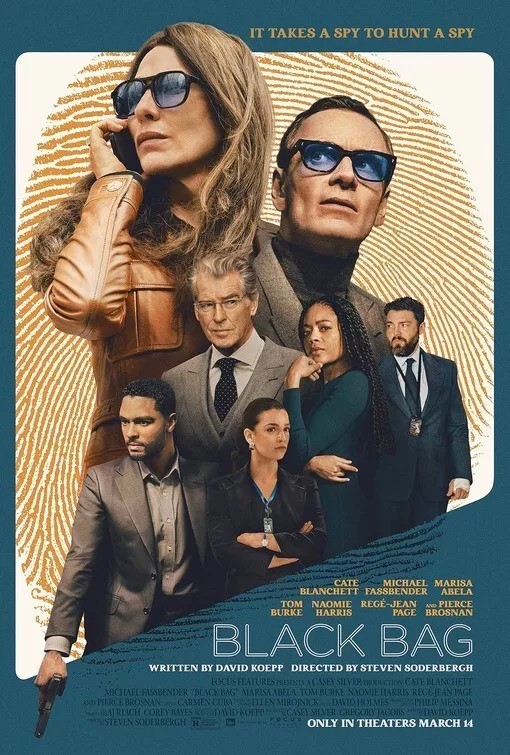
Black Bag (2025) *** – Seen at the Cinema

Explain to me how this cost anything like the reported $50 million. Unless the cost of a nightclub scene has gone through the roof. Or someone has slapped an almighty tariff on shooting in Zurich. Or such middling box office attractions as Cate Blanchett and Michael Fassbender, against the laws of marquee valuation, are pulling down salaries in the region of $10 million apiece.

Because this is nothing but a glorified chamber piece, most scenes shot indoors or in secluded locations. There’s no car chase, one minor explosion (drone-triggered), not even a pursuit on foot. Some clever marketing oik has dressed up what’s no more than a BBC TV film as an expensive espionage picture in the hope of hooking a larger audience.
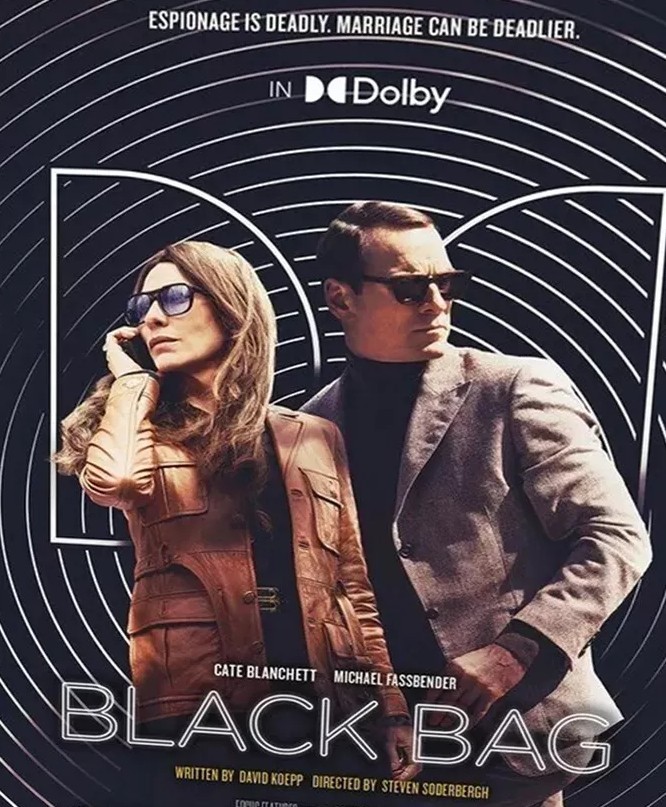
It’s short, little more than 90 minutes, so that’s on the plus side. But the plot’s full of holes, you’re scarcely going to swallow Fassbender and Blanchett, faces welded to stiff upper lip,  as a hot middle-aged couple, and I wouldn’t have been at all surprised to see  Hercule Poirot or more likely Miss Marple lurch into view for the grand finale with all the potential culprits being set to rights around a dinner table.

Fassbender is so impassive at the best of times his character hardly needs to be expanded to include some OCD, and the most expressive he becomes is, wait for it, hand shaking when he pours a glass of water. The theme, wait for it, is that people who lie for a living are not to be trusted in their domestic lives. And just to polish the virtue-signalling credentials there’s still running amok in MI5/MI6/Black Ops/CIA some rogue top dog who thinks he can stop the unnamed war – presumably Ukraine – by causing a nuclear power plant meltdown in Russia.

And when Pierce Brosnan steals the show in a small supporting role you know your movie’s in trouble.

That said, there’s enough going on to keep you entertained. Top British agent George (Michael Fassbender) begins to suspect – or does he really – that his wife, also a top British agent, Kathryn (Cate Blanchett), is up to no good. So he begins to investigate. Mirror is piled upon mirror, complicated by the occasional murder, so that we are soon knee-deep in the kind of narrative where you don’t know who trust – but, equally, unfortunately, don’t much care because none of the characters is remotely attractive.

At least one them, Freddie (Tom Burke), would have been considered a security risk. So  often does he stray he would be catnip for any passing honeytrap. But you might also have asked questions about his current squeeze, analyst Clarissa (Marisa Abela), paranoid as a posse of schizophrenics, who knows exactly how to pass a polygraph test (clenching the anal sphincter one of the tricks in case you’re interested), and as likely as not to ram a carving knife into unfaithful boyfriend Freddie’s hand at the dinner table. Naturally, it doesn’t do much harm, because Freddie is back at work next day with bandaged hand and not investigated by cops over a knife wound that could hardly be covered by the old slipping the shower routing.

Then we’ve got straitlaced psychiatrist Dr Zoe Vaughan (Naomie Harris) with a penchant for erotic fiction, sex in the office (including breaking the cardinal rule of her profession, sex with a patient), and stringing along two men at once, both of whom, Freddie and Col James Stokes (Rege-Jean Page), are engaged in other affairs.

George soon realizes he’s being played as a patsy, and that his investigation has compromised another operation, and facilitated the handover of a top secret document to the Russians.

In the current dearth of movies for the over-40s, make that over-30s not yet suffocating in superheroes and multiverses, this is what passes for entertainment aimed at an adult audience. And it is short, as I said, but this is exactly the kind of low-budget movie with a decent cast that traditionally ends up on a streamer.

For once, director Steven Soderbergh (Magic Mike’s Last Dance, 2023), whose career is littered with self-indulgence, sticks to the knitting, and it’s a more than passable espionage thriller, but the kind that would be more at home on the small screen. Written by David Koepp (Indiana Jones and the Dial of Destiny, 2023).

Neither Fassbender (Next Goal Wins, 2023) nor Blanchett (Tar, 2022) do the most basic task required of a marquee name, which is to set the screen alight, and all the rest, excepting the much-in-demand Pierce Brosnan (Black Adam, 2022) – seven pictures in the last two years –  merely trundle along in their wake, saddled with scenes where they express alarm at their deepest secrets being revealed like they have drifted in to some shopworn melodrama.

For all the actual investigation that takes place you could have set this in the kind of remote spot favored by Agatha Christie and played it out in traditional Poirot/Marple fashion.

Interesting but ultimately disappointing.

And the big question remains – where did the $50 million go? And, did it exist in the first place?

Tar (2022) *** – Seen at the Cinema

Editor wanted to stop self-indulgent director sabotaging his own work. Normally, this would be a producer’s job but there’s so many of them (I counted 14) in this co-production that I doubt any was at the wheel of the ship, trusting the director wouldn’t do something so guaranteed to alienate an audience as stick in four minutes (or more) of credits on a blank screen at the start. Credits that, virtue-signalling gone mad, list every Tom, Dick and Harry (and potentially their dog) who so much as pushed a pen for any of the production companies involved.

That won’t erode much of the mighty 158 minutes but it will make it appear several minutes shorter, assuming the audience bolts at the end. The cinema audience I saw it with wasn’t so courteous. Some were bolting long before the end. The sound of clacking chairs could be heard on a regular basis from halfway through the film.

You what!!! But this is an acclaimed picture, 92 Metascore on Imdb! Are we going to have start screening audiences now so that only people with the taste to sit to the end are allowed in?

To be honest, I shared their pain. Absolutely terrific Oscar-worthy performance by Cate Blanchett, pretty good work too from Nina Hoss as her long-suffering partner, but boy does it go on. And on. Was the director assuming the audience was too thick to get that the eponymous lead was a bit of a fitness freak without sticking that in endlessly? It’s not like it builds tension a la Vertigo with James Stewart’s apparently endless driving.

I enjoyed quite a lot of this even though at times it felt like one of those Classic Albums documentaries where those involved dissect their work, explaining how they married a riff here with a riff there, except given the composers are all dead the only creative force available is the conductor, otherwise those pesky musicians will just go off and do their own thing.

The problem is a lot of the dialog is “dead.” It doesn’t enhance our understanding of character, build character or (God forbid!) narrative or tension. One way or another it’s just intellectual discussion of classical music. Which is fascinating – but only for a time.

The story itself is told with subtlety in some places and with a sledgehammer in others. You couldn’t have telegraphed more an impending problem with an unseen musician than have Tar (Cate Blanchett) delete email correspondence. And the minute cellist Olga (Sophie Kauer) appears on the scene with her come-to-bed eyes, you know this is a femme fatale on the prowl, and expect speedy unfair promotion is on the cards at some point.

That power corrupts, whether in male or female hands, appears to the driving point of the rest of the story but you have to wait a good 90 minutes before that assumes any real significance, plus social media is presented here in its best guise as an instrument of truth.

It’s a rise and fall tale, although the climax doesn’t ring true, the director either dodging the true climactic scene, a confrontation with Tar over an enforced change in her professional status, or that didn’t take place and the first thing the conductor knows about what has occurred is when she’s about to take her place on stage. Neither decision makes much sense.  

So, onto the good parts. Blanchett puts in a riveting performance, not just in her sense of her own superiority, but in managing so effortlessly to make a conversation just sound like a conversation rather than a string of points making dramatic emphasis. She leaves most of the parenting of their child to partner Sharon (Nina Hoss) only stepping in when someone needs to put a bullying girl in her place. That this relationship is long past its best is obvious from the off, and that Tar has a wandering eye is plain once Olga appears.

And although Tar seems to have a fine grasp of orchestral politics and can drive a hard bargain with those seeking financial gain, she is blind to consequence, needlessly making enemies of long-standing supporters, failure to provide promised promotion triggering betrayal.

What the film does get right (I guess, since I’m no expert) is the role of the big-name music director/conductor in the classical world, ferried across continents in private planes, knowing how to bend the rules in a business where, it transpires, the orchestra wields a great deal of power, and with a genuine genius for imbuing listeners with her enthusiasm for music.  

Her interpretation of “Mahler’s Symphony No 5,” initially fascinating, soon lost its hold because I had no idea what she was up to (so I hold my hands up on that one) but you’d have to be intimately acquainted with the work to get so much out of it given the time spent exploring it. This isn’t about a composer of course and lacks Peter Shaffer’s instinct with Amadeus (“too many notes” and the scene where the ill  Mozart describes his music to his arch-enemy) so quite a lot of the music stuff went over my head, leaving me with no interest in large sections of the film.

Cut down to two hours plus, okay, those four minutes of credits back in their proper position at the end, and you would have a very satisfactory movie that explored the classical musical world while detailing the downfall of a female tyrant.

Director Todd Field (Little Children, 2006) carries the can on this one.

But I would also point out to him that if you’re appealing to an adult audience and a largely arthouse one at that you’re trying to target generations that have seen all the best stuff, that respond to unusual films that take them to new places dramatically or stylistically and will not stand to be bored rigid.

People slapping down £14 to see it in their local Odeon aren’t going to be as inclined to tell people to go see it than critics watching it for free. And anybody who thinks a streaming audience isn’t going to be reaching for the switch-off button during the marathon opening credits is asking for further financial misery.

Discover WordPress

A daily selection of the best content published on WordPress, collected for you by humans who love to read.

The Atavist Magazine

by Brian Hannan

WordPress.com News

The latest news on WordPress.com and the WordPress community.