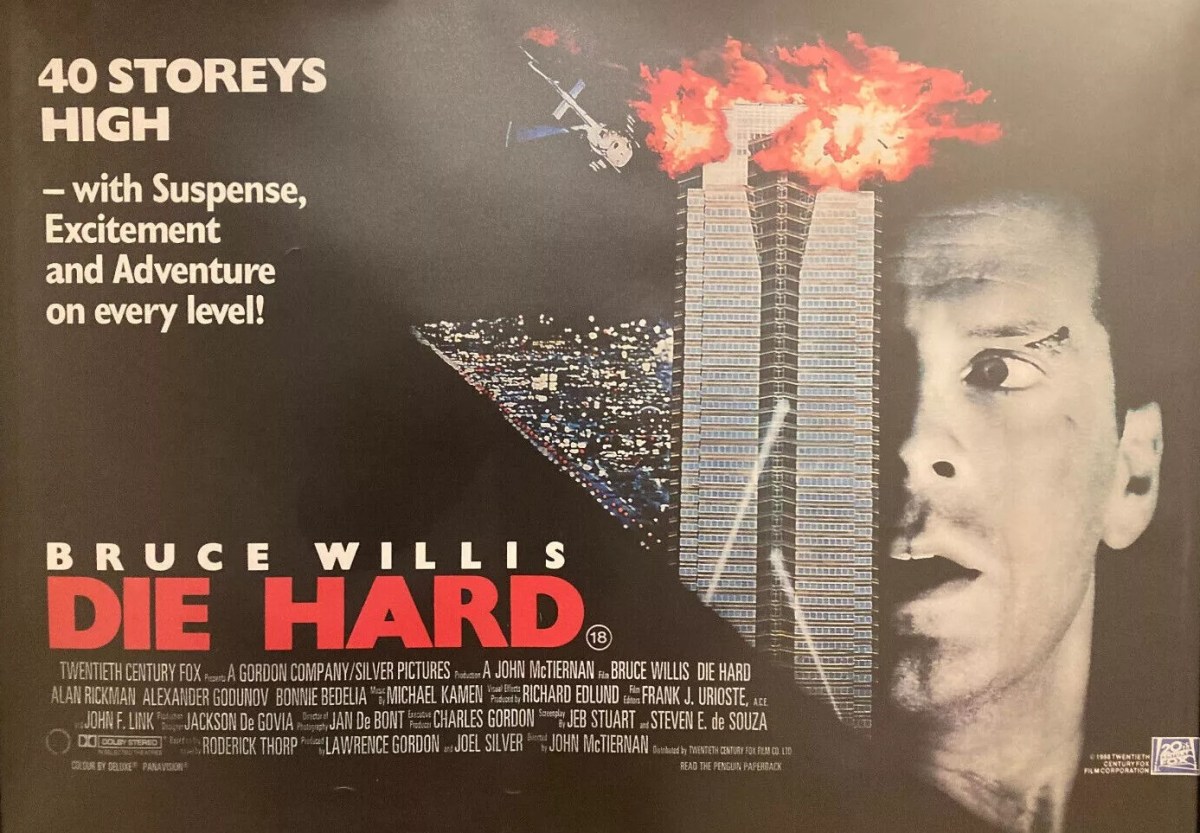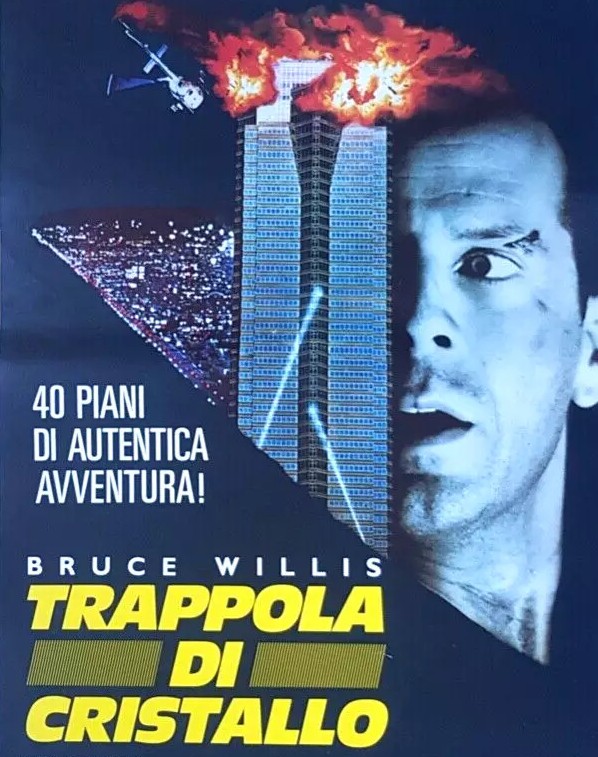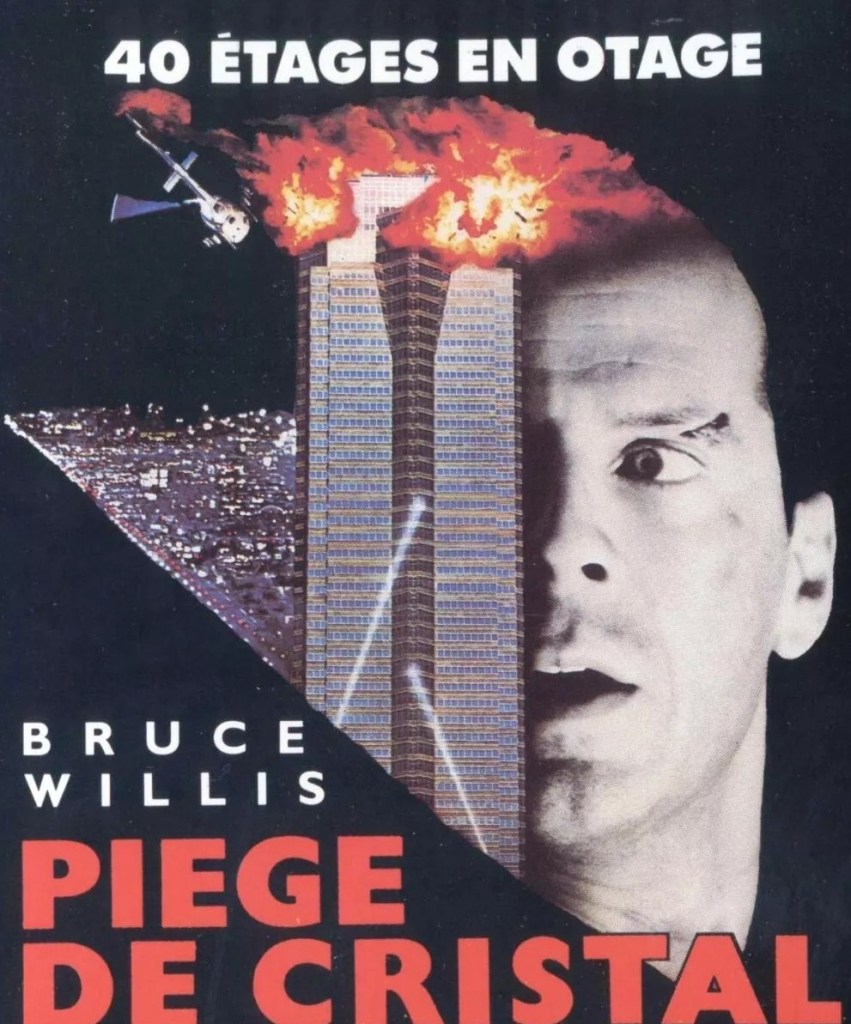
Die Hard (1988) ***** – Seen at the Cinema

Kiss goodbye to your suicidal small town banker helped by a passing angel who had dominated the Xmas reissue horizon for half a century. There’s a new Xmas sheriff in town and he doesn’t play by any merry rules. Some marketing whiz has hit upon the notion that an action picture with a pretty vague Xmas background would be a better bet for the contemporary audience than James Stewart in the snowbound It’s A Wonderful Life (1946) that owed a great deal of its popularity to the fact that it was out of copyright and could be played on extremely inexpensive terms – a better Xmas present a cinema owner could not expect.

This is one of these moves that cries out to be revisited on the big screen. I saw it on Monday this week and was astonished to find that it had attracted a full house. You forget how much of a revelation this was, a complete rethink of the action hero. Sure, it owed something to the muscular heroics of Sylvester Stallone and Arnold Schwarzenegger, but they always seemed like they were looking for trouble. Albeit that he’s a cop, Bruce Willis was a throwback to the kind of movie where a relatively innocent character gets caught up in mischief.

And it’s surprisingly contemporary in its attitude to romance, New York cop John McClane (Bruce Willis) left behind by careerist wife  Holly (Bonnie Bedelia), who reverted to her maiden name when she headed out to Los Angeles with the kids. He’s made the trip to try and stitch back their marriage, but only comes to terms with his failings as a careerist cop once he’s battered and bloodied in the Nakatomi tower where his wife and 30 other employees are being held hostage by heist merchant Hans Gruber (Alan Rickman), posing as a terrorist in order to steal 600 million bucks from one of the most secure vaults in the world.

This isn’t one of those robberies where we’re told in advance of the plans, instead as the strategy takes shape we can only marvel at Gruber’s brilliance and ruthlessness. He’s not, as would be the norm, trying to hijack cash on the quiet, but instead needs the “assistance” of the FBI to complete his program.

Bruce Willis had been struggling to establish a big screen persona that took him away from the smirking quip-slinger of Moonlighting (1985-1989). Blake Edwards romantic comedy Blind Date (1987)  and the same director’s Hollywood drama Sunset (1988) had signally failed to advance his marquee credentials. Donning a vest, losing his shoes, picking glass from his feet, blasting away at all and sundry, and using brains as much as  bullets to outwit the robbers, set him on a new career path.

Director John McTiernan was a rising star having helmed Predator (1987) but this was a different kind of actioner to the Schwarzenegger sci-fi malarkey. There’s nothing trim about the timing – it comes in a just under two-and-a-quarter hours – but that allows not just for a proper three-act set-up and several twists, but, more importantly, through a series of clever devices, permits the character to breathe. Through intermittent contact with street cop Sgt Powell (Reginald VelJohnson), we learn a good deal more about McClane and, critically, his change of heart about his marriage.

Unusually, for an action picture it’s riddled with interesting characters, not just bureaucratic nincompoops and FBI gunslingers fully conversant with acceptable collateral damage, but two kings of smugness, one a television reporter (William Atherton), the other a high-ranking executive who has his eye on Holly.

And that’s before we come to the villains. For Gruber, British actor Alan Rickman was drafted in from the stage, no movie credentials at all, and created a silky supervillain every bit as memorable as those who challenged James Bond. In fact, in other circumstances his sidekick, former ballet dancer Alexander Gudonov, should have stolen the show as he had threatened to in Witness (1985). Perhaps the most surprising casting was Bonnie Bedelia. She’d been a female lead or top billed (The Stranger, 1987) for more than a decade, and what she brings to the role is the quiet skill of not over-acting.

If you weren’t particularly interested in the well-drawn characters, you would be more than happy with the extensive action sequences which set new highs for the genre. This should have revived Frank Sinatra’s career since he had first dibs on the character, a sequel to The Detective (1968). And Clint Eastwood for a time had the rights. Screenplay by Jeb Stuart (The Fugitive, 1993) and Steven E. de Souza (48 Hrs, 1982) from the novel by Roderick Thorp.

But yippee-ki-yay, it sure made a star out of Willis.

Top notch.

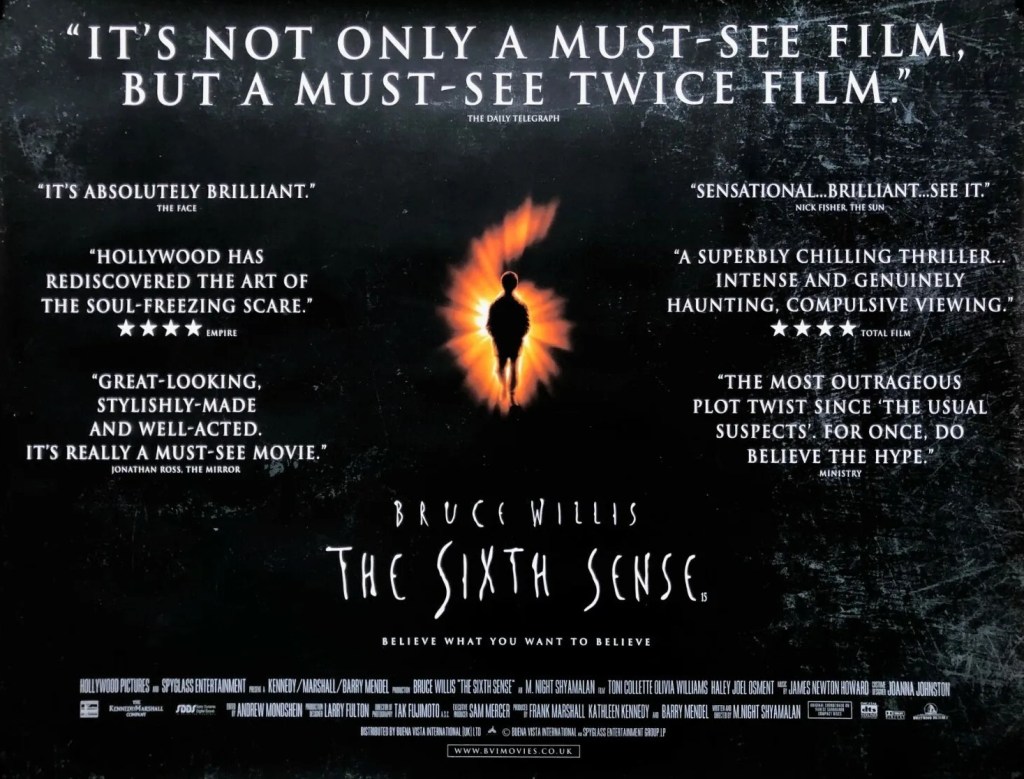
The Sixth Sense (1999) **** – Seen at the Cinema

If “I see dead people” isn’t one of the greatest lines ever written, I don’t know what is. Apart from anything else it highlights the screenwriting element of director M. Night Shyamalan’s talent. Had the little boy, in whatever haunted manner, simply said, “I see ghosts,” it wouldn’t at all have had the same impact. And reinventing this genre took a lot more than knitting together a few scary moments.

The horror genre had morphed into scaring the pants off women, their screams the soundtrack of the decade, and, of course, it was often the last sound they made as slicing-and-dicing became the norm and body counts multiplied. Nobody dies here. And the dead aren’t zombies either. Little Cole (Haley Joel Osment) almost acts as a psychiatrist, putting ghosts back together, listening to their woes, letting them come to terms with death. I won’t spoil the ending for you in case you haven’t seen it because when it first came out every audience member was urged not to reveal the ending.

What Shyamalan has done is give the ghost story narrative purpose, two characters who need each other, guilt-ridden psychiatrist Malcolm (Bruce Willis), marriage in trouble, suspecting wife Anna (Olivia Williams) of having an affair, finds himself getting unspoken guidance  from the kid he is meant to be giving advice to. Cole is bullied at school, treated as a freak, having to conceal his own torment from everyone, and teachers who should recognize signs of disturbance instead resort to punishment. Kids lock him in a cupboard and single mother Lynn (Toni Collette) is at her wit’s end.

The great screenwriters invent scenes nobody’s ever thought about before. Trying to elicit information from Cole, Malcolms plays a game. If he is correct in an assumption, the child takes one step forward. A few correct answers and he’ll be plonked down in a chair opposite the psychiatrist. But if the answers are wrong, Cole takes a step backward. It’s an incredibly clever conceit, exposition disguised as a game. By the end of it, Cole is back where he started, and the boy’s ostensible savior is revealed as a failure.

These are two tormented souls coming together and for the most part it plays almost with an arthouse sensibility to a kid growing up, making his way in the adult world, except as much as Cole is developing, so is Malcolm, his life foundering, walking around in permanent lament for a world that’s gone wrong, somehow slipped away from his grasp from a time he was physically adored and professionally acclaimed.

It’s the psychiatrist’s burden to occasionally fail. Sometimes the consequences are unendurable even if the client was beyond repair and Malcolm puts his current depression, forgetting his anniversary, for example, down to one terrible failure. Cole isn’t entirely defenceless. He can spot adult weakness, and feeling threatened, humiliates his teacher with  with vicious aggression that exposes a childhood disability that appears on the face of it successfully overcome but, in reality, still lurking.

Gradually, Cole grows in confidence, matures, is given the leading part in the school play, accepted, and Malcolm can take pride in his accomplishment. Shyamalan is too clever a screenwriter to have the child identify point blank the adult’s problems. The revelation is a moment of stunning self-clarity.

But I promised not to say any more.

Instead, I’ll talk about Shyamalan’s directorial skill, in particular his use of the fade, a little-used technical device from back in the day. Most directors simply employ the cut. Everything is connected, let’s move on, keep this narrative going. The fade is like the end of a chapter, time to turn a page, a sigh, every section allowed time to breathe, before we move on.

We might also credit Shyamalan with bringing out two superb performances from the leads. He wipes that trademark smirk off Bruce Willis’s face, finds ways of making the screen’s biggest tough guy come off as weak. Haley Joel Osment was a tad older than the character he plays, but still no more than ten, I guess, at the time of filming. To carry off such long speeches with such authenticity would be beyond most child actors, who usually come to the fore in some inconsequential froth, rather than a serious drama, was jaw-dropping. Amazing he didn’t win the Oscar or be given a special one. Because it’s a very special performance and without such singular acting the movie wouldn’t have worked at all.

Shyamalan’s been around longer than Christopher Nolan but with none of the comparable accolade. Apart from an occasional foray into sci-fi, he’s stuck, like Hitchcock, to the thriller genre. He followed The Sixth Sense with, in my opinion, his masterpiece, Unbreakable (2000) and had another big hit with Signs (2002) but thereafter his box office wavered and though consistently churning out a movie every two years ended up at the lower-budget end of Hollywood. His new one Trap, due out later this month, is distributed by a major studio, Warner Bros, so if it succeeds, and it’s getting great buzz, he might be welcomed back into the fold.

I was able to see The Sixth Sense on the big screen again not because someone was attributing retrospective glory to Shyamalan but because a marketing whiz has come up with the great publicity wheeze of tying up a package of pictures from the same year by different studios and chucking them out under the anniversary aegis (25th in case you can’t do the maths) so tapping into nostalgia. As with the current reissue formula, these pictures are restricted to one showing on one day and to my surprise when I saw this, I would reckon the theater was three-quarters full and as much with youngsters as older people.

So while you’ve already missed it on the big screen, I’m sure it’s available on DVD or streaming.

Don’t miss it.  

Behind the Scenes: Sean Connery, Robert De Niro, Kings of the Flop

Big names were rarely immune to box office upset. Top stars like Sean Connery, Robert Redford, Jack Nicholson, Meryl Streep, Al Pacino and Sylvester Stallone had their fair share of clinkers while the careers of the likes of the much-touted Mickey Rourke fizzled out in the face of audience indifference. Of course, it was the supposed marquee pull of big stars that got them attached to sometimes dodgy projects in the first place, the idea that their presence would be sufficient to generate box office heat.

You’ll probably be surprised to discover that Highlander (1986) – especially given its cult status and the various sequels – was an out-and-out flop in the U.S., rentals of just $2.8 million on a budget of $17 million. But that was a comparative hit compared to other Connery items, Fred Zinnemann’s Five Days One Summer (1982) with only $100,000 in the kitty on a $15 million budget. The Red Tent (1969) was covered in so much red ink it could have qualified as a horror picture, a return of $900,000 on a $10 million cost. Martin Ritt’s mining saga The Molly Maguires (1968) dug out only $1.1 million, around 10 per cent of its budget. Comparatively speaking, Meteor (1979) was a success, $6 million taken in on a $20 million budget.

Connery wasn’t the only big name cashing in on the disaster picture only to encounter disaster at the box office. Income from When Time Ran Out (1980), another in the $20-million range, barely covered Paul Newman’s fee. Other than a big fat check who knows what Jack Nicholson saw in an octet of calamities. The Border (1982) generated just $4.6 million rentals from a $22 million investment, the joke was on Martin Scorsese for King of Comedy with $1.2 million from $19 million, and even the $30 million Midnight Run (1988) failed to cross the line with just $18 million. Prayers and good reviews couldn’t save The Mission (1986) its $8.3 million take barely one-third of its cost, Angel Heart (1987) took about the same level of hit, $6.5 million from an $18 million expenditure.

A dream teaming with Oscar fave Meryl Streep proved a nightmare, not once but twice, Ironweed (1987) smoking out $3.5 million from $27 million, Falling in Love (1984) marginally better with $5.8 million out of $14 million, but all hope dashed on Once Upon a Time in America (1984), $2.5 million retrieved from $30 million spent. Streep on her own, and even with a dark wig, could do little to save A Cry in the Dark (1988) from picking up a paltry $2.5 million from a $15 million undertaking.

When you realize Angel Heart was one of Mickey Rourke’s better performers you can guess at the scale of his problem. The heavily-touted 9½ Weeks (1986) went straight down the plughole, recovering a distant $2.5 million from hot $17 million. Crime didn’t pay either, Michael Cimino’s Year of the Dragon (1985) flamed out at $7.3 million, less than one-third of cost.

Few were exempt. Richard Gere might as well have worn a crown of thorns in King David (1985) – $2.5 million return on $22 million forked out. And he was impotent to revive Sidney Lumet’s Power (1986), $1.7 million from a $14 million handout. Al Pacino served up $200,000 for Revolution (1985), a $28 million turkey. Burt Reynolds was stuck on $3.4 million for his directorial debut the $22 million Stick (1985). Steve Martin billed just $2.3 million for Lonely Guy, a $14 million no-hoper.

Even Clint Eastwood could not always work his box office magic, The Dead Pool (1988), his fifth iteration on Dirty Harry, coming up $1 million shy of its $20 million budget. Bruce Willis in Sunset (1988) lost $17 million. Sylvester Stallone was down $30 million for Rambo III (1988) and $16.7 million for Over the Top (1987).

Michael Keaton in The Squeeze (1987) lost $21 million, Sidney Poitier and River Phoenix in Little Nikita (1988) lost $14.3 million, The Adventures of Baron Munchausen (1988) lost a colossal $48 million hit, Heaven’s Gate (1980) $34.5 million, Honky Tonk Freeway (1981) $23.5 million, Bette Midler in the appropriately-named Jinxed (1982) $13.1 million. The Big Town (1987) starring Matt Dillon lost virtually all its $17 million budget, as much as prehistoric drama Clan of the Cave Bear (1986). Sheena (1984) roped a $23.1 million loss, Supergirl (1984) $24 million, the original Dune (1984) $25.4 million

Francis Coppola will be hoping his forthcoming self-financed $120 million Megalopolis doesn’t go the way of The Cotton Club (1984) – $12.9 million in rentals from $51 million – or One from the Heart (1981) – $400,000 back out of $26 million.

Of course, the best stars have longevity, a bad run doesn’t always spell the end. Connery bounced back big style with The Untouchables, The Hunt for Red October, Indiana Jones, Rising Sun and The Rock. Stallone went back to basics and drew on more Rocky and Rambo and flexed his muscles with The Expendables franchise.

SOURCE: “Film Costs vs Rentals,” Variety, February 21, 1990.

Discover WordPress

A daily selection of the best content published on WordPress, collected for you by humans who love to read.

The Atavist Magazine

by Brian Hannan

WordPress.com News

The latest news on WordPress.com and the WordPress community.