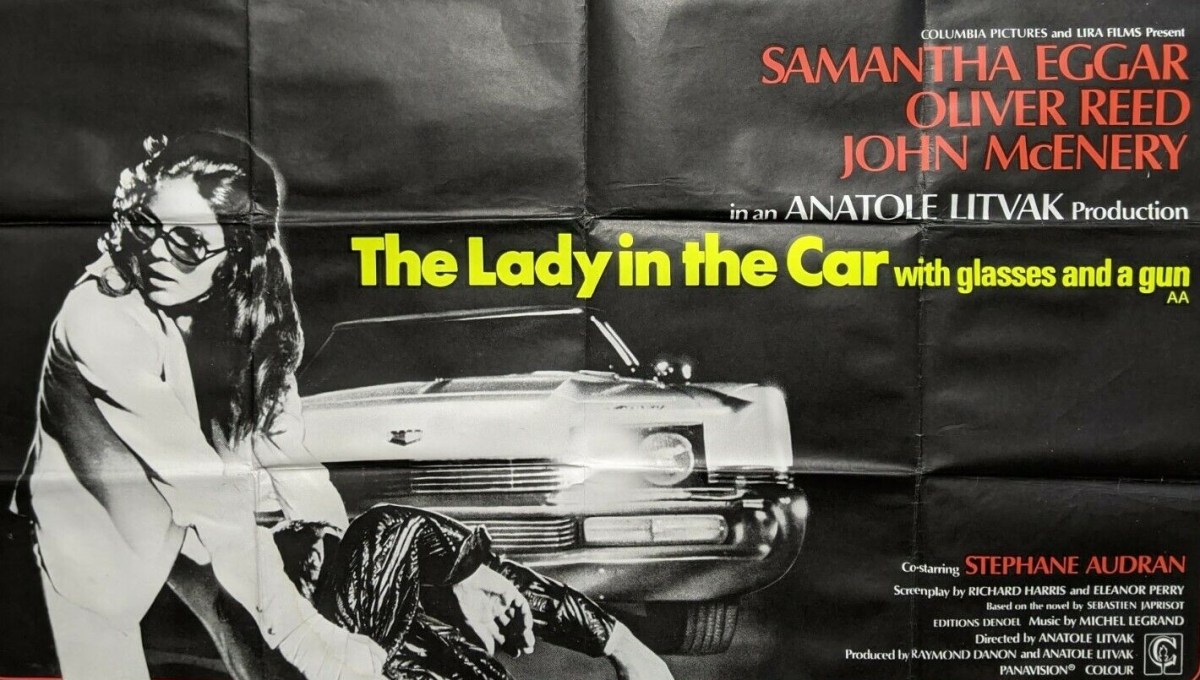
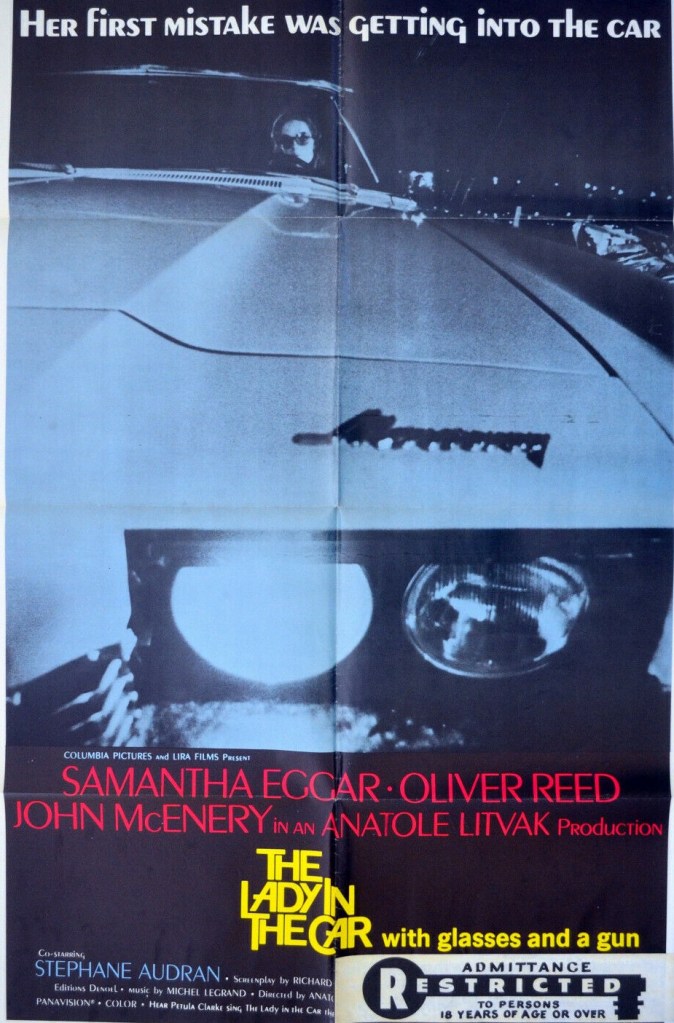
The Lady in the Car with Glasses and a Gun (1970) ***

Samantha Eggar (The Collector, 1965) in her first top-billed role and an adapatation of a novel by French cult item Sebastian Japrisot (Adieu L’Ami/Farewell Friend, 1968). You couldn’t get a better mix.

Fashion photographer Danielle (Samantha Eggar) sets off on road trip from Paris to the south of France only to discover everywhere she goes a doppelganger has been there first. She’s on edge anyway because she’s “borrowed” the car of employer Michael (Oliver Reed) and once police start recognizing her she gets jumpier still. The discovery of a body in the boot and the titular gun (a Winchester rifle) don’t help her frame of mind. But instead of reporting the corpse to the police – she’s a car thief after all – she tries to work it out herself. Amnesia maybe, madness because she keeps having flashes of memory – a spooky surgical procedure – or something worse?

She’s got a battered hand she doesn’t know how. Michael’s wife Anita (Stephane Audran) says she’s not seen Danielle in a month though she is convinced she stayed with the couple the previous night. A drifter Philippe (John McEnery) starts helping her out. Eventually she ends up in Marseilles none the wiser.
It’s a tricksy film and like Mirage (1965), recently reviewed, being limited to her point of view means the audience can only work out everything from her perspective. The string of clues sometimes lead back to the original mystery, other times appear to provide a possible solution. The explanation comes in something of a rush at the end.

Despite being the first top-billed role for Samantha Eggar (Walk Don’t Run. 1966), she would not scale that particular credit mountain again until The Demonoid (1981) but she is good in the role of a mixed-up woman struggling with identity. But since it’s based on a novel by Sebastian Japrisot (The Sleeping Car Murder, 1965) there’s a sneaky feeling a French actress might have been a better fit. Oliver Reed (Women in Love, 1969) is not quite what he seems, a difficult part sometimes to pull off, but he succeeds admirably.
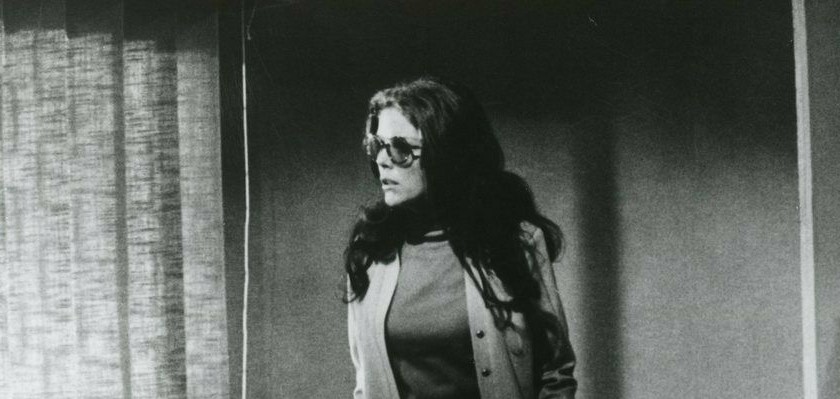
Stephane Audran (Les Biches, 1969), jealous of Danielle, a friend whom she views as a rival for her husband’s affections, has the most intense part, using Danielle as an unwitting cover for betraying Michael. John McEnery (Romeo and Juliet, 1968) could almost be a London spiv, blonde hair, impecunious, clearly using women wherever he goes. Watch out for French stalwarts Marcel Bozzuffi (The French Connection, 1971) and Bernard Fresson (The French Connection II, 1975).

There’s certainly a film noir groove to the whole piece, the innocent caught up in a shifting world, and that’s hardly surprising since director Anatole Litvak began his career with dark pictures like Sorry, Wrong Number (1948) while previous effort Night of the Generals (1967)  also involved murder. Litvak and Japrisot collaborated on the screenplay.

I expected a project laced with more atmosphere and a host of original characters. In truth, this is less atmospheric than the other two Japrisot adapatations , the interplay between the characters not so tightly woven, nor the climax so well-spun but it was enjoyable enough.

There was a remake in 2025 starring Freya Mayor (The Emperor of Paris, 2018).
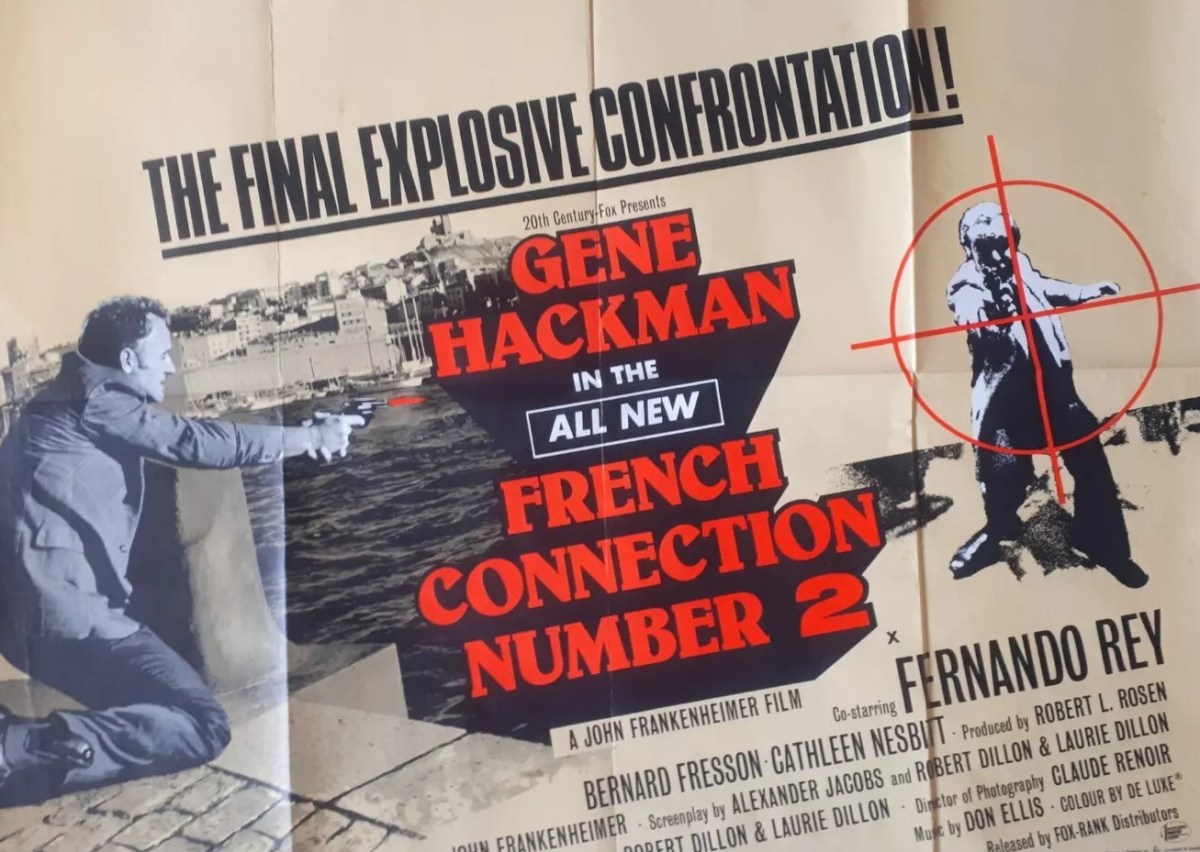
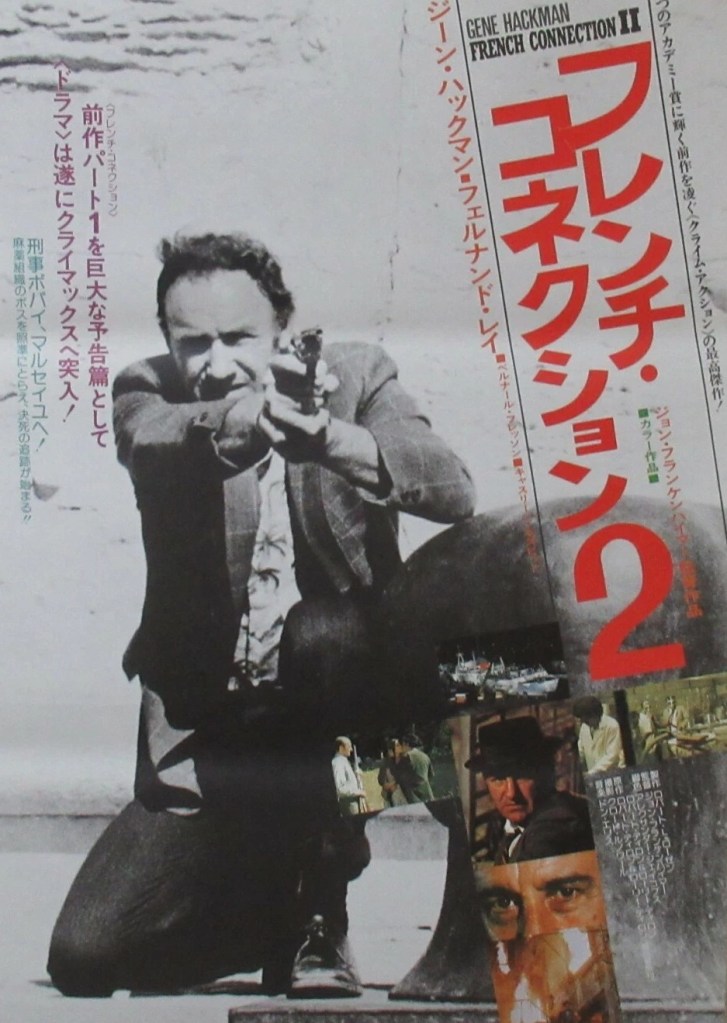
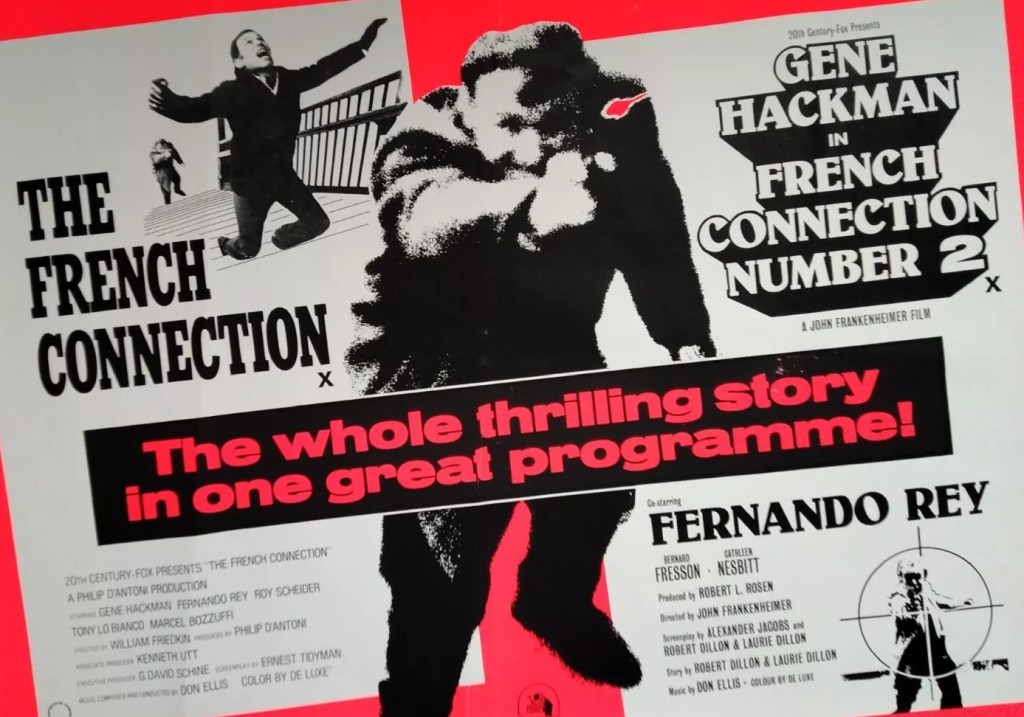
The French Connection 2 (1975) ***

Back to Marseilles four decades on from Borsalino (1970) and a preposterous plot that virtually sinks this fictional sequel to the factual original. For a start, French drugs kingpin Alain Charnier (Fernando Rey) has a very distinctive face, and it could hardly been beyond a cop, accustomed to issuing identikits, to provide the French police and Interpol for that matter with a mugshot, thus eliminating the contention that New York cop Popeye Doyle (Gene Hackman) is the only one who can identify him.

Throw in the fact that, unlike other U.S. exports like Jason Bourne who is fluent in several languages, Doyle is instantly at a disadvantage because, blow me down, the ordinary French citizen doesn’t speak English, ensuring that the cop comes across as one of these witless foreigners who thinks shouting louder in English makes him any more intelligible. And his sole method of detection is to simply wander the streets of a city with a population of 1.3 million hoping to catch sight of his quarry.

Doyle, being a natural rule-buster, soon causes the death of a local cop to add to the five people he’s killed (including two cops) in his home country. The bull-in-a-china-shop is so ham-fisted that it’s embarrassing rather than comedic. And the get-out-of-jail-free card is just as preposterous. Turns out Popeye is bait – this was a trope of 1960s low-budget crime or espionage movies though usually a woman was either the willing or unknowing lure – sent to Marseilles by his own bosses, in the hope that his presence will lure Charnier out of hiding, when, in fact, the Frenchman hides in very plain sight, on his very fancy yacht or dining in very fancy restaurants.

You’d have thought it would be an incredibly simple matter to feed the Charnier’s face into the police system and come up with a match which would then just involve either breaking down doors or taking the more discreet approach of catching him in the act.

What saves this, and only just, is Gene Hackman’s performance, not as the aforementioned bull, but as a junkie going cold turkey. And that in itself is reduced to only a handful of outstanding scenes, when his opposite number Barthelemy (Bernard Fresson) has to listen to his meanderings about baseball and his childhood. The action finale, the equivalent of a dam burst, where the two cops are flooded in a dry dock is good too. But, devoid of the racing automobiles, the climax drags, as Doyle sets up a later action trope of the endless footslog (which Liam Neeson probably thought he had trademarked). This doesn’t even involve any leaping or running across rooftops just a canter along busy streets, down alleys and then along the marina hoping to catch Charnier before he escapes by yacht.

It’s slim on atmosphere, too. Where the original had a down’n’dirty lived-in feel, this comes over as a tourist version of Marseilles if a tourist fancied a stroll down some mean streets. There’s a really dumb scene where Popeye, hoping to scare out the crooks in the hotel where he was imprisoned, sets fire to the place. But he goes upstairs with a jerrycan of petrol, rather than starting at the top and working is way down, no guarantee that when he reaches the roof there’s going to be any avenue of escape left open to him.

Sure, a sequel was always going to be in the works after the success of the original. But why not concentrate on the obvious follow-up, how a cache of heroin with a street value of $32 million seized by Popeye and Co managed to vanish from a police property office.   

Director John Frankenheimer (The Gypsy Moths, 1969, also featuring Hackman) hadn’t had a hit in a decade. This didn’t match the original at the box office. Written by Alexander Jacobs (Point Blank, 1967) and Robert Dillon (Bikini Beach, 1964) and Laurie Dillon, their only screen work.

Disappointing.

Discover WordPress

A daily selection of the best content published on WordPress, collected for you by humans who love to read.

The Atavist Magazine

by Brian Hannan

WordPress.com News

The latest news on WordPress.com and the WordPress community.