One Battle after Another (2025) **

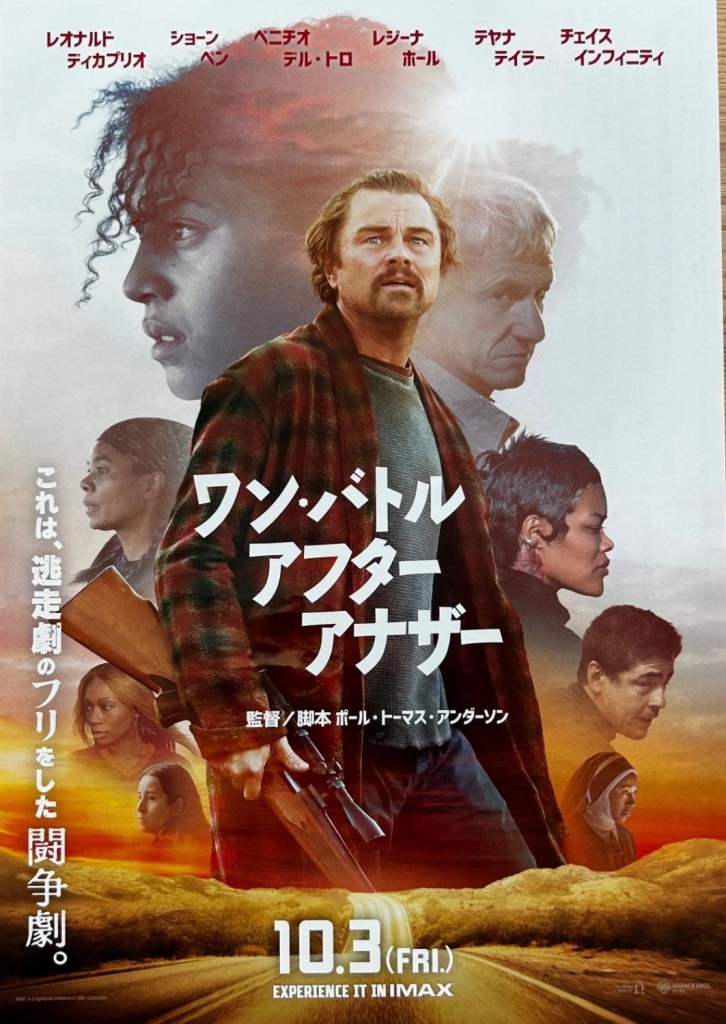
Sorry to be a party-pooper but I didn’t take to this critically-acclaimed shaggy dog story heavy on the satire. It’s partly redeemed by the performances – Sean Penn, in particular – but there’s not much to say that hasn’t already been said, and far more succinctly, about immigration and the rising right-wing influence in America. I’m sure Leonardo DiCaprio’s $20-$30 million standard remuneration fee might account for a good chunk of the $130 million budget but unless rates for extras have soared I can’t see where the rest of the money has gone.

Perhaps Warner Bros, having lost out on cult box office hotshot Christopher Oppenheimer, was hoping to replace him with Paul Thomas Anderson, who while generally a critical darling, has none of Oppenheimer’s box office clout. Though let’s not forget Anderson’s highly rated by his peers, otherwise how to explain his three Oscar nominations for direction and four for writing. He should be a good fit for the wild unwieldy sprawling works of Thomas Pynchon, another cult darling, and his previous effort Inherent Vice (2014) made a reasonable stab at capturing, albeit on a smaller scale, the author’s idiosyncrasy, though the writer as often took the blunderbuss approach to his subject.

The only element of directorial bravura that I detected here was the Cinerama effect of mounting and falling down hills in the car chase.

The tale is just lame. Revolutionaries grow old or turn snitch to save their skin. White old guys belong to some secret racist organisation going by the name of the Santa Claus Club or some such. Black gals get to kill people and rattle off machine guns. The nuns, as you might guess, are  another secret organisation. The main element of the narrative appears to be whether racist Col Slackjaw – I mean Lockjaw (Sean Penn) – but I mean, who cares, when you give the bad guy such an improbable name you’re stating from the outset that he’s a joke and not the threat he’s meant to be

Anyway, improbable as it sounds, the avowed racist has a thing for dominant Black women – check out his erection at first sight of gun-toting Perfidia (Teyana Taylor) and his predilection for being anally probed by her. She’s sometime revolutionary, sometime aforementioned snitch, sometime boyfriend of revolutionary-cum-hophead Bob (Leonardo DiCaprio), and definitely not maternal material given she walks out on new-born Deandra (Regina Hall) leaving the hophead to bring her up.
The Santa Claus Club gets wind of the fact that Lockjaw might not be as racist as he pretends so that sets it at odds with its very own top racist as he embarks on a scorched-earth quest to find out if he should have a paternal bone in his body.

All sorts of chases ensue, mostly revolving around one-dimensional characters though Benicio del Toro makes a fair stab at humanizing his revolutionary.

It just went on and on, like a latter-day Anora (2023), making same point over and over again, albeit that presumably it is aimed at the intelligent section of the cinematic audience who shouldn’t need to be battered over the head with the message. This is the kind of picture which complains about the treatment of people by the Santa Claus Club but then expects audiences to burst into a round of applause when the club meets out punishment to one of its own.

File under major disappointment.

Leonardo DiCaprio (Killers of the Flower Moon, 2023) is good, but there’s not much for him to get his teeth into, we’ve seen this deadbeat character so many times before, even ones that form emotional ties with their children.

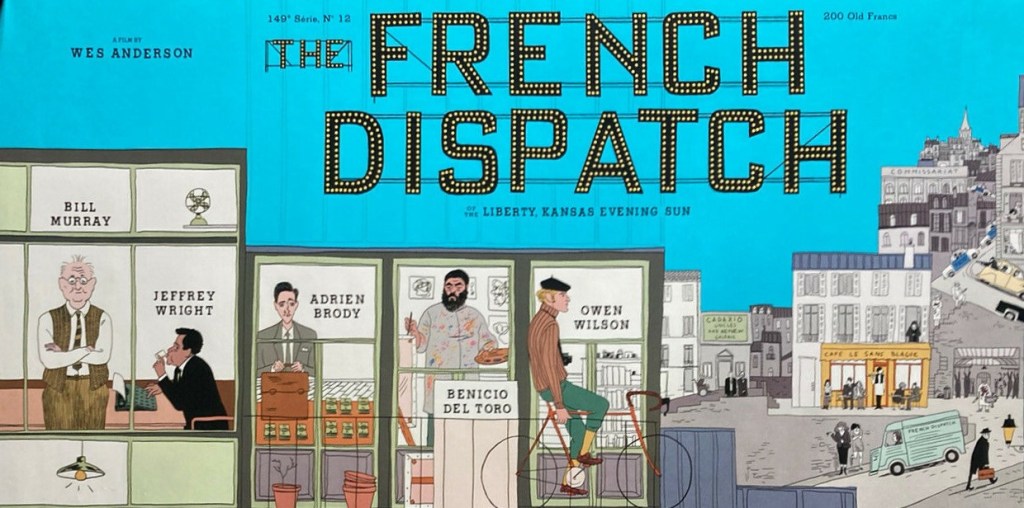
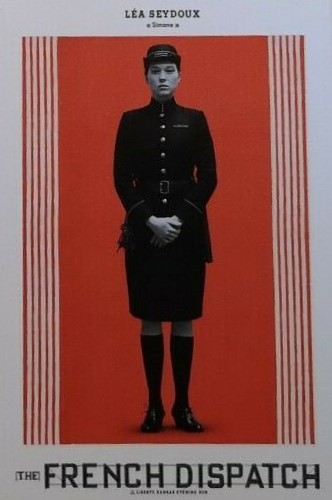
The French Dispatch (2021) **** – Seen at the Cinema

It can only be ironical that Wes Anderson’s wonderfully idiosyncratic, evocative, often hilarious, picture – featuring ex-pats writing for an American magazine in the style of the New Yorker – is located in the French town of Ennui (translation: “boredom”) because it is anything but, a continuous stream of imaginative and inventive scenes, settings and characters. Where other directors make aspects of history their own (Ridley Scott, David Lean) and others lay claim to greatness by inverting genres (Quentin Tarantino), Anderson’s genius lies in creating worlds nobody else could lay claim to. Although this particular film covers just a triptych of tales, you can easily imagine Anderson has another hundred or so stories at his fingertips, all contained in his own unique universe.

You can see why actors queue up to work with him for he allows them to develop highly-individual characters far removed from their denoted screen personas.  Some like Timothy Chamalet, Benicio del Toro, Jeffrey Wright and Lea Seydoux take advantage of this freedom to conjure deliciously realised human beings, while others such as Owen Wilson and Tilda Swinton let the opportunity slip or appear  in the picture so briefly (Elisabeth Moss, Henry Winkler, Bob Balaban) as to make little impact. Even headliner Bill Murray, who bookends the show, is given to more inventiveness than usual, breaking up his usual deadpan  delivery to make an occasional emphatic point.

While mostly this zips along, when Anderson occasionally stops for breath the effect is electric, for example a static camera taking in the back of a tenement through which we see by virtue of various windows a waitperson’s exhausted ascent. Mostly, the tales follow their own internal logic, but when forced into a genre corner, such as a shoot-out, Anderson resorts to pure zest. And while the narrative is mostly driven by voice-over, this takes on different aspects, from a loquacious raconteur (Jeffrey Wright) to a droning lecturer (Tilda Swinton).

Clearly planning to keep one step ahead of critics who claim his movies run out of steam, Anderson heads off that issue by filming three short unconnected stories. Del Toro and Seydoux head up the best item which sees a psychotic murderer embark on an artistic career that hooks art dealer (Adrien Brody).  Those who expect Anderson to spring surprises might still be taken aback when it transpires that the nude model (Seydoux) of the prisoner (Del Toro) is in fact his gaoler. Having opened a box of twists, Anderson continues in this wild vein. Narrators attempting to impose a semblance of normality generally find themselves at odds with their subject matter. In the second tale, as off-beat a student revolutionary as you could find, Chamalet breathes as much life into the character as he appeared stultified in trying to create a real person in the misfiring Dune (2021). Crime is not usually best served best by asides and droll self-importance but Wright, in the final story, manages to tie up in knots what should a taut kidnapping tale.   

If you come looking for star turns by Bill Murray and Oscar-winner Frances McDormand, you will be sorely disappointed but if you willing to settle for an energetic, fresh, nostalgic take on an imaginary France, with plenty laugh out loud moments, you should come away well satisfied. Of course whether the French will feel as insulted as by television show Emily in Paris remains to be seen but I’m sure the Hungarians did not take The Grand Budapest Hotel (2014) too literally.

I notice that this received a platform release in the States and broke per-cinema box office records in the process and I wonder what might have been the fate of The Last Duel (2021), regardless of its budget, had it opted for a similar launch approach.

Discover WordPress

A daily selection of the best content published on WordPress, collected for you by humans who love to read.

The Atavist Magazine

by Brian Hannan

WordPress.com News

The latest news on WordPress.com and the WordPress community.