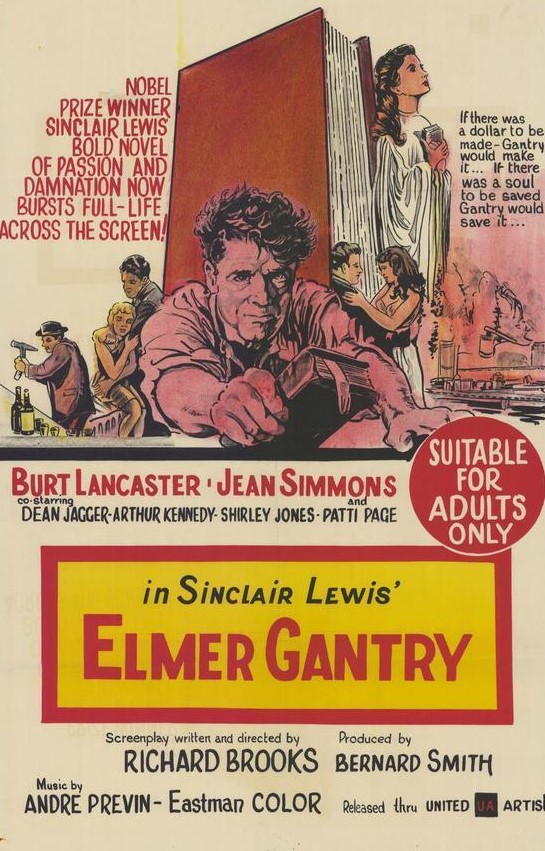
The one element that every movie requires – advance publicity – was denied Elmer Gantry. Shooting took place on a closed set with all visitors carefully screened. Only six actors were given access to a complete screenplay while a general synopsis was denied distributors and cinema owners.
Over 30 years after publication of the source novel by Sinclair Lewis, its contents were considered so volatile and contentious that, rather than be pre-judged by the industry on expectations of what the movie may contain, director Richard Brooks took to issuing baffling statements such as describing Elmer Gantry as “The All-American Boy.”

Even the 12-page A3 Pressbook/Campaign Book, the prime source of marketing contact between studio and theater owner, was niggardly in the extreme. Narrative detail was limited to “the story of a spellbinding evangelist” rather anything approaching a synopsis.
Stuck with how to woo an audience in advance, United Artists fell back on a teaser campaign comprising six separate ads. The sequence was as follows: “Elmer Gantry Is Coming!” / “Sinners! Elmer Gantry Is Coming!” / “Sinners! Elmer Gantry Is Coming! starring Burt Lancaster”/ “Sinners! Elmer Gantry Is Coming! Starring Jean Simmons” / “Sinners! Elmer Gantry Is Coming! starring Burt Lancaster and Jean Simmons”. The last advert was coupled with a quote from the New York Times with the final salvo the same ad repeated but with a different quote from the New York Post.
The New York campaign – in those days a movie might take a few months to spread out from initial opening locale to other cities allowing promotional ideas that worked in one area to be publicized – relied on the first two teasers. But they went out in saturation – in railroad stations, subways, buses and race tracks with additional displays on poles, stilts and drums.
The major print advertising onslaught was led by two bold large-sized adverts intended to run facing each other on the same page. “Bless Him! Tens of thousands of believers shouted his praises!” was accompanied by the iconic illustration, Bible in hand, of Burt Lancaster. “Damn Him! Three women damned his soul” showed Lancaster grappling with Jean Simmons with Shirley Jones and Patti Paige in the background in more revealing clothing. But these two elements could also be fitted into the one ad, as shown above.
There were nearly a dozen full-size advertisements with a range of taglines. In all Lancaster is shown in the same pose with the Bible while Simmons is presented clutching a Bible and gazing heavenward. Shirley Jones appears in even skimpier outfits.
As was standard at the time, taglines could stand on their own or mix and match. Snippets for other ads were edited from this main ad: “Nobel Prize Winner Sinclair Lewis’ Bold Novel Of Passion And Damnation Bursts Full-Life Across The Screen! If there was a dollar to be made – Gantry would make it…If there was a soul to save -Gantry would save it…”
“Sinner! Elmer Gantry Wants You!” ran another ad backed up by “Are you ready, sinner? He wants you to know all about heaven…but not about his whiskey and his women!” Other adverts were fashioned from taglines like: “You’re all sinners…you’ll all burn in Hell! Tell ‘em Gantry…save ‘em from sin…lead ‘em to salvation…tell ‘em about everything…but not about your whiskey and your women!” Or included: “From the book that shook a nation with its sledgehammer theme…from a Nobel Prize-winning author…comes the raging story of a man who used the Holy Bible and broke every rule in it!”
Rarely have so many exclamation marks been employed in so short a space, but equally, rarely has a marketing team encapsulated so vividly a movie with a difficult subject matter, all tease and no substance.
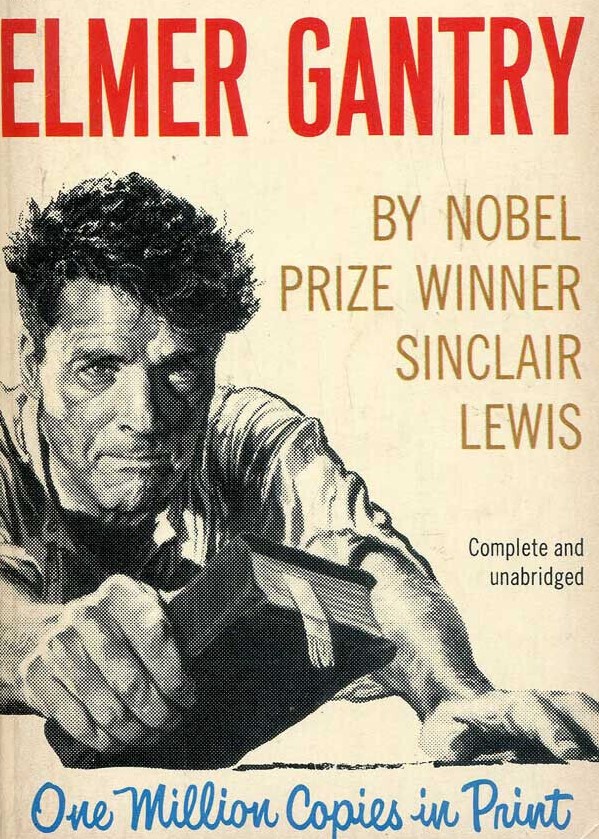
Out-with the usual marketing routes, the marketing team were able to take advantage of various ancillary promotional opportunities. Dell organized a massive paperback book tie-in in thousands of bookstores and newsstands, Burt Lancaster dominating the front cover with Simmons and Jones pictured on the back. Music retailers also played their part, United Artists Records launching the Andre Previn soundtrack album while Mercury released an album of revival tuness sung by Patti Paige, who made her movie debut in the film. With record sales exceeding 35 million, Paige’s host of fan clubs were a natural target for contact and if there was none in the local vicinity cinema managers were encouraged to start one by the simple device of setting up “a giant postcard in the lobby” and inviting fans to attach their signatures.
Department stores were called upon to run 1920s Fashion Shows.
Anniversaries, so important today, helped out. It was 30 years since Sinclair Lewis was awarded the Nobel Prize, the first American author so recognized, and 1960 was the 75th anniversary of his birth. But the promoters also played upon the book’s initial controversy, hoping to re-ignite the debate as a promotional tool.
With the bulk of the Pressbook given over to advertising and promotional ideas, barely little more than a single page was devoted to the stars, but even then there was little of the usual soft-focus puff pieces. The kind of journalistic nuggets that might help an editor fill a vacant space were limited. All we learned of Burt Lancaster, who had worked with Richard Brooks before on Brute Force (1947), was that – as if this was a mark of respect – he agreed to read the screenplay twice. Of Jean Simmons it was pointed out she had played an evangelist in Guys and Dolls (1955) but the Pressbook erroneously states that she played a nun in Black Narcissus (1947); in fact, she was a beggar girl. Arthur Kennedy is mentioned in relation to his Oscar nominations.
Shirley Jones was the most likely to attract column inches as a result of explaining how she made the transition from more demure roles in Oklahoma (1955) and April Love (1957). “It feels just fine – now,” she told the Pressbook interviewer. “At first, well, I really don’t wear much except what you see. A slip, these shoes with the green frills, and slinky black silk wrap-around that’s transparent.
“Usually, I walk into a movie set wearing my bustle and petticoats and some of the boys turn round as I go by and say, ‘Hiya, Shirl.’ But when I walked in dressed like this the fellows all just turned round and didn’t say anything. They never turned round like that before. Well, not really. It did take some getting used to after provoking the big brother reactions for so long.
“But I guess every girl dreams of being a conversation stopper some day. This is my chance. Of course, I am embarrassed sometimes…or maybe it’s inhibited.”
Brooks rewrote the script eight times before “he felt he had captured the essence” of Gantry. Most of the scenes were filmed on sound stages or adapted from an assortment of 1920s vintage streets from the backlots of other studios. The tabernacle was constructed out of an ice skating rink on a beach pier in Santa Monica.
Art director Edward Carerre spent $6,500 erecting and furnishing a genuine evangelist tent rented from Canvas Specialty. It was slightly trimmed to fit onto two combined sound stages on the Columbia lot. A total of 400 benches each measuring eight- or ten-feet were constructed by studio carpenters to provide seating for 1,000 – the tent accommodated another 2,000 standing. The stage required 500lb of imported sawdust and banners 30ft long were specially made to incorporate Biblical quotations. Where most movies required a maximum of 15-20 sets, Elmer Gantry boasted 62.
The climactic scene, conflagration in a tent, took five days to film. Soaking the set in kerosene would not supply the instant flash of flame the director demanded. So, instead, he turned to old film footage, including some frames from It Happened One Night (1934). “We’re burning film to make film,” quipped Brooks.
 The Magnificent 60s