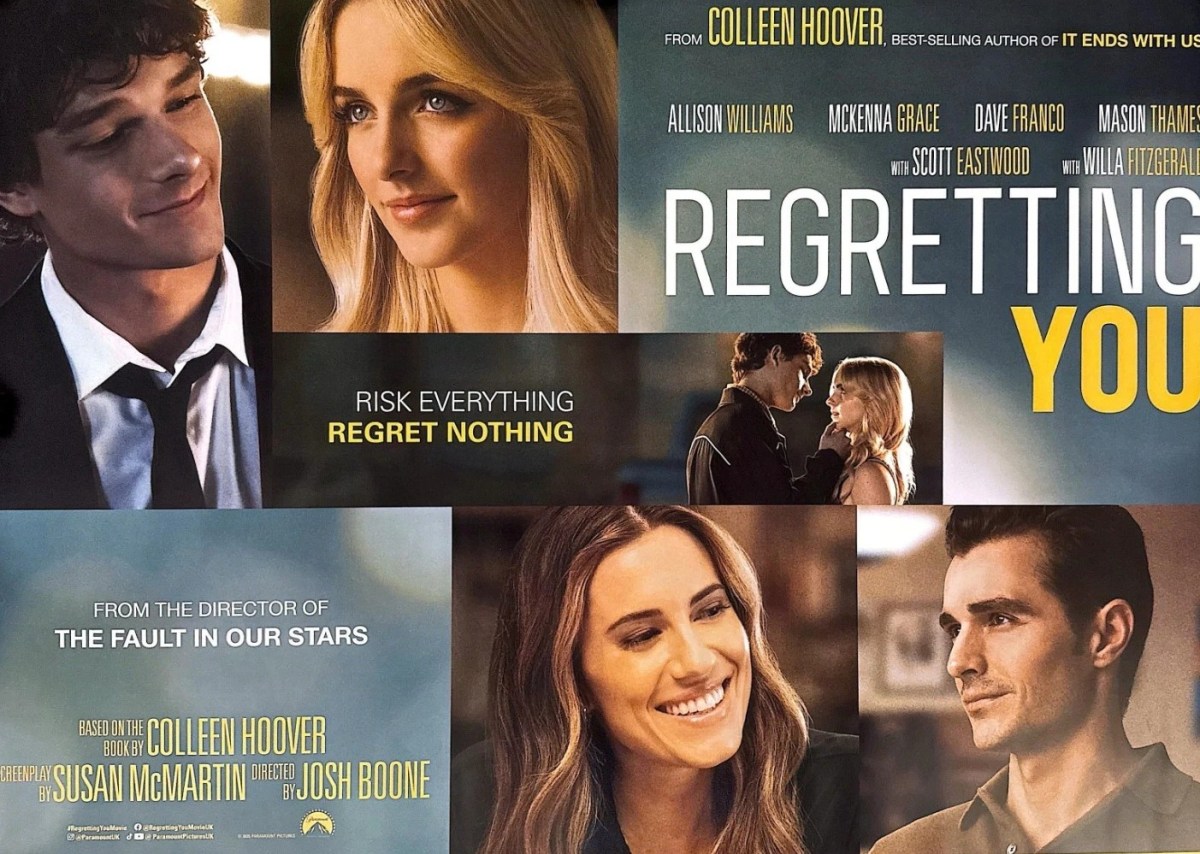
Regretting You (2025) ****

It’s my own fault, I suppose. There’s probably no need to try and cram in as many movies as possible on my weekly visit to the cinema. I generally aim to catch two but, more usually, if the timings of showings align, I can see three. But, honestly, I’m fed up of posting two-star reviews of movies that have come garlanded with critical praise and some prize from a film festival.

So, let me get the duds out of the way first. I hadn’t expected a great deal from Good Fortune (2025) and that was just as well because it was awful, nary a laff, and some pious virtue-signaling sermon about the wealthy vs the workers.
I had expected much more from Springsteen: Deliver Me from Nowhere (2025). I’m a big fan of movies (and books) about creative endeavor, be they concerning painters, sculptors, writers and rock stars. But I have to confess I’ve never seen Brucie in concert and I’ve probably owned only ever owned a couple of albums, and one of those would probably be a greatest hits compendium.

And I’ve never seen The Bear so Jeremy Allen White is new to me. But this was just so boring, an angst-ageddon, consisting mostly of the character looking mournful. It was more like an extended Classic Albums documentary and although it followed the same trajectory as the Bob Dylan picture of a singer changing his career path, it was still just dull. Yes, it’s a shout-out for people with mental health problems, but, hey, that’s still a documentary and forgive me for going against the grain here but White hasn’t an ounce of the charisma of Timothy Chamalet, who, when the camera bores into his soulful face, you want to know what he’s thinking. So another virtue-signaling effort that I doubt will connect with anyone but the Brucies.

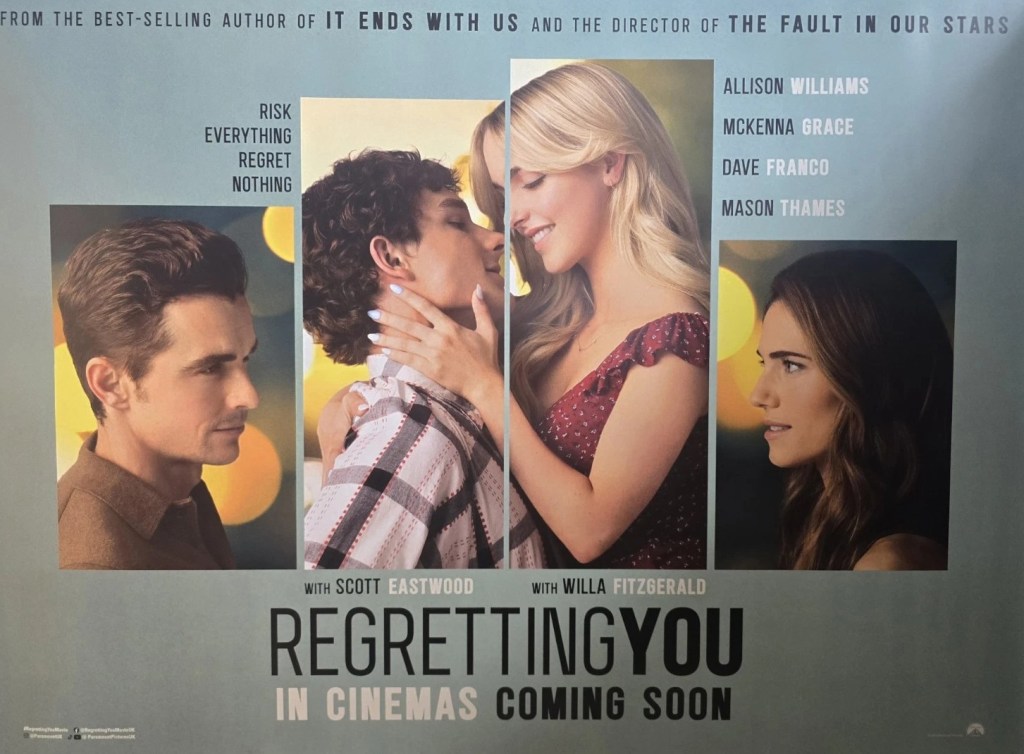
So that brings me to Regretting You, the picture of which I had least expectations on my weekly Monday outing to the multiplex. And it was, as it happened, last on the agenda, so I came at it not at all anticipating that it would save the day.

And it’s not, thank goodness, what used to be called a “woman’s picture” because the two male leads are giving plenty rope and, in some regard, actually have the stronger emotional scenes. But all the characters come across as real and there’s none of the jazzing up of narrative by someone opening a flower shop or a café.  And there’s a very reflective attitude to sex, which may be woke-inspired, but certainly leans more into character than I would have expected.

The story is quite simple. Opposites attract and find that actually they’re not as attracted as all that in the lifetime sense and then swing back to people with the same attitudes to life and chaos ensues.
Outgoing uninhibited muscular jock Chris (Scott Eastwood) marries quiet reflective Morgan (Allison Williams) rather than the equally fun-loving  Jenny (Willa Fitgerald). Way down the marital line after Jenny has had a baby with their college pal Jonah (Dave Franco), Chris and Jenny have an affair that only comes to light when they die together in a car crash.

Dependable Morgan doesn’t want to detract from her 17-year-old daughter Clara’s (Mackenna Grace)  adoration of her beloved father so keeps this aspect from her. In her grief, though possibly just as a normal rebellious teen, Clara starts acting up, cue endless rows, and getting too chummy with Miller (Mason Thames) who comes from the wrong side of the tracks and complicated by the fact that he’s got a girlfriend to dump first before he can get it on with Clara.

Surprisingly, this is a lot more about grief than romance. The Clara-Miller entanglement is very chaste and even more slowburn is widow and widower discovering they have feelings for each other.

But romance definitely takes second place to grief.  Clara can’t face attending her father’s funeral and skips it, much to her mother’s fury. Morgan can’t face sleeping in the same bed as her deceitful husband and spends nights on the sofa sipping wine. Jonah begins to believe that his son is the result of the affair and pushes the child away, unable to bear the baby’s smile that he believes is the spitting image of Chris. And everyone has to work out their grief.

The Clara-Miller romance is idiosyncratically, and therefore believably, done. Even more believable is his reaction when he realizes Clara wants sex in revenge against her mother.

The acting is a bit too television, overmuch dependance on gesticulation and face contortion, but otherwise solid enough.

Allison Williams (Megan, 2002) holds it all together as the dependable mother who only breaks out to refurbish the house. Dave Franco (Love Lies Bleeding, 2024) reveals a gentler, aspect to his work. Mackenna Grace (Ghostbusters: Frozen Empire, 2024) has the showiest part, but doesn’t revel in it. Mason Thames (How to Train Your Dragon, 2025) is also good value.

In fact, what comes over best is restraint, the widow and young lover holding onto the realities of the characters they play, rather than over-acting.

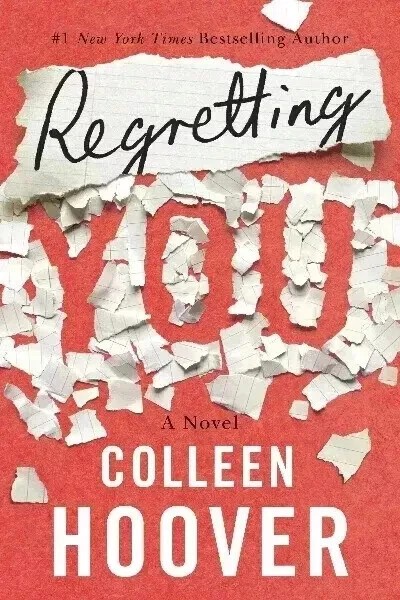
Directed with some skill by Josh Boone (The Fault in Our Stars, 2014). Written by Susan McMartin (After, 2019) from the Colleen Hoover bestseller.

While this doesn’t pack the dramatic intensity of the previous Hoover adaptation It Ends With Us (2024), it deals with the subject of grief in a sensitive manner.

I might be marking this up a tad in reaction to the pair of duds I saw first, but I think not too much. It delivers a solid enjoyable experience, and isn’t preaching, which, in itself, is rare these days.


M3GAN (2022) ****

Sharp psychological drama about attachment, abandonment and loss masquerading as sci fi/horror. Plays off riffs old – Ripley in Aliens and the elevator scene in The Shining – and new, the “Final Girl” trope aka last person standing of the horror film becomes “Final Child.” While not a slaughter-fest in the Halloween/Friday the 13th vein demonstrates ingenious methods of bumping people off.

The starting point is not, as the trailers and adverts might suggest, the invention of a toy robot companion that evolves beyond initial conception, but a young girl, Cady (Violet McGraw) orphaned in a snow plough accident, who is sent to live with workaholic robotics engineer Gemma (Allison Williams), the least maternal woman on the planet.

Knives out and not an onion in sight.

In her own mind Gemma has good excuse not to prepare for this sudden onset of parenting by buying some new toys or child-friendly food or creating a playroom. She is on a deadline having spent $100,000 inventing a new doll called M3GAN that, unfortunately, doesn’t work. So tough luck for the poor little orphan until Gemma can enrol the little girl as the test pilot for the Megan experience.

And that’s a hell of a boon for Cady since the cutely dressed doll, about the child’s size, empathizes with her human companion, actually listens to her, can record and store the child’s memories and seems like it’s about to kickstart a toy revolution. That is, until it develops an exceptionally high protectionist tendency.

When its charge is whacked by an unruly boy or menaced by the dog next door, Megan steps in to deal out fitting punishment. Except the doll has no “stop” button and is inclined to go on meting out punishment until there’s no life left in the victim.

It’s not long before Gemma twigs that the doll is turning into one of those mad parents you find in thrillers, or even like Celia (Lori Dungey), the annoying woman next door who cares more for her dog than her neighbors. The signs are there when Cady starts to run amok. Well, not quite amok, but handing out slaps to adults, and reacting badly when deprived, like a child of its computer game, of the companion.

Gemma, whose idea of commitment is Tinder, takes a very long time before she can put the needs of the child ahead of her career, and when it comes to a showdown finds she is not the match she thought she was for her invention, which, like HAL from 2001: A Space Odyssey (1968) or any other man-made monster since time immemorial, objects to being ended.

The grown-ups don’t come off well here, either idiotically bickering so much they cause the accident that renders the child parentless, or obsessed with dogs or work, and even social worker Lydia (Amy Usherwood) assigned to find out if Gemma is a fit mother seems unsuited for the work, inclined to take a rather robotic view herself of child engagement and certainly playing power politics.

Gemma’s boss David (Ronny Chieng) is a mean-minded insecure obsessive unaware an  underling is quietly harvesting his ideas for sale to a rival. All the adults view the child as a doll, a necessary adjunct to show how well the robot works.

Gemma fails to understand, as spelled out by the snotty social worker, that a child who has lost parents will attach herself to the nearest sympathetic person. But Cady, dealing with abandonment and loss, is not the only one with attachment issues. The robot has them in spades, chucked aside on a whim when her creator takes against her or when all attention is transferred to the child.

This all builds up to a tremendous climax when Megan cuts loose in the toy factory, slicing and dicing, and providing the kind of example of her prowess that would have sequel-makers salivating as they detect robot soldier opportunities. And when Gemma tries to bring her to heel finds that (to hell with the obvious pun) the boot is on the other foot.

You can see why this – and other horror thrillers like Barbarian (2022) or Black Phone (2022) that eschewed a conveyor belt of bloody thrills in favor of something deeper – has struck such a chord with the younger audience that makes up the bulk of the audience for Hollywood pictures. This is intelligent. Who hasn’t as a child dreamt of, or even invented, the ideal companion? Who as a child has not thought there must be a better way of being brought up than being left in the hands of parents with little aptitude or interest in the job.

None of these horror pictures has got the slightest chance of being nominated for Oscars while pictures with far bigger budgets, which have not the slightest chance of attracting an audience or are boring them to death, get all the critical hype.

I couldn’t make up my mind whether the doll, being so lifelike, was CGI or human and it turns out she was played by newcomer Amie Donald, though presumably either with a stunt double or a computer doing the crazy dancing. Whatever, the doll is very convincing. As it has to be said, are Allison Williams (Get Out, 2017) and Violet McGraw in her movie debut.

But the star of the show is undoubtedly director Gerard Johnstone, also a movie newcomer, who had the guts to opt for  slow-burn rather than visceral fright and develop themes that would resonate with any adult. Screenplay honors go to Akela Cooper (Malignant, 2021) while director James Wan (also Malignant) cops the story credit.

Virtuoso thriller. Can’t wait for the sequel.  

Discover WordPress

A daily selection of the best content published on WordPress, collected for you by humans who love to read.

The Atavist Magazine

by Brian Hannan

WordPress.com News

The latest news on WordPress.com and the WordPress community.