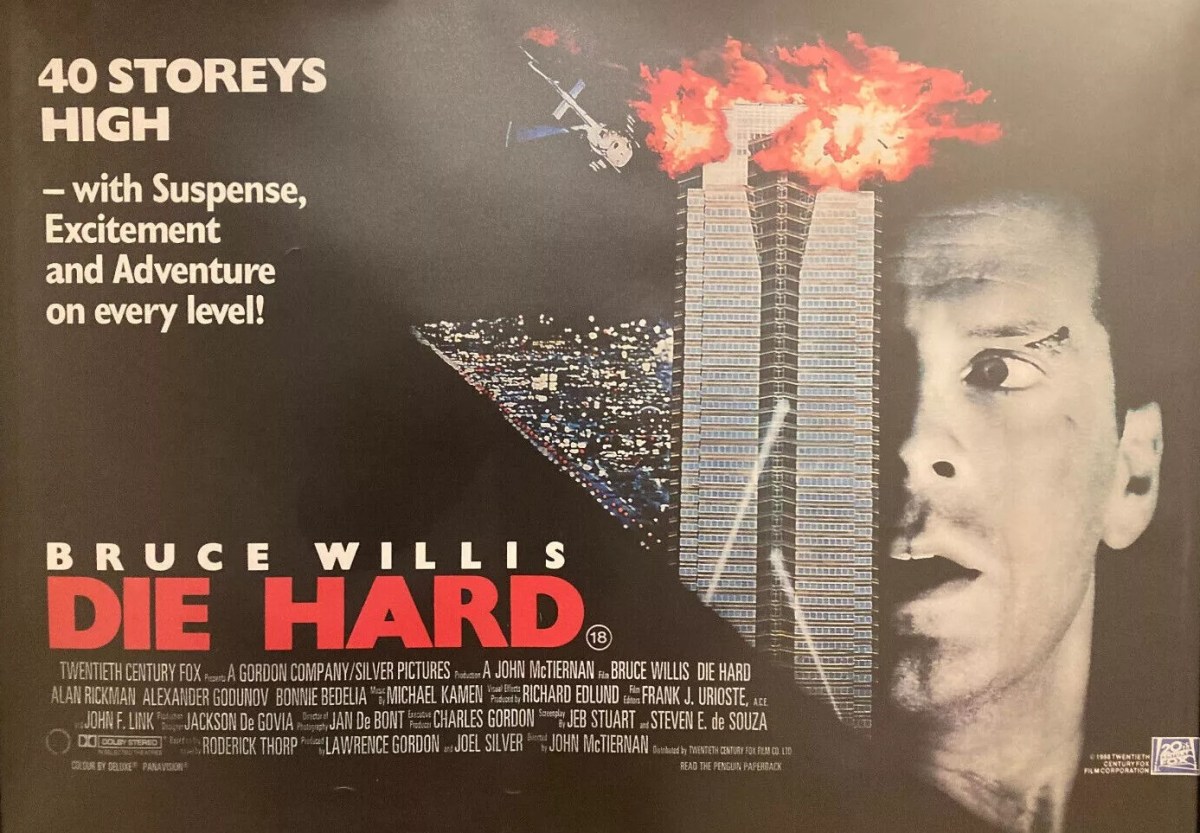
Kiss goodbye to your suicidal small town banker helped by a passing angel who had dominated the Xmas reissue horizon for half a century. There’s a new Xmas sheriff in town and he doesn’t play by any merry rules. Some marketing whiz has hit upon the notion that an action picture with a pretty vague Xmas background would be a better bet for the contemporary audience than James Stewart in the snowbound It’s A Wonderful Life (1946) that owed a great deal of its popularity to the fact that it was out of copyright and could be played on extremely inexpensive terms – a better Xmas present a cinema owner could not expect.
This is one of these moves that cries out to be revisited on the big screen. I saw it on Monday this week and was astonished to find that it had attracted a full house. You forget how much of a revelation this was, a complete rethink of the action hero. Sure, it owed something to the muscular heroics of Sylvester Stallone and Arnold Schwarzenegger, but they always seemed like they were looking for trouble. Albeit that he’s a cop, Bruce Willis was a throwback to the kind of movie where a relatively innocent character gets caught up in mischief.
And it’s surprisingly contemporary in its attitude to romance, New York cop John McClane (Bruce Willis) left behind by careerist wife Holly (Bonnie Bedelia), who reverted to her maiden name when she headed out to Los Angeles with the kids. He’s made the trip to try and stitch back their marriage, but only comes to terms with his failings as a careerist cop once he’s battered and bloodied in the Nakatomi tower where his wife and 30 other employees are being held hostage by heist merchant Hans Gruber (Alan Rickman), posing as a terrorist in order to steal 600 million bucks from one of the most secure vaults in the world.
This isn’t one of those robberies where we’re told in advance of the plans, instead as the strategy takes shape we can only marvel at Gruber’s brilliance and ruthlessness. He’s not, as would be the norm, trying to hijack cash on the quiet, but instead needs the “assistance” of the FBI to complete his program.
Bruce Willis had been struggling to establish a big screen persona that took him away from the smirking quip-slinger of Moonlighting (1985-1989). Blake Edwards romantic comedy Blind Date (1987) and the same director’s Hollywood drama Sunset (1988) had signally failed to advance his marquee credentials. Donning a vest, losing his shoes, picking glass from his feet, blasting away at all and sundry, and using brains as much as bullets to outwit the robbers, set him on a new career path.
Director John McTiernan was a rising star having helmed Predator (1987) but this was a different kind of actioner to the Schwarzenegger sci-fi malarkey. There’s nothing trim about the timing – it comes in a just under two-and-a-quarter hours – but that allows not just for a proper three-act set-up and several twists, but, more importantly, through a series of clever devices, permits the character to breathe. Through intermittent contact with street cop Sgt Powell (Reginald VelJohnson), we learn a good deal more about McClane and, critically, his change of heart about his marriage.
Unusually, for an action picture it’s riddled with interesting characters, not just bureaucratic nincompoops and FBI gunslingers fully conversant with acceptable collateral damage, but two kings of smugness, one a television reporter (William Atherton), the other a high-ranking executive who has his eye on Holly.
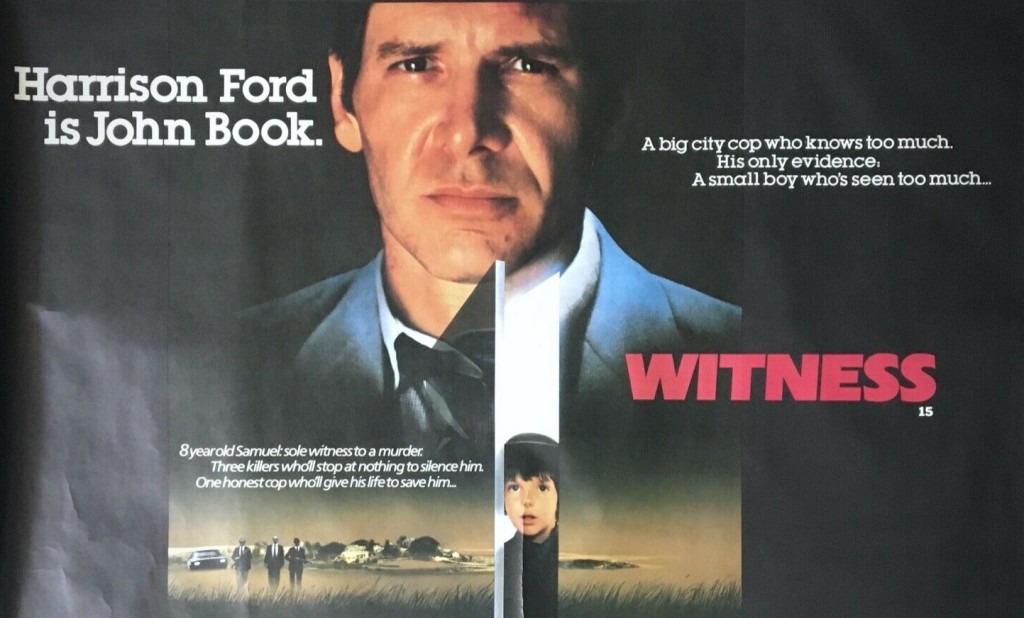
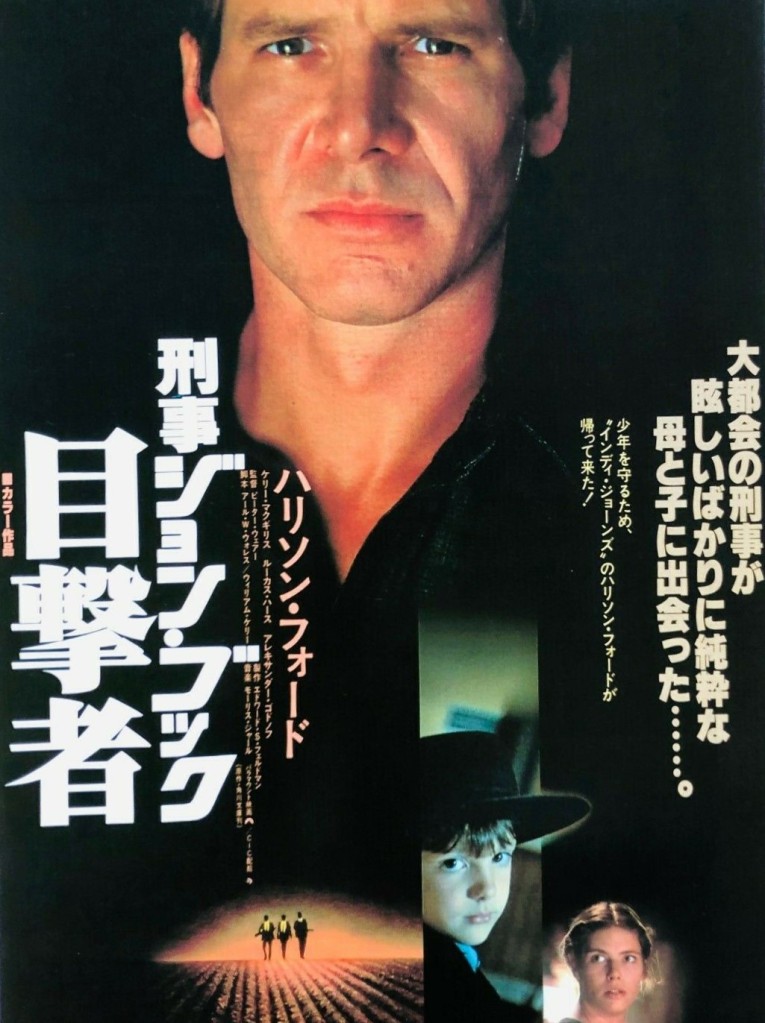
And that’s before we come to the villains. For Gruber, British actor Alan Rickman was drafted in from the stage, no movie credentials at all, and created a silky supervillain every bit as memorable as those who challenged James Bond. In fact, in other circumstances his sidekick, former ballet dancer Alexander Gudonov, should have stolen the show as he had threatened to in Witness (1985). Perhaps the most surprising casting was Bonnie Bedelia. She’d been a female lead or top billed (The Stranger, 1987) for more than a decade, and what she brings to the role is the quiet skill of not over-acting.
If you weren’t particularly interested in the well-drawn characters, you would be more than happy with the extensive action sequences which set new highs for the genre. This should have revived Frank Sinatra’s career since he had first dibs on the character, a sequel to The Detective (1968). And Clint Eastwood for a time had the rights. Screenplay by Jeb Stuart (The Fugitive, 1993) and Steven E. de Souza (48 Hrs, 1982) from the novel by Roderick Thorp.
But yippee-ki-yay, it sure made a star out of Willis.
Top notch.
 The Magnificent 60s