Zeta One / The Love Factor (1969) **

Perhaps best described as a more sophisticated occasionally psychedelic companion piece to Orgy of the Dead (1965).

You can’t blame screen wannabes and future Hammer queens Swedish bombshell Yutte Stensgaard (Lust for the Vampire, 1970) and Valerie Leon (Blood from the Mummy’s Tomb, 1971) for wanting to kick-start their careers any way they can. But you have to wonder what career nadir James Robertson Justice (Doctor in Distress, 1963) and  Dawn Addams (The Two Faces of Dr Jekyll, 1960) found themselves in to have signed up.

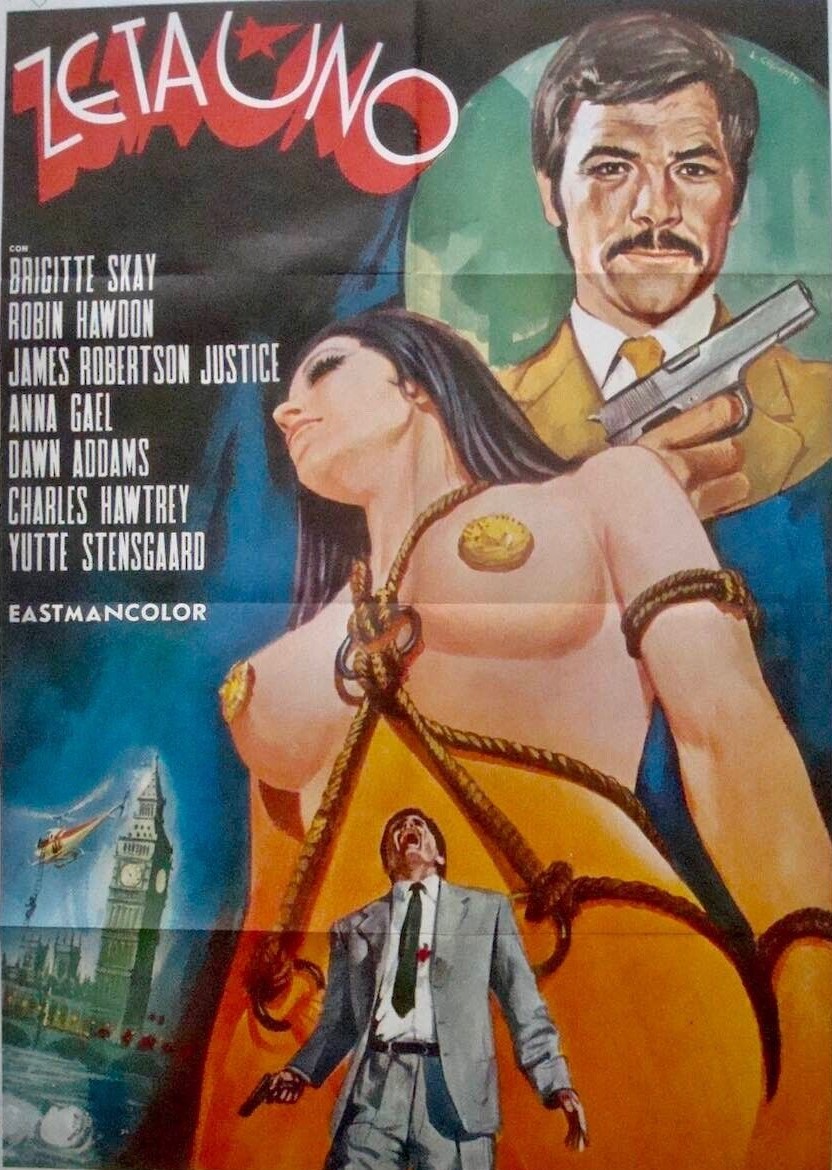
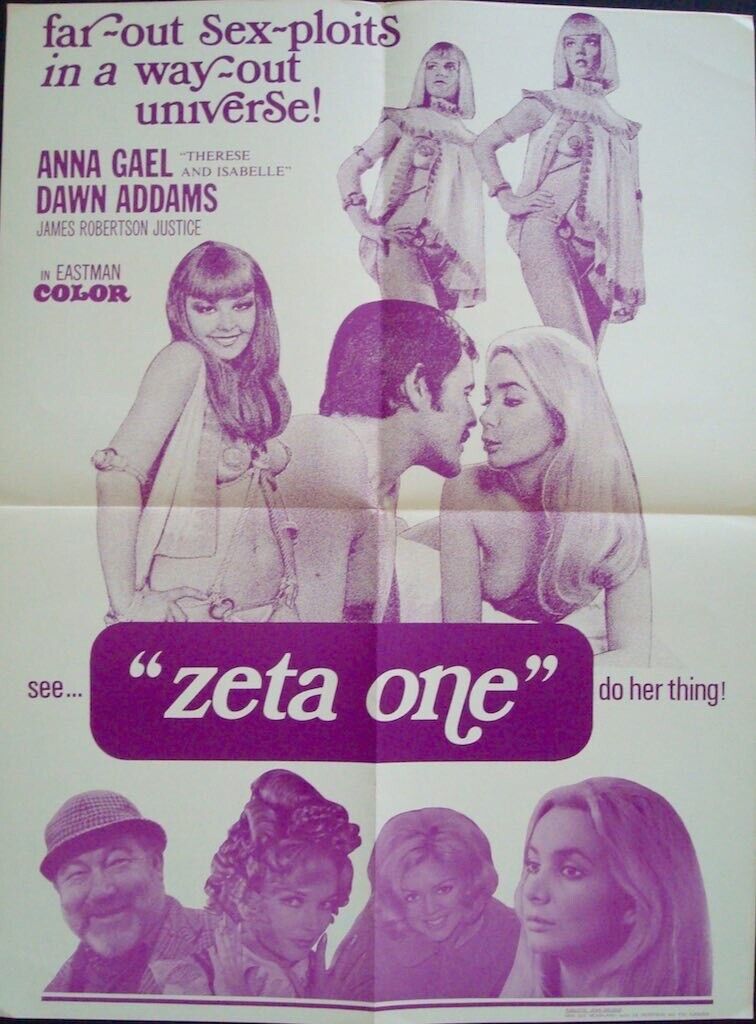
Credits depended on where you saw the film. Here, Anna Gael takes top billing courtesy of box office success “Therese and Isabelle.” The poster does Dawn Addams a favor –
in the film she is way down the credits as a guest star.

Compared to Orgy of the Dead this has a helluva plot though it takes its sweet time getting there. Secret Agent James Word (Robin Hawdon) has the details of his previous mission (to Scotland!) dragged out of him – no torture required just strip poker followed by sex – by secretary Ann (Yutte Steensgaard).

The story, told in flashback, recounted by Word mostly in bed – perhaps this is where Game of Thrones acquired the notion of “sexposition” – concerns the efforts of spy boss Major Bourdon (James Robertson Justice) to prevent Zeta (Dawn Addams) leader of a race of women from repopulating her planet Angvia by kidnapping females from Earth, having set her eyes this time on a Soho stripper.

The Wonder Woman race of women theme – the Sumuru version a bit more aggressive – has been given a good airing in contemporary times, but where those ancient Amazons kept themselves busy with sport and battle training, the Angvian women do little more than disport themselves in the most minimal of costumes – even for contemplation and hibernation – although to be fair topless nudity is hidden from prying eyes by the use of purple nipple pasties. There’s a definite hint of bondage in costumes held together by rope and the Sapphic angle is teased out.

Bear in mind this was made before alien abduction became a huge trend but the idea of men being kidnapped for the sole purpose of impregnating beautiful women might be the real reason why so many cases of alien kidnapping later came to light.

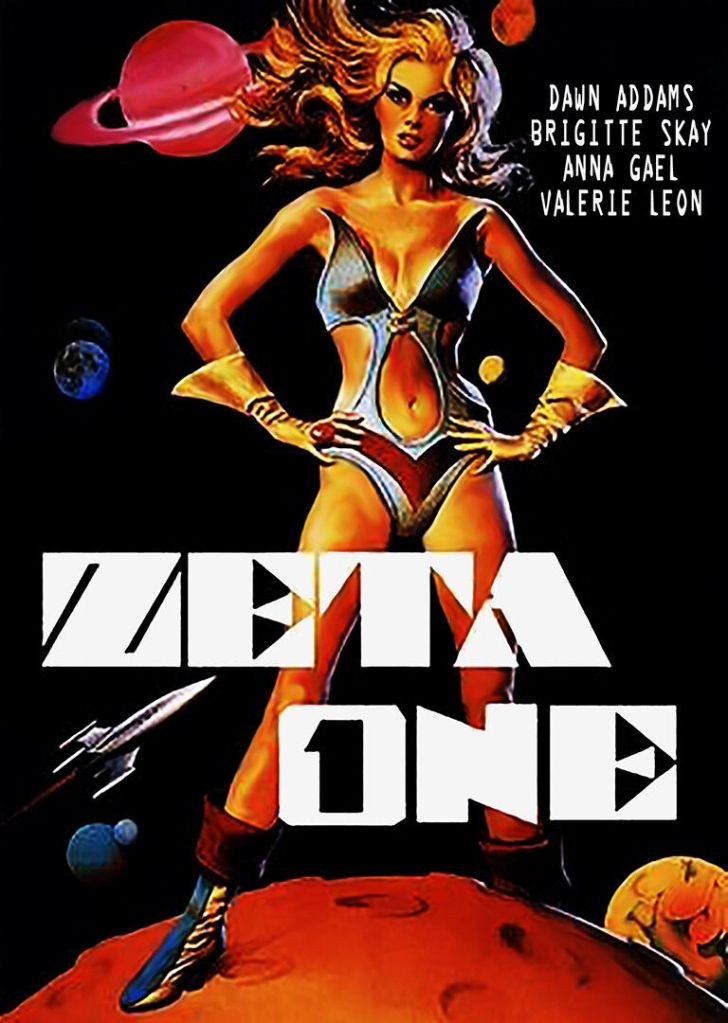
Perhaps in keeping with the theme of female domination no males get a mention
on this poster where Brigitte Skay takes second top billing.

The women are superior in every way, peaceful and with an aristocratic bearing, though with a tendency to wear trendy thigh-high boots, and willing to put up with the intrusion of an occasional male for the sake of perpetuating their community. But the men, as instanced by the Major and Word, are a pretty crude and dumb bunch. Word is only too happy to indulge every female he comes across without appearing to extract any information while the Major, clearly lacking the sex appeal to get himself into a similar situation, relies on cruder means, torture the most obvious.

If it weren’t so crass you could point to feminism, a superior world that survives mostly independent of men without their base desires and who can channel inner power when it comes to physical confrontation rather than relying on old-fashioned weaponry. At its worst it’s just a parade of naked and semi-naked women (Ann, for example, rarely seen clothed), but at its best it’s a somewhat ham-fisted sci fi spoof with it has to be said the occasional burst of humor (the names, for example, have connotations) and if nothing else should provide a cautionary tale for stars whose careers are imploding.

This was produced by Hammer’s sometime rival, Tigon, the Tony Tenser outfit that sexed up the horror field. It’s ironic that the three stars, Stensgaard, Leon and also Robin Hawdon (When Dinosaurs Ruled the Earth, 1970) were snapped up by the competitor for later top-billing.   I’m not sure we heard any more of Yutte’s original voice than we did in Lust for a Vampire where she was more famously dubbed.

The first and last film of director Michael Cort who co-wrote the screenplay with Alistair McKenzie, who never wrote another one either, possibly a separate cautionary tale.

You might enjoy it more by star-watching. Carry On favorite Charles Hawtrey pops up as Bourdon’s sidekick and you can spot the future “wifelet” of the Marquess of Bath  Hungarian Anna Gael (Bridge at Remagen, 1968), German Brigitte Skay (Isabella, Duchess of the Devils, 1969), British character actor Rita Webb (The Strange Affair, 1968) and Carol Hawkins (TV series The Fenn Street Gang, 1971-1973).

I came to this having wondered about the apparent demise of Dawn Addam’s career after Where the Bullets Fly (1966). That’ll teach me to indulge my curiosity. The best you can say is she doesn’t disgrace herself, not being required to strip, and has a more commanding presence than the random James Robertson Justice who just looks suitably embarrassed.

Charge of the Light Brigade (1968) **** – Seen at the Cinema

It’s rare that I watch an older movie twice over a relatively short period of time and it virtually never occurs that after seeing a DVD-sized version I am afforded the opportunity to see the picture in all its original glory on the big screen. But, courtesy of a Victorian-era strand of this year’s Bradford Widescreen Weekend. I was able to do so, and it was well worth the experience to clarify several aspects of the movie.

On second go-round what stood out most were the characters rather than the political commentary and that the military disaster portrayed was caused by simple human error, a miscommunication, rather than the result of a bunch of buffoons being in charge.

Certainly, the approach is unusual for a war movie, a lot less of the glory, courage and glamor of war, and much more, in fact more than ever before, of the details of mounting a campaign. Even a movie as detailed as Apocalypse Now (1979), which had more than its fair share of gung-ho cavalier buffoons at the helm, drew the line at showing the organisational calamity to which every military endeavor will at some time fall victim. War movies, like westerns, tend to stick to the knitting of action rather than consequence and reprisal.

The over-simplification of reasons for Britain going to war are more obviously over-simplified on reappraisal. The effect on Turkey and the extended Middle East of an unopposed Russian invasion would have scarcely borne thinking about, never mind complaining about who or why various countries sought to withstand the aggressor. While applauding the vigor of the animated sequences, their content, and the way director Tony Richardson tries to sway audience opinion, seems dubious.

It’s worth noting that at the time the infamous charge was reported as a debacle by The Times newspaper and the idea that there was anything glorious about it only occurred because a few days later Alfred Lord Tennyson wrote the famous poem that acted as an epitaph to courage. While no attempts are made to embroider the myth of war, and it’s clear the army is mostly made up of people with no other chance of employment (which would as true at any time in the previous millennium), nonetheless the  focus is on personality clashes at the highest level, as various commanders jostle for position and control. But I doubt if personal enmity actually affected decisions on this particular battlefield, although occasional incompetence is readily addressed.

As Lord Cardigan, Trevor Howard gives the greatest performance of the second half of his career when he had shifted away from the romantic hero of Brief Encounter (1945) to gruff characters with a tendency towards the choleric. His portrait of a soldier who bristles against his position in the chain of command even as he tries to impress the importance of hierarchy on his junior officers, is superb, especially as he is in turn puffed up and then torn down by public opinion, and for all he may appear an unsavory character still appears to be catnip to the ladies.

In my previous viewing I had followed the director’s line in taking as our conscience dashing cavalry officer Nolan (David Hemmings), even though he is not quite so principled that he refrains from an affair with the wife Clarissa (Vanessa Redgrave) of his best friend. But although he played an integral role in the actual battle, he seems on reflection to be a sop to the film’s backers, a handsome leading man (and beautiful Redgrave) as the apparent audience focus rather than the other individuals who were altogether less attractive personalities.

Instead, what I responded to more was the depiction of the enclosed society of soldiers writ much larger on the big screen than on the small. And yes, this is class-ridden Britain (though when was it not so) at war in 1854, when military advancement was purchased rather than officers promoted for their leadership skills, and far removed from the idealized U.S. Cavalry as portrayed by John Ford when at dances  the officers mixed with the ordinary soldiers.

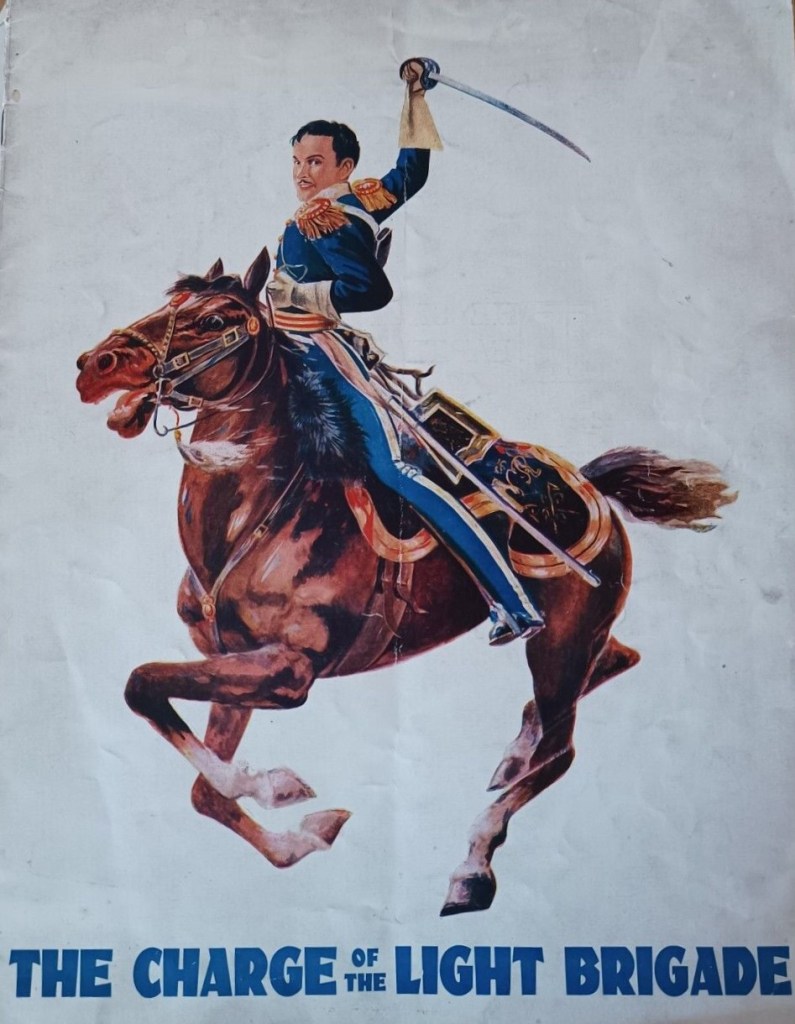
Errol Flynn in the previous version for which Balaclava was the code to an adventure that took place for the most part in India.

The lower-class recruits, lured by a wage and the promise of glory, are so ill-educated they don’t know their left foot from their right, something of a problem in obeying orders in the field. Where turning raw recruits into soldiers proved manna from heaven for the likes of Robert Aldrich in The Dirty Dozen (1967) or Andrew V. McLaglen in The Devil’s Brigade (1968), here no concessions are made to the sheer brutality of the job.

Lord Cardigan (Trevor Howard) engages in open warfare with brother-in-law Lord Lucan (Harry Andrews). Cardigan is irascible to the point of apoplexy, incredibly brave, vainglorious, a vindictive sex-mad peacock, with an odd selection of principles (refuses to deal with spies, for example). Nothing can beat a quite marvellous spat between the pair over how to pitch tents. Commander-in-Chief Lord Raglan (John Gielgud) requires immense skills just to deal with the personalities under his control and comes across as more politically astute and more effectual than another officer who refuses to allow battle to take precedence over breakfast.

The effete Nolan, initially introduced as the good guy who stands up to Cardigan, is revealed as ineffectual, possibly more so than the superiors he so wantonly offends. But since his romance with Clarissa as clearly as opportunistic as Cardigan’s brief fling with the married Mrs Duberly (Jill Bennett) it clears the way for the picture to concentrate on how an army operates and goes to war, to touch upon, unlike most war or historical pictures, as much on what goes wrong as goes right. The splendor of cavalry on parade plays second fiddle to  dead horses, the Crimean heat and the scourge of cholera.

The detail of what exactly went wrong on the battlefield is obscured by the fact that Nolan, who hand-delivered the famous order to attack, itself unclear, died in battle, so it’s like one of those Netflix documentaries about unsolved murders, fascinating but ultimately annoying. If incompetence is measured in casualties, apart from this one charge the British came out better than the other participants, 40,000 dead compared to three times as many among the French allies and more than ten times as many among the Russian enemy.

The acting is of a very high quality, David Hemmings (Alfred the Great, 1968) as good as I’ve ever seen him, Vanessa Redgrave (Blow-Up, 1966) an early Stepford Wife, Trevor Howard (Von Ryan’s Express, 1965) brilliantly outrageous while John Gielgud (Sebastian, 1968) turns occasional befuddlement into a high art.

Tony Richardson (Tom Jones, 1963) makes some bold choices, not least in what is included and what is left out, and despite his determination to show up the action as deplorable in fact he achieves the opposite effect, a sense of overwhelming sadness that one mistake can trigger terrible consequence. The action on the big screen is quite magnificent, the detail of costumes and the thundering of the horses bursts out of the screen.

Although it made box office sense to re-team David Hemmings and Vanessa Redgrave from Blow-Up (1966, from a narrative perspective this is not only misleading but they fail to match the sheer screen magic of the feuding Cardigan and Lucan.

While I would challenge aspects of Richardson’s approach it remains an engrossing watch.

Dracula, Prince of Darkness (1966) **** – Seen at the Cinema

Almost a chamber piece rather than grand guignol. Highly atmospheric and psychologically-charged rather than plot-driven and nary a bosom in sight. Even taking account that he’s dead, Dracula (Christopher Lee) with his mesmeric bloodshot eyes takes a good while to put in an appearance and this time round regular nemesis Van Helsing (Peter Cushing) is nowhere to be seen although there is a version of fly-eating acolyte Renfield.

For much of the time it’s an intimate six-hander, Dracula almost a mute deus ex machina, given little to do until it’s time for murder, so we’re spared any self-pitying exposition, but like a modern MCU/DC villain appears to have supernatural powers, enough at least while dead to draw people against their will to his castle.

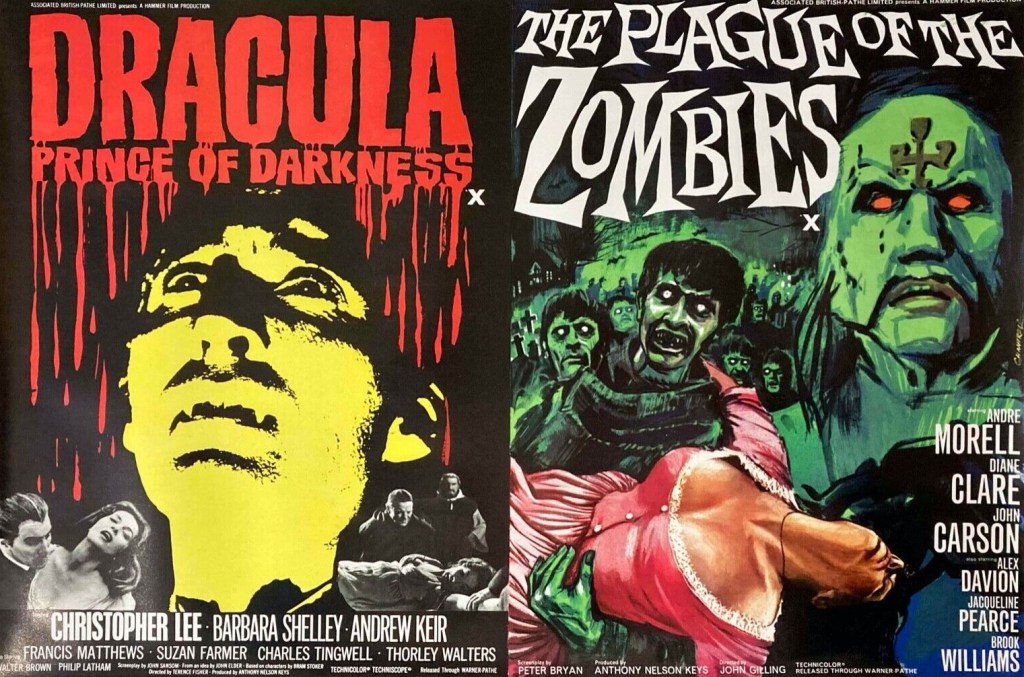
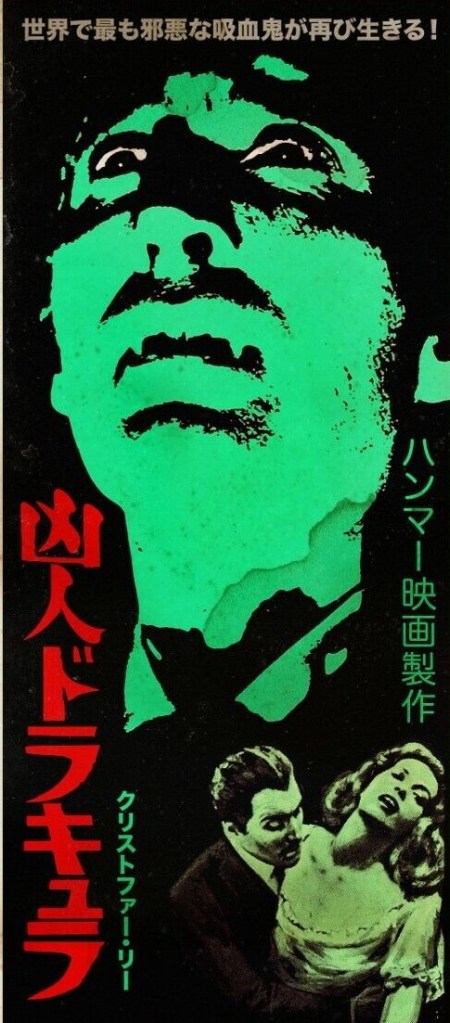
British double bill – as a marketing ploy they handed out plastic fangs to men
and plastic eyeballs to women.

Victims this time are four travellers, Charles (Francis Mathews) and wife Helen (Barbara Shelley) and his younger brother Alan (Charles Tingwell) and partner Diana (Suzan Farmer), who ignore the warnings of local priest Sandor (Andrew Keir) not to visit Karlsbad, a place now so feared it has been removed from any map. With little in the way of sense, the foursome board a driverless carriage and find themselves inside a castle with a table set for dinner and their rooms made up by malevolent servant Klove (Philip Latham).

Alan is the first to die, his blood reviving the Count. Helen is next, but isn’t killed, instead becoming his blood-sucking accomplice and handy as a lure for her unsuspecting sister-in-law. Eventually, Charles and Diana escape to the abbey where the rifle-toting stake-wielding Sandor offers protection, although not enough to deter the internal traitor Ludwig (Thorley Walters), the aforementioned insect-eater. So it’s back to the castle for an unexpected climax.

Hammer upped the budget to include color. The shades of rich red add an opulence to the proceedings, and do not detract from the atmosphere, especially effective when it comes to the blood-letting. In general, the biting is masked, Dracula using his cloak so as not to offend audience sensitivities, but particularly effective in one sequence where he draws a sharp nail down his bare chest to offer a stream of blood for Helen to lick, her enslavement more like a seduction.

Females remain largely innocent here unlike the gender-twisting vampire quartet a few years later of The Vampire Lovers (1970), Countess Dracula (1971), Lust for a Vampire (1971) and Twins of Evil (1971) which not only doubled down on the blood quotient but ramped up the nudity. Helen cannot resist the compelling force of Dracula’s eyes rather then willingly embracing evil.

But this remains a prime example of Hammer at its peak, the wordless Christopher Lee (The Brides of Fu Manchu, 1966) never more terrifying, with pounding hooves and an unusually busy action-driven score by Don Banks to heighten the dramatic effect. This was the third in the series directed by Terence Fisher (The Devil Rides Out, 1968) and together with Lee they pare down the effects and build up the suspense.

Barbara Shelley (The Gorgon, 1964) is the pick of the supporting cast, transforming from timid soul to conniving blood-thirsty bride, at times challenging her master for first dibs at the victims. Francis Mathews (Crossplot, 1969) essays the dapper suave screen character that would be put to better use in the Paul Temple television series (1969-1971). Charles Tingwell (The Secret of Blood Island, 1965) and Suzan Farmer (Rasputin: The Mad Monk, 1966) make up the numbers. But Andrew Keir (The Viking Queen, 1967) is a worthy adversary.

I was lucky enough to catch this on the big screen at the Widescreen Weekend in Bradford a couple of weeks back, slotted into the festival I guess due to timing, and was taken aback by its power, the color palette and the thundering score. But also seeing Lee at his magnificent best, towering over his victims, the close-up of the eyes, the supervillain to top all supervillains.

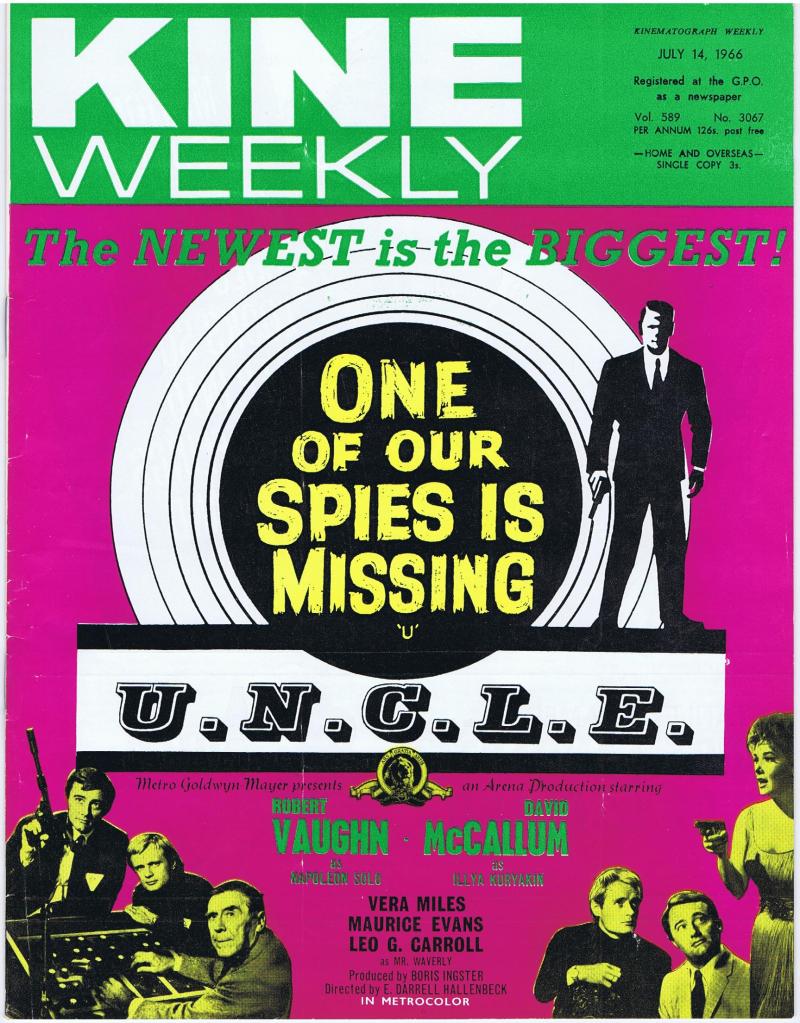
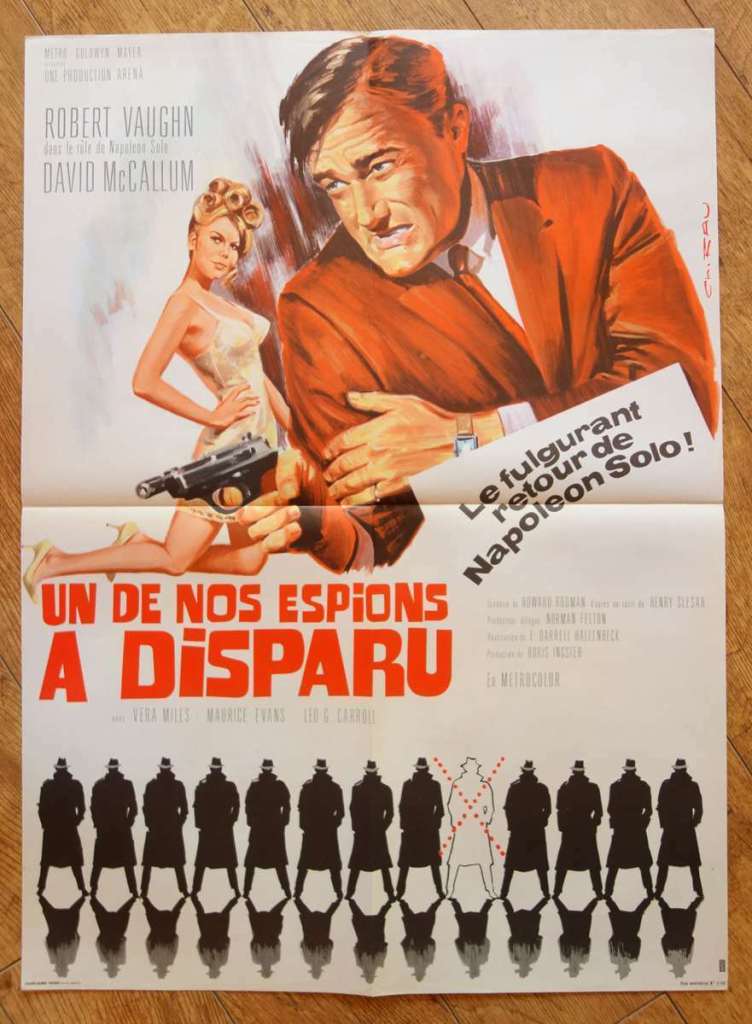
One of Our Spies Is Missing (1966) ***

Sometimes completing the circle just turns the wrong way and the idea that the search for eternal youth can be viewed as a bad thing seems a tad out of touch with today’s mentality. It’s also open to question whether it was ever seen as having much of a downside in the 1960s when there must have been anti-ageing creams although not the availability of cosmetic surgery to ostensibly turn back the clock.

Trust the men from U.N.C.L.E. to uncover the only genius not intent of monetizing his discovery to the tune of gazillions but intent on using it for dire political purpose. This time out Napoleon Solo (Robert Vaughn) and Ilya Kuryakin (David MacCallum) are on apparently different missions in Britain and France which eventually coalesce. Ilya is cat-hunting in London’s Soho. Not pet-hunting which might be a harmless occupation and give us an insight into his carefully-concealed personal life, but chasing down cats which look different from what they did before, mature cats, for example, that turn into kittens. (Probably a fortune to be made from that, too, the eternal pet, putting pet cemeteries out of business).

So is Solo’s investigation of the disappearance of renowned 83-year-old biologist Benjamin Lancer which takes him into the orbit of Parisian couturier Madame de Sala (Vera Miles) where Lancer’s daughter Lorelei (Dolores Faith) is a model. Anyone with any experience of Solo would have warned Lorelei off since he seems too closely associated with danger. As it happens, Lorelei doesn’t get the chance to make his acquaintance as she is bumped off by models Olga (Monica Keating) and Do Do (Ahna Capri).

Solo and Kuryakin soon realize there are a lot of malevolent women on the loose including  obstreperous nurse Joanna Sweet (Ann Elder), full-time carer to aged statesman Sir Norman Swickert (Maurice Evans), to whom de Sala is devoted.

Judging from the number of characters mentioned so far you can guess how complicated this one gets, so to cut to the chase, yes, the cats-turned-kittens are linked to attempts to rejuvenate Swickert, the power to do so eventually controlled by T.H.R.U.S.H. (you were wondering when they would turn up, weren’t you?).

As in The Spy with the Green Hat (1967), Solo spends most of the time being ineffectual, tripped or trapped, here at least in the novel situation of being crushed in a wine press, an odd item to find in England but never mind, movies always have creative latitude. Things come to a fine pass when Alexander Waverley (Leo G. Carroll), normally recumbent in New York, is parachuted in to save the day.

As usual, the actions zips along, but due to the way the original two-part episode from which this was culled has been oddly edited some of the zipping goes zap straight into a cul de sac of confusion. That said, there is a very tender scene when De Sala pours out her heart to the infirm Swickert and Ms Sweet is similarly defensive of her charge, a strict ration of emotion in the otherwise action-swirling picture. Solo manages some deft comedy outwitting the man mountain guarding a mansion.

This is a bit harder to follow than the others, and no expense has been spared in sticking to the MGM backlot in attempting to emulate British locations, Soho especially quaint as if imagined by a tidy-up campaign, and, as I mentioned, the wine press (??).

This was drawn from the second season two-parter The Bridge of Lions Affair, broadcast in February 1966, the concept of the bridge and the lions it connects too dumb to bother explaining. But one of the beauties of this series is you never quite know what you’re getting, Vaughn and MacCallum pretty much stick to the knitting of their screen personas, and it’s left to the guests stars to take advantage of the opportunity to do something different, Vera Miles (Hellfighters, 1968) in this case the opportunist.

Bit parts in spy pictures were seen as a boost for young actresses, but that wasn’t always the case. Ann Elder (Don’t Make Waves, 1967) was making her movie debut, Dolores Faith (Mutiny in Outer Space, 1965) was coming to the end of her short career, but Anha Capri (Kisses For My President, 1964) lasted another decade.

Screenwriter Howard Rodman was the pick here, going on to write Madigan (1968) and Coogan’s Bluff (1968). E. Darrell Hallenbeck didn’t received another movie director credit until as a contributor to The Green Hornet (1974) when it surfaced as a re-edited version of several episodes of the television series.

U.N.C.L.E. pictures regularly crop up on streaming services and mainstream television but if you can’t wait and fancy splurging on the entire series, check this out.

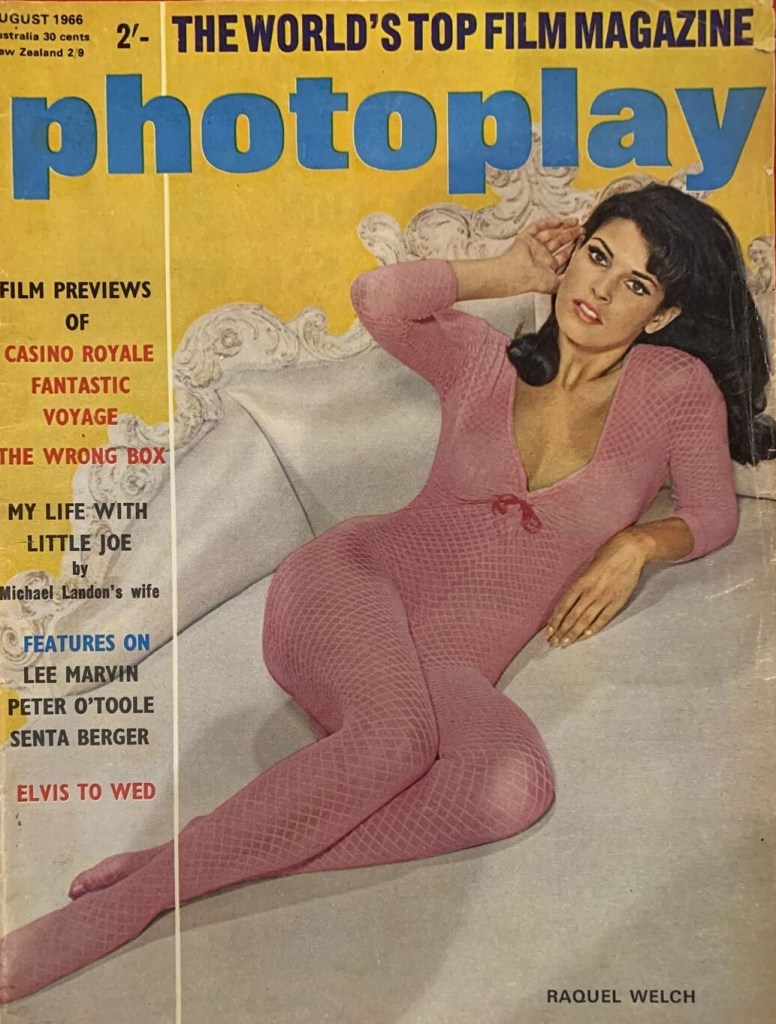
When Raquel Ruled The Reissue

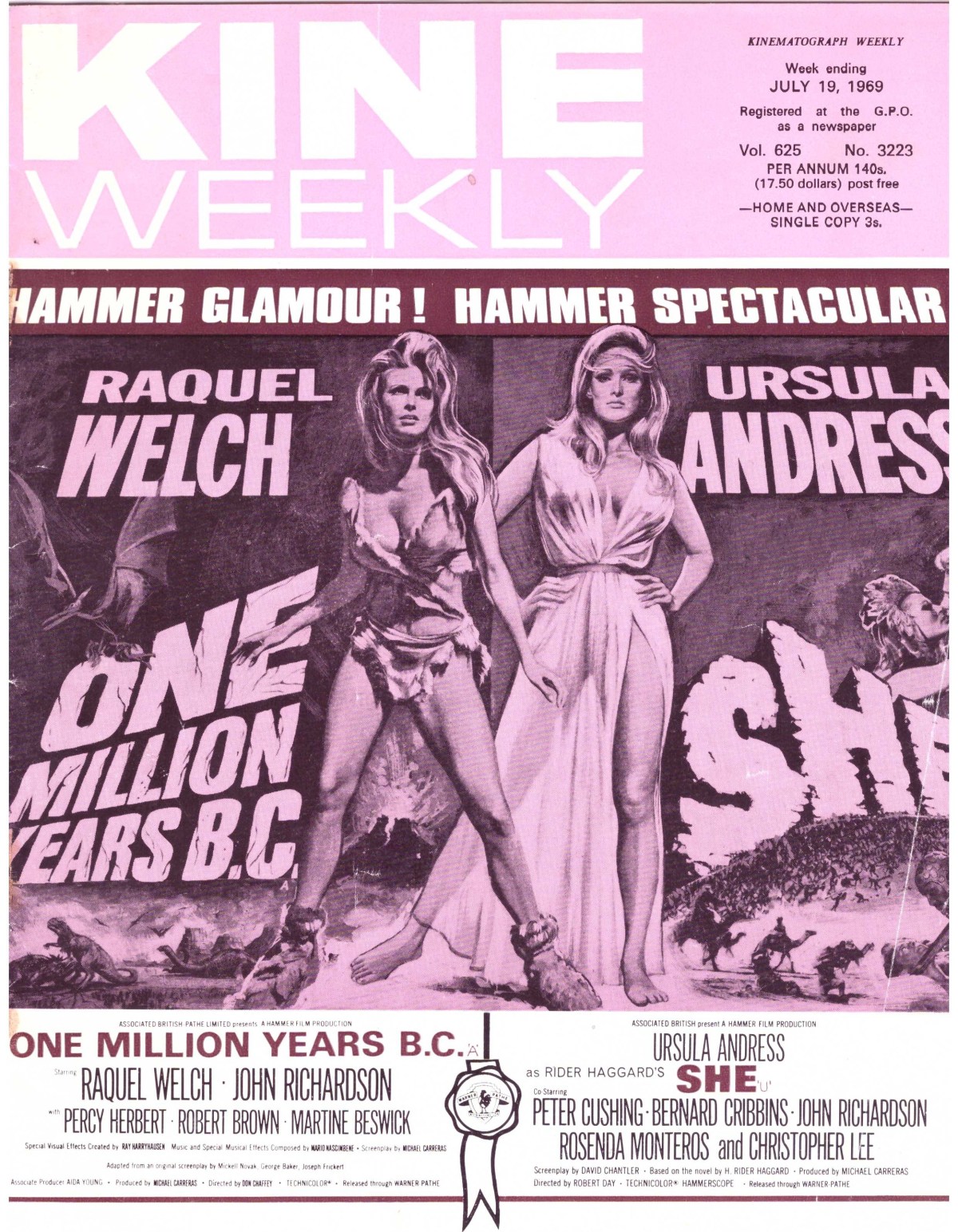
Despite being sold to television within a few years of initial release, as was standard at the time, One Million Years B.C. enjoyed an exceptionally long big-screen life, still available in reissue over a decade after premiere. Although a highly successful reissue double bill with She (1965) in the British home market in 1969, that revival did not strike gold in the U.S. One Million Years B.C. had enjoyed a surprisingly successful launch in the U.S., beating the Thunderball record at the New Amsterdam theatre in New York and going on to hoist $2.5 million in rentals putting it ahead in the annual box office race of A Fistful of Dollars, For a Few Dollars More and Point Blank.

Factors in its unexpected longevity included: proving a natural stablemate for movies set in the distant past or distant future, as double bill material for other Welch product, and supporting other Fox new releases. It was a studio workhorse. In 1967, it supported western Hombre, gangster picture The St Valentine’s Day Massacre, comedy Caprice, war epic The Blue Max and a revival of Those Magnificent Men in Their Flying Machines. The following year it backed Frank Sinatra in Tony Rome, Walter Matthau comedy Guide for the Married Man, Steve McQueen big-budgeter The Sand Pebbles, Sinatra again in The Detective, The Bible and hoping-to-be-hip The Sweet Ride. Roll on to 1969 it was the support to westerns Butch Cassidy and the Sundance Kid and The Undefeated.

And that should have been the end of its big screen career. By then it had been shown on television, on ABC, the second best program of the week. So, in theory at least, that should have been the end of exhibitor interest.

But it wasn’t. Come 1970 and it turned up in a triple bill of Butch Cassidy and The Boston Strangler, was geared up as support to Mash and Patton, and another triple bill, Butch again, with The Prime of Miss Jean Brodie. Butch Cassidy was its partner again in 1971.

Outside of the Twentieth Century Fox connection, there were sorties with She and its sequel The Vengeance of She, and The Lost Continent, a triple bill with Hammer stablemates The Viking Queen and Prehistoric Women, and in 1970 with She and Goliath and the Seven Vampires plus the following year a quadruple bill featuring The Viking Queen, The Vengeance of She and Five Million Miles to Earth.

The following year it turned up as support to When Dinosaurs Ruled the Earth (“from the creators of One Million Years BC”), The Creatures The World Forgot, and the original King Kong (1933). In future years there were triple bills with Tarzana the Wild Girl and Prehistoric Women and with The Valley of Gwangi and Earth vs Flying Saucers.

With striking regularity it was teamed up with Planet of the Apes, Beneath the Planet of the Apes, Escape from the Planet of the Apes, Conquest of the Planet of the Apes and Battle for the Planet of the Apes.

Elected to form a Welch double bill with One Million Years B.C. were Fantastic Voyage (various bookings over 1967-1969), Fathom (1967-1968), The Biggest Bundle of Them All, 100 Rifles, Bandolero and The Three Musketeers (1974) while a Welch triple bill in 1973 augmented the dinosaur picture with Fantastic Voyage and Lady in Cement.

While Fox had first call on its services, at a certain point the studio relinquished exclusivity and exhibitors were free to book it whenever they wanted, Fox content to make a few extra bucks every time. So it went out with Paramount westerns El Dorado with John Wayne and Robert Mitchum and Five Card Stud with Robert Mitchum and Dean Martin, Disney animated feature The Jungle Book and its revival of In Search of the Castaways, UA war picture The Devil’s Brigade, comedy Inspector Clouseau and football drama Number One, MGM comedy The Maltese Bippy, big-budget war spectacular Where Eagles Dare with Clint Eastwood and Richard Burton and the reissue of Ben-Hur, NGC comedy How Sweet It Is, Columbia’s space drama Marooned,  French political thriller Z, Harry Alan Tower’s jungle adventure Eve and the British sex drama All Neat in Black Stockings.  The last sighting I made of it was with sci-fi Futureworld in 1976.

Add One Million Years B.C to Ben-Hur and you’re talking a near-five-hour program, four hours for Where Eagles Dare. You can see from the indiscriminate double bills that nobody was trying to find the ideal match. Exhibitors didn’t have to, Raquel Welch and her fur bikini had something everyone wanted, a picture that moviegoers were happy to see again and again.

Where were you when you first saw One Million Years B.C.? And what age? And what gender? Did you see it on the small screen or the big, on original release or a reissue?

SOURCES: Brian Hannan, Coming Back to a Theater Near You, A History of Hollywood Reissues 1914-2014 (McFarland, 2016), p208-210; “Georgy, Flint in ABC Film Line-Up,” Variety, April 30, 1969, p35. Box office figures Variety: August 2, 1967, p 11; August 16, 1967, p10; Jul 21, 1971, p8. Listings in Newspapers: Argus, Fremont; Evening Standard, Uniontown; Valley News, Van Nuys; Independent, Long Beach; Kingsport Times; Standard-Examiner, Ogden; Des Moines Register; Tucson Daily Citizen; Abilene Reporter News; Kansas City Times; Wellsville Daily Reporter; Morning Herald, Uniontown; San Antonio Express; Aniston Star; Manhattan Mercury, Kansas; Gastonia Gazette; El Dorado Times; Fresno Bee; Gallup Independent; Post-Standard, Syracuse; Arizona Republic; Daily Times, Salisbury, Maryland; News Journal, Mansfield, Ohio; Corpus Christi Caller; Naples Daily News, Florida; Journal News, Hamilton, Ohio; Statesville Record and Landmark, North Carolina; Hamburg Reporter; Beckley Post-Herald; Brownsville Herald; Nashua Telegraph; Portsmouth Herald; Delta Democrat-Times; South Illinoisian; Terre Haute Tribune; Pasadena Independent; Xenia Daily Gazette; El Paso Herald-Post; Cumberland News, Maryland; Delaware County Times; and Northwest Arkansas Times, Fayetteville.

My Greatest Hits: The Blog Speaks

Yep, I’m back on the air in a podcast on “The Misfits” with the wonderful and well-informed Grace Collins who runs this acclaimed operation.

Here’s the link below.

https://truestoriesoftinseltown.podbean.com/e/i-speak-to-brian-hannan-from-the-blog-the-magnificent-60s-about-the-making-of-the-misfitsclark-gable-and-marilyn-monroes-final-film/

Copy this into your browser. That opens up the podcast page and then if you scroll down to the Start button you’ve got it.

But if it doesn’t, you’ll get there in a couple of clicks doing this: go to the “contact me” link further down the page then on the top right hand corner click on “episodes” and the interview with me is the first one down.

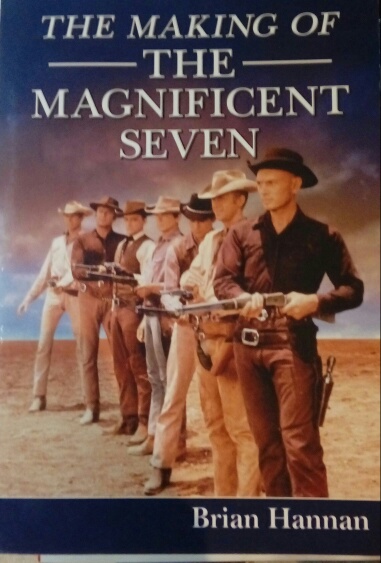
And if that’s not enough for you, you can catch me in a previous podcast about the making of “The Magnificent Seven.”

Hey, I’m not done – there’s this little introduction to my book “When Women Ruled Hollywood.”

Invitation to a Gunfighter (1964) ****

If ever a movie was in sore need of reappraisal it’s Richard Wilson’s western, which encountered both audience and critical indifference on initial release. If you’ve heard of Wilson at all it will, hopefully, either be down to his connection with Orson Welles or from his crime duo Capone (1959) with Rod Steiger and Pay or Die (1960) with Ernest Borgnine.  On the other hand, you may be more familiar with the name from the Ma and Pa Kettle series in the 1950s or perhaps raunchy comedy Three in the Attic (1968). Or because he was an unlikely contender for the triple-hyphenate position (writer-producer-director) held on the Hollywood scene by the likes of Billy Wilder and less-heralded figures such as John Lemont ( The Frightened City, 1961).

 Wilson was not first choice to direct since the western had been on the Stanley Kramer company slate since 1957 when it was planned for Paul Stanley before it moved in 1961 into Hubert Cornfield’s orbit with a script by James Lee Barratt and then repossessed by Kramer when Rod Steiger was briefly attached. The film, backed financially by Kramer, barely rates a paragraph in the director’s autobiography in which he describes the picture as “an adult western with a somewhat complicated plot.” There’s no getting past the fact that the plot is complicated, but it’s not the plot but the characters that held me in thrall.

Kramer thought the film contained elements of High Noon (1952). But for me the starting point was surely The Magnificent Seven (1960) and not just because Yul Brynner played a gunfighter complete with black outfit and cigar. It wasn’t Brynner’s look in the previous western that brought me to that conclusion, but the scene where the gunfighters sit around talking about where their career has taken them – to precisely nowhere: no wives, no family, no home.

Invitation to a Gunfighter makes more sense as an adult sequel to The Magnificent Seven than any of that movie’s other retreads. Imagine that Brynner, despite the boost to his esteem from beating the Mexican bandits, had not shaken off what we would most likely classify these days as a malaise or a depression. He is trying to make sense of a life that has proved unfulfilled. His options are salvation or suicide. At some point he will come up against a quicker gun, so it is suicide to continue in this profession.

But this gunfighter is also close kin to Clint Eastwood’s man with no name, the mercenary who takes full advantage of his power in lawless towns, and especially to the later embodiment of such a character in High Plains Drifter (1973). (Perhaps Eastwood got the idea of renaming the town ‘Hell’ and painting it red from the scene where Brynner, fed up with the hypocrisy of the righteous townspeople, goes on a drunken wrecking spree.) However, the hired gun Brynner is far from anonymous.

His name is so rich – Jules Gaspard D’Estaing – that the locals curtail it to the more peremptory Jewel. And he is cultured, plays the spinet (a kind of harpsichord) and the guitar, sings, quotes poetry and cleans up at poker. He is sweet to old ladies, but that is in the guise of righting wrongs. And he is defender of the under-privileged, in this case downtrodden Mexicans. He was himself the son of a slave. The most compelling aspect of this picture is that despite knowing so much about him he remains mysterious.

Brynner wasn’t the two-fisted kind of action hero, but more the guy who could disarm the opposition with a mean stare, and charm women with his brooding good looks. As mentioned, the plot is complicated so to get the best out of the picture you need to kind of set that to one side.

Simply put, Confederate soldier Matt (George Segal), returning from the Civil War, finds his farm has been appropriated and his sweetheart Ruth Adams (Janice Rule) has married someone else, the one-armed Crane Adams (Clifford David). D’Estaing is brought in to get rid of Matt whose principled stand is causing a nuisance to the immoral town.

So the story, rather than the plot, is the interaction between these four. Crane Adams clearly wants any opportunity to kill off his rival. Equally, Matt wants to win Ruth back. D’Estaing finds himself unexpectedly drawn to the sad, pensive Ruth, abandoning his planned stagecoach trip to Santa Fe on catching a glimpse of her, only hired when the townsfolk discover his occupation. D’Estaing has a fantasy of taking her away from all this, the pair of them riding off together, and there is no doubt Ruth is tempted as he implants himself in their household and shows himself to have everything her husband, or Matt for that matter, lacks.

Perhaps the best thing about the movie is that nothing is clear cut. Our sympathy shifts from D’Estaing to Matt to Ruth. Even when D’Estaing brings the town’s hierarchy to heel, there is no guarantee that will be enough to win over Ruth. And if he cannot have her, what does he have? The Eastwood loner never seems to care about emotional involvement, he just takes what he wants, but D’Estaing is more sensitive and does not want a one-sided relationship based solely on power.

For the movie to work at all, Ruth needs to engage our sympathies. Having clearly been somewhat mercenary herself in discarding Matt in favor of Crane Adams (presumably not originally disabled), she needs to come across as a woman who is not just going to jump at the next best thing. In this regard Janice Rule is especially good, far better than in more showy roles in Alvarez Kelly (1966) and The Chase (1966). Never given the opportunity to verbalize her emotions, nonetheless in scene after scene her quiet anguish is shown on her face.

Yul Brynner (Villa Rides, 1968) has a peach of a part and does it more than justice. Often derided or ignored for his acting, this shows him at the peak of his powers, portraying a contradictory and conflicted character, arrogance tempered by depression. George Segal (The Quiller Memorandum, 1966), a rising star at this point, has his meatiest role to date. In supporting roles are Pat Hingle, Brad Dexter (The Magnificent Seven), Strother Martin (Cool Hand Luke, 1967), Clifton James (Live and Let Die, 1973) and famed cinematographer John A. Alonzo (Chinatown, 1974).

Five names are attached to the screenplay: Richard and Elizabeth Wilson, Hal Goodman and Larry Klein credited for the story which they had originated as 1957 television drama directed by Arthur Penn, and Alvin Sapinsley for the adaptation.

I certainly saw a different picture to the “offbeat but confusing western” viewed by Variety’s critic and possibly, for once, because the passage of time has allowed this film to be seen in a new light. Rather than a morality play in the vein of High Noon, I recognized saw it as a character study of a gunfighter knocking on heaven’s door.

Crimes of the Future (2022) *

An hour of this was enough for me. Which was a shame because it started so well. A trio of short, sharp, scenes – boy on a seashore  with a rusted capsized ship in the background, said boy munch on a plastic bin, said boy suffocated in his sleep by this mother – set up an intriguing premise. Whose significance takes forever to resurface.

Meanwhile, we are thrust into the world of underground performance art based on the notion that surgery is sex or, to put it another way, sex is surgery (the characters seem to think this is a point worthy of dispute). Buried deep is a clever idea: if human beings are pain free, what perversities will they dream up? If they can cut themselves open with impunity, will they just indulge?

And if tumours, rather than being the cause of death, are celebrated, will human beings engage in a competition to see who can grow the best/worst one. There is an actual such competition, called the “inner beauty” contest, presumably an alternative to the Miss World beauty pageants. As if the Alien that used to burst free out of stomachs and caused such terror was now being deliberately grown and harvested for the purpose of entertainment/art.  

Our guides into this bizarre world are Saul Tenser (Viggo Mortensen), the incubator of such phantoms, and his partner former surgeon Caprice (Lea Seydoux) whose job is to tattoo whatever on his unique internal organs before they are summoned in front of audience with a flourish. We know he is Saul Tenser because every time he turns up at a door he is welcomed with “Saul Tenser.”

This might work as black comedy but not as serious drama. I call it drama because it certainly ain’t horror. The whole point of horror is to make the audience jump or at least wince. I’m a very good audience for genuine horror because I jump at the slightest thing and won’t event watch surgical reality television programs. But this looked more like a special effects festival to me rather than something that had a chance of scaring the pants off me.

And in real life – as in real Hollywood life – if there was any chance of humans being able to evolve in tis fashion you can bet your Hollywood dollar that the government would already be backing such a scheme and the story would be about an intrepid couple uncovering such  goings-on.

Anyway, a creepy guy called Wippet (Don McKellar) for no reason at all runs an underground “organ registry” and whose only purpose it seems to me is to have, as in the best horror pictures, an even creepier assistant Timlin (Kirsten Stewart). So, eventually, after wading through tons of boring examples of creative scalpel, with bodies sculpted into all sorts of configurations including a job lot of ears, we come to the crux.

The killer mother has donated her child’s boy to the father Lang Dotrice (Scott Speedman) who is bidding to become the all-time king nutjob by performing a public autopsy on the child, the mother’s assumption being that Lang has somehow given birth to a new kind of human. But, to be honest, by this point I couldn’t care less.

Part of the problem was that all the actors had been allowed to overact. Every face was a gurn fest, every word endless chewed over, as if they had all decided this was a chance for Oscar glory, Timlin the worst example, every line she uttered was just excruciating. In fact, it there was any entertainment to be had, it was to see which actor could put on the greatest show of tics or utter the worst mangled words.

I would even argue that director David Cronenberg, often deservedly acclaimed as a “visionary” director, deserves better than this, except that he’s the cause of the entire mess. Despite the endless exposition it’s still hard to make out key elements. Is Saul in genuine pain, he sleeps in some kind of neo-skeleton contraption with the long arms monsters used to have before special effects grew up, or is he conjuring up pain because that’s the kind of perverse person he is in a pain-free world. If he’s not pain free, how could he possibly endure his body being sliced open to extract the organs? Don’t bother supplying answers, I couldn’t care less.  

I generally make a point of not walking out of movies – maybe three in total in the last five decades of moviegoing – and I left not because I was shocked but because I was bored rigid. I’m giving this one star because I left more than halfway through. If I’d waited till the end it might have been elevated to two stars – or I might have been tempted to give it no stars at all.    

The Appaloosa / Southwest to Sonora (1966) ****

High expectation can kill a picture. Low expectation can have the opposite result. I came at The Appaloosa with the latter attitude in mind. I knew the picture had been a big flop and that critics had carped – as they had done through most of the 1960s – about the performance of Marlon Brando.

Neither was director Sidney J. Furie’s style to everyone’s taste. And it seemed an odd subject – Texan takes on Mexican warlord to recover a stolen horse. It is surely a slow burn, but it certainly worked well beyond my anticipation. There’s not much more to the story than two guys fighting over a horse.

First of all, Brando’s performance came across as natural, not mannered. Secondly, this was a real character. He was not a John Wayne striding into action to protect the underdog or a woman or out of some goddam principle.

At first it did seem odd that Matt Fletcher (Marlon Brando) placed so much importance on the horse given that said warlord Chuy Meena (John Saxon) had offered him a more than fair price for it. But in one brilliant two-minute scene, expertly directed and with virtually no close-ups – the actor caught mostly with his back to the camera or in silhouette – we discover why. Fletcher has been such a disappointment to his father that bringing home such a quality animal was proof that he had made something of himself. A buffalo hunter to trade, he was on the verge of starting a new life.

The second aspect of this intriguing picture was that Medena placed so much importance on a horse when he could easily buy any horse he wanted. But he was faced with losing face. His wife Trini (Anjanette Comer) had tried to escape from him on the horse and the only remedy was to persuade the watching federales that Fletcher had previously sold him the horse.

When Fletcher refuses, Medena takes the horse by force. Fletcher, in retaliation, and to save his own sense of pride, tries to take it back. He is not represented as a superhuman John Wayne or savage Clint Eastwood, but an ordinary guy who soon finds himself out of his depth. So ordinary that the first time he aims his rifle he misses the target by a mile.

Nor is he burdened with an over-enlarged empathy gland. He not only refuses to help Trini, but steadfastly refuses to take her with him, not even as far as the border, until in another of the film’s lengthy scenes she explains the reasons for her escape attempt.

Few films have exceeded it for atmosphere. This Mexico is grim, pitiless. Hostility and suspicion are endemic. Women are abused and discarded. The standout scene is Medena and Fletcher arm-wrestling over scorpions, played out against a soundtrack of scraping chairs and the poisonous insects scrabbling on the table. 

This brooding western is enhanced by the best brooder in the business. And Brando is matched by Sidney J. Furie’s (The Ipcress File, 1965) gift – or affliction depending on your point of view – for the unusual camera angle. Here I think the former is on show. John Saxon (Istanbul Express, 1968), making his name as a specialist in bad guys, creates one his best. Anjanette Comer (Guns for San Sebastian, 1968) is worth a watch. Keep your eye out for Emilio Fernandez (The Wild Bunch, 1969) and Alex Montoya (The Flight of the Phoenix, 1965).

James Bridges (writer-director of The China Syndrome, 1979) and Roland Kibbee (Valdez Is Coming, 1971) wrote the screenplay based on the novel by Robert MacLeod, also responsible for the source western for 100 Rifles (1969).

When you watch this and The Chase (1966) together it’s hard to see what on earth got the critics so rattled about Brando’s mid-decade performances. This is realistic acting at his best. Where John Wayne or Clint Eastwood present a superhuman screen persona, even if for part of a picture they are downtrodden, Brando was happy to play very human characters. In both pictures he is just an ordinary joe – forced into action by circumstance.

The Chase (1966) *****

Arthur Penn’s movie came with a lot of baggage. Notwithstanding that he was in need of redemption – he was fired from The Train (1964) and Mickey One (1965) had flopped – he virtually disowned The Chase a week before it opened, denouncing Hollywood in the media, complaining that films were being made by committee. Producer Sam Spiegel was desperate to prove he could make big pictures without David Lean, who had decamped to Carlo Ponti and MGM for Doctor Zhivago (1965) and the knives were out, as always by this point, for Marlon Brando.

So it’s quite astonishing that the finished picture carries such visceral power. It’s a rich, meaty movie, part drama, part thriller, part social comment. Thematically it covers racism, power, adultery, civic apathy, injustice and integrity. At the same time it’s action-driven and the acting from a stunning cast is uniformly excellent. Theoretically, covering so much ground, it should be all over the place.

But three elements keep it grounded. The first is Lillian Hellman’s screenplay. Only using the bare bones of the source material (Horton Foote’s novel and play), she creates a fabulous intermeshed canvas wherein every character no matter how small has an integral part to play. As Coppola would do later with The Godfather she employs the device of large gatherings (two parties, in fact, one for the rich and one for the lower classes) to expose frailties.

The second is Brando, in a thoughtful performance, as an ex-farmer turned sheriff who despises the people he represents and battles to maintain his integrity. And third is Penn’s classical direction. Regardless of the interference he detected, nobody told him where to point the camera. It is noticeable that characters are often centered on the screen, rather than the more arty off-center compositions gaining in popularity. This creates an onscreen equality.

Basically, the narrative revolves around a small Texan town’s reaction to the return of escaped prisoner Bubber (Robert Redford), now wanted for a murder he did not commit, which both brings the past to light and exposes existing tensions within the community. That Bubber takes a good while to return allows those tensions to gently simmer. By the time he does the town is at fever pitch.

Meanwhile, his wife Anna (Jane Fonda), taking advantage of his absence to indulge in an affair with millionaire’s son Jake (James Fox), fears her adultery will be discovered.  Timid banker Edwin (Robert Duvall) dreads Bubber finding out that he was initially imprisoned for a crime Edwin committed. Edwin’s sexy wife Emily (Janice Rule) taunts him with her exhibitionism, openly flaunting her affairs. Bubber’s mother (Miriam Hopkins) expects her son’s arrival to bring further humiliation.

Adding further bile to the proceedings are Anna’s venomous stepfather (Bruce Cabot), real estate manager and gossip-monger Briggs (Henry Hull) who preys on adversity, and Emily’s lover Damon (Richard Bradford) who drums up racial hatred against Bubber’s friend. And throw in the distraught Ruby (Angie Dickinson), Calder’s wife.

The incorruptible Sheriff Calder (Marlon Brando) is faced with keeping the lid on a number of potential explosions.

Hellman’s script and Penn’s empathetic direction prevent it from falling to a swamp of melodrama. All of Bubber’s mother’s maternal despair is captured in one shot of her sitting on a stool. Millionaire Val (E.G. Marshall) is building a local college so “young men do not have to leave here like my son.” The poor Anna and wealthy Jake are genuinely in love but she holds it against him that he married someone else (of his own class) first while she waited “all those bad years.” When Calder imprisons Bubber’s African American friend (Joel Fluellen) for his own protection, he lets him find his own way to the cell and trusts him to lock himself up.

Instead of descending into a ramped-up Peyton Place of the Deep South this tackles serious issues in a gut-wrenching manner. In some ways a modern take on High Noon (1952) with townspeople deserting the Sheriff, and more vicious in its violence this highly-underrated picture (at the time critical response appeared to give too much weight to highly-publicized production problems), develops into a searing drama, with terrific performances all round, especially from Marlon Brando, a slow start building through mounting tension to a blistering finale.

And there even time is an ample wit. A drunk confronts Calder with “the taxpayers of this town pay your salary to protect this place.” The Sheriff’s response: “If anything happens to you, we’ll give you a refund.”

While Brando (The Appaloosa, 1966) is without doubt the linchpin, Robert Redford (This Property Is Condemned, 1966), while relegated to dipping in and out of the story to keep tension high, produces a memorable performance. Jane Fonda (Hurry Sundown, 1967)and James Fox (Tamahine, 1963) are class acts. Martha Hyer (The Happening, 1967) is estimable as an alcoholic wife while Angie Dickinson (Jessica, 1962) extends her acting credentials with an untypical role as a domesticated wife.

John Barry’s score, dismissed by the Variety critic as having “no particular theme that lingers in the ear,” is in fact it is a triumphant piece of work, with a central melody that is in turn jarring and romantic.   

But it is Arthur Penn who brings home the bacon, bringing together a disparate tale in fine style, drawn tight to a stunning conclusion, and proving he had a mastery of both style and material that would stand him in good stead for his next picture Bonnie and Clyde (1967). Lillian Hellman (The Children’s Hour, 1961) wrote the screenplay from the novel by Horton Foote.


Discover WordPress

A daily selection of the best content published on WordPress, collected for you by humans who love to read.

The Atavist Magazine

by Brian Hannan

WordPress.com News

The latest news on WordPress.com and the WordPress community.