I am a published author of books about film - over a dozen to my name, the latest being "When Women Ruled Hollywood." As the title of the blog suggests, this is a site devoted to movies of the 1960s but since I go to the movies twice a week - an old-fashioned double-bill of my own choosing - I might occasionally slip in a review of a contemporary picture.
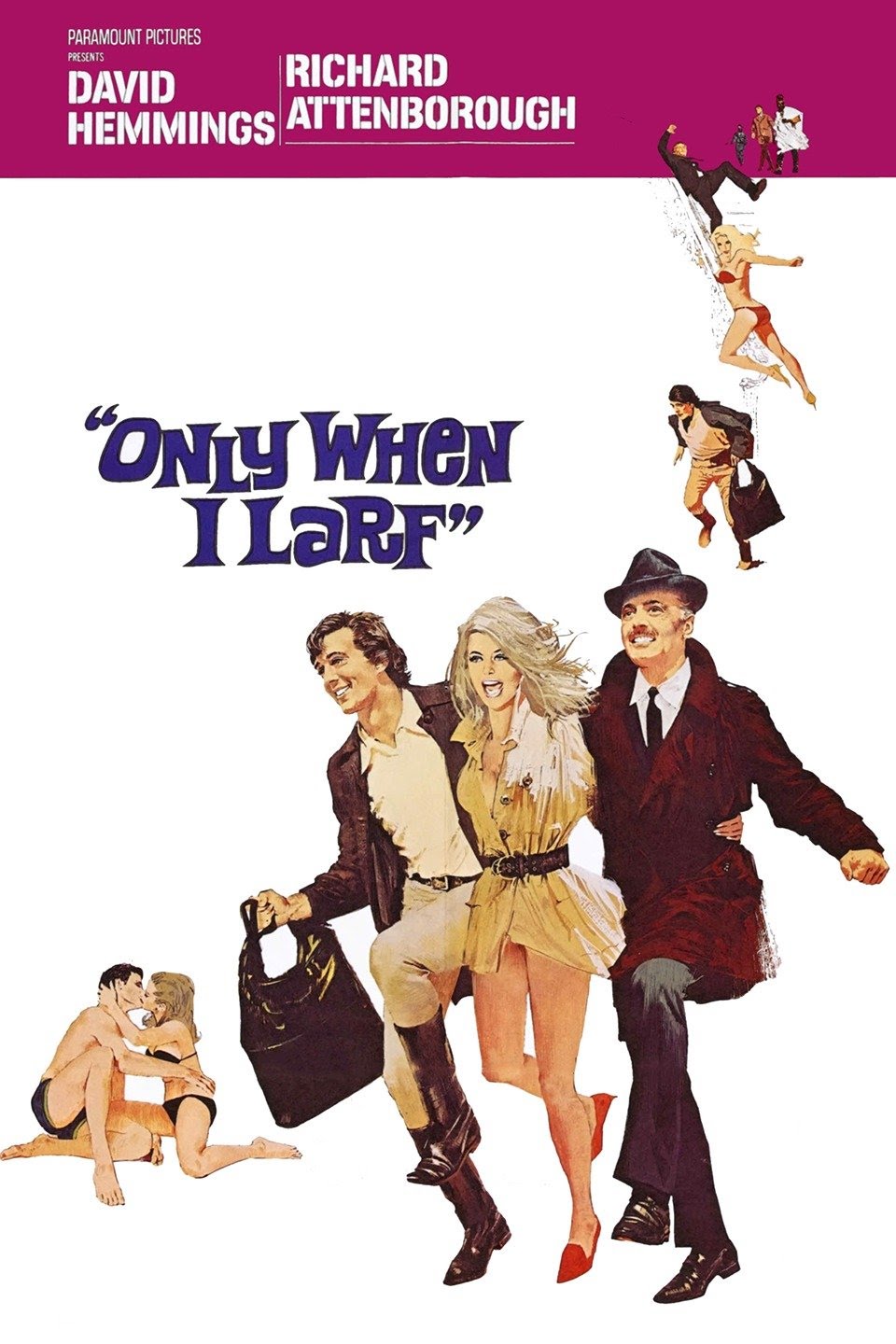
Terrific, elongated, 20-minute pre-credit sequence sets up this brisk con-man thriller as the trio of Richard Attenborough, his younger lover Alexandra Stewart and apprentice David Hemmings fleece a couple of greedy businessmen in New York. The action moves with military precision, the trio so appealing, the scam so well-worked, you want them to escape.
But when their next sting fails to come off, roles are reversed and it is floppy-haired Hemmings who takes charge, organizing the scheme, and making moves on Stewart. Meanwhile, Attenborough is planning to double-cross them. The first and last schemes work a treat but the middle one sags, even allowing for cracks to appear in the relationships.
Attenborough is the pick of the bunch, switching accents and personalities, one minute a suave businessman, the next a nervous Lebanon banker, while at other times his stiff upper lip contends with his sergeant-major attitude. Hemmings’ accents are less convincing, all over the place at times, but the switch from junior partner to operation controller is convincing especially as he clearly enjoys putting Attenborough in his place, forcing him to shave off his moustache and giving him the name Longbottom. And Stewart is never quite what she seems, willing to indulge either man to suit her purpose. Scottish actress Melissa Stribling, wife of director Basil Dearden, is a late addition to the crew and colder-eyed.
This was a departure for author Len Deighton, better known for The Ipcress File and Funeral in Berlin.
This was Attenborough’s first starring role since Guns at Batasi (1964) – Best Actor at the Bafta Awards – and although he had featured roles in Hollywood productions The Flight of the Phoenix (1965) and The Sand Pebbles (1966) – his screen person was quite confined in those pictures. Here, it feels like he has been let free. Hemmings was coming off three heavy roles in Camelot (1967), The Charge of the Light Brigade (1968) and The Long Day’s Dying (1968) so it felt like he, too, had a spring in his step. This was a distinct mainstream jump for Canadian actress Alexandra Stewart, although she had small roles in Maroc 7 (19670 and Truffaut’s The Bride Wore Black (1968),
Basil Dearden slipped this one in between the more lavish Khartoum (1966) and The Assassination Bureau (1969). There is a slapstick chase reminiscent of the latter but, basically, he keeps to the story and allows character to develop. This being a British film, you might find some outdated British attitudes. This was bestselling author Len Deighton’s first stab at production.
The Flight of the Phoenix, Khartoum and The Assassination Bureau have previously been reviewed in this blog.
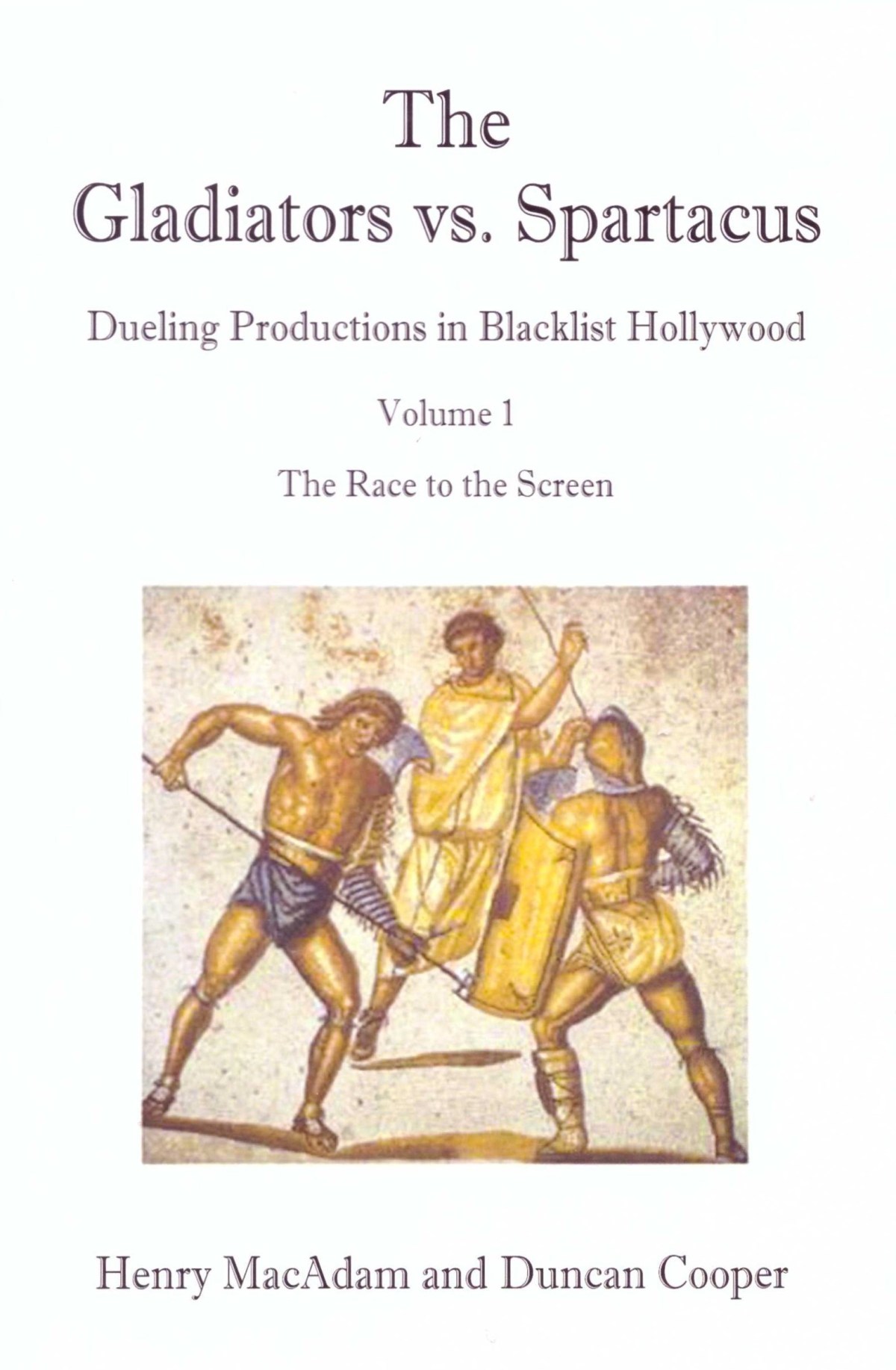
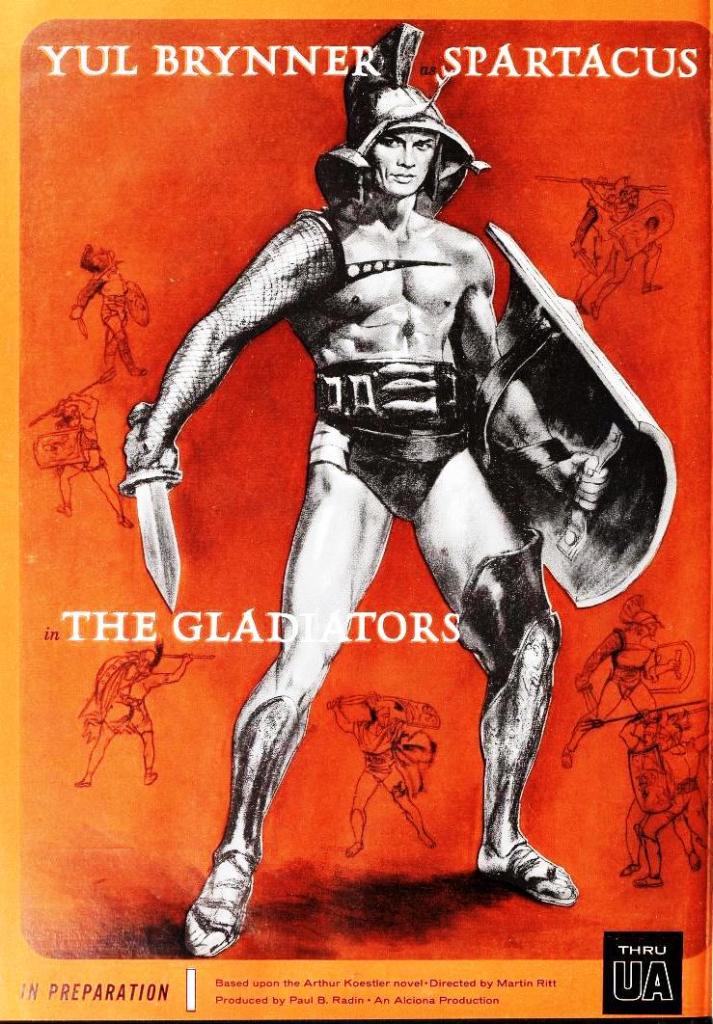
When I wrote my book some years back on the making of The Magnificent Seven (1960) I was aware that Yul Brynner had attempted to set up a project called The Gladiators in direct opposition to rival Kirk Douglas venture Spartacus. What I didn’t know until I came across this fascinating new book, telling the untold story of The Gladiators vs. Spartacus, Dueling Productions in Blacklist Hollywood by Henry MacAdam and Duncan Cooper, was just how close Brynner came to derailing the Douglas production. Indeed, at first it appeared Brynner’s The Gladiators, based on the novel by Arthur Koestler (Darkness at Noon, The Ghost in the Machine), was a cinch to be first past the post. After winning the Best Actor Oscar for The King and I (1956) and starring in box office behemoth The Ten Commandments (1956), Brynner was set to become a movie mogul after being handed a record $25 million – $230 million at today’s prices – from United Artists for 11 pictures. His first project was The Gladiators on a $5.5 million budget, Meanwhile, Douglas, rejected for the title role in the forthcoming Ben-Hur, his picture Paths of Glory (1957) producing dismal returns, struggled to find funding for Spartacus, based on the book by Howard Fast.
Promotional ad in 1958 for Yul Brynner as Spartacus in ‘The Gladiators.’
There are instances of two studios embarking on similar projects at the same time – sci fi adventures Deep Impact and Armageddon appeared within months of each in 1998 but Warner Bros and Twentieth Century Fox decided to combine competing movies about a skyscraper on fire into The Towering Inferno (1974). Here, as much as efforts were made to combine the projects both actors were determined to continue the battle despite the potential competition. At another point, Brynner sought to recruit Douglas for The Magnificent Seven. The race to the screen went back and forth for a couple of years, Brynner unable to choose between the historical drama and the western, while Douglas had the luck to have as his agent Lew Wassermann, in the process of buying up Universal who determined that Spartacus would be the ideal prestige vehicle to relaunch the studio.
What gives this volume special significance is that the films were being produced against the backdrop of the blacklist, the anti-Communist hysteria stirred by HUAC in the late 1940s/early 1950s. Screenplays for both films were the work of blacklisted writers, Abraham Polonsky on the Brynner side and Dalton Trumbo for Douglas. Polonsky was writer-director of Force of Evil (1948) as well as writer of another quintessential film noir Body and Soul (1947), for which he was Oscar-nominated, before his career was prematurely interrupted. Trumbo was held in even greater esteem, Oscar-nominated for Kitty Foyle (1941), and with A Guy Named Joe (1943) under his belt. While blacklisted, both wrote under “fronts”, Trumbo responsible for the Oscar-winning screenplays for Roman Holiday (1953) and The Brave One (1956), Polonsky successfully switching for a time to television. Both productions proceeded with the need to keep secret the real screenwriters, Ira Wolfert fronting for Polonsky, author Howard Fast unknowingly doing the same for Trumbo.
The parallel tales of two ambitious producers dueling for supremacy and of two blacklisted writers fighting for survival make a thrilling read. At any moment, either production could be killed by revelations about the screenwriters, while the planned films faced a succession of what seemed sometimes insurmountable obstacles. Both movies pursued, for example, the same three stars – Laurence Olivier, Charles Laughton and Peter Ustinov. Martin Ritt, initial director for The Gladiators, dropped out while Anthony Mann, in the same position for Spartacus, was fired. Script problems dogged both pictures. Rivalry was conducted openly in the trade press while the productions clashed over the title. Even when Spartacus nudged ahead in the production process, the spiraling budget almost put paid to the endeavor, while The Gladiators hovered in the background, intent on capitalizing should, as appeared for a long time the most likely outcome, the Douglas film flop at the box office.
The third riveting element of this book is a scoop. The authors have located the original Polonsky screenplay for The Gladiators, believed lost for over 60 years, and so are able to contrast the different approaches to the subject of the Spartacus revolution. (In a separate volume, the entire screenplay has been published with annotations and critical commentary by Fiona Radford and background essays by MacAdam and Cooper). Koestler was a cult figure, far better known than Howard Fast, and has remained in the literary consciousness ever since his suicide in 1983. With The Gladiators failing to reach the screen, Polonsky remained under the Hollywood radar for several years before his career revived with the screenplay for Madigan (1968) and as writer-director of modern western Tell Them Willie Boy Is Here (1969) starring Robert Redford. The revelation that Trumbo had written Otto Preminger’s Exodus (1960) and the involvement of Polonsky in The Gladiators helped break the blacklist. Trumbo went on to enjoy a successful official comeback, biopic Trumbo (2105) depicting the tribulations he suffered as a blacklistee.
This Brandon Cronenberg (son of you-know-who) rumination on identity is heavily disguised as a gory and occasionally sexy dystopian thriller. What appears at first glance a homage to giallo – toplining on shock, flesh and blood – soon reveals deeper layers of something more insistently disturbing. Focusing on an identity thief whose victim turns the tables into a who-owns-who, the films asks questions about the nature of identity and the effect of memory loss or memory accrual on individual personality. An early scene, part-debrief/part-interrogation, sees identity mind-robber Andrea Riseborough interviewed by boss Jennifer Jason Leigh to determine her own memory status, picking her way through a box of items carrying emotional connection, but it later becomes clear that Leigh has more sinister concerns: is the Riseborough returned from her latest adventure the same one as was sent out or has she been infiltrated by another?
Riseborough borrows identities in order to perpetrate a series of assassinations for an unseen corporation. Such murders are gorier than her employers would expect, invariably involving sharp implements, and setting the viewer to wonder whether the source for such brutality comes from a deeper part of the woman’s psyche. How much she is who she says she is is also questionable; before turning up on her ex’s doorstep, she rehearses what she wants to say. So there is mental and emotional dislocation at play, though whether that is the result of the experiments she appears to willingly undertake or whether from an existing characteristic is hard to say. So Cronenberg always has us at a disadvantage, and he keeps us that way, one step removed from what is going on, and may have occurred in the past, and only the determined assurance that nothing is going to turn out as it should.
One of the elements that places this picture in the top-notch category is that Cronenberg’s future does not fully work, components appear constantly out of place, as if a gear is always slipping. When Riseborough impersonates a man it is clear she has not quite grasped his full personality. When she possesses the identity of Christopher Abbott, a lowly drone partnering boss’s daughter Tuppence Middleton, he/she appears to be sleepwalking, parts of his personality eluding her, the disconnect so obvious that Middleton continues to ask what’s wrong and Abbott seems to forget that he is having an affair or has a friend at work. Again, it’s not clear whether this is Riseborough’s skillset drifting, or an extreme example of the dangers of identity theft. Instead of this whole concept being a scientific marvel, he/she is always one step behind. (Nothing to do with the plot but the previous butter-wouldn’t-melt-in-her-mouth English actress Middleton has also gone through a screen persona transformation, searching out her inner raunch for hot action with Abbott).
When Abbott begins to imagine inhabiting Riseborough’s face, the ghastly apparition seen on the poster, and in one of the movie’s most compelling scenes, the story takes a different turn, as if a Terminator is now on her tail.
The world depicted is an invasive one. Riseborough can infect the brain and take over the body, while Abbott’s day-job appears voyeuristic, as if the internet eye had become all-encompassing. To complete the dystopian feel, streets are always deserted and although that may be the result of budget restriction it fits the overall tone, this concrete jungle in sharp contract with murder in marble halls (a cameo by Sean Bean).
Riseborough is at her haunted best, Leigh steely as her boss, Abbott a revelation as the disturbed stolen property. Nod to Jim Williams for a brilliant score. While Cronenberg tags Blade Runner, Brazil, Blue Thunder and Terminator, the movie is an original. With enough drive and mystery to keep the thriller aspects at full tilt and while following in father David Cronenberg’s footsteps in his thirst for gore, the thrust of the picture is quite different, the concept so good it could have gone any number of different ways: the burglar trapped between two identities: the identities at war: or the personalities trying to make up what has been removed. You are left wondering what else could be going on in the world of Cronenberg’s imagination and not so much begging for a sequel but another parallel adventure in this particular universe. When a movie is still preying on your mind several days later, that’s when you know you have uncovered something special.
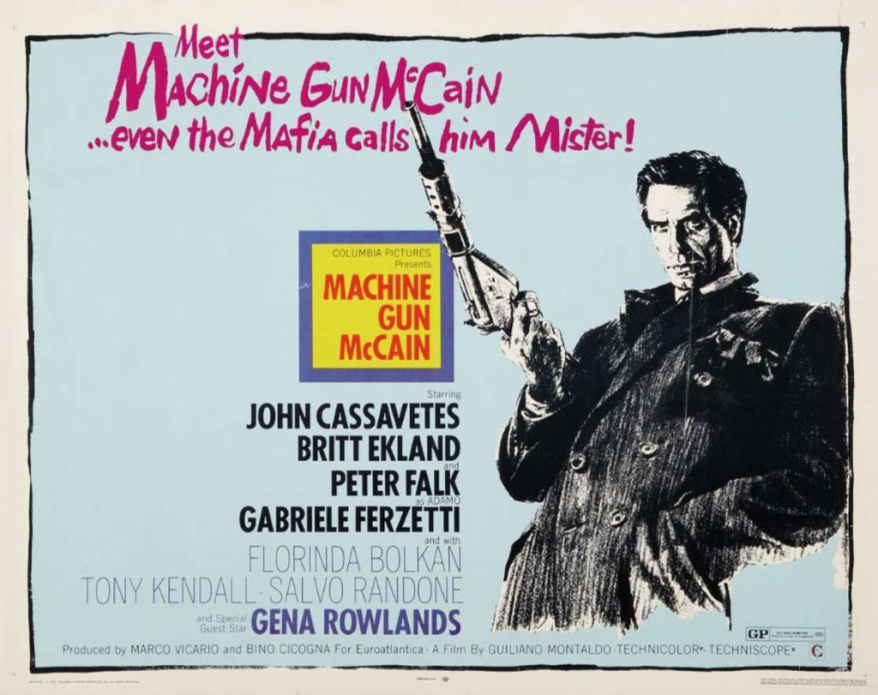
Armed robbers lack the finesse of a jewel thief or burglar when it comes to pulling off a major heist. Rather than resorting to the weaponry of the title, they are more inclined, as John Cassavetes does here, to plant bombs, both as a diversionary tactic and within the target building, in this case a Las Vegas casino.
Although boasting Hollywood leads in Cassavetes and Peter Falk and rising Swedish leading lady Britt Ekland (The Double Man, 1967) and wife of star Peter Sellers, this was an Italian-made gangster thriller with the usual abundance of location work. Minus the romantic complications of A Fine Pair (1968), it concentrates on the machinations of the central characters. And it is a pretty lean machine. The robbery takes place against the background of warring Mafia chieftains, West coast boss Falk trying to muscle in on a Vegas casino without being aware it is controlled by the New York hierarchy. Cassavetes does not realize the robbery has been set up by his naïve son on behalf of Falk. Ekland is on board as a kind of mostly mute magician’s assistant, helping Cassavetes.
Little dialogue comes Cassavetes’ way, either, which plays to his strength, that glowering intense unpredictable weasel-face, whose reactions are less likely to be emotional than violent. Falk gets the dialogue and little help it does him, his goose is cooked when he has the temerity to shout at the New York kingpin.
Yet this slimmed-down documentary-style hard-nosed picture in the vein of Point Blank (1967) manages several touching moments, even more effective for completely lacking sentimentality. When Cassavetes’ son is knifed in the back, the gangster finishes him off with a burst from the titular machine gun rather than see him suffer. His old flame Gene Rowlands, making too brief an appearance, has a wall covered in newspaper headlines of herself with Cassavetes when she was his moll and she accepts without enmity the new woman in his life and she proves the toughest moll of all when confronted with Mafia gunslingers.
The planning of the heist is well done, no explanatory dialogue, just action on screen; there’s a car chase; and the gangster dragnet is unexpectedly powerful. Gabriele Ferzetti (the railroad baron in Once Upon a Time in the West, 1968) is excellent as the calm authoritative New York boss, Falk a bit too excitable, and Florinda Balkan (The Last Valley, 1971), in her third screen role, has a small part as a traitorous moll. Ekland is surprisingly good with not much to play with, a couple of lines here and there but still emoting with her face.
Cassavetes, who always claimed he was only acting to fill in the time between directing (Faces, 1968), and as a means of financing them, was at a career peak, Oscar-nominated for The Dirty Dozen (1967) and male lead in Rosemary’s Baby (1968). He had just appeared in another Italian gangster movie Bandits in Rome (1968). Cassavetes and Falk would go on to have a fruitful partnership over another five films. Falk and Ekland had played opposite each other in Too Many Thieves (1967). Falk also had an Oscar nod behind him for Murder Inc. (1961) but his career was about to go in a different direction after the TV movie Presciption: Murder (1968) that introduced Columbo.
Trivia trackers might also note a score by Ennio Morricone. Though not one of his best, a few years later he would deliver one of his most memorable themes for Sacco and Vanzetti (1971) for the same director Giuliano Montaldo.
Essentially an Italian take on the slick glossy American thriller in the vein of Charade (1963), Arabesque (1966) and of course Blindfold (1966) which previously brought together Rock Hudson and Claudia Cardinale. Produced by Cardinale’s husband Franco Cristaldi, directed and co-written by Francesco Maselli (Time of Indifference, 1966), it is a cute variation on the heist picture.
Fans accustomed to seeing the more sultry side of the Italian actress (as in The Professionals, 1966) might appreciate how effective she is in more playful mood apart from one scene where she strips down to bra and pants. The other major difference is that in her American-made films, Cardinale is usually the female lead, that is, not the one driving the story, but here she provides the narrative thrust virtually right up until the end.
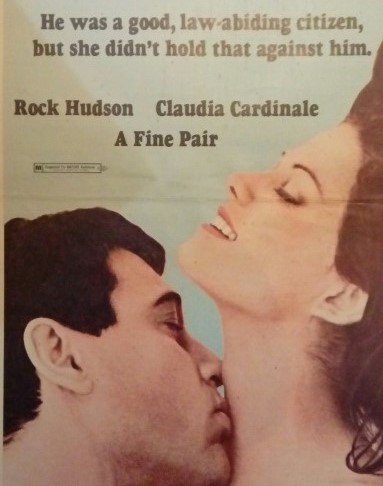
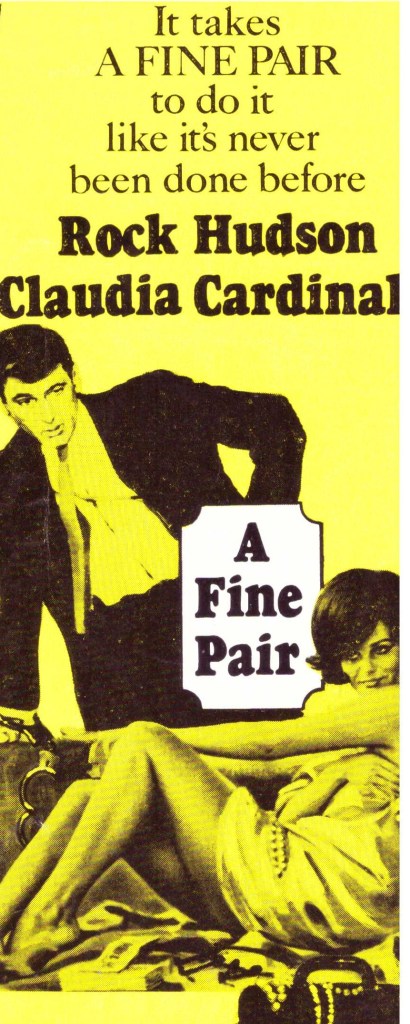
The American marketing campaign focused on the romantic element.
The British marketing campaign (top) took a different slant, not surprising since the film flopped in America. Even in Britain, however, it went out on the lower part of a double bill.
The twist here (as in Pirates of the Caribbean nearly four decades later) is that the bad guy (in this case bad girl) wants to return stolen treasure. Cardinale arrives in New York to seek help from old family friend Rock Hudson, a stuffy married American cop, so rigid he even uses a timer to regulate cigarette consumption. She has come into jewels stolen by an internationally-famous thief and wishes to return them to a villa in the Alps before the vacationing owners discover the theft. The bait for Hudson is to try and apprehend said thief.
The audience will have guessed the twist, that she is not breaking in to return jewels, but once Hudson, though his police connections has been shown the alarm systems, to deposit fakes and steal the real thing. So Hudson has to work out an ingenious method of beating three alarm systems, one of which is heat-sensitive, the whole place is “one big safe.”
Most of the fun comes from the banter between the principals and the is-she-telling-truth element essential to these pictures. “I lied – and that’s the truth,” spouts Cardinale at one point. I disagree with a common complaint of a lack of chemistry between Hudson and Cardinale. What the film lacks is not enough going wrong to lighten up such a hidebound male character such as occurred in Man’s Favorite Sport (1962), which makes the audience warm to the otherwise upright Hudson, or as seen in Gambit (1966) where Michael Caine played a similar stand-offish character. Cardinale is terrific in a Shirley Maclaine-type role, as the playful foil to the uptight cop, and who, like Maclaine in Gambit, knows far more than she is letting on.
What does let the film down is that it is at cross-cultural cross-purposes. As mentioned, this is an Italian film with Italian production values. The color is murky, way too many important scenes take place outside. Italians filmmakers of this generation never bothered with sound engineers for exteriors, simply dubbing and lip-synching back in the studio. More importantly, the actual heist lacks sufficient detail, and post-heist, although there are few more twists, the film takes too long to reach a conclusion. But for the first two-thirds it is a perfectly acceptable addition to the heist canon, the script has some very funny lines, Cardinale is light, charming and sexy.
The American title of this film was Steal from Your Neighbor, which is weak. A Fine Pair while colloquial enough in America has, however, an unfortunate meaning of the double-entendre kind in Britain.
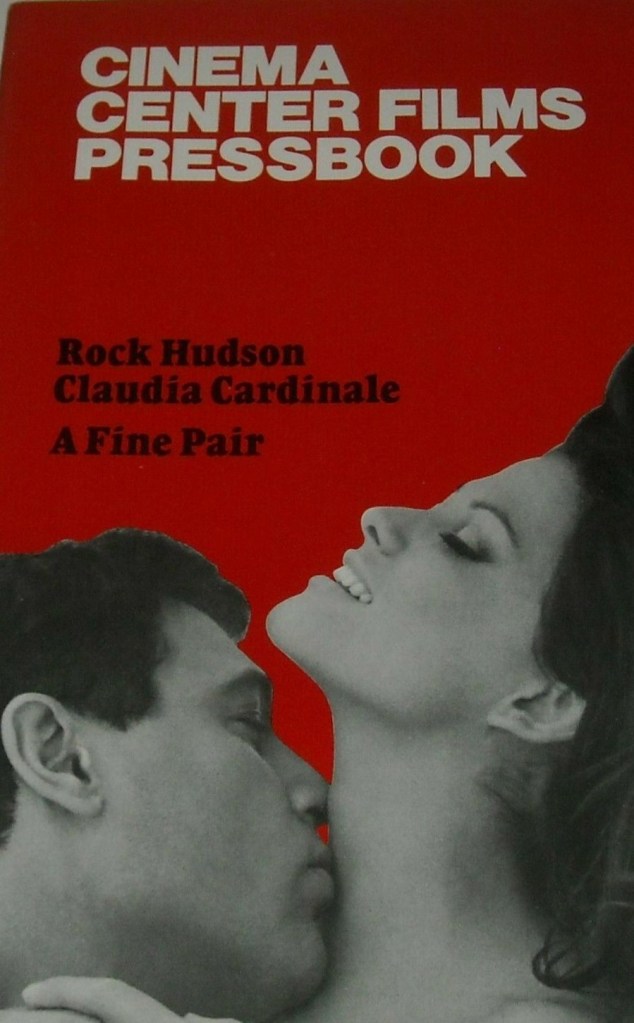
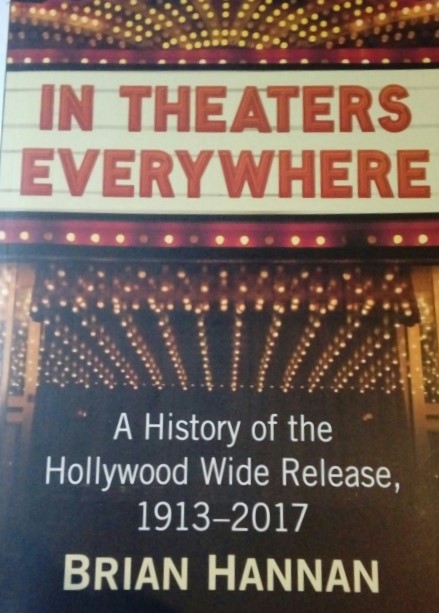
Lack of films being released – these days due to the pandemic – is not new. “A Fine Pair” was made during a time of chronic low production. But there was a sickening irony to the story of this film’s production. It was financed by the short-lived Cinema Center owned by the American television network CBS. When television was in its infancy, American studios had been barred by the Government from becoming involved in the new media. CBS got into movie production after studios had suffered from another governmental policy reversal. In 1948 the Paramount Decree prohibited studios from owning cinemas, a move which led to the end of the studio system and decimated production. The most sacrosanct rule of American film regulations was that studios could not own movie houses. Everyone assumed that applied the other way until in the early 1960s cinema chain National General challenged the ruling. By this point, production was so low that exhibitors were crying out for new product so the Government relented, much to the fury of the studios. That opened the door for television networks like CBS and later ABC (“Charly,” 1968) to enter movie production. I found all this out while writing my book “In Theaters Everywhere: A History of the Hollywood Wide Release 1913-2017.” And now, of course, studios have re-entered the exhibition market as have, once again, television companies.
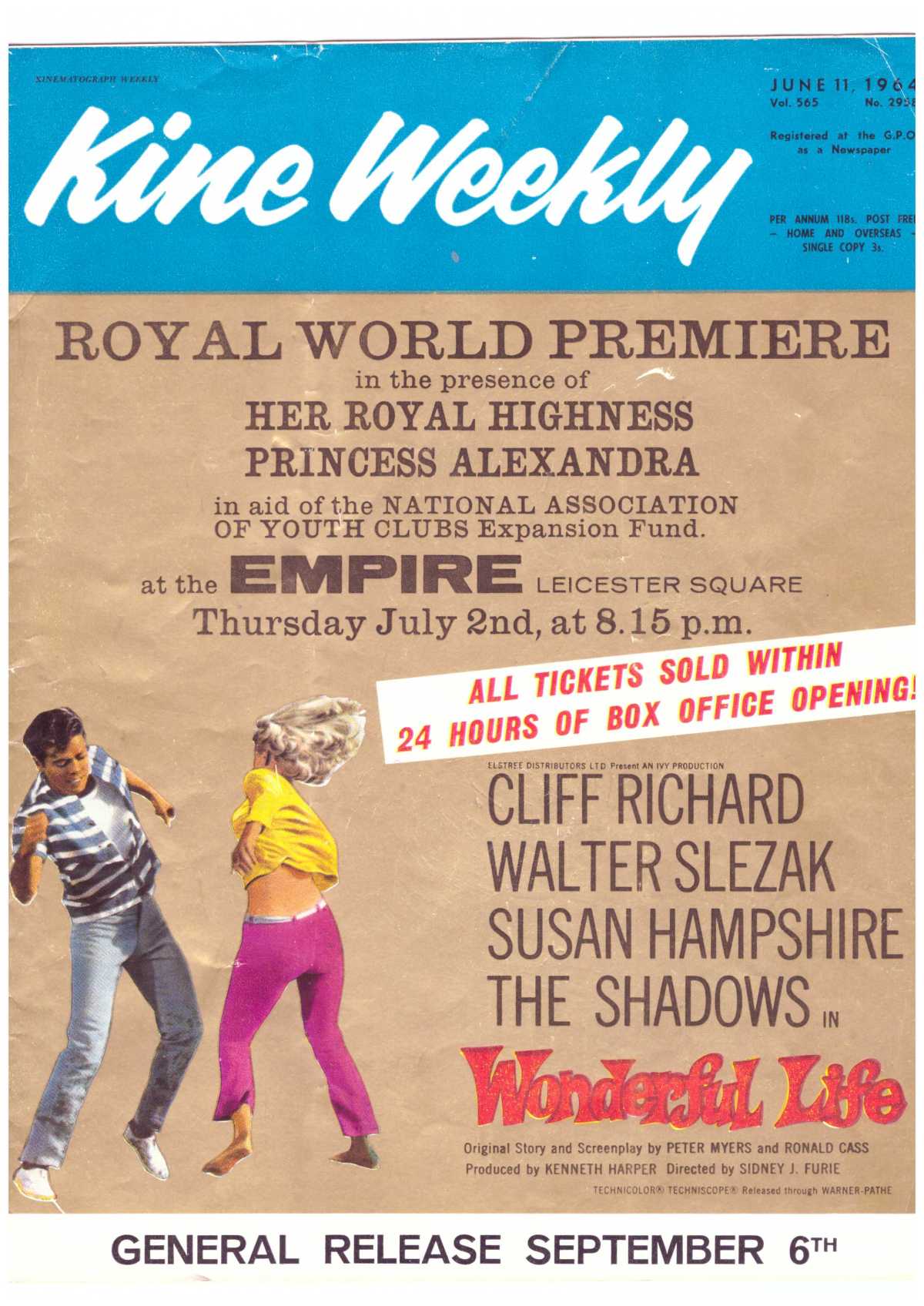
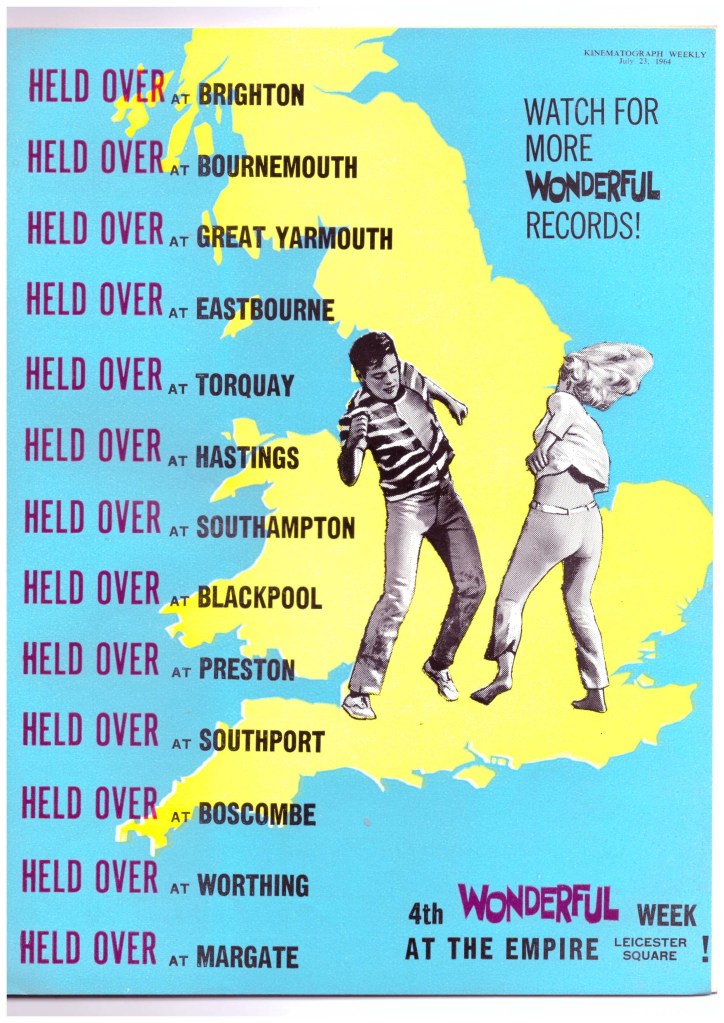
I have just discovered a new guilty pleasure. I was too young to remember when Cliff Richard was the British equivalent of Elvis and by the time I became aware of him he was already in the family-favorites league with his own television show and popping up in the wider consciousness from time to time with a number one single. But I was conscious that Cliff’s aspiring film career was totally obliterated by the emergence of the Beatles. I found Wonderful Life to be totally innocuous, highly enjoyable, charming fun. There’s no story to speak of beyond an affectionate spoof of Hollywood but it has zest and exuberance and some decent choreography by Gillian Lynne who went on to be deified for her work on the original London productions of Cats and Phantom of the Opera.
But there are some very funny visual gags, beginning with the opening scene when Cliff and Co are waiters on board a ship attending to a drunk whose glass moves out of reach every time the ship rolls. Having caused a power outage, they are chucked overboard in a dinghy and turn up in the Canary Islands where Cliff becomes a stunt man on the terrible Foreign Legion movie directed by a Hollywood ogre (Walter Slezak) and starring incompetent actress Susan Hampshire who has made a career of sorts playing the daughter of a sheik or sultan. You have to like a movie with lines like, “Follow that camel” and a geek (Richard O’Sullivan) whose scientific predictions invariably come undone. Cliff, realizing the lines are better sung than spoken, begins to make a musical on the back of the drama. And it’s true – the lines are good lyrics.
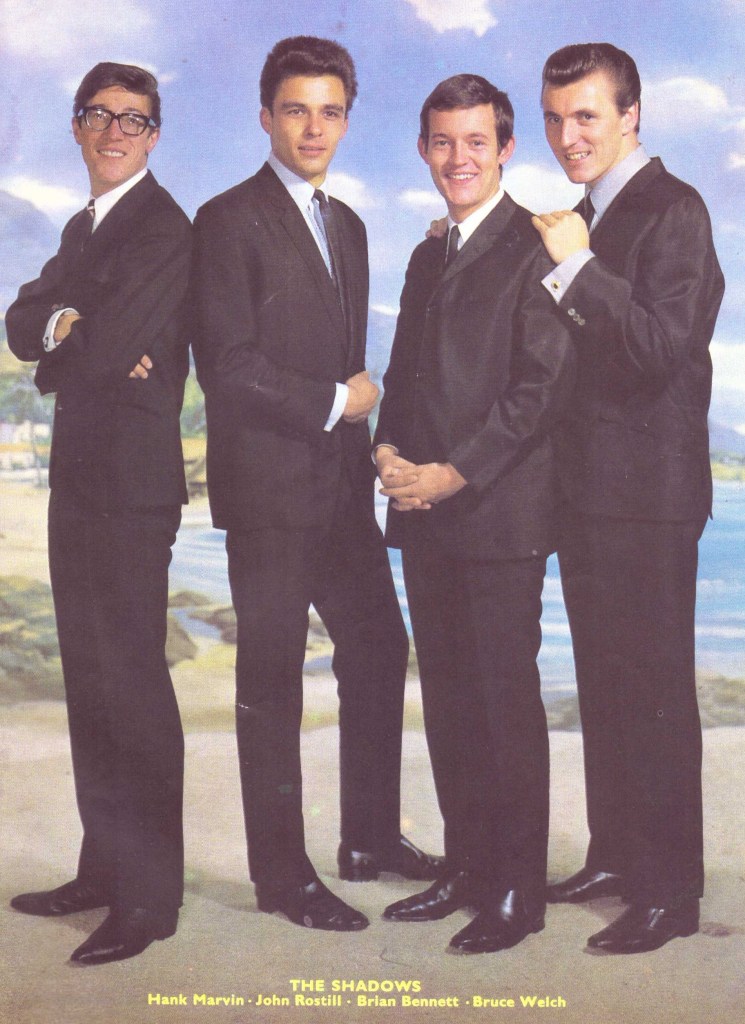
Britain had no reputation for musicals among the Hollywood cognoscenti unless you count the Jessie Mathews and Gracie Fields films of the 1930s which were far too parochial and contrived for American tastes and in terms of invention and musical technique a far cry from Lionel Bart’s Oliver! which would be filmed a couple of years later and in terms of originality not a patch on A Hard Day’s Night (1964) the same year. The songs are evenly contributed by various members of the Shadows – Bruce Welch composed the standout “A Matter of Moments” and with Brian Bennett the theme song – and the Peter Myers-Ronald Cass team who also wrote the screenplay. But this film comes across as naturalistic, rather than the contrivances of most Hollywood musicals. It doesn’t take much for these lads to strike up a song, any excuse will do. And the film is better for the lack of high emotion attached to every lyric.
You would be mightily surprised to learn that director Sidney J. Furie’s next film was stylish spy thriller The Ipcress File (1965) followed by Appaloosa (1966) with Marlon Brando and The Naked Runner (1967) starring Frank Sinatra. Here, he is in free-association mode, the ideas tumbling out, especially in the Hollywood parody dance numbers sections where we go from Chaplin pastiche to Greta Garbo and Groucho Marx, Fred Astaire-Ginger Rogers, West Side Story and James Bond. We have gangsters whose violin cases contain violins, a singing cowboy with subtitles (to explain the growth of the foreign movie) and a song about homesickness played out with Battersea Power Station in the background. If anybody can actually act they’re not putting any great effort into it. And that doesn’t matter either. The storyline is no more preposterous than many of the great Hollywood musicals. Everyone looks as if they’re having a whale of a time and I guess that would include the audience because the movie was the fifth-best performer of the year in Britain. This was the type of movie, during the rise of the permissive cinema, that you could take your grandmother to see and still come away surprised you had enjoyed it so much yourself.
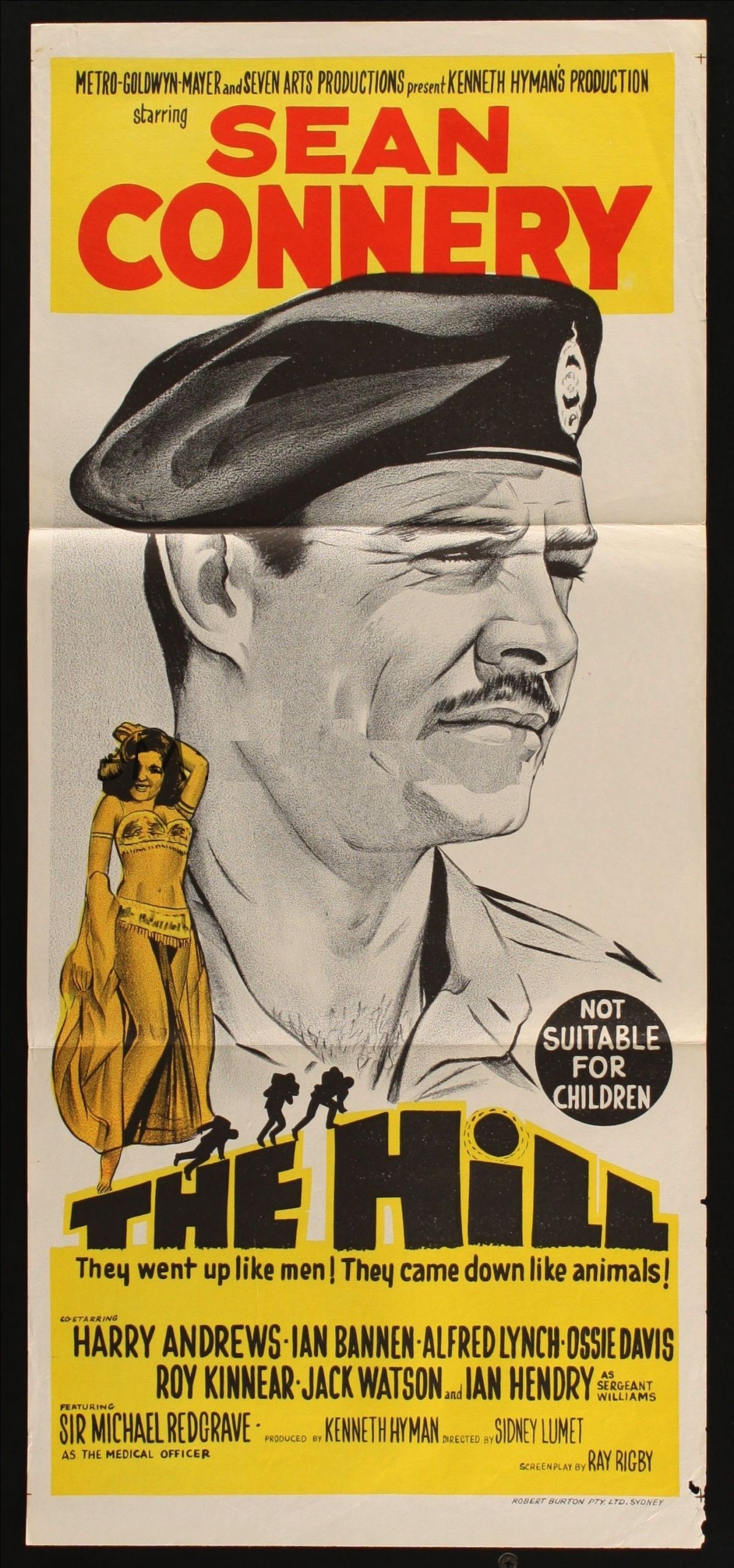
Set in a British Army prison camp in North Africa during World War Two ruled by sadistic Sergeant Wilson (Harry Andrews) who believes himself above the regulations he forces others to follow, The Hill is a parable about the hypocrisy of totalitarian rule. And much of what is shown would be offensive to modern sensibilities. Although the commandant (Norman Bird) and medical officer (Michael Redgrave) are his superior officers, Wilson runs the unit by force of personality. He believes his ruthless treatment of the prisoners turns them into proper soldiers. Into his fiefdom come five new prisoners including coward Joe Roberts (Sean Connery), spiv Monty Bartlett (Roy Kinnear), African American Jacko King (Ossie Davis), another Scot Jock McGrath (Jack Watson) and weakest link George Stevens (Alfred Lynch).
Most films about prisons emphasize imprisonment, most scenes taking place in cells or other places of confinement. Sidney Lumet (The Pawnbroker, 1964) directs this film as though it is a paeon to freedom with incredible shots of the vista within which the men are contained. He uses some of the most bravura camerawork you will ever see outside of David Lean. The film opens with a two-minute crane shot credit sequence that begins with a prisoner collapsing on the titular hill and pulls back to reveal the entire encampment and follows with a one-minute reverse tracking shot of Andrews striding through his domain. And while the camera controls what we see, our ears are constantly assailed by the constant drumbeat of other marching prisoners.
Climbing the hill in full pack would break any man and those who collapse are roused by pails of water. The first to crack is Stevens who is constantly tormented by homophobic jibes. Continuous racist abuse is heaped on Jacko King until driven to the point of madness he begins to behave like a gorilla which frightens the life out of his superiors. Obeying orders, says Joe Roberts, is “like a dog picking up a bone.” RSM Wilson is out of control, the commandant spending his nights with a prostitute, the medical officer clearly sent here as punishment for some previous misdemeanor. Of the senior staff only Harris (Ian Bannen) comes away with any dignity, constantly trying to thwart the worst bullying.
When Stevens dies suddenly, the film changes tack and becomes a battle for survival among those who could be blamed for causing his death and those who dare to point the finger. Wilson has no problem stitching up his colleagues and blackmailing the medical officer while Roberts is beaten up for his effrontery in standing up to authority. But the astonishing presence and self-confidence and, it has to be said, courage of Wilson lords it over everyone, and there is an extraordinary scene where he forces the entire battalion of prisoners to back down when they are on the brink of open rebellion.
Connery as Roberts is superb in what is his first dramatic role in a bread-and-butter dramatic production rather than the glossier Marnie (1964) and Woman of Straw (1964) and while he has his moment of defiance he gives enough glimpses of vulnerability and fear to ensure we do not mistake him for his alter ego James Bond. Ian Bannen delivers a touching assured performance far removed from the nasty sarcastic personalities he portrayed in his other desert pictures, Station Six Sahara (1963) and the Flight of the Phoenix (1965). Ossie Davies, as defiant as Connery, is brilliant as the man who works out a way to beat the enemy by confusing them; the scene in the commandant’s office where he treats the officer as his inferior is a tour de force.
Although the Army is meant to run according to established regulation, where obedience to a superior is paramount, it is equally apparent that it can also become a jungle if those who are the fittest assume control. Sgt Wilson demands unquestioned discipline even as he is breaking all the rules in the book. But he retains his authority not just by bullying, but by intelligence, exploiting weakness, coolness under pressure and by welcoming confrontation, his personality as dangerous as any serial killer.
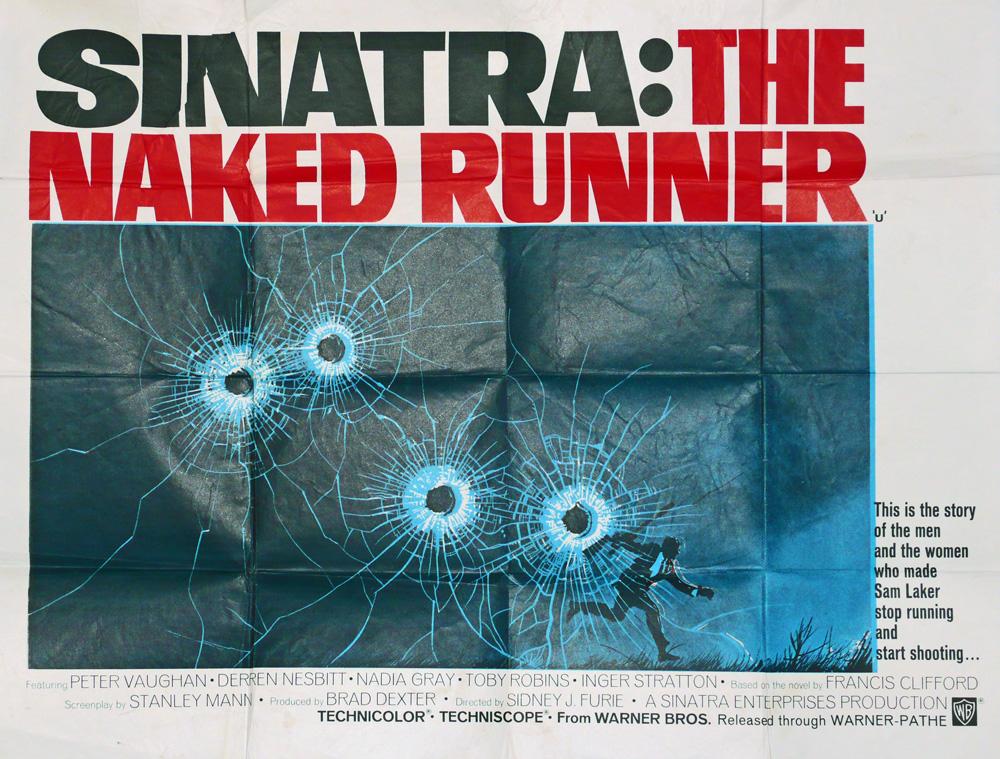
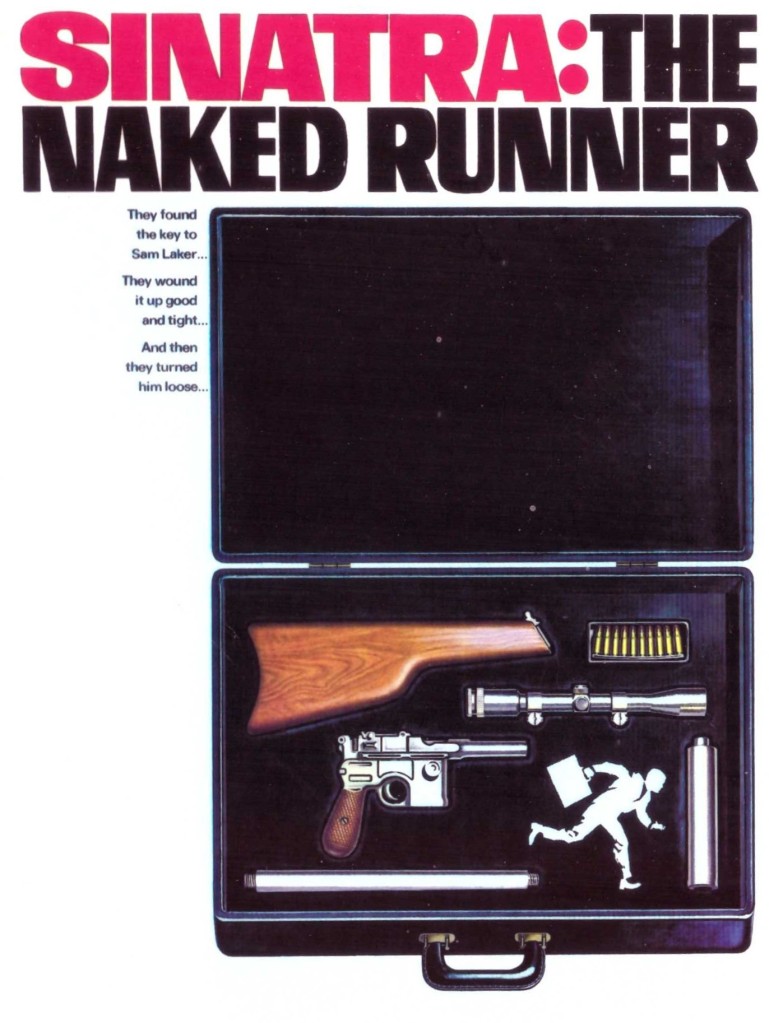
We always knew the spy world was filled with the worst kind of legal renegade, the type who can get away with murder in the name of King and Country, with little regard for collateral damage, claiming the Cold War justifies any action. British espionage chiefs, wishing to assassinate an escaped spy before he can reach the Russian border, recruit against his will widowed businessman Sam Laker (Frank Sinatra). The spy top brass don’t care what methods of persuasion are used, “blackmail or drugs,” and eventually they decide that kidnapping his only son will make Laker toe the line.
Spy chief and wartime colleague Martin Slattery (Peter Vaughan) is a cold-blooded killer aiming to turn an ordinary man, albeit with a distinguished war record, into a cold-blooded killer. Laker is duped into delivering a message while on a business trip to Leipzeig in East Germany. When his son disappears it is at the behest of the equally ruthless East German secret police boss Colonel Hartmann (Derren Nesbitt) and thus begins a game of cat-and-mouse between Sinatra and the two spymasters competing for his services especially when it transpires he is a crack marksman. He is shifted to Copenhagen to assassinate the fugitive.
Naturally, the web is soon even more tangled. Laker becoming even more tense, with his son’s life hanging in the balance questions of morality are void. It’s edge-of-the-seat stuff because the audience is as much in the dark as Laker about what is actually going on. Fans of the sophisticated spy thriller will not be surprised that there is a surprise ending.
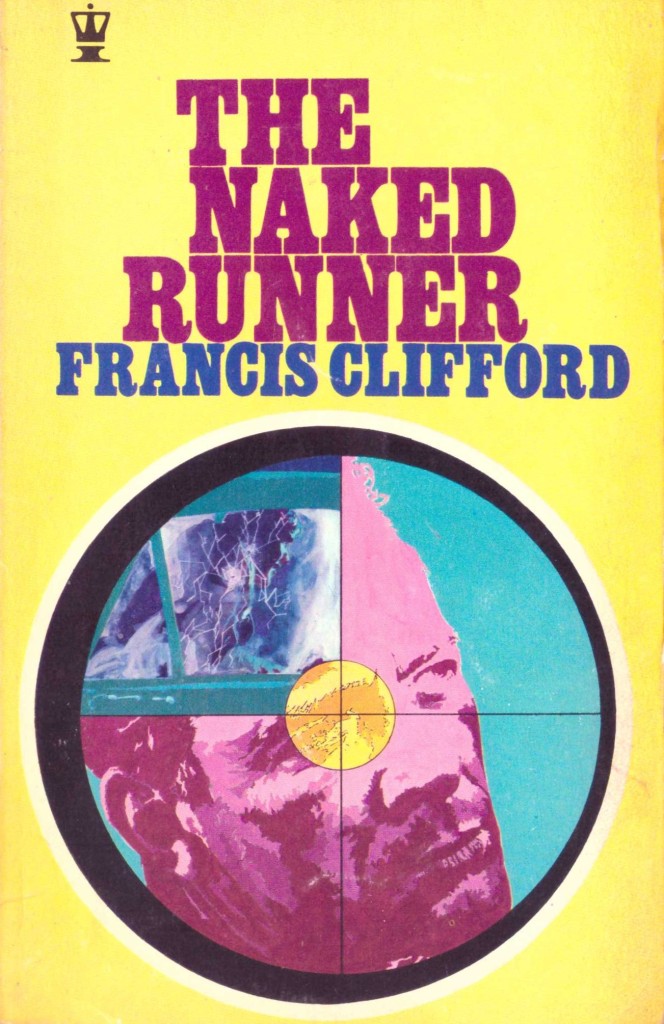
The main departure from the book by Francis Clifford (also author of the source novel for “Guns of Darkness,” 1962) is the movie overview. The book follows the hero from start to finish. Only at the end is explanation offered. In the book the assassin’s target is a defector not an escaped spy. However, opening the book up to involve Slattery discussing his methods and providing an overview of the espionage world is a bit like tacking on an unnecessary message to an otherwise straightforward thriller. Straying from Laker’s point-of-view lessens rather than increases tension. Sinatra Enterprises produced the picture so presumably screenwriter Stanley Mann’s change of emphasis had the actor’s blessing.
Director Sidney J. Furie has some form in this murky world, having helmed the ground-breaking The Ipcress File (1965) whose spies are lot less glamorous than their James Bond counterpart. Even so, Michael Caine was a jaunty hero. Sinatra is the polar opposite. A more dour individual you could not meet. Sinatra is excellent in a role that asks him to bury a normal screen persona that oozes self-confidence. Furie is obsessed with odd camera angles and extreme long shots and extreme close-ups which has probably the intended disconcerting effect, concentrating the viewer on characters rather than surroundings.
While this approach worked in The Ipcress File and The Appaloosa it is less effective here, largely I think because Sinatra cannot brood with Brando’s intensity nor is his face as open and inviting as Caine’s. Although Sinatra is good in the role it does not suit the director’s intent which was surely to portray a man about to crack. Whereas the director’s impulse for the unusual made The Ipcress File a stylish film, here the camera angles get in the way of what is otherwise a taut story of a man driven to the limit. In fairness, the abundance of close-ups may not have been Furie’s fault. Sinatra disappeared for several days when the shoot moved to Copenhagen forcing Furie to shoot around him and inserting previous filmed close-ups.
Edward Fox (Day of the Jackal, 1973) has a small role as a diplomat and Romanian Nadia Gray (Two for the Road, 1967) appears as Laker’s initial contact in Leipzig.
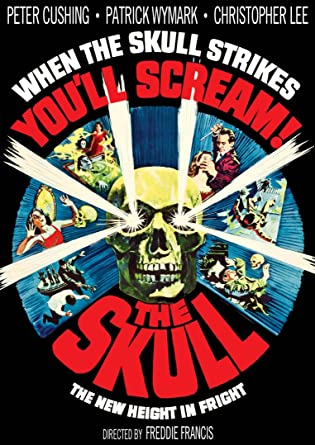
I have no idea why this masterpiece has not been acclaimed. For virtually half the picture, there is no dialogue, the entire focus on camerawork and reaction. Even Stanley Kubrick in The Shining (1980) gave in to grand guignol and The Exorcist (1973) was filled with over-the-top scenes but here the psychological impact of possession remains confined.
Initially, it appears we are in familiar Hammer territory, a grave-robber detaching a skull from a corpse only to meet an untimely end. There is another flashback to the gothic where the presence of the skull drives an ordinary man to murder. But this is an Amicus production and set in contemporary times with Christopher Lee and Peter Cushing once again in opposition, but this time only in an auction house bidding for demonic artefacts. Exposition is straightforward. A dealer (Patrick Wymark) sells Cushing a book about De Sade bound in human skin. Wymark may be a con man. He claims to possess the skull of the Marquis de Sade but his attitude towards it, kissing its head, plucking its nose socket, and the fact that he willing to halve his asking price, suggest otherwise. Lee, who once owned the skull, warns Cushing against it.
The rest of the film covers Cushing’s possession of the skull and the skull’s possession of him. There is a notable Kafkaesque sequence where Cushing is arrested, taken before a judge and forced three times to play Russian roulette before ending up in the house of the dealer where he steals the skull. What is less often commented upon is that this nigh-on 15-minute sequence including a 90-second taxi ride conducted in virtual silence, the camera mostly on Cushing’s face, that silence only broken by the feeding of bullets into the barrel of the gun and the barrel being rolled round. It is not long before Cushing commits his first murder.
There is a famous scene in the Last Tycoon (1976) in which Robert De Niro explains to a truculent word-obsessed British writer why dialogue is redundant in the movies. All you need is camera and reaction. That sets up The Skull’s greatest scene, a 17-minute dialogue-free climax, where Cushing is effectively preyed upon and consumed. The skull itself appears to have a point-of-view, various shots of Cushing through the skull’s eyes. The actual special effects are limited to what is imminently achievable, the skulls glows, it moves through the air. The impact of its presence is shown on Cushing’s face and by his action. It is just hypnotic.
Various directors have been anointed for the way they move their camera – Antonioni’s 360-degree turn in The Passenger (1975) comes to mind, large chunks of 2001: A Space Odyssey (1968), the long wait for sunrise in Lawrence of Arabia (1962), the lengthy shots of James Stewart driving a car in Vertigo (1958). But I have never seen anything as innovative as the silent sequences in The Skull which would be a waste of innovation were the sequences not so effective, especially on the small screen. Freddie Francis directed from a story by Robert Bloch. Equally innovative is the jarring music by avant-garde composer Elizabeth Lutyens.
Many of the films from the 1960s are to be found free of charge on TCM and Sony Movies and the British Talking Pictures as well as mainstream television channels. But if this film is not available through these routes, then here is the link to the DVD and/or streaming service.
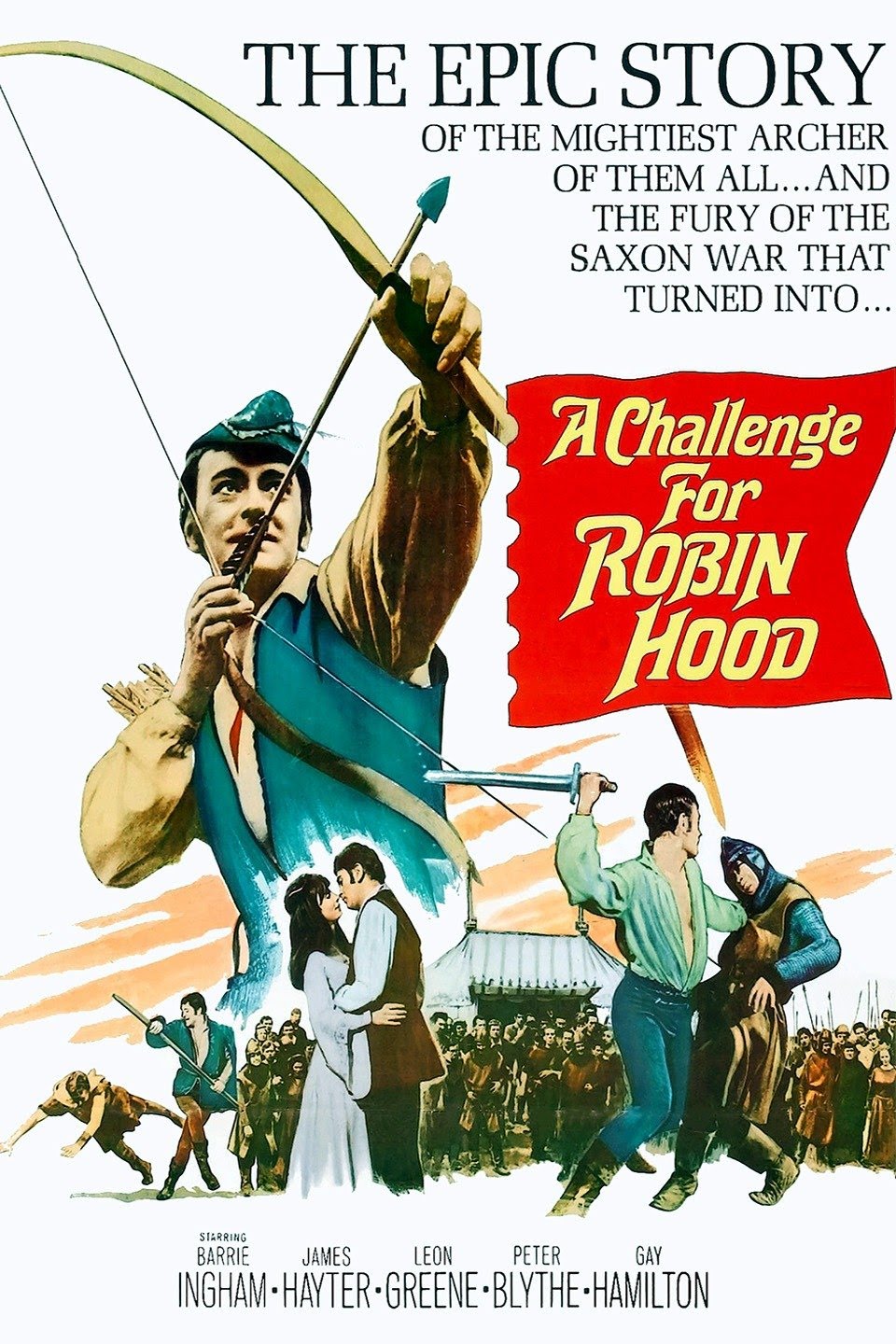
British studio Hammer made a second valiant attempt at reviving the moribund swashbuckler – six years on from Sword of Sherwood Forest. More in the way of an origin story, this explains how a nobleman turned into an outlaw and how the merry band was formed. For in this tale Robin Hood (Barrie Ingham) is a Norman nobleman framed for murder, Will Scarlet (Douglas Mitchell) and Little John (Leon Greene) are castle servants (also Normans) while Maid Marian (Gay Hamilton) is in disguise. Some liberties are taken with the traditional version – there is no fight with Little John, instead, as noted above, they are already acquainted.
There are a couple of excellent set pieces and although the swordfights are not in the athletic league of Errol Flynn they are more inventive than the previous Hammer outing and there is enough derring-do to keep the plot ticking along. Robin’s cousin Roger de Courtenay (Peter Blythe) is the prime villain this time round, the sheriff (John Arnatt), although involved up to the hilt at the end, content to offer acerbic comment from the sidelines.
When Robin and Friar Tuck escape the castle by jumping into the moat, Will Scarlet is caught and later used as bait. Meanwhile Robin’s archery prowess and leadership skills have impressed the Saxon outlaws hiding in the forest and he takes over as their head. The picture follows the swashbuckler template with clever ruses, jousting, Robin disguised as a masked monk, torture, and a pie fight.
Being plucked from obscurity and turned into a star was a standard Hollywood publicity story from the 1930s and 1940s, but the notion survived well into the 1960s – and “A Challenge for Robin Hood” was proof for one lady. Liverpool-born Sheila Forrest had won the “Girl in a Million” competition organized by the ABC cinema chain as a promotional gimmick for “One Million Years B.C.” Fifteen regional finalists had been judged at Elstree film studios by a panel including Martine Beswick, a supporting actress in “One Million Years B.C.,” West Ham footballer and World Cup winner Geoff Hurst, and “ABC Film Review” editor Peter Haigh. As well as the £1,000 first prize, Sheila won a role in a forthcoming Hammer film, which turned out to be the Robin Hood picture, known at that time as “Legend of Robin Hood,” and she appeared in a photoshoot for “ABC Film Review” (August 1967, p12) dressed as a lady-in-waiting and pictured with star Barrie Ingham (mispelt as Barry Langham in the fan magazine) and James Hayter. Unfortunately, the role was not large enough to receive a credit and as far as I am aware that was her only film..
Director C. M. Pennington-Richards had some swashbuckling form having helmed several episodes of The Buccaneers and Ivanhoe television series but his big screen experience was limited to routine films like Ladies Who Do (1963) with Peggy Mount. This was a departure for scriptwriter Peter Bryan, more used to churning out horror films like The Brides of Dracula (1960) and The Plague of the Zombies (1966), and he has invested the picture with more wittier lines and humorous situations than you might expect. It’s certainly Saturday afternoon matinee material and unless compared to the likes of ThePirates of the Caribbean or the classic Errol Flynn adventure it stands up very well on its own.
Many of the films from the 1960s are to be found free of charge on TCM and Sony Movies and the British Talking Pictures as well as mainstream television channels. Films tend to be licensed to any of the above for a specific period of time so you might find access has disappeared. But if this film is not available through these routes, then here is the link to the DVD and/or streaming service.


 The Magnificent 60s