The one where Burt Reynolds suddenly alights on his screen persona. At the outset he’s just another B-picture dude hoping to get by on macho posturing. Then, as though his brain has sparked into silver screen intelligence, the cocky grin appears. And we’re off.
If any director was skewered by his insistence on retaining his artistic vision, it’s Samuel Fuller (The Naked Kiss, 1964). He wasn’t one for good guys and bad guys. Everybody’s up to something, if good deeds occur it’s by accident. Such realism would make him catnip for today’s disillusioned generation.
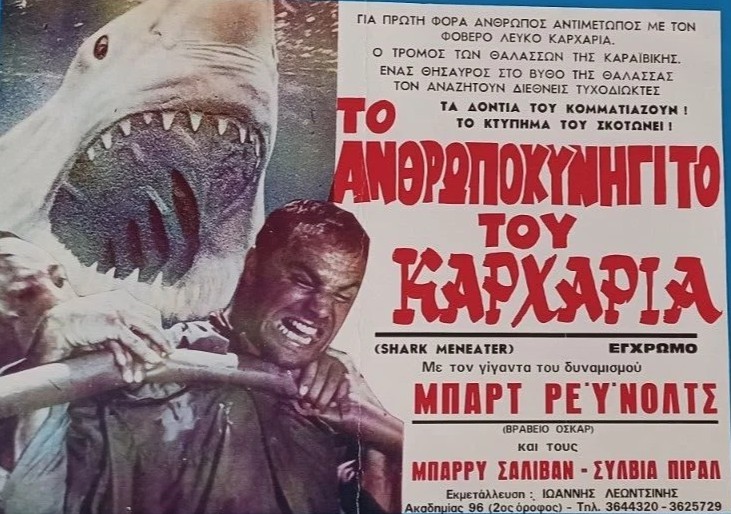
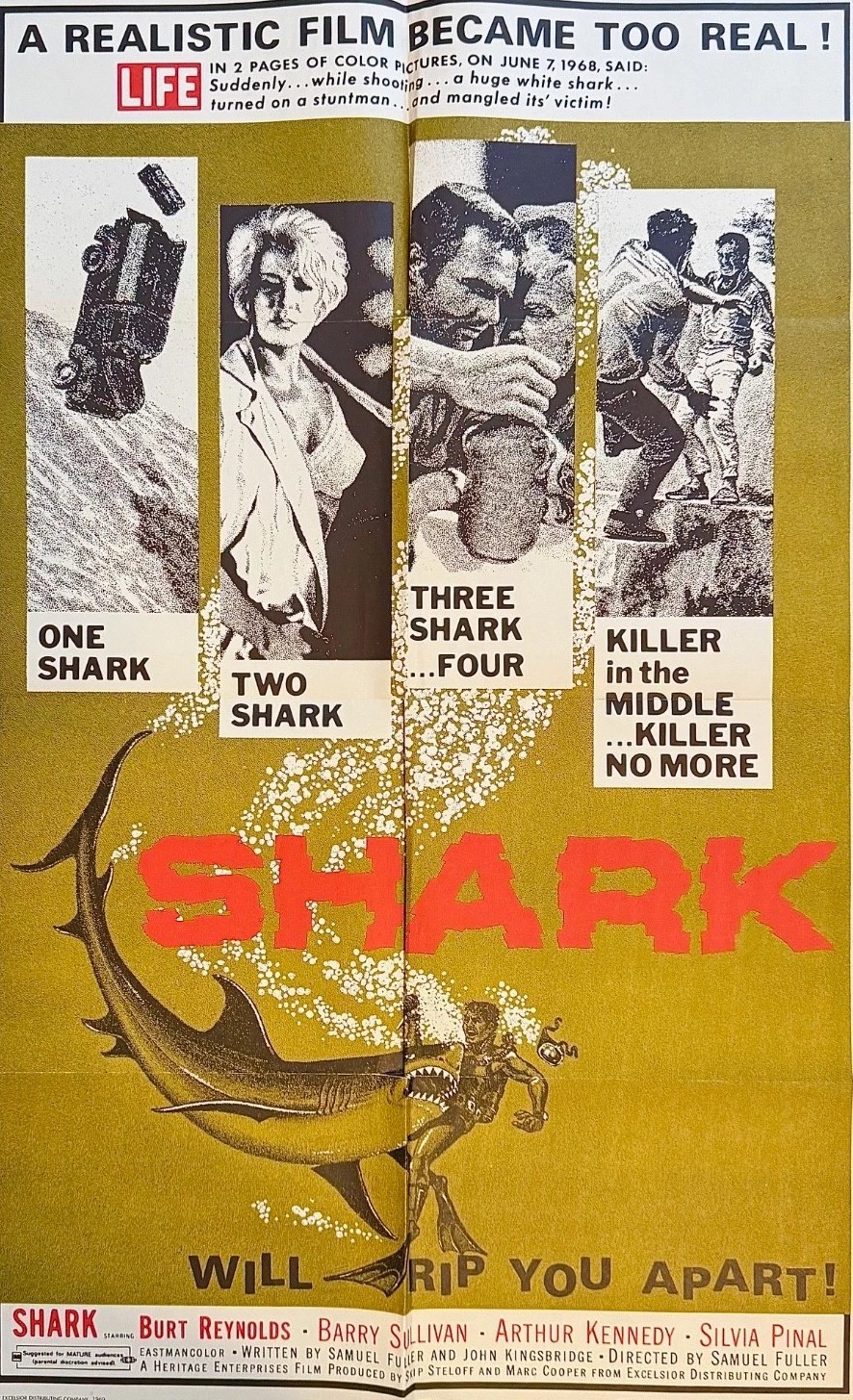
And it’s got cult written all over it because Fuller wanted to take his name off the picture after it was re-edited by the producer, possibly to include more shark footage at the expense of the human flotsam and jetsam trying to make a buck in the shark-infested waters off the Sudan in Africa. (Spoiler alert: it was filmed in Mexico). The shark footage for the era, it has to be said, is pretty damn good and although the sequences of people being gobbled up by a marauding shark must have been staged with a fake shark they look entirely convincing on the small screen.
And this was before the shark exploded on the screen via documentary Blue Water, White Death (1971) and of course Jaws (1975). Even so, the producers managed to make the sharks here sound even more fearsome by duping Life magazine into running some fake news about Burt Reynolds’ stunt double being killed by a shark.
In any other world two partners hunting for sunken treasure who were in sore need of a diver would simply have made an honest approach to their target, offering a share of the loot. Who’d not jump at the opportunity? Except Professor Mallare (Barry Sullivan) and Anna (Sylvia Pinal) only have a license to dive for strange sea specimens, not lost gold, and Caine (Burt Reynolds) is a gunrunner wanted by the police. The local cop Inspector Barok (Enrique Lucero) does his best to keep tabs on things except, short of donning scuba gear, he’s got no way of seeing what they’re getting up to underwater, though, clearly, as the story plays out, he has his suspicions.
Anna reckons she needs to offer Caine a sweetener to come on board, so she hops into bed with him. The only person who has a redemptive bone in his body is the alcoholic doctor (Arthur Kennedy) who spoils his own salvation by demanding dough for saving someone’s life.
So while, what with being unable to resist the delectable Sylvia, Caine signs on for a share of the gold, he is from the outset planning how, in the event of striking it lucky, to get rid of his partners, which is just as well because they’re equally intent on getting rid of him. The climax is a pretty good one, and given I’d just watched Gene Hackman in Night Moves (1975) being left stranded and dying in a boat going round in circles in the ocean, that notion is matched here where Sylvia makes her escape on a boat she doesn’t know is sinking.
Burt Reynolds (Sam Whiskey, 1969), once the cocky grin puts in an appearance, isn’t the only plus point here. Five-time Oscar nominee Arthur Kennedy (Anzio, 1968) is slumming it but no doubt having a ball as an incorrigible drunk. This might also be perceived as a bit of a comedown for Sylvia Pinal (Guns for San Sebastian, 1968) after being a regular in Luis Bunuel arthouse offering like Viridiana (1961), The Exterminating Angel (1962) and Simon of the Desert (1965) but her part is too underwritten to do her talents justice. Barry Sullivan (Harlow, 1965) fills in the blanks.
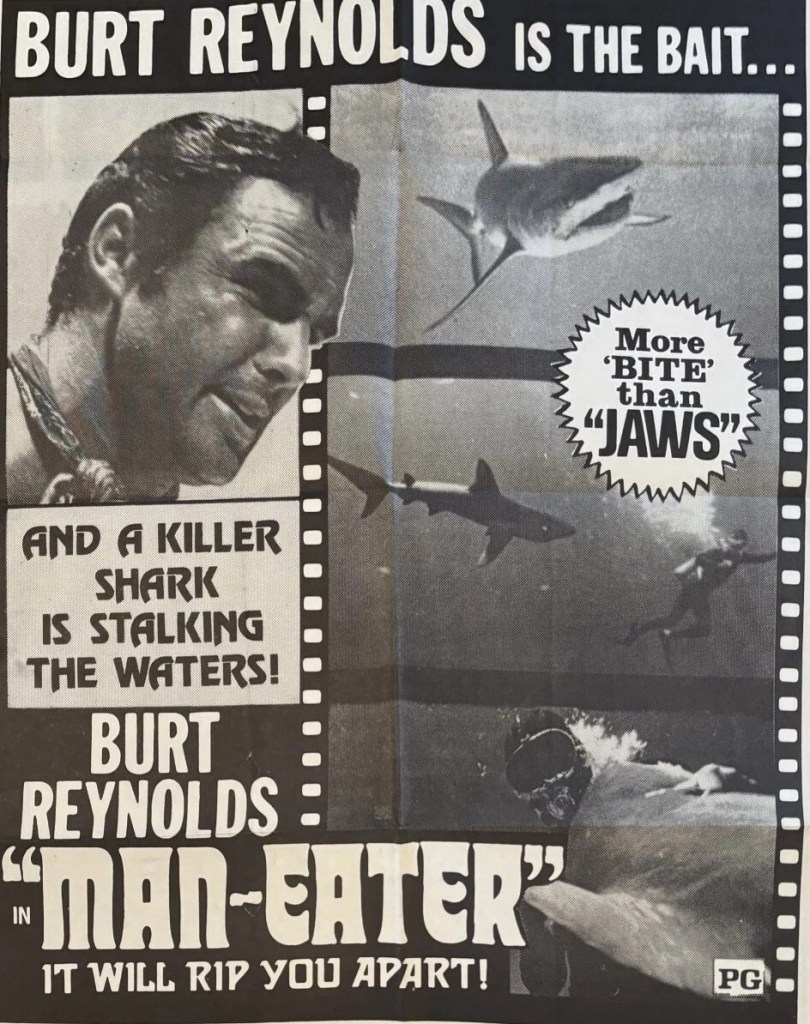
But maybe the star attraction is the shark in the days when such a creature made rare appearances on screen even if it’s not a great white as with Blue Water, White Death or Jaws. The Steven Spielberg blockbuster did Shark! a good turn, and in its wake the Fuller picture was reissued as Man-Eater in both 1975 and 1976 and again in 1978 after Burt Reynolds, cocky grin to the fore, had achieved superstardom thanks to Smokey and the Bandit (1977) and Hooper (1978). Screenplay by the director and television writer John T. Dugan in his movie debut based on the Victor Canning (Masquerade, 1965) bestseller.
It’s a shame Samuel Fuller objected to the end result for as far as I can see, after a slow start, it’s quite a decent picture and as I said the characters will appeal to a contemporary audience.
Give it a chance.

 The Magnificent 60s
One thought on “Shark! / Man-Eater (1969) ***”