
Fans of reality television shows will be only too aware how participants volunteer for ritual humiliation, but swallowing a few locusts and being stuck with a couple of snakes has nothing on the realities facing individuals during the Great Depression who would literally dance non-stop for days on end with a ten-minute break every two hours. It’s impossible to imagine that anybody could think of dreaming up such a degrading circus to take advantage of the desperate. But then this is America, land of opportunity and the MC Rocky (Gig Young) continues to spout aphorisms and continues to promote the American Dream even as it disintegrates in front of him.
When the partner of Gloria (Jane Fonda), out-of-work actress and one of the more physical and cynical of the candidates hoping to scoop the $1,500 first prize (no prizes for coming second, of course), is ruled out through bronchitis – in case he passes it on to others rather than more any humane consideration – she pairs up with dreamer Robert who initially wanders in as spectator rather than participant. Glamorous platinum blonde aspiring actress Alice (Susannah York) is already coming apart. Sailor (Red Buttons) is a former war hero and James (Bruce Dern) drags his heavily pregnant wife (Bonnie Bedelia) around the dance floor.

There is not a great deal of story except to watch everyone grow mentally and physically incapacitated. There is betrayal and lust and survival instinct leads characters into sexual situations. When Alice seduces Robert, in retaliation Gloria dumps him and then has sex with Rocky, while attempting to retain control of that situation, but clearly needing at the very least consolation and confirmation of her attractiveness and at best some sign of favoritism.
As well as non-stop dancing, Rocky throws in stunts to keep the audience, who can sponsor a pair, interested. So there are 10-minute races, the last three to be eliminated. So determined are some of the competitors they will even lug their dead partner over the finishing line. Another of Rocky’s wheezes is to have Gloria and Robert marry, worth $200 in terms of the gifts they will receive from a sentimental audience, in the middle of the dance floor.
They are literally dancing for hours, over 1,000 in over 40 days so gradually the dance floor becomes less crowded as dancers collapse from exhaustion or cannot take it anymore. The spectators, we are reminded, are only there because “they want to see someone worse than them.” Just when you think nothing can shock you any more, it is revealed that the first prize is minus the cost of feeding, sheltering and looking after the winner.
Those who think they are tough find that the demands of mental and physical endurance are beyond them. This is a shocking film and there’s no doubt it will stay with you for a long time. I saw it first when it came out but not again until now and thank goodness for forgetfulness otherwise I doubt if I would have chosen to sit through it again.
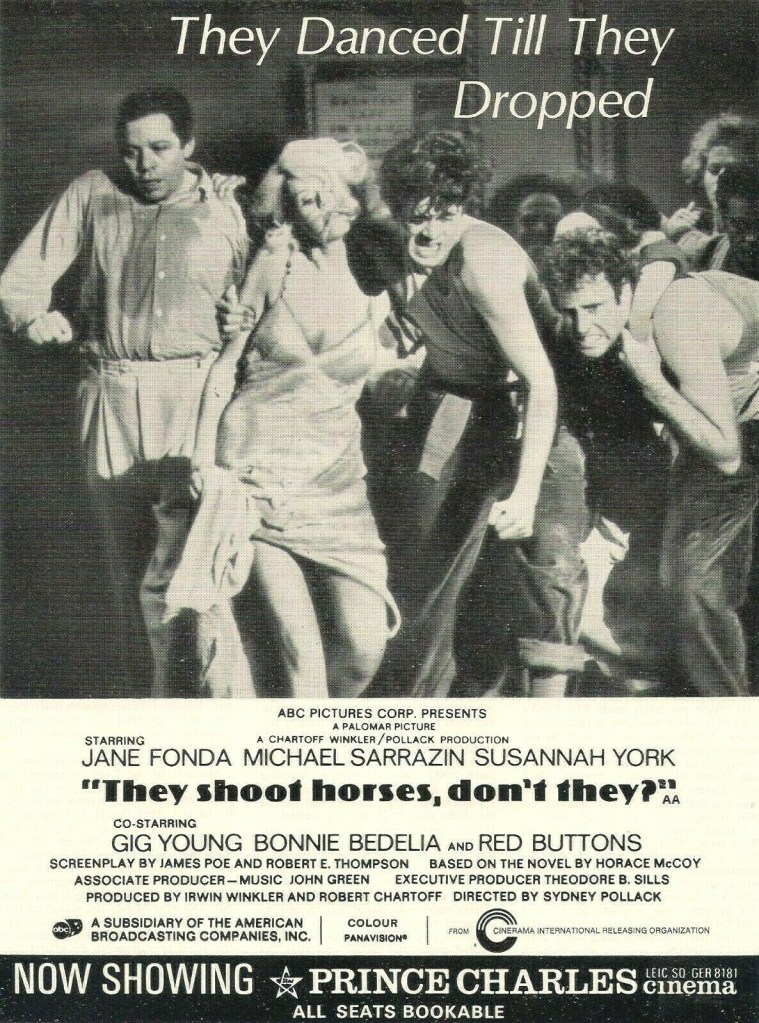
It’s doubtful if any actress had achieved such a speedy transition from glamorous leading lady to serious actress as Jane Fonda. From stripping in space in Barbarella (1968) to stripping away the last vestiges of her humanity here. Suddenly, she appears in a brand-new screen persona with the grating voice, the chip on the shoulder, the feistiness and worthy inheritor of father Henry’s acting genes. It’s also a bold role for Susannah York, in an extension of the weak character she essayed in Sands of the Kalahari (1965) but far more delusional, believing in a rainbow that will never appear. Michael Sarrazin (In Search of Gregory, 1969) initially appears out of his league but his character calls for a gentle innocence that is well within his scope.
Gig Young steals the picture, offered the opportunity to bring alive a multi-faceted character, as big a spiel-merchant who ever crossed the screen, but engaging in a marathon of optimism, and at some points, such as when coaxing a demented Alice out of the shower, earning our sympathy. Red Buttons (Stagecoach, 1966), Bruce Dern (Castle Keep, 1969) and Bonnie Bedelia (Die Hard, 1988) also put in sterling work.
The movie received nine Oscar nominations but was ignored in the Best Picture category. Only Gig Young won for Best Supporting Actor. Jane Fonda and Susannah York both received their first Oscar nominations, for Fonda the first of many, for York the one and only. It was also a debut nomination for Pollack, a future winner.
Sydney Pollack directs with simplicity, concentrating on the indignities of the event and focusing mostly on the personalities draining away, and even the drama is undercut, most of those scenes directed in straightforward style. However, Pollack plays around with the innovative fast forward – flashes into scenes that have not yet taken place. James Poe (Lilies of the Field, 1963), at one time down to direct, and Robert E. Thompson, a television writer making his first venture on the big screen, wrote the screenplay from the Horace McCoy novel.
Check out the Behind the Scenes article on this one.

 The Magnificent 60s
Loved the book but never saw the movie. Got it bookmarked now though.
LikeLiked by 2 people
Not exactly a film to “enjoy,” it’s often brutal stuff but the acting is terrific.
LikeLiked by 1 person
Great acting in this, and as you say, the subject matter is very now with tv competitions like Touch the Truck demonstrating that the public still has an appetite for this kind of degredation. Didn’t remember bedelia in this, but do remember Young being pretty amazing here…
LikeLiked by 1 person
I think he stole the show. He needed as much stamina as the rest and had to put a gloss on the whole degrading spectacle.
LikeLike
A once watcher. So brutal. Stuff of nightmares.
For your files:
“Horace McCoy’s 1935 novel, They Shoot Horses, Don’t They?, sold only 3,000 copies when it was first published in 1935, according to the 20 Nov 1969 DV review of the film, but the book was later described as a “minor classic” in the 11 Dec 1969 NYT. It was republished in 1948, 1955, and 1966, an article in the 6 Mar 1966 LAT noted. In 1947, screenwriter James Poe became interested in optioning screen rights, but his acquisition of the property was not announced until summer 1966, when a 25 Jul 1966 LAT article reported that Poe would produce, write, and make his feature film directorial debut on the project. The 10 Jan 1969 DV named Charles Chaplin as one of several other filmmakers who had previously optioned the novel.
The original budget was cited as $850,000, and $1-$1.5 million, in 10 Jan 1968 and 27 Aug 1969 Var articles, respectively. Principal photography was initially scheduled to begin in spring 1968. Set to be produced by Palomar Pictures International, Ltd., a subsidiary of ABC Pictures Corp., the film was delayed until late fall 1968. In the meantime, Jane Fonda’s casting was announced in the 17 Jul 1968 LAT, and a 7 Oct 1968 LAT brief named Donald Sutherland as the top contender for Fonda’s co-star. Previously, the 16 Sep 1968 DV had reported that Michael Sarrazin, Alex Cord, and Scott Wilson were the three candidates being considered by producers Irwin Winkler and Robert Chartoff. Sarrazin, who was under contract with Universal Pictures at the time, was ultimately cast, as announced in the 21 Nov 1968 DV. The 11 May 1969 LAT later noted that Sarrazin had almost lost the role due to Universal’s demands for a high “loanout” fee.
On 2 Dec 1968, an LAT brief reported that Martin Baum, who had recently taken over as ABC Pictures Corp. president, was having second thoughts about first-time director Poe. Leonard Goldenson, Jerry Lewis, and Roger Vadim (then married to Jane Fonda) were considered as replacements before Larry Peerce was hired to take over, as reported in the 13 Feb 1969 LAT. However, Peerce was forced to drop out of the project “when he couldn’t be cleared of a Paramount pre-empt.” Sydney Pollack then replaced Peerce, as announced in the 31 Dec 1968 LAT. A 13 Feb 1969 LAT item explained that Baum had decided to fire Poe when he “found the budget was well over $3 million, and the script in no condition to use.” Possibly with the aid of another, unnamed writer, Pollack made revisions to the screenplay, according to a news brief in the 16 Jan 1969 LAT, which also noted rumors that Pollack might fire Sarrazin. Items in the 3 Feb 1969 and 13 Feb 1969 LAT confirmed that Sarrazin would remain on the film, despite Baum’s attempt to replace him with Warren Beatty, who was said to be Pollack’s first choice for the role.
Palomar originally planned to shoot the film at Metro-Goldwyn-Mayer (MGM) studios, as noted in the 16 Oct 1968 DV, but the production company ultimately rented soundstages at the Warner Bros.—Seven Arts, Inc., studio lot in Burbank, CA. The 27 Dec 1968 DV noted that in Santa Monica, CA, location shooting was slated to take place at Ocean Park Pier, and at the derelict Aragon Ballroom on the Santa Monica Pier, the onetime setting of the The Lawrence Welk Show (ABC, 2 Jul 1955—4 Sep 1971). The following month, the 10 Jan 1969 DV stated that filming at the Aragon was cancelled due to a protest by the Teamsters Union, which had insisted on transportation for background actors to and from Santa Monica, even though the Screen Extras Guild (SEG) had reportedly agreed to waive its mandatory transportation rule. Irwin Winkler claimed that such transportation would have added $45,000 to the $3.2 million budget, and to save costs, the Aragon was constructed on Stage Four at Warner Bros.—Seven Arts, instead, as noted in the 13 Mar 1969 LAT. Set decorations included period movie posters for Susan Lenox (Her Fall and Rise) and Five Star Final (1931, see entries), and, according to an item in the 31 Mar 1969 LAT, some scenes shot on the dancefloor entailed camerawork done by Pollack, who wore a sky-diver’s helmet with a camera attached as he roller skated ahead of actors. Principal photography began on 17 Feb 1969 and ended in Jun 1969, according to a 21 Feb 1969 DV production chart and a 25 Nov 1969 LAT article, which quoted Jane Fonda as saying (of her time on the film), “God, it was hard!” The actress claimed that playing “Gloria Beatty,” whom she described as “miserable,” led her to discover “a black side” to her own character, and, although she was opposed to “taking work home,” she had been unable to break from the character during the shoot.
On 21 Nov 1969, a DV brief reported that test screenings had been met with favorable reviews, but nevertheless, five minutes were set to be trimmed from the film, and music was due to be changed in one sequence. The post-production work was slated to be completed at MGM before another round of sneak previews in late Nov 1969, prior to the 10 Dec 1969 New York City opening at the Fine Arts Theatre.
A final budget of $4.5 million was cited in the 27 Aug 1969 Var. James Poe, who was due to receive a thirty-percent share of the profits, speculated that the film would not break even unless it grossed $12 million at the box office. The 6 Jan 1971 Var later listed They Shoot Horses, Don’t They? as the fifteenth-highest-grossing picture of 1970, with cumulative film rentals of $6.5 million.
For his portrayal of “Rocky,” Gig Young received an Academy Award for Actor in a Supporting Role and a Golden Globe Award for Best Performance by an Actor in a Supporting Role in Any Motion Picture. The film also received Academy Award nominations for Actress (Jane Fonda), Actress in a Supporting Role (Susannah York), Art Direction, Costume Design, Directing, Film Editing, Music (Score of a Musical Picture—original or adaptation), and Writing (Screenplay—based on material from another medium); and Golden Globe nominations for Best Motion Picture – Drama, Best Director – Motion Picture, Best Performance by an Actress in a Supporting Role in Any Motion Picture (Susannah York), Best Performance by an Actor in a Supporting Role in Any Motion Picture (Red Buttons), and Best Performance by an Actress in a Motion Picture – Drama (Jane Fonda).
Marvin Paige was named as the casting director in a 17 Sep 1968 DV brief, and the following actors and actresses were listed as cast members in DV and NYT items dating from 21 Feb 1969 to 10 Apr 1969: Kippie Kovacs; Beverlee McKinsey; Murray McLeod; Eric Sevareid; and Carolan Daniels. Lionel Stander, who was originally cast as “Rocky,” as announced in the 16 Sep 1968 DV, later sued ABC Pictures Corp. for loss of the role without compensation, according to the 27 Aug 1969 Var.”
LikeLiked by 1 person
Terrific stuff. Thanks once again. Didn’t know Sutherland was in the frame.
LikeLike