
The one with the wife-swapping. Like Easy Rider released earlier the same year, a hymn to freedom, only this time of the sexual kind. Responsible thirtysomethings, well-to-do, married with children, jealous of the younger generation’s counter culture, seek guilt-free irresponsibility. They feel they’ve missed out, despite knocking back cocktails in their heyday, probably remained virgins until marriage. Like the recently-reviewed The Battle of the Villa Fiorita (1965), the problems incurred in marriage appear eternal, and decades later this holds up superbly, not just for taking a measure of its times, but for a screenplay setting up a bold series of reversals, character reaction you would never expect, that will have you in stitches even as it dissects universal truths.
Documentary film-maker Bob (Robert Culp) and housewife Carol (Natalie Wood) “find” themselves at a weekend retreat espousing naked yoga, primal screams, group therapy and emotional intimacy. Carol admits she finds her husband controlling. They return in evangelistic mode, desperate to pass on their new-found knowledge to their stuffier friends, Ted (Elliott Gould) and Alice (Dyan Cannon).
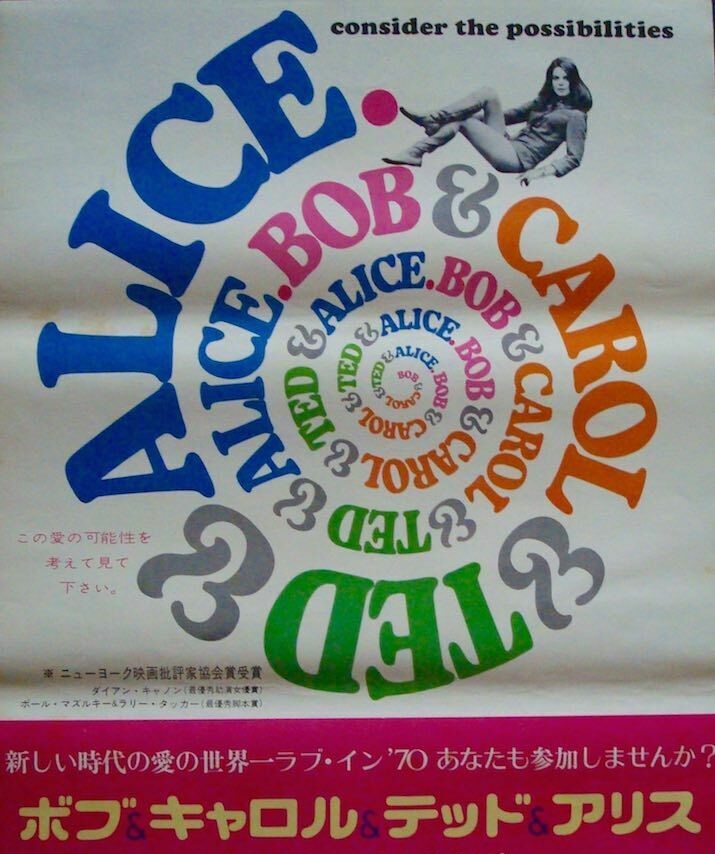
The film unfolds in a series of long sequences, each sparked by external incident. Bob confesses to his wife that while away on business he had an affair. To his astonishment she forgives him. Expecting this to be a prelude to some new way of tormenting an unfaithful husband, Bob remains skeptical until Carol convinces him that her world-view has changed following the retreat.
But Ted and Alice find it harder to accept. In a brilliant scene that exposes basic gender differences, he sees the problem as his revelation, she as the act of infidelity itself. High after meeting the other couple, Ted wants sex, but Alice, shocked by what she has heard, cannot contemplate it. He exerts so much pressure that she, deeply insecure, is almost on the verge of giving in. The dialogue not just marvelously encapsulates their marriage but sets out opposing views that, I am sorry to say, would probably be as prevalent today.
But the best scene, a superb reversal, occurs when Bob, spurning another night of illicit passion, returns home from a trip early to find his wife in bed with the tennis coach. Gender equality et al. The sequence turns completely on its head when, according to the couple’s new philosophy, Bob should not only accept and forgive, but help the tennis coach out of his predicament, calming his fears of facing an angry husband, in effect consoling his bedroom rival.

What appears to have been just a Ted fantasy, hooking up with a woman he met on an airplane, turns out to be true, creating a crisis in that marriage and when Alice is pacified, acknowledging a new truth, it is she who calls for an orgy. Now this is a revolution for Alice is by far the most repressed, although attractive almost matronly, and still using a childish word to describe her private parts. Her confessions to a psychiatrist reveal a tormented individual.
It’s a stunning debut from Paul Mazursky (An Unmarried Woman, 1978) who also had a hand in the screenplay with Larry Tucker (I Love You, Alice B. Toklas, 1968). He takes a story of endorsed immorality and stamps it as a morality tale. A movie that depended so much on dialogue concludes with a fabulous series of shots where the look on the faces of the characters tells you all you need to know.
Elliott Gould (The Night They Raided Minsky’s, 1968) and Dyan Cannon (The Murder Game, 1965) are the pick of the actors, both stepping up to the plate after less than stand-out performances previously. Both were Oscar-nominated but more importantly here created screen personas that would define their futures. Natalie Wood (This Property Is Condemned, 1966), in her first picture in three years, revitalized her career after a string of flops. Robert Culp, in a step-up from the I Spy television series (1965-1968), initially takes center stage but cedes ground to the superior acting of the others.
Where a whole bundle of films by new directors flopped that year and the next by targeting the younger generation, this was a success by painting a wry picture of a slightly older generation, not yet tipping into middle age, but terrified they might be missing out on something.

 The Magnificent 60s
I only saw this on STV about 1982, and would assume I saw a heavily cut version. I’ll circle back for another look…
LikeLiked by 1 person
Not much to actually cut. Only fleeting nudity. Most of it is bait and switch.
LikeLike
Here is something:
”
In the summer of 1968, producer M. J. “Mike” Frankovich acquired rights to Bob & Carol & Ted & Alice, an original comedy written by Paul Mazurksy and Larry Tucker, as noted in the 18 Jul 1968 DV and 23 Jul 1968 LAT. The film was set to be financed and released by Columbia Pictures, with Mazursky making his feature-length directorial debut. The following month, a 30 Aug 1968 DV brief noted that Natalie Wood had been cast as “Carol Sanders,” and Columbia was seeking Joanne Woodward to play opposite her, in the role of “Alice Henderson.” The 12 Sep 1968 LAT listed Richard Benjamin and his wife, Paula Prentiss, as candidates for two of the four leading roles. One week later, the 20 Sep 1968 DV confirmed that Wood’s co-stars would be Robert Culp, Dyan Cannon, and Elliott Gould. Wood reportedly forwent her going salary of $750,000 per picture; instead, the 30 Oct 1969 LAT stated that she was paid $250,000 plus a percentage of the profits.
Two weeks of rehearsals preceded principal photography, which began 21 Oct 1968 at Columbia Pictures studios on Gower Street in Hollywood, CA. On 6 Nov 1968, DV announced that four days of location filming had begun in Pasadena, CA. Shooting resumed on the Columbia lot on 12 Nov 1968, according to a DV brief published that day. Another bout of location shooting took place 2–5 Dec 1968 at the Riviera, a casino and hotel in Las Vegas, NV, as noted in the 29 Nov 1968 and 6 Dec 1968 DV.
According to a quote from Dyan Cannon in the 15 Feb 1970 NYT, Donald F. Muhich, who played the “Psychiatrist,” was Mazursky’s real-life psychoanalyst. Various items in issues of DV published between 10 Oct 1968 and 18 Dec 1968 listed the following actors and actresses as cast members: Harold Gould; Al Ward; Richard Reed ; Ivan Markota; Le June; Ted Foulkes; Anna Maria Majalca; Tanya Lemani; siblings Dawn and Leif Nervik (a.k.a. Dawn Lyn and Leif Garrett); Georgianne White; Nanci Roberts; Bridgette Devlin; Jan Narramore; Paula Warner; Sally Marr; Karen Halver; Bridgett Singhause; Michael Morris ; Amy S. Toned; David Roya; Sunny Tomblin; Barbara Stanley; and Raul Castro.
In the 15 Feb 1970 NYT, Cannon stated that a “spooky” sequence in which her character, Alice Henderson, dreamt of being attacked by 100 men was edited out of the final film. Previously excised from the script, a comedy involving subjects such as “wife-swapping” and orgies, were “a couple descriptive words” that were met with disapproval by the Alliance of Motion Picture and Television Producers (AMPTP), according to Larry Tucker in a 15 Nov 1968 DV interview. Although some speculated that Mazursky’s toned-down approach to nudity and sex would win the film an “M” rating (suggested for mature audiences) from the Motion Picture Association of America (MPAA), it was given the harsher “R” rating which barred viewers under the age of sixteen, unless they were accompanied by a parent or guardian.
On 25 Aug 1969, DV announced that Bob & Carol & Ted & Alice would be the first American picture to open the New York Film Festival. The film debuted there on 16 Sep 1968, and although the 17 Sep 1968 NYT review panned the picture and lamented that such studio fare was being highlighted by a festival known for championing foreign and independent films, the 2 Nov 1969 LAT review deemed it “a scintillating social comedy” and “one of the few movies thus far to be concerned with the generation in the gap: the awkward age generation who are too old for acid and too young for Geritol.” The picture went on to receive many accolades, including four Academy Award nominations: Actor in a Supporting Role (Elliott Gould); Actress in a Supporting Role (Dyan Cannon); Cinematography; and Writing (Story and Screenplay–based on material not previously published or produced). Dyan Cannon was also named Best Supporting Actress by the New York Film Critics Circle (NYFCC), in addition to receiving Golden Globe Award nominations for Actress in a Leading Role – Musical or Comedy, and New Star of the Year – Actress, while Elliott Gould was named “New Film Star of the Year” by the Loew’s theater circuit, as announced in the 19 Nov 1969 DV. Mazursky and Tucker won a Writers Guild of America (WGA) Award for Best Original Comedy, and the script was chosen as best screenplay of 1969 by the NYFCC.
Bob & Carol & Ted & Alice proved to be a commercial success. On 5 Aug 1970, Var stated that cumulative box-office earnings had reached $12 million in 2,000 theaters, and the release was expected to widen to an additional 8,000 screens.
The soundtrack was set to be released by Columbia’s recently acquired subsidiary, Bell Records, as stated in the 21 Oct 1969 DV. Along with the Cactus Flower (1969, see entry) soundtrack, it marked one of the first two film soundtracks on the Bell label. A novelization of the film was slated to be published by Bantam Books as part of a larger, eight-picture film-to-book promotion in which Bantam planned to distribute over two million copies of the eight titles in Nov and Dec 1969, according to the 29 Oct 1969 DV.”
LikeLiked by 1 person
Some fascinating material here. Thanks for digging it up.
LikeLike