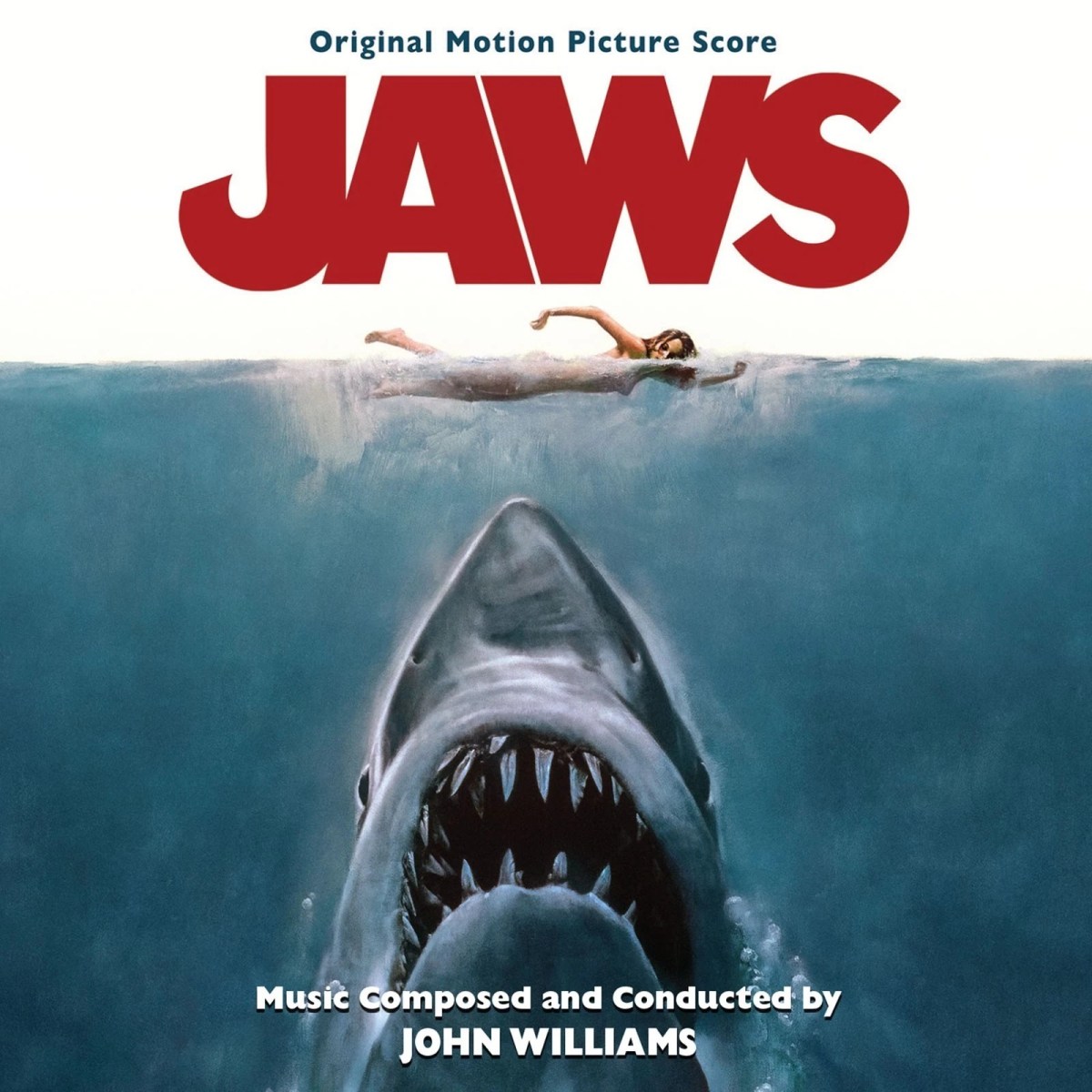
I hadn’t planned on a Jaws triple-bill but the new biography of John Williams popped through my door yesterday and I dug in.
I was astonished to discover first of all that movie music was in his blood. His grandfather had been involved in accompanying silent music films and then, dipping his foot in Hollywood, had snagged a gig with Shirley Temple. His father went one better – he had been instrumental in the radio revolution and eventually moved to Hollywood to become a session musician in movie studios recording film scores.

Film composers don’t lend themselves that easily to biography – I still have a treasured copy of the book on John Barry – and what has appeared hasn’t been on the same scale as, say, a major account of the career of John Ford or Clint Eastwood and certainly nothing approaching the 200,000 words Tim Greiving has amassed. I’d never heard of this author although it shouldn’t have surprised me that there was a university course on movie music run by him and that he describes himself as a “film music evangelist.”
By the time Jaws (1975) came around, Williams was a Hollywood veteran, 10 Oscar nominations to his name and, having made his debut in 1958 with Downbeat, had already composed over 30 scores including The Rare Breed (1966) and The Towering Inferno (1974). But you wouldn’t call him a household name. While his name would be familiar to the aficionados, the general public did not go around whistling his tunes the way they might with the James Bond theme.
And although movie music was his bread-and-butter, Williams had a hankering for Broadway, where composers were top of the bill not way down the credits. So since 1973 he had been working on a musical about the relationship between King Henry II and Becket, which had been the subject of plays by T.S. Eliot and Jean Anouilh and the film Becket (1964) starring Richard Burton and Peter O’Toole. He already had musical experience, though of the movie variety, and uncredited, having worked on Goodbye Mr Chips (1969).
In fact, Thomas and the King was scheduled for the British equivalent, London’s West End, to open in October 16, 1975 at the 1200-seat Her Majesty’s Theatre and starring Australian Jim Smillie and former Bulldog Drummond Richard Johnson. The critics weren’t impressed. One described it as the kind of show where you came out “humming the costumes.” It folded after 27 performances in a mere two weeks.
Luckily, salvation in the form of a certain shark was at hand. Williams had scored Steven Spielberg’s 1973 debut Sugarland Express (Duel, though released theatrically abroad, was strictly a made-for-tv number Stateside). The director had in mind “avant-garde horror music” along the lines of the “freaky cerebral score” Williams had composed for Robert Altman’s Images (1973).
Williams had enough confidence in himself to tell the director that approach was wrong. He went instead for something that was “all instinct.” Explained Williams, “meaning something that could be very repetitious, very visceral, and grab you in your gut not your brain.” Since the movie itself was a masterclass in suggestiveness – the shark remains largely unseen for the first part of the picture – the music was able to infer its presence.
The two notes – a bass ostinato – could be played softly to suggest the shark was far away. “You can keep playing it louder and louder,” said Williams, “there’s no shark there but you can feel it. It can be deafening – it can accelerate as it comes towards you…You can paint a whole choreography without seeing anything.”
Spielberg wasn’t convinced. He thought it “too primitive”, favoring something “more melodic” for the shark. In due course, the director succumbed. Williams was integral to the movie in another way – deciding when the music should appear, “spotting” being the technical term. “The art of film composition,” said Spielberg “is the placement of that composition.”
And while Jaws set a new template not just for box office but for scaring the pants off moviegoers, the impact of those two notes went far beyond the movie business. Hans Zimmer summed it up, “The scary thing about Jaws is those two notes.” The soundtrack reached No 32 in the Billboard chart and Williams won the Oscar. In Time magazine he was named the most influential composer of the 20th century. American conductor Leonard Slatkin said, “In classical music if you say I can name that tune in four notes” everybody knows Beethoven’s Fifth, “but with John he had it with two notes. There’s somebody whose legacy is assured.”
I have to confess this isn’t a proper book review in the sense that I’ve read it from beginning to end. I didn’t want to rush it just for the sake of a book review. But I’ve dipped in and out enough to be knocked out.
John Williams, A Composer’s Life, by Tim Greiving is published by Oxford University Press.

 The Magnificent 60s
John Williams was the first composer whose work and name I ever learned as a kid back when he was scoing the Irwin Allen shows. He sparked my love for film music (as well as classical) and I actually followed his career for a few years before “Jaws” and have strong memories of standing in record stores with his “Towering Inferno” and “Earthquake” LPs clutched in my hands. Everyone loves the two-note theme but I actually favired the more Korngoldian, dramatic flourishes in the “Jaws” score and the whimsical little neoclassical “Tourist on the Menu” track.
I’m very much looking forward to the book and hope to see your review here soonm
LikeLiked by 1 person
My first movie composer hero was John Barry. Take a while for me to get through the book – it’s a whopper.
LikeLike