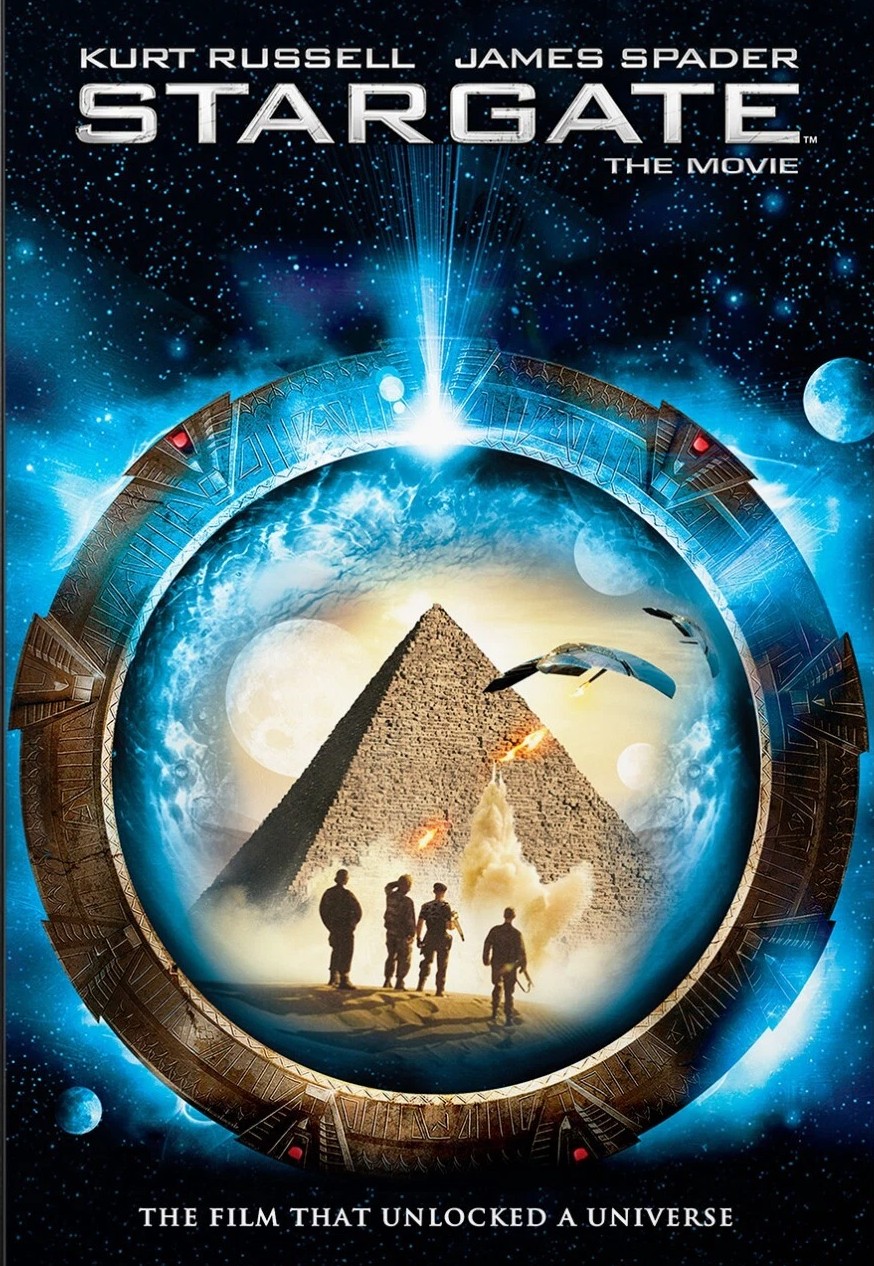
Outside of James Bond, why is it that science fiction has generated the biggest franchises? Star Wars, of course, and all the cross-over cross-under twiddledeedee Marvel worlds, three iterations of Planet of the Apes, Alien, Avatar, Star Trek, Terminator and Predator immediately come to mind. I hadn’t thought of including Stargate until I realized that the initial movie has generated three DTV movies and five television series.
When it first appeared I was knocked out by the chutzpah of bumping up the basic idea behind Chariots of the Gods – that the pyramids were built by aliens – into a big-budget heady adventure. I’ve not seen this in over a quarter of a century so came at it with some misgivings especially as the latest efforts of director Roland Emmerich such as Moonfall (2022) died at the box office, ditto writer-turned-director Dean Devlin (Geostorm, 2017).
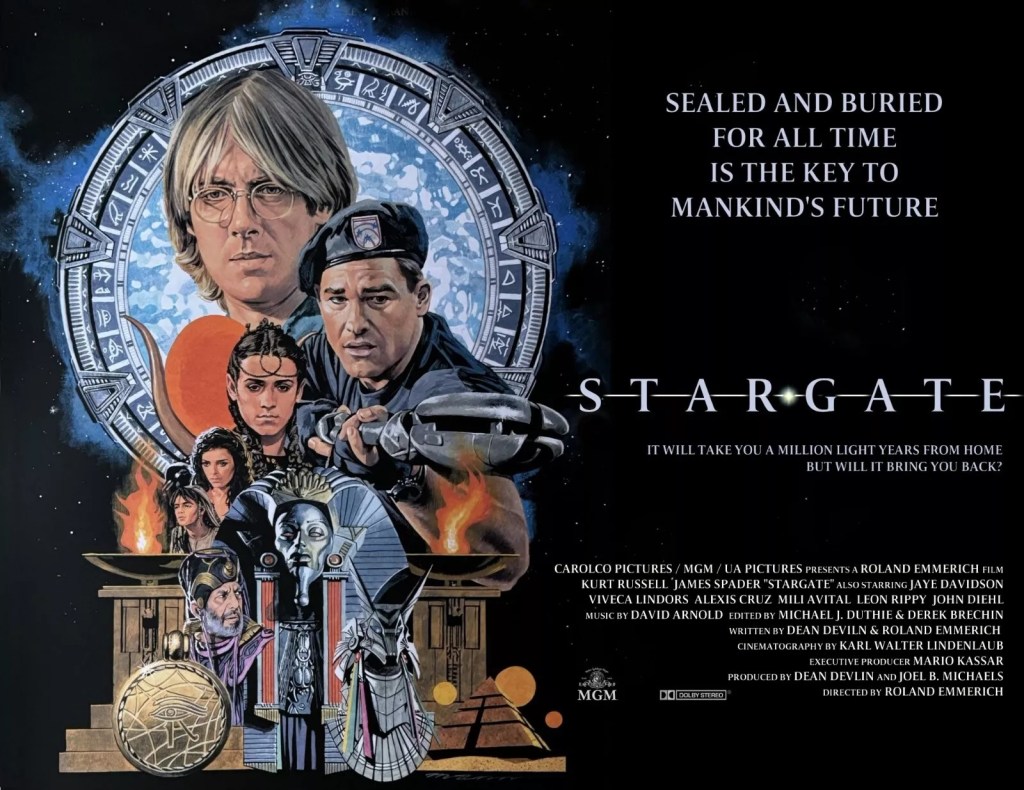
The rather basic premise of Universal Soldier (1992) didn’t lead anyone to believe that Emmerich had a much more creative bent and would soon reinvent the invading alien subgenre. But Emmerich takes the greatest imaginings of the popular Egyptologist and produces everything that audience could ever desire, including the curious dog-faced snouts found on statues and of course flying pyramids and ancient gods with a side hustle into a futuristic version of shapeshifting.
Theoretically, Kurt Russell (The Thing, 1982), all brush-cut and snappy diction, is the star as Col O’Neil, heading up some kind of intergalactic task force. But in fact it’s meek Egyptologist Dr Jackson (James Spader), who does the heavy lifting – he even gets the girl – and who if he’d had a bit more pizzazz about him would have been a latter-day Indiana Jones.
The plot is, of course, preposterous, but that’s the nature of the beast. In true Indiana Jones style Jackson discovers the missing piece of an archaeological jigsaw that points to some kind of wormhole, redefined here as a stargate, that can zip people light years away in the blink of an eye, and in a speeded-up version of the phantasmagorial elements of 2001: A Space Odyssey (1968). And just as in the director’s Independence Day (1996), the U.S. Government is up to some shady stuff, the kind usually designated to Area 51, and has been working on its own stargate.
Quite why Col O’Neil is taking along an atomic bomb for the ride is anyone’s guess. But once we race through the titular stargate we land on a desert planet inhabited by humans building pyramids and in thrall to Ra, who turns up every now and again to terrorize them into submission and/or steal the next body he requires to continue his journey into eternity. There’s plenty mumbo-jumbo and as many plot holes, but Emmerich has such a knack for narrative that it fair zips along. Col O’Neil has signed up for the mission because, frankly, he’s in a suicidal state of mind after his son died in a gun accident. Anyway, without the involvement of Jackson, who has no great scientific standing whatsoever, the US Government has worked out that whoever controls the other end of the stargate needs a good thumping.
Emmerich has the knack of posing verbal questions, leaving them dangling, and providing visual answers, which is all you need to propel a narrative. There’s plenty to play with here, the visuals are outstanding, especially for the time and the budget, and you are soon swept into the futuristic version of Egypt, and sinuous villain Ra (Jaye Davidson), and all the humorous misunderstandings that arise from language miscommunication. There is plenty action, either the kind of advanced aerial fighters emanating from the mothership (as occurred on a larger scale in Independence Day), or the gun-blasters, or the superhuman powers exhibited by Ra’s guards or indeed by Ra himself, not one to let mistakes go unpunished. There’s a clever twist on the regenerating device, and naturally someone has to lead a rebellion, though without spouting poetry.
Despite a few snatches at stardom, James Spader (Wolf, 1994) was still in marquee terms strictly second potato. This turns on its head his usual intense screen persona, and he’s quite a delightful little nerd, and just the guy if you need saved in the nick of time. Kurt Russell is mostly taciturn and, except for being engaged on a secret mission, has too little to do, but his presence still manages to anchor the picture.
All in all the concept works magnificently. I remember being impressed when I saw it on its release (but not so taken to subsequently trawl through the later small screen iterations) and was equally impressed now.
Go with the flow.

 The Magnificent 60s