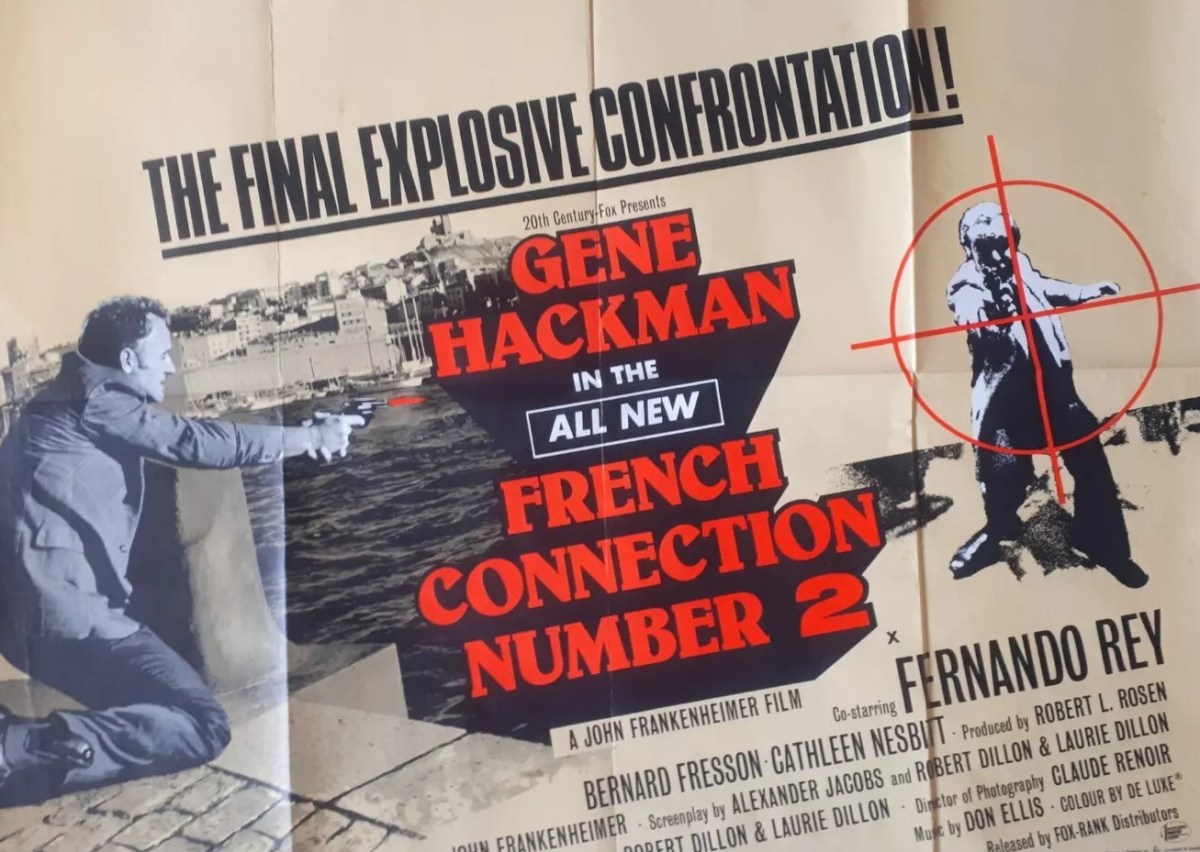
Back to Marseilles four decades on from Borsalino (1970) and a preposterous plot that virtually sinks this fictional sequel to the factual original. For a start, French drugs kingpin Alain Charnier (Fernando Rey) has a very distinctive face, and it could hardly been beyond a cop, accustomed to issuing identikits, to provide the French police and Interpol for that matter with a mugshot, thus eliminating the contention that New York cop Popeye Doyle (Gene Hackman) is the only one who can identify him.
Throw in the fact that, unlike other U.S. exports like Jason Bourne who is fluent in several languages, Doyle is instantly at a disadvantage because, blow me down, the ordinary French citizen doesn’t speak English, ensuring that the cop comes across as one of these witless foreigners who thinks shouting louder in English makes him any more intelligible. And his sole method of detection is to simply wander the streets of a city with a population of 1.3 million hoping to catch sight of his quarry.
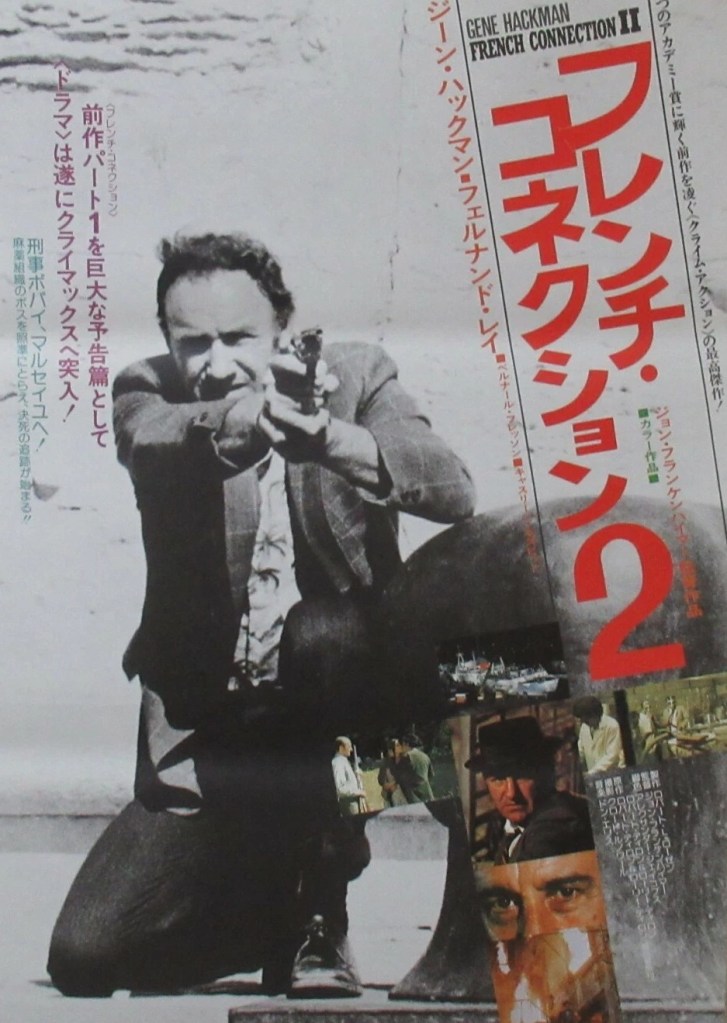
Doyle, being a natural rule-buster, soon causes the death of a local cop to add to the five people he’s killed (including two cops) in his home country. The bull-in-a-china-shop is so ham-fisted that it’s embarrassing rather than comedic. And the get-out-of-jail-free card is just as preposterous. Turns out Popeye is bait – this was a trope of 1960s low-budget crime or espionage movies though usually a woman was either the willing or unknowing lure – sent to Marseilles by his own bosses, in the hope that his presence will lure Charnier out of hiding, when, in fact, the Frenchman hides in very plain sight, on his very fancy yacht or dining in very fancy restaurants.
You’d have thought it would be an incredibly simple matter to feed the Charnier’s face into the police system and come up with a match which would then just involve either breaking down doors or taking the more discreet approach of catching him in the act.
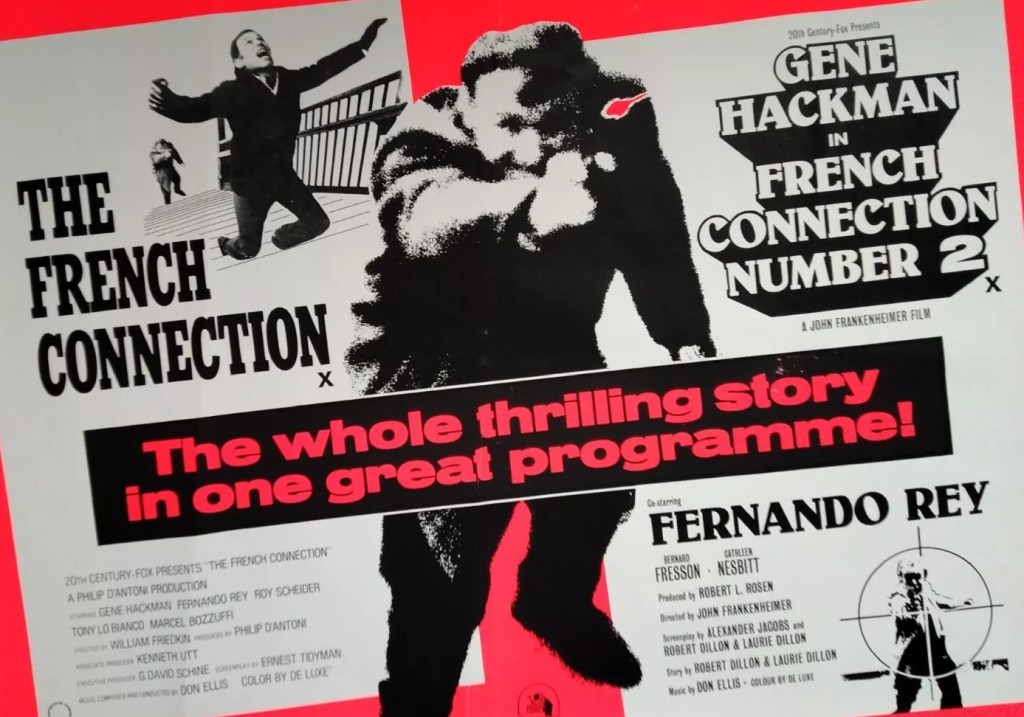
What saves this, and only just, is Gene Hackman’s performance, not as the aforementioned bull, but as a junkie going cold turkey. And that in itself is reduced to only a handful of outstanding scenes, when his opposite number Barthelemy (Bernard Fresson) has to listen to his meanderings about baseball and his childhood. The action finale, the equivalent of a dam burst, where the two cops are flooded in a dry dock is good too. But, devoid of the racing automobiles, the climax drags, as Doyle sets up a later action trope of the endless footslog (which Liam Neeson probably thought he had trademarked). This doesn’t even involve any leaping or running across rooftops just a canter along busy streets, down alleys and then along the marina hoping to catch Charnier before he escapes by yacht.
It’s slim on atmosphere, too. Where the original had a down’n’dirty lived-in feel, this comes over as a tourist version of Marseilles if a tourist fancied a stroll down some mean streets. There’s a really dumb scene where Popeye, hoping to scare out the crooks in the hotel where he was imprisoned, sets fire to the place. But he goes upstairs with a jerrycan of petrol, rather than starting at the top and working is way down, no guarantee that when he reaches the roof there’s going to be any avenue of escape left open to him.
Sure, a sequel was always going to be in the works after the success of the original. But why not concentrate on the obvious follow-up, how a cache of heroin with a street value of $32 million seized by Popeye and Co managed to vanish from a police property office.
Director John Frankenheimer (The Gypsy Moths, 1969, also featuring Hackman) hadn’t had a hit in a decade. This didn’t match the original at the box office. Written by Alexander Jacobs (Point Blank, 1967) and Robert Dillon (Bikini Beach, 1964) and Laurie Dillon, their only screen work.
Disappointing.

 The Magnificent 60s
Some more:
“The film opens with a card that reads: “Marseilles.” According to the 20 Dec 1972 Var, which referred to the film as The French Connection II, the producer and scriptwriter were Philip D’Antoni and James Poe, respectively, but neither man was credited in the final film. D’Antoni did produce The French Connection (1971, see entry), on which this sequel was based. Only one week before the production of The French Connection II was announced, New York Police Commissioner Patrick V. Murphy disclosed that eighty-one pounds of the nearly ninety-one pounds of heroin impounded in 1962, during the operation on which The French Connection was based, had been stolen. D’Antoni said the sequel would cost roughly $2.4 million, the same as the original, and would take twelve or thirteen weeks to shoot. Many years later, director John Frankenheimer said that all exterior scenes were shot in Marseilles, France, and the interiors of Sûreté headquarters, “Popeye Doyle’s” hotel, and Colonnades Hotel where Popeye was held captive, were filmed on sound stages in Paris, France. Frankenheimer added that Twentieth Century-Fox Film Corp. executives cut eight minutes from the film after it opened, without his permission; one lost scene contained Popeye’s sexual relationship with a French volleyball player he met on the beach. However, Frankenheimer himself excised an originally-scripted “resolution” scene, which resulted in the film’s much-criticized abrupt ending, where the screen faded to black as Popeye shot villain “Alain Charnier.” Also, Spanish actor Fernando Rey, who portrayed Charnier, spoke imperfect French, so his French dialogue had to be dubbed. Frankenheimer said the Corsican Mafia assisted in two crucial scenes, including the construction of a functioning heroin lab in which the drug was liquefied and canned as bouillabaisse, a fish soup for which Marseilles is internationally known. Several sources, including Frankenheimer and the 14 May 1975 HR review, mentioned that New York Post columnist Pete Hamill wrote dialogue for a couple of Popeye’s scenes that explained the effects of his Irish-American upbringing on his personality. Hamill had previously written the screenplay for Badge 373 (1973, see entry), a film based on the exploits of New York Police Department detective Eddie “Popeye” Egan, the same man on whom Popeye Doyle was based. According to the 29 Jul 1974 DV, principal photography began that day in Marseilles. The 25 Oct 1974 HR reported that filming ended twelve days under schedule and cost $250,000 less than the estimated budget. Twentieth Century-Fox documents on file at AMPAS library listed the film’s completion date as 18 Oct 1974. The film premiered 21 May 1975 in Los Angeles, CA, and opened the following day. The 14 Aug 1975 LAHExam reported that the film was a hit in France.”
LikeLiked by 1 person
Thanks very much. Great stuff as ever.
LikeLike