
Yep, another plug. I’m honored to have been invited to adapt my book The Making of The Magnificent Seven (McFarland, 2015) for this magnificent full issue, packed full of illustrations, of the iconic Cinema Retro magazine.
Anthony Quinn was convinced it was his idea. In 1956 watching a new 155-minute Japanese film about seven samurai, which had won the Silver Lion at the annual Venice Film Festival, second only in global prestige to Cannes, and was astonishingly action-packed for a movie playing an arthouse theatre, it occurred to him this would make a good western. It already had a great title – The Magnificent Seven(as Akira Kurosawa’s Seven Samurai was known in the US). Thinking it would be an ideal vehicle for them both, Quinn mentioned his samurai idea to Yul Brynner.
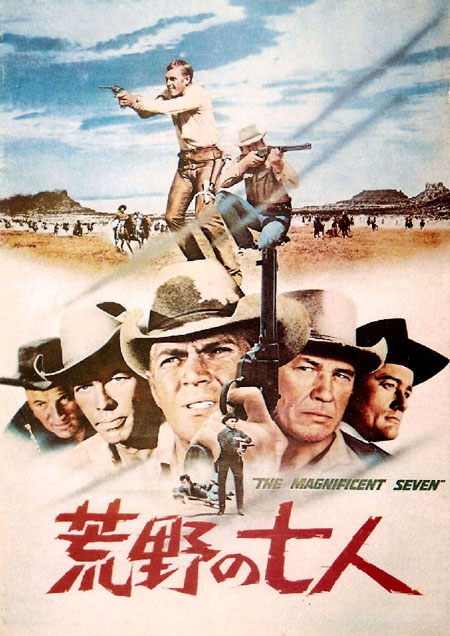
Brynner had been a star-in-waiting since appearing on stage in the Rodgers and Hammerstein musical The King and I in 1951. Born on July 11, 1920, in Vladivostok in the USSR, reaching the USA in 1941 via Paris, he starred in one of the first U.S. television shows Mr Jones and His Neighbors (1944) but also directed over 1,000 programs. He briefly decamped to Broadway for Lute Song (1946), leading man to star Mary Martin, but turned down the film version, making his movie in Port of New York (1947). “You’ll be seeing plenty of him after this film break,” prophesied Variety. But television presented better opportunity, future director Martin Ritt dabbed him “ a brilliant tv producer” and the BBC sent over a team to study his innovations.
When Rodgers and Hammerstein went looking for a strong male presence to compete with star Gertrude’s Lawrence’s stage charisma in The King and I, Mary Martin pushed for him. The musical turned Brynner into a star.
Paramount signed him up, along with Audrey Hepburn, for its new talent roster. The first project, A New Kind Of Love, to be directed by Billy Wilder, would pair him with Greta Garbo. Sam Spiegel wanted him for a biopic of Nijinsky. When Garbo proved, as you might expect, disinterested, Audrey Hepburn stepped in and when she dropped out was replaced by namesake Katharine Hepburn. When that project died, Paramount shifted Brynner to South Seas Story in 3D. But that didn’t work out either. He was up against Charlton Heston and Mel Ferrer for Columbia’s Miss Sadie Thompson starring Rita Hayworth. He was wooed by Dino De Laurentiis and Carlo Ponti for Lust for Life and then for Biblical drama Judith and Holofernes with Silvano Mangano.
At the interval of a performance of The King and I, Cecil B. DeMille went backstage. “In four years,” noted Brynner, “I have never had a visitor. There are only 7½ minutes between acts. By the time I had to go on stage again I had not only agreed to do The Ten Commandments with him but another picture following it.” Twentieth Century Fox ponied up $1m for movie rights to The King and I. Brynner pushed the studio to allow him to direct the musical.
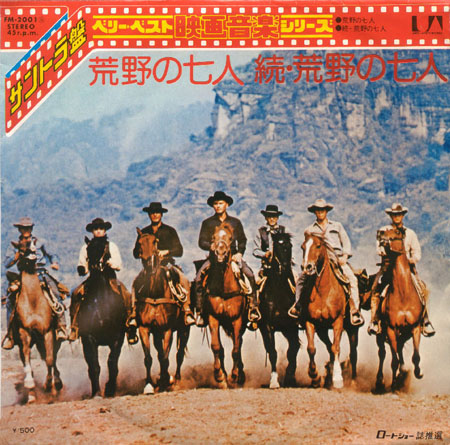
Anthony Quinn was also hankering after going down the route of direction, or at least greater production control of his career. But while Brynner’s career was taking off, Quinn’s was at a standstill. Even winning the Best Supporting Actor Oscar for Viva Zapata (1952) had not done much for this career and in a bid to revitalize that he had gone to Italy in 1954, but Attila, Ulysses and Fellini’s La Strada did not bring him stardom, second-billed in all three. When top billing finally did arrive in film noir The Long Wait (1954) it sank without trace
By contrast, Brynner made a pampered entrance to screen stardom, flown to Egypt at the end of October, 1955, for just two days shooting on The Ten Commandments (1956) for a scene involving Pharaoh heading his army of 10,000 men, then whisked back to the U.S. and not required for shooting until six months later. While assigned the male lead in Fox big-budget drama Anastasia (1956), directed by Anatole Litvak, as with The King and I (1956) he was not top-billed. That honour went to Ingrid Bergman, making her Hollywood comeback after her scandalous affair with Italian director Roberto Rossellini, while Deborah Kerr’s name came first for the musical. Whatever way you cut it, in his first three movies, Brynner was not considered the main attraction.
So his thoughts turned once again from acting to directing. “Acting was only supposed to be a temporary job,” he complained and he hustled Paramount to give him an actor-director deal. “Directing is my baby. It is for me more satisfying than acting – it’s like leading a symphony orchestra compared to playing a fiddle.” As to genre, “I have a yen to make westerns,” he said. “Westerns are the poetry of films.” he said. His badgering paid off. In 1956 Paramount announced it had signed him up as an actor-director in a purported million-dollar deal.
To take more control of his career, Quinn had shifted gear and established Antone Productions. But none of the fist six projects announced – including an MGM-backed El Cid – made it over the line. By contrast after the triple success of The King and I, The Ten Commandments, and Anastasia, Brynner could not be flying higher. He was inundated with offers.
But he envisaged himself as a mogul, setting up production outfit Alciona. And won a unheard-of $25m deal with United Artists for eleven movies. This was unprecedented. Nobody in the annals of Hollywood had ever been given such largesse, never mind a man with no experience of the two skills – producing and directing – which he would have to master. On his slate, the idea to turn Seven Samurai into a western.
Unbeknownst to Brynner and Quinn, ex-newspaperman and Columbia Studios story editor Lou Morheim snapped up the remake rights for $2,500 from International Toho Inc. Despite previous cooperation Brynner and Quinn became rivals in bidding for the project. Brynner won, contract signed in February 1958.
Brynner had decided the movie was the ideal vehicle for his directing debut. But he wouldn’t act. The Magnificent Six, to be shot in Europe, was announced as Alciona’s first film, being made for United Artists with Brynner directing.
Brynner offered Quinn $125,000 plus a profit share to star. Despite various delays, Brynner, still intent on directing, in January 1959 went to Spain to scout locations. But there were problems with Quinn. Brynner handed over the directorial reins to Anatole Litvak, while remaining on board as star, Glenn Ford
drafted in as co-star. But with the budget rocketing to $2.4m, UA pulled the plug on Alciona, reimbursing Brynner’s $112,000 investment, turning the project over to Mirisch. Mirisch had the ideal director in mind, one who was equally proficient in the genre – John Sturges.
Yep, sorry, this is just a taster. You can read the whole story (or a condensed version of it) in Cinema Retro – see link below – and if you want the whole shebang check out my book.
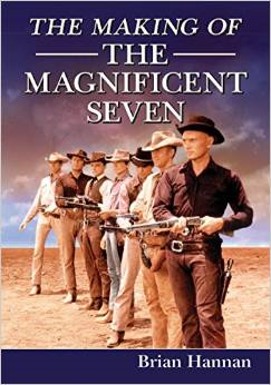

 The Magnificent 60s
Ordered it months ago.
LikeLike
Great. Enjoy.
LikeLike
Excellent!! Definitely ordering soon!
LikeLiked by 1 person
Great. Thanks.
LikeLike