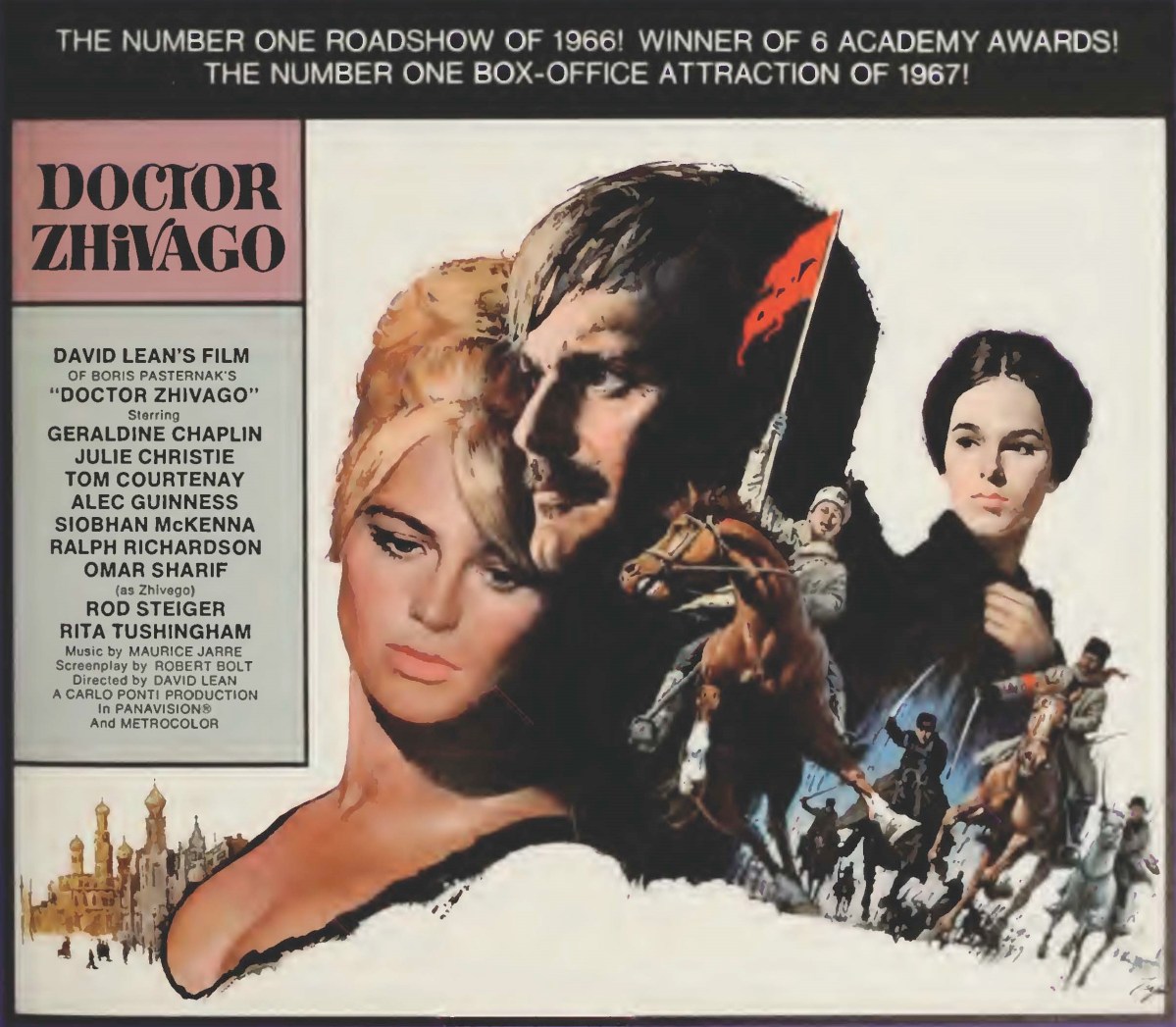
That Italian producer Carlo Ponti owned the rights to Boris Pasternak’s worldwide bestseller – beating out a bid by Kirk Douglas and Stanley Kubrick – made it easier for David Lean to sever links with Sam Spiegel, producer of his two previous Oscar-winning blockbusters, Bridge on the River Kwai (1957) and Lawrence of Arabia (1962). Ponti lined up a deal with MGM who not only gave Lean carte blanche but the biggest ever salary handed to a director plus a generous profit share. Max von Sydow (The Quiller Memorandum, 1966) was Lean’s first suggestion for the leading role while MGM wanted Paul Newman (Cool Hand Luke, 1967) and Ponti was keen on Burt Lancaster (The Train, 1964).
Peter O’Toole (Lawrence of Arabia), fearing another exhaustive shoot, reportedly turned it down. Michael Caine (The Ipcress File, 1965) read for it. Omar Sharif (Lawrence of Arabia), all set to play the smaller role of Pasha, stepped in. Marlon Brando (The Chase, 1966) and James Mason (North by Northwest, 1959) were considered for Komatovsky – the former not replying to Lean’s offer, the laterr dropping out after accepting the role – before that went to Rod Steiger (The Pawnbroker, 1964).

Jeanne Moreau (Viva Maria, 1965), Jane Fonda (Barbarella, 1968, who turned it down, then, recanted, by which time it was too late) Yvette Mimieux (Dark of the Sun, 1968), Sarah Miles (Lean’s Ryan’s Daughter, 1970), and, inevitably Ponti’s wife Sophia Loren (dismissed as “too tall” by Lean), were in the running for Lara until, on the recmmendation of John Ford who had directed Julie Christie in Young Cassidy (1965), the part went to the British actress. Audrey Hepburn (Charade, 1963) was Lean’s choice for Tonya until he was bowled over by the screen test by Geraldine Chaplin, the waif-like daughter of Charlie Chaplin, who, in the run-up to release, received the bulk of the advance publicity. Contrary to received wisdom, this was not her debut, she played opposite Jean-Paul Belmondo in Lovely Summer Morning (1965).
So, effectively, Lean was launching MGM’s biggest-ever productions with a cast headed by unknowns, Sharif’s marquee value not up to the mark, every film he had been in since Lawrence of Arabia had flopped and he had never received top billing – and would not here either.
Initially, Lean considered shooting in 70mm in black-and-white but 70mm equipment was deemed too cumbersome and monochrome too risky for such a big film so it was made in 35mm with the intention of blowing it up to the larger format for roadshow release. Ponti reckoned the movie could be made in the Soviet Union or Yugoslavia for $5 million. After switching to the eventual location, Spain, with some sequences filmed in Finland, it cost much more, over $11 million.
The shoot lasted 33 weeks but the production actually took two years and involved 800 craftsmen in three countries. . Original cinematographer Nicolas Roeg dropped out after “creative differences”, replaced by Freddie Young (Lawrence iof Arabia), adding two weeks to the schedule to reshoot Roeg’s scenes.
Much of what appeared on the screen was illusion. The Red Army charged across an apparently frozen lake at the height of summer, the lake itself non-existent, just a field covered in cement with sheet iron topped with thousands of tons of crushed white marble ironed out by steamrollers so when the horses slid it looked realistic. To complete the picture, a rowing boat was moored at the edge.
Other effects combined direcotrial genius with practicality. Prior to the scne featuring a huge field of daffodils, Lean had filmed three minutes of Zhivago and Lara against a freezing background, everything sprayed gray to remove any hint of color so that the sudden appearance of of the golden flowers cast a spell of spring. To prevent the flowers – 4,000 of them imported from the Netherlands – blooming too early, they had been dug up and put in pots to control their growth and replanted when required. To make snow glisten in another scene, cellophane was spread over wintry bushes and trees.
The sleighs had little wheels fitted to the runners, icicles were made from polystyrene, the balalaika was created by the props team and the interior of the Ice Palace made from cellophane crushed into thousands of creases, paraffin wax and salicylic acid powder creating fantastic shapes. The floor was fashioned from a layer of soap flakes. The train journey went through Spain and in places where there were no railroad tracks, these were built.
Moscow, ten acres of it, rebuilt on a Spanish lot, took 18 months to construct and included 800 yards of cobbled street, the Kremlin, trolley cars and 60 houses and shops. Pasha’s armored train was an authentic replica. Even with the props trickery, Lean wanted to capture the different seasons so that was partly responsible for the long schedule. Sharif has his eyes taped back and his hairline shaved and straightened.
The aftermath of the dragoon charge down the steeets of Moscow was seen through the eyes of Zhivago – Lean’s advice to the actor was to imagine the moment before orgasm – and it was just as well it worked because Lean had filmed no alternative.
The film intially struggled to attract public attention despite a $3 million publicity budget. Lean was not as marketable as Hitchcock or DeMille. The female leads were unknown, Darling (1965) not yet setting the box office buzzing except in arthouses. Sharif, as I mentioned, had not yet capitalized on Lawrence of Arabia.
“Lara’s Theme” was not yet in the shops – the soundtrack album sold 600,000 copies in a year becoming MGM’s biggest soundtrack seller – and designer Phyllis Dalton’s furs were a long way from setting a fashion trend. Advance sales for the roadshow openings were poor, only $200,000 compared with $60,000 for Exodus (1961) and $500,000 for Cleopatra (1963). There was even speculation that the Capitol in New York where the film premiered had massaged the opening week’s figures. However, this kind of trickery would have been anathema in the industry, telling the truth about receipts to Variety every week considered the right thing to do, even if they fell short of expectation.
Historical epics had been long out of fashion. Lord Jim (1965) and The Agony and the Ecstasy, also roadshow numbers, were among the year’s box office casualties while a completely different type of movie, bouncy musical The Sound of Music (1965), was cleaning up. It didn’t help that Doctor Zhivago opened at the same time as Thunderball, the fourth Bond, which surpassed expectations with collosal initial box office. Nor did reviewers help. While Variety hailed its “soaring dramatic intensity” and the New York Daily News called it a “haunting emotion-charged drama,” the more influential New York Times slammed its “painfully slow-going and inevitable tedium” and it was condemned by the New York Herald Tribune as a “soap opera.”
In fact, if audiences had been slow to latch on, that was only during the first week, for soon it turned into a phenomenon, ending the decade as the $38.2 million in rentals. Lifetime rentals topped $60 million.
SOURCES: Kevin Brownlow, David Lean (Faber and Faber, 1996); Eddie Fowlie, David Lean’s Dedicated Maniac (Austin & Macauley, 2010); Pressbook for Doctor Zhivago; “Metro Plots Two Features for Geraldine Chaplin,” Variety, February 24, 1965, p5; “Zhivago LP Soars Over 6000,000 Units,” Variety, August 17, 1966, 43; “All-Time Champs,” Variety, 1993.

 The Magnificent 60s
Ah, for the days when word of mouth might sell a film, or the initial weekend box-office didn’t seal the fate. My granny had a music box that played Lara’s theme, quite a marketing tool!
Laterr is my only complaint.
LikeLiked by 1 person
I think you heard Lara’s theme every where, a music box would be the least of it. Initial box office was counted by the level of advance bookings. The Sound of Music in Glasgow opened its box office every eight weeks and took eight weeks bookings in advance in a couple of days and then shut up shop. Plus I discovered Rank were os leery of its prospects that they agreed to pay a flat rate rather than a percentage.
LikeLiked by 1 person
Well that was a fascinating read. As impressive as the production was some of the winter scenes have always looked a bit stagey to me although one can’t help but give into the illusion. I didn’t realize the film wasn’t an immediate hit but it certainly held the public’s imagination well through the later sixties. I wonder if audiences don’t hold a film they’ve discovered by word of mouth closer to their hearts than one that opens with a strong critical momentum. The score certainly struck a nerve with the public and I can remember the soundtrack album prominently displayed on the walls of record stores and department store music departments into the midseventies (often beside the “2001” soundtrack).
Lots of solid performances (with the exception of the reliably hammy Steiger) and Chaplin in particular really impresses while Sharif demonstrates what a solid actor he was with a quietly authoritative performance. On a side note, Sharif was a consummate contract bridge player and coauthored a popular column for the Chicago Tribune that was syndicated in many major newspapers throughout the states in the seventies.
LikeLiked by 1 person
I knew about Sharif’s bridge but didn’t know he had a syndicated column. I agree word of mouth is much more powerful than anything else.
LikeLike