
You could come away from the Pressbook/Exhibitors Manual wondering if some of the actors were in the wrong profession, given the number of accomplished pilots on the roster. James Franciscus held a commercial license for multi-engine planes and had logged three thousand flying hours in three years. Gene Hackman not only had a private flying license but was in the process of building his own biplane.
Producer Mike Frankovich had flown with the US Air Force during World War Two, clocking up 7,000 hours flying time and ending up a colonel. Technical expert George Smith had ejected at 6,000 feet from a plane flying at 800 mph.
Another less well-known fact, Natalie Wood (who was appearing in producer Mike Frankovich’s Bob and Carol and Ted and Alice, 1969) was fluent in Russian and was brought in to translate for a showing of the movie to visiting Russian spacemen. Nancy Kovack, by the way, was equally talented, speaking Persian and other languages.
As much as the main function of the Pressbook was to provide exhibitors with a range of adverts in every conceivable size that they could cut out and take along to their local newspaper, its secondary function was to provide cinema owners with promotional ideas and to provide snippets and articles that could be passed on to a local friendly reporter. But pickings were slim for jouranlists. Not surprisingly, Gregory Peck didn’t have much say, since whatever he did have to say he’d said already as promotion work for the two other features preceding Marooned this year. And nobody’s spilling the beans on the special effects.
Due to the bulkiness of their space suits, the three actors playing astronauts couldn’t sit down between takes and instead the production employed “the slanted boards usually leaned against by elaborately-gowned female stars to protect their costumes.” (You learn something new about the business every day!). Never mind the bulkiness, the actors spent a chunk of their time in the air and the one day James Franciscus expected to meet acting hero Gregory Peck (they had no scenes together) it proved impossible as when the star visited the capsule set Franciscus was 60 ft in the air.
Richard Crenna got a better response from his young son, who had little concept of what an actor did. But after seeing his dad floating around in space high above him, he reckoned his father was actually a hero
For such a male-oriented picture, Columbia made a big play for the female audience. “The Ladies Love Marooned,” boasted one advert in the 16-page A2 Pressbook/Campaign Manual aimed at exhibitors. Pulling on quotes from critics nobody had really heard of, it managed to present the notion that the picture was as exciting, fascinating, “ingeniously-devised,” and suspenseful for women as much as men, at the same time as focusing on the feminine aspects of the movie – “Lee Grant is a knockout.”
The Pressbook itself allocated editorial space to the three female stars. For Lee Grant the slant was that her talent had been recognized by a host of awards – Emmy, Obie, Best Actress at Cannes plus an Oscar nomination (she would later win an Oscar for Shampoo, 1975). But you have to wonder how an actress would respond to be called, in print, “an egg-head with sex” as was the case with Nancy Kovack. In between turning out such pictures as Tarzan and the Valley of Gold (1966) and this, Kovack had been resident in Iran where she made Diamond 33 (1967) and Night of the Angels (1968). By comparison, Mariette Hartley got off lightly, thanks to her Shakespearian training.
A separate 4-page A2 insert promoted the three Oscar nominations for cinematography, sound and visual effects. “Nominated for 3 Academy Awards,” was the slug accompanying the ads. Never mind the reviews from female critics, much bigger space was devoted here to a rave review form Rex Reed, one of the most famous critics of the day (and star, if that’s the right word, of Myra Breckenridge, 1970), who claimed Marooned was “as exciting, spirited and suspenseful as any spy movie or any cops-and-robbers movie ever made.”
As you might expect, the bulk of the promotional ideas were science-based. Exhibitors were told to target the country’s 2,500 science clubs, the armed forces, the industries that supported the space program and, of course, schools and colleges. Tie-ins had been achieved with 4,500 A&P stores, Jane Parker Donuts, and Philco-Ford dealers.
From a contemporary marketing standpoint, the surprising tie-in was with Omega watches, tagged “the first watch on the moon,” the company’s Speedmaster brand not just worn by the astronauts who did land on the moon in July 1969 but seen in the picture on the wrists of Gregory Peck, Richard Crenna, David Janssen, Gene Hackman and James Franciscus. Over 4,000 dealers were backing the movie.
Model kit manufacturer Revell was offering space suits as prizes in a competition. It distributed more than 42,000 standees and posters and printed five million entry forms. Bantam books was promoting the original novel by Martin Caidin. That exhibitors would be eager to equip a staff member with an astronaut’s garb and have him/her parade through the streets went without saying. Using lift-off sound effects in a cinema lobby was another idea or turning the entire lobby into a space set.
Rather disconcertingly, the marketing bigwigs thought it would be a clever idea to propose a discussion program on radio or local television on the subject of what would happen if spacemen were marooned, a rather tetchy subject when that became reality.
Unusually, but not surprisingly, the posters stuck with the one tag line: “Three marooned astronauts. And only 55 minutes left to rescue them. While the whole world watches and waits…” and buttressed by some thumbs-up quotes from the likes of reviewers from the New York Times, Redbook, Los Angeles Times and Los Angeles Herald Examiner. In fact, the advertising department took such a shine to Charles Champlin of the LA Times that they cut up his review and stuck snippets of it in three separate ads.
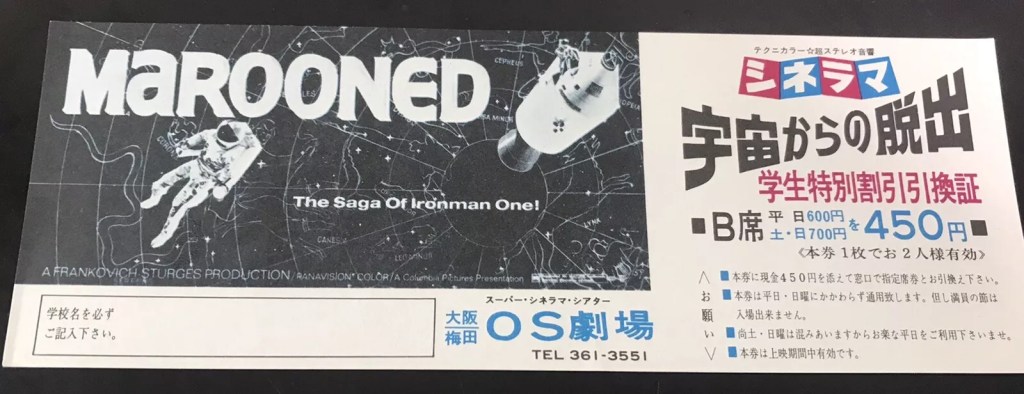
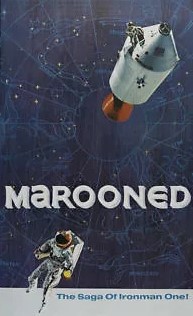
You’ll have seen from the variety of adverts I’ve used to support the review and the Behind the Scenes article earlier in the Blog, that there was a wider range, initially, of adverts, some showing the capsule stuck out in the middle of space. By the time it came to printing this Pressbook, the one for the picture’s general release, all of those were jettisoned in favor of the insipid “thumbs-up” poster with faces to the foreground and the launch in the background, attendant quotes and the “3 Academy award Nominations” slug.

 The Magnificent 60s
‘Not surprsingly, Gregory Peck…’ a second yellow and a red for persistent fouling…
LikeLiked by 1 person
Corrected. Thanks.
LikeLike
I remember ads in comic books for the spacesuit giveaway which seemed insanely cool to a nine-year-old boy at the time but even kids weren’t fooled by the Ironman Revell model which was just the existing Apollo kit with a few new decals and no retooling to make it match the ship in the movie.
LikeLiked by 1 person
Can’t believe they just ripped off an existing model.
LikeLike