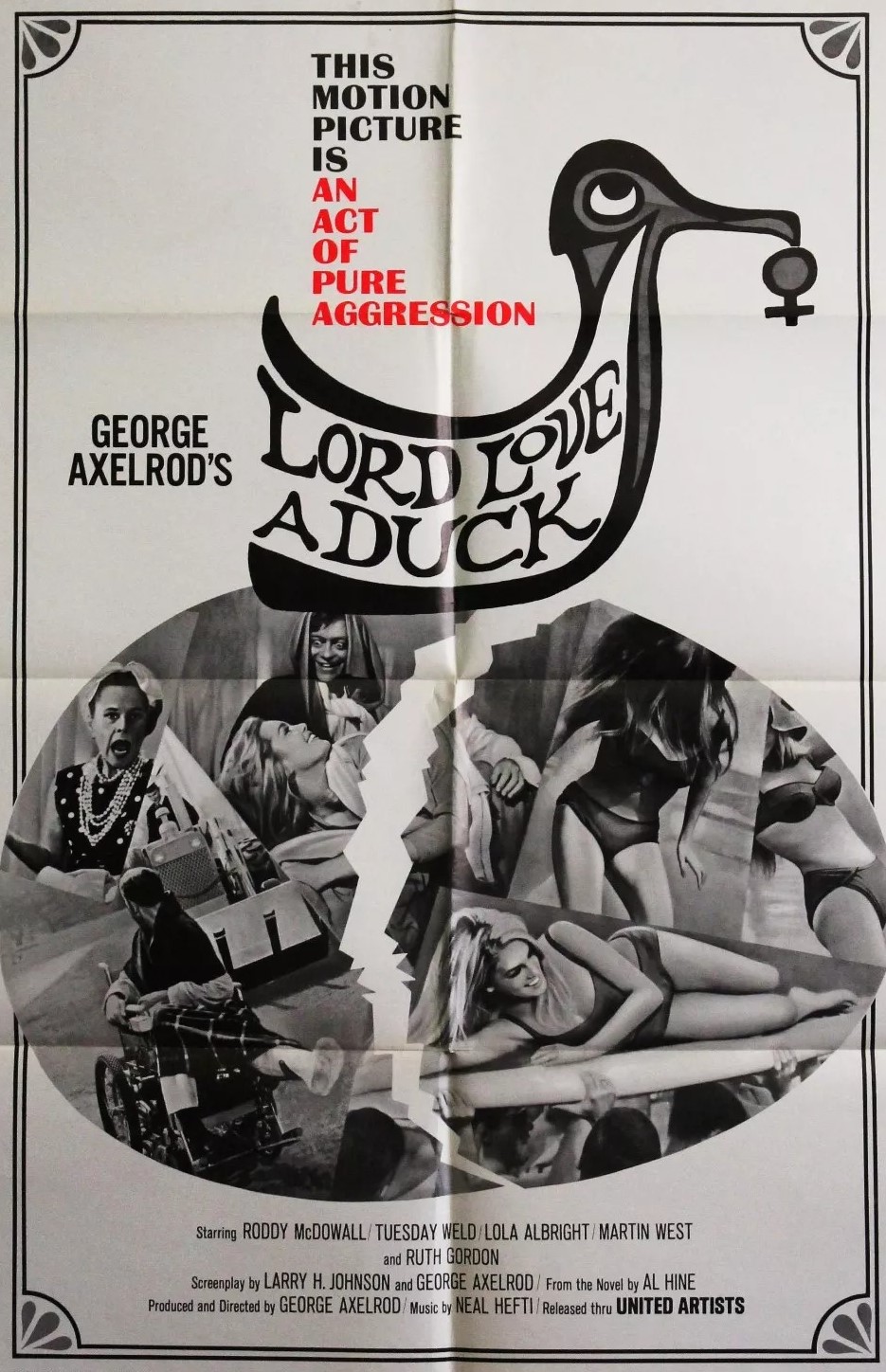
Satire’s a difficult game at the best of times. Of course, it usually requires a cocky writer or director blessed with the self-belief to even consider the sub-genre. The hardest part is getting all the elements to match. Not only do you require a subject that’s going to reverberate beyond the immediate, but a director who can apply stylistic muscle and actors who are in on the game but don’t tip the wink to the audience. Stanley Kubrick’s paean to nuclear nightmare Doctor Strangelove (1964) is about the only one that’s ever unquestionably pulled it off.
Other attempts fizzle out like the over-sexualized Candy (1969), reliant on rampant nudity and marquee names to pull in an audience despite hitting the target in several areas that would touch a contemporary nerve – the aggrandizement of the medical industry, literary celebrity and the fool’s gold of the new religion. Unlike the Kubrick with its settled unremitting narrative arc, Lord Love a Duck took the scattergun approach, like a series of comedy sketches, if this one doesn’t work then they’ll chortle at our next brilliant idea. At least that had the salvation, if you’d like to call it that, of aiming for some big targets.
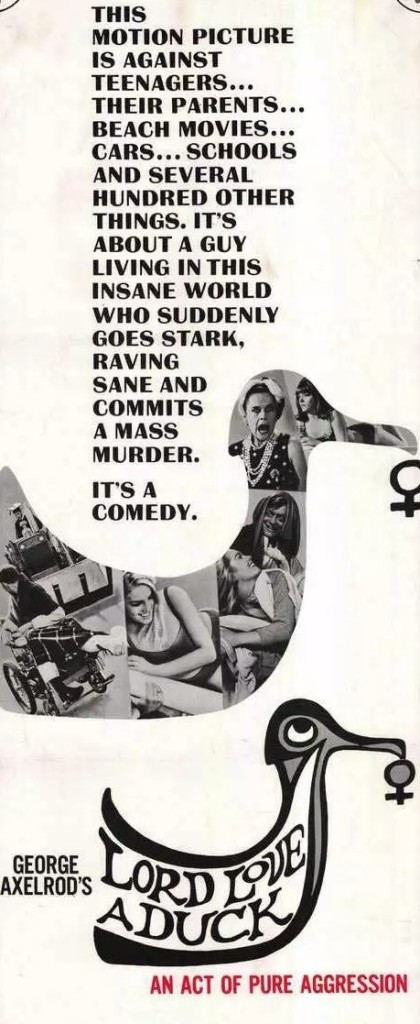
Beach movies wouldn’t fall into that category and hardly the kind of pompous bubble that required to be pricked. So whatever kind of self-belief director George Axelrod exuded, it wasn’t one of high intelligence, picking apart contemporary mores until the heart of America lay dismembered in the dust.
In any case, the majority of the satire in Lord Love A Duck would go over the head of anyone who wasn’t American although it stands as a snapshot of a generation in which adults were in control before the “youthquake” embodied by long hair and dropping out and pot had the older citizens muttering over their cocktails.
But you try and convince a general audience of the importance of the “Cashmere Club” or wearing a guy’s pin (whatever that is). Spring break we’re just about familiar with as an American rite of passage these days from countless other movies about rampant youth but I doubt audiences in other countries would have been familiar with the concept, least of all that the censor had no problem with endless scenes filled with beefcake and cheesecake. I’ve no idea where Balboa is and why it should assume prominence in student life. But sure, old guys have always been creepy and at the sight of teenagers prancing about they become even creepier, but I’m assuming that all this male playing with pencils is incidental.

The main pot shots are, I guess, stardom, religion and beach movies. Barbara Ann (Tuesday Weld) is the young lass in the thrall to Hollywood stardom, how being known and feted would redeem her shallow life. Rather than taking the usual boring route of attending drama classes or auditioning for the college play she somehow manages to enlist the support of fellow student Alan (Roddy McDowall) whose self-appointed task is to fulfil her dreams, no matter how outlandish and despite his own shortcoming in the dream-realization business.
Poverty keeps her out of the kind of exclusive girls’ club inhabited by malicious teenagers put in their place in later years by a serial killer. With the help of the wealthy Alan, rather than as you might hope embarking on a shoplifting spree, Barbara acquires sufficient cashmere to join a particular club. And instead of ascending to Queen Bee status and ruling over all the other mean girls, she drops out and takes a job as a secretary – hardly a sure route to stardom unless you plan on hanging out in a tight-fitting cashmere sweater in a drugstore.
From here it’s a quick step to organized religion where she falls for pastor Bob (Martin West) and then, as is standard with movies that quickly run out of narrative steam, chance encounter takes over. She meets film producer T. Harrison Belmont (Martin Gabel) and realizes she won’t get far if she’s weighted down by a disapproving husband. So the movie takes another sharp turn and becomes one of those movies investigating how many ways you can kill a guy. Largely incompetent in this department, Alan only succeeds in maiming Bob. Then Axelrod provides Lindsay Anderson with the idea for the ideal climax to the more artie If… (1968) by having Alan taking out several classmates via tractor rampage. Naturally, Barbara becomes a star though I doubt if Axelrod had the foresight to work out that the beach movie was on the way out so her type of stardom would be immediately redundant.
Tuesday Weld (Bachelor Flat, 1965) isn’t sufficient compensation and Roddy McDowall (Five Card Stud, 1968) is miscast. Sure, he was fresh-faced but it was asking a lot of the cinemagoer to accept an actor approaching 40 as a student roughly half his age. Lola Albright (A Cold Wind in August, 1961) is underused.
In his directorial debut, Axelrod (The Secret Life of an American Wife, 1968) also co-wrote the movie with Larry H. Johnson from the bestseller by Al Hine.
While slight, it does, as I mentioned, cast a look at some of the issues of the era.

 The Magnificent 60s
Sorry, I’ve been called over the the VAR monitor…a voice in my earpiece says it looks a lot like two different spellings of McDowell/McDowall, and that could be a straight red card…
LikeLike
I shouldn’t get that wrong. I lived in a flat in a McDowall St. Better check my forthcoming review of Bullwhip Griffin.
LikeLiked by 1 person
Crikey, that would have been a lifetime ban if I hadn’t check Bullwhip.
LikeLiked by 1 person